

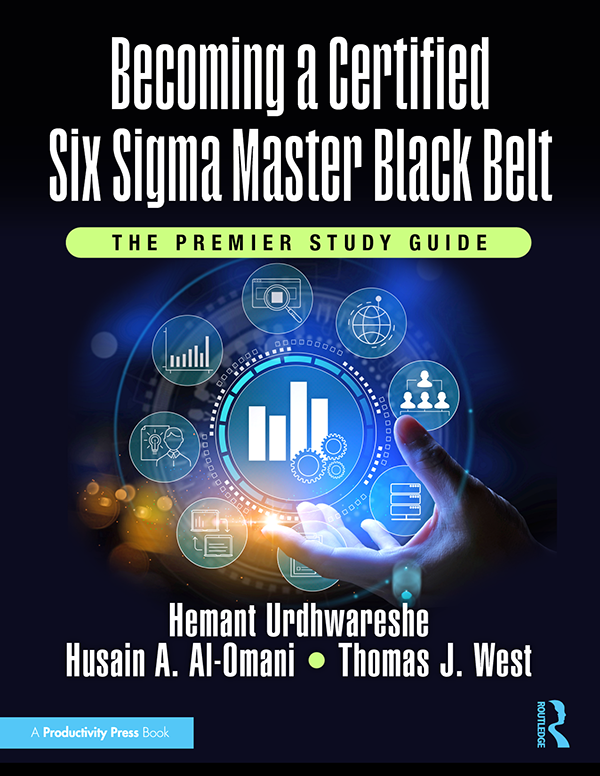
In companies implementing Six Sigma, the role of Master Black Belt is to train, guide, and coach Black and Green belts to execute their improvement projects efficiently. In addition to this, Master Black Belts are often responsible for overseeing the organization’s entire improvement program with the ultimate responsibility for creating a robust culture of continuous improvement. Thus, the competence of MBBs is critically important for the success and long-term sustainability of Six Sigma in organizations.
This book is ideal for all those who wish to get trained and certified as Master Black Belts and train others to achieve breakthrough results using Six Sigma to shape and execute improvement projects. The book has the right balance between topics such as strategic planning, project selection, stakeholder management, and training design, to advanced statistical techniques such as propagation of errors, destructive measurement systems, general linear models and components of variation, and complex blocking structures in Design of Experiments
Strategic Plan Deployment
Strategy answers critical questions for the organization:
- What should the organization be doing?
- What are the ends organization seek and how should it achieve them?
Strategic planning is a process defines the strategy/direction of the organization’s future by establishing and developing long-term goals, objectives, and making decisions on allocating the required resources to achieve them.
Strategic planning is the most important area when it comes to long-term benefits for the organization. The principal role of strategic planning is to align work process with strategic directions, thereby making sure that development and mastering strengthen organizational priorities. Six Sigma must be incorporated into the strategic planning framework to ensure that accountability is well established and the resources required to promote change are allocated in a timely manner.
SWOT
SWOT analysis is a useful tool for organizations to identify their strengths Weakness, Opportunities and Threats.
SWOT analysis Acronym for strength-weakness-opportunities-threats analysis.
Strengths
List Strengths
Weaknesses
List Weaknesses
Opportunities
List Opportunities
Threats
List Threats
Table: SWOT analysis template
Examples of strengths; excess working capacity and strong R&D
Examples of weaknesses; insufficient capacity and poor employee morale
Examples of opportunities; 30% annual growth in the market and exit of three major foreign
competitors form the market
Examples of threats; Weak economy and the cost increase of raw materials
Strengths address what the organization does well while weaknesses what organization doesn’t well or lacks. Both address the internal issues of the organization.
Opportunities and threats assess the external environment.
Example: Thomas is the owner of a telecommunication company (Thomas Telecom Co.). He met with his managers to conduct a workshop for their strategic planning. After the workshop discussion, the below SWOT analysis was developed.
Strengths
Weaknesses
• Holds 35% market share
• Professional management team
• High brand recognition in the market
• Focus on quality of service and customized
solutions
• Well developed mobile network coverage with
5G services
• Major loss in operations
• Not serving all areas
• ROI ration is 3%
Opportunities
Threats
• Partnership with parent operator for roll out of
value added services
• Partnership with parent operator for entering
new telecom markets
• Rising demand for some sectors which depend
on online services
• Smart phones should help to promote use of
mobile data and video
• Changing government regulations
• Increasing raw material and labor rates
• Decline in margins as a result of price wars
• Failure of masses to adapt to changing
technology
• Erosion of market share with the entry of
competition
• Increased the competition after launching two
well-known brands
Table: SWOT analysis matrix for Thomas Telecom Co.
PESTEL
For mega scale investment on industrial sector projects and programs, PESTEL analysis is a great tool used to make comprehensive analysis. PESTEL stands for Political, Economic, Social, Technological, Environmental and Legal analysis.
Since all multiannual companies and organizations work in different environments, it’s important to analyze each individual environment through a combination of the six PESTEL factors. The concept is to constantly scan these six areas in order to detect changes in the external environment.
Political
Economic
Social
Technological
Environment
Legal
Income Taxes
Recession
Birth Rates
Production Technology
Allowed Emission of CO2
Labour law Synergy with International Norms and Practices
Corporate Tax Rate
Employment Levels
Death Rates
New Materials
Layout and Minimum Space
Imposed National Work Force Percentage
National Elections
Inflation
Levels of Education
R&D Investment by Industry
Disposal Regulations
Hiring & Firing Flexibility
Monetary Policies
Interest Rates
Population Diversity
New Processes
Designated Industrial Cities location from End Customers
Working from Distance Flexibility
Exchange Rates
Stock Market Trends
Cultural Diversity
Information
Incentive Utilities Rate for Manufacturing Facilities
Minimum Wage Policy
Intellectual Property Protection
Business Cycles
Age of Population
Diffusion Rate of Technology
Green Landscapes
Equal payment for Different Sex
Business Regulations
Salary Growth
Social Classes
Knowledge Management
Applied Accessibility to/from the Project Site
Anti-Age Discrimination
Table: PESTEL Analysis
Hoshin Kanri
One of the approaches for strategic planning in Japanese companies is Hoshin Kanri. The term Hoshin Kanri has four components (ref: Strategic Approach to Continuous Improvement by David Huchin and Gower)
Ho – means Direction.
Shin – refers to Focus.
Kan – refers to Alignment.
Ri – means Reason.
Hoshin Kanri (Strategy/Policy Deployment) is a method used to ensure that the strategic goals of the organization drive progress and action all levels within the organization.
Fundamental principles and concepts of Hoshin Kanri:-
- Alignment/focus
- Reviews/organizational learning
- Metrics/targets/dashboards
- PDCA/continuous improvement
- Long-term strategies
- Mid-term strategies
- Customer/external inputs
- Long-term over short-term
- Accountability, ownership, and empowerment
Hoshin Kanri can be summarized as:
- Develop the vision and goals to realize it.
- Development of Strategy, Policy, Benchmarking and Targets.
- The deployment of the Targets must be to all levels through a cascaded process and the creation of policy at each level of management.
- Establish a feedback loop of results to complete the Plan-Do-Check-Act (PDCA) Cycle which is the Shewhart Cycle (which sometimes nowadays referred to as the Deming Wheel).
Figure.. shows the hierarchy of plan deployment which plans may be deployed through individuals and may be deployed to cross-functional teams as well.
Figure The hierarchy of plan deployment
The PDCA Cycle is fundamental to Hoshin Planning, Deployment and Control.
Figure: Generalized hoshin kanri process flow
One tool used in Hoshin Kanri for getting constituents involved and engaged in discussing business objectives is Catchball.
Figure: Catchball Process
Important aspect of Hoshin Kanri is alignment of key performance indicators (KPIs) with the vision. This is also an essential aspect of Six Sigma Projects.
Vision: Long-term goal that summarizes who the organization wants to become in the
future.
Strategy: 3-5 years plan for realizing the organization’s vision. Communicates the
organization’s top priorities and objectives. (Long-Term Plans)
Tactical: 1-year focus areas, tactics, and projects that are deployed to meet the
organization’s strategic objectives. (Mid-Term Plans)
Work: Day-to-day improvements that support the organization’s tactics. It’s called
Operational. (Short-Term Plans)
We are Best Practice Sales GmbH had been approached by one of the major ceramics companies in Germany to provide consultation services. Our customer was the € 50 M subsidiary of a European group who developed, produced, and sold technical ceramics for multiple applications and customer industries. The company was in a difficult situation – financially, strategically, and organizationally and it was badly managed. As a team of four consultants, two of us as interim general and sales managers, we had to reorganize the company, to develop and to implement a strategy and to make the company ready for being sold.
From the very beginning we identified the need not only to develop but to sustainably implement a new strategy and to optimize the management of the company. As we were familiar with the Japanese methodology “Hoshin Kanri” as a means for strategy deployment and continuous numbers-oriented management, we decided to use Hoshin Kanri as the backbone of our project work.
The first challenge was – after having defined the management team for the weekly Hoshin sessions and the accountable managers for the main initiatives – to convince the team to learn and to use a methodology they had never heard about before. They had to understand the Hoshin Kanri philosophy, meaning not only to define results oriented KPI[1] but also activity and change oriented KCI[2], to understand “red is okay” and to discuss based on numbers and facts. “Red is okay” means that KPI and KCI – not for the official budget but for Hoshin management – must be set ambitious and not strictly SMART[3]-oriented. If targets are set too low and not ambitious enough it is easy to achieve them. With ambitious KPI and KCI targets it may happen that target are missed and the numbers in the X-Matrix[4] turn red. It was difficult to teach and convince the team that red numbers are not bad numbers but those areas where focus, improvement, and special efforts are necessary. If all numbers are green, it usually means that the targets were not ambitious enough and too easy to meet. In consequence, working with too low targets means staying behind one’s possibilities. This is a difference between Hoshin Kanri targets and budgets figures, where the latter must be achieved.
It took us six months and about twenty Hoshin meetings to get the Hoshin methodology understood, accepted, and successfully working. In each of the weekly Hoshin meetings of about 90 minutes one initiatives owner had to present the respective initiative in detail focussing on missed goals, giving explanations for red figures, and presenting the measures to improve on these numbers. Using the entire Hoshin X-Matrix for the other initiatives and targets (long-term, short-term KPI and KCI) we focussed solely on the red figures and sometimes whether for some green figures the objectives were not ambitious enough and had to be increased.
The four most important learnings from the successful implementation of Hoshin Kanri was a) to set ambitious targets for results (KPI) as well as for activities (KCI), b) to focus on numbers, c) to understand “red” as being okay and d) to discuss the entire organization in frequent meetings with a clear agenda, clear tools-based documentation, and defined accountabilities. It took six months to implement the three cornerstones of Hoshin Kanri a) the philosophy, b) the processes and c) the tools and instruments. Finally, we overachieved the business targets and the company was sold for 200 percent of the originally expected price.
[1] KPI = Key Performance Indicators, i.e., results oriented indicators like turnover, margin, EBITDA
[2] KCI = Key Change Indicators, i.e., indicators used to steer activities like number of customer visits, OTIF; also called TTI = Targets to Improve
[3] SMART means that targets must be Specific, Measurable, Assignable, Realistic and Time-related
[4] X-Matrix is the high-level monitoring tool in Hoshin Kanri combining long-term and short-term KPI, projects and initiatives to achieve the targets, KCI and the defined accountabilities of people and roles


Comments
This book has achieved the…
This book has achieved the International Lean Six Sigma Institute (ILSSI) Book Award 2026.
This book has received many endorsement/recommendation letters.
The piece currently reads…
The piece currently reads more like a draft outline or notes than a finished narrative. Adding more substance around the bullet points would make it feel fuller and more valuable to read. The anecdote at the end is engaging; bringing such elements earlier could help. If the opening is meant as a workbook activity, it may work better after setting some context.
Yea, but see the the table…
In reply to The piece currently reads… by Falguni Jain
Yea, but see the the table of contents below:
I. Enterprise-wide Planning
Chapter 1 Strategic Plan Deployment
Chapter 2 Strategy Alignment
Chapter 3 Infrastructure Elements of Improvement Systems
Chapter 4 Improvement Methodologies
Chapter 5 Opportunities for Improvement
Chapter 6 Pipeline Management
Section I Questions
II. Organizational Competencies for Deployment
Chapter 7 Organizational Design
Chapter 8 Executive Leadership Roles
Chapter 9 Organizational Challenges
Chapter 10 Organizational Change Management
Chapter 11 Organizational Feedback
Chapter 12 Organizational Performance Metrics
Section II Questions
III. Project Portfolio Management
Chapter 13 Project Management Principles and Life Cycle
Chapter 14 Project Portfolio Management Infrastructure
Chapter 15 Project Portfolio Financial Tools
Section III Questions
IV. Training Design and Delivery
Chapter 16 Training Needs Analysis
Chapter 17 Training Plans
Chapter 18 Training Materials and Curriculum Development
Chapter 19 Training Effectiveness
Section IV Questions
V. Coaching and Mentoring Responsibilities
Chapter 20 Coaching Executive and Champions
Chapter 21 Coaching Teams and Individuals
Section V Questions
VI. Advanced Data Management and Analytic Methods
Chapter 22 Measurement Systems Analysis (MSA), Process Capability, and
Control
Chapter 23 Measuring and Modeling Relationships Between Variables
Chapter 24 Design of Experiments (DOE)
Chapter 25 Data Management and Analytics
Chapter 26 DFSS (Design for Six Sigma)
Section VI Questions
VII. Cases & Essays
Chapter 27 – Essay Writing Strategies
MBB Simulated Examination Questions
I'm sure this would be…
I'm sure this would be easier to understand for people who deal with and understand business more than I do. As it is, it feels like a lot of words just thrown together. Maybe because it feels rushed. Like the previous commenter, the end is more engaging, even for my nonbusiness mind.
Becoming a Certified Six Sigma Master Black Belt
In reply to I'm sure this would be… by Jennifer Rarden
Yea, because only I posted the first 10 pages but if you will get book fully, you will find it so valuable.
Below you can see the table of contents:
I. Enterprise-wide Planning
Chapter 1 Strategic Plan Deployment
Chapter 2 Strategy Alignment
Chapter 3 Infrastructure Elements of Improvement Systems
Chapter 4 Improvement Methodologies
Chapter 5 Opportunities for Improvement
Chapter 6 Pipeline Management
Section I Questions
II. Organizational Competencies for Deployment
Chapter 7 Organizational Design
Chapter 8 Executive Leadership Roles
Chapter 9 Organizational Challenges
Chapter 10 Organizational Change Management
Chapter 11 Organizational Feedback
Chapter 12 Organizational Performance Metrics
Section II Questions
III. Project Portfolio Management
Chapter 13 Project Management Principles and Life Cycle
Chapter 14 Project Portfolio Management Infrastructure
Chapter 15 Project Portfolio Financial Tools
Section III Questions
IV. Training Design and Delivery
Chapter 16 Training Needs Analysis
Chapter 17 Training Plans
Chapter 18 Training Materials and Curriculum Development
Chapter 19 Training Effectiveness
Section IV Questions
V. Coaching and Mentoring Responsibilities
Chapter 20 Coaching Executive and Champions
Chapter 21 Coaching Teams and Individuals
Section V Questions
VI. Advanced Data Management and Analytic Methods
Chapter 22 Measurement Systems Analysis (MSA), Process Capability, and
Control
Chapter 23 Measuring and Modeling Relationships Between Variables
Chapter 24 Design of Experiments (DOE)
Chapter 25 Data Management and Analytics
Chapter 26 DFSS (Design for Six Sigma)
Section VI Questions
VII. Cases & Essays
Chapter 27 – Essay Writing Strategies
MBB Simulated Examination Questions
International Impact Book Award
The book has achieved one more award " International Impact Book Award"
No doubt this will be of…
No doubt this will be of great value to readers who can identify with the subject matter.
Becoming a Certified Six Sigma Master Black Belt
In reply to No doubt this will be of… by Stewart Carry
Thanks a lot for your comment.
By the way, the book has achieved 8 awards this year!!
"Becoming a Certified Six Sigma Master Black Belt" - 2026 Awards
Our book "Becoming a Certified Six Sigma Master Black Belt" has achieved the below 9 awards this year (2026):
1- 2026 Book award - The International Lean Six Sigma Institute
2- International Impact Book award
3- Literary Titan Gold Award
4- Pinnacle Book Achievement Award
5- Hermes Platinum award
6- Non Faction Book Gold Award
7- Infinite - Positive Impact award
8- International Firebird Book Award
9- Global Book Awards (Bronze Medal)