

Biblical Interpretations of Same-Sex Relationships
Traditional Interpretations and Their Impact
Traditional interpretations of the Bible regarding same-sex relationships have profoundly shaped religious and cultural attitudes towards LGBTQ individuals. For centuries, passages often cited to condemn homosexuality have been viewed as definitive by many religious leaders and communities. These interpretations not only influenced theological perspectives but have also contributed to societal stigma and discrimination against LGBTQ people. Understanding the historical context of these interpretations is crucial in evaluating their impact on contemporary faith practices and beliefs.
The influence of cultural context on biblical teachings cannot be overstated. Many traditional interpretations arose during periods where heteronormativity was the societal norm, affecting how scripture was understood and applied. This led to a skewed perspective that often ignores the nuances of the original texts and their intended messages. By analyzing how cultural contexts shaped these views, we can better appreciate the complexities involved in interpreting same-sex relationships in biblical scripture.
Moreover, these traditional interpretations have sparked significant theological debates within faith communities. Many pastors and theologians are now challenging established norms and advocating for a more inclusive understanding of scripture. This shift has opened up discussions on the nature of sin, love, and acceptance, encouraging a re-evaluation of how same-sex relationships are perceived within the church. Such theological re-examination is essential for fostering an environment where LGBTQ individuals can find acceptance and support in their faith journeys.
The impact of scripture on LGBTQ+ activism has also been profound. Activists often cite traditional biblical interpretations as a source of oppression, using them to argue for a reinterpretation that affirms LGBTQ identities and relationships. This has generated a movement within many religious communities to reconcile faith with sexual orientation, aiming to create spaces where love and acceptance prevail over condemnation. The dialogue between traditional beliefs and contemporary understandings continues to evolve, reflecting broader societal changes.
Traditional interpretations of same-sex relationships in the Bible have played a critical role in shaping both religious thought and cultural attitudes. As society progresses toward greater inclusivity, it is essential for religious leaders and religious communities to engage with these interpretations critically. By doing so, they can contribute to a more nuanced understanding of scripture that embraces diversity and promotes love, ultimately providing a more affirming environment for LGBTQ individuals within religious spaces.
The tendency throughout the history of the Church to surround sexual expression with so many prohibitions, cautions and caveats led for many centuries to the elevation of celibacy and virginity as higher callings than intimate, faithful, loving, sexual relationships. Yet the basis of God’s good creation ( is that sexual relationship is part of the very essence of God’s good gifts to the whole of humanity: "And God saw everything that he had made, and behold, it was very good" (Genesis 1:31).
Contemporary Reinterpretations
The traditional approach to the question of same-sex love has been to look at the six or so verses in the Bible where certain same-sex activities are forbidden in differing cultures, contexts, and religious situations. This approach has an inbuilt prejudice at its very heart for, although the Bible has many more prohibitions about heterosexual activity in various situations, we do not begin with these prohibitions when we evaluate the purpose and wholeness of heterosexual love. This dichotomy between the methodology of examining heterosexuality as opposed to same-sex relationships belittles and dehumanizes gay people even before the question is asked.
In studying the Scriptures, where we begin largely determines what answer we get.
Contemporary reinterpretations of biblical texts regarding same-sex relationships reflect a growing understanding of LGBTQ identities within faith communities. Many theologians and scholars are challenging traditional interpretations that historically condemned homosexuality, advocating for a reading that emphasizes love, inclusion, and justice. This shift is not only a response to advancements in LGBTQ rights but also a recognition of the diverse ways in which scripture can be understood in light of contemporary values and experiences.
One significant aspect of these reinterpretations involves examining the cultural and historical contexts in which biblical texts were written. Scholars emphasize that the ancient societies reflected in the Bible had different norms and understandings of sexuality and gender than those of today. By analyzing the original languages and cultural practices of the time, contemporary theologians seek to uncover meanings that resonate with modern LGBTQ experiences, thus promoting a more inclusive interpretation of the scriptures.
In the past, homosexuality was categorized by Christian churches and theology as sin. However, many argue that homosexuality should be put in the same category as slavery and segregation. Just as Christians interpreted the Bible to support segregation and slavery until times changed, so their interpretations about homosexuality should change as history moves forward.
Additionally, the dialogue surrounding homosexuality in religious texts is enriched by comparative analyses of different religious perspectives. Many faith traditions have begun to engage in conversations that highlight narratives of acceptance and love found in their own sacred texts. This comparative approach illustrates that the views on homosexuality are not monolithic and that there are rich traditions of affirming same-sex relationships within various religious contexts.
The impact of these contemporary reinterpretations extends beyond theological debates; they also play a crucial role in LGBTQ activism. By reimagining scripture in ways that affirm rather than condemn, religious leaders and communities can foster environments that support LGBTQ individuals. This not only aids in the healing of those who have felt marginalized by their faith but also empowers activists who seek to promote justice and equality within their religious institutions.
Therefore, the contemporary reinterpretation of biblical texts regarding same-sex relationships represents a significant shift in understanding within many faith communities. It highlights the importance of context, the value of diverse perspectives, and the potential for scripture to serve as a source of empowerment and affirmation for LGBTQ individuals. As these discussions continue to evolve, they pave the way for a more inclusive and loving interpretation of faith, covenant, and communal experiences that resonates with the realities of today’s world.
Same-sex love has been in the holy texts since their inception, and the Bible celebrates this relationship (Saul loses the anointing from God and becomes the villain in the story of David and Jonathan). If you dig a little bit deeper and look at all the classic so-called condemnations of homosexuality in the Bible, they actually condemn male (gang) rape, sex in the temple during acts of worship, and sex with minors (pederasty), but not homo erotic love. As the vast majority of gay men don’t partake in these things that are condemned, but live happy, peaceful, loving lives, perhaps the hate preachers should read their scriptures and back off the from their erroneous preaching.
Key Biblical Passages Addressing Homosexuality
When exploring the topic of homosexuality in the Bible, several key passages often emerge as focal points for discussion and interpretation. These passages, such as Leviticus 18:22 and Romans 1:26-27, have frequently been cited in debates regarding the morality of same-sex relationships. However, understanding these verses requires a nuanced approach that considers historical and cultural contexts in which they were written. By examining the original language and intent behind these texts, readers can gain deeper insights into their meanings and implications for contemporary discussions on sexuality.
Although its unlikely that the biblical authors had any notion of sexual orientation (the term homosexual wasn't even coined until the late 19th century) for many people of faith, the Bible is looked to for timeless guidance on what it means to honor God with our lives; and this most certainly includes our sexuality.
Most scholars hold that Paul had two passages of the Book of Leviticus – Leviticus 18:22 and Leviticus 20:13 – in mind when he used the word ἀρσενοκοῖται (which may be of his coinage), with most commentators and translators interpreting it as a reference to male-male intercourse.
Perhaps that why biblical literalists place such an emphasis on Sodom & Gomorrah ... with Sodomites preceding "faggots" as biblical words of derision and exclusion. Careful examination of the culture and traditions of people living in the region at that time, however, more correctly shows that the sin wasn't men having sex with other men, but inhospitality — outlanders and transients being raped. Brutal and insulting, it contradicted all biblical edicts about welcoming outsiders and foreigners.
The Bible contains numerous passages emphasizing the importance of inclusion, of welcoming strangers and foreigners, highlighting themes of compassion, justice, and recognizing the inherent worth of every individual. Key verses include Leviticus 19:33-34, which commands treating strangers with the same respect as citizens, and Matthew 25:35, where Jesus identifies with the stranger and links welcoming them to welcoming him. Other relevant texts include Hebrews 13:2, encouraging hospitality to strangers, and Exodus 23:9, reminding people of their own experience as aliens in Egypt.
Leviticus 19:33-34: "When a stranger sojourns with you in your land, you shall not do him wrong. You shall treat the stranger who sojourns with you as the native among you, and you shall love him as yourself, for you were strangers in the land of Egypt: I am the Lord your God."
Matthew 25:35: "For I was hungry and you gave me food, I was thirsty and you gave me drink, I was a stranger and you welcomed me.
Hebrews 13:2: "Do not neglect to show hospitality to strangers, for thereby some have entertained angels unawares."
Exodus 23:9: "You shall not oppress a stranger. You know the heart of a stranger, for you were strangers in the land of Egypt."
Deuteronomy 10:19: "Love the stranger, for you were strangers in the land of Egypt."
Acts 10.15: "What God has called clean, you must not call profane." Peter sees that what God creates as clean and acceptable must not be categorized as unclean or unacceptable, even if the law or religious tradition claims otherwise. We must abandon the unjust and unjustifiable categorization of LGBT+ people and their relationships as somehow less than fully wholesome. They are an equal part of the diversity of God’s good creation. Same-sex love is as natural, good, and sustaining for gay and lesbian people as are male-female sexual relationships for heterosexuals.
Luke 10: The parable of the good Samaritan illustrates that compassion and care for those in need, even those from different backgrounds or perceived enemies, is a devout and holy value.
These scriptures emphasize that welcoming strangers is not just a social custom, but a moral and spiritual imperative rooted in God's love and the experience of being outcasts and outsiders.
A careful reading of these verses shows that "all the men of Sodom" wanted to have sex with the visitors. (Genesis 19:4-5) "Before they had gone to bed, all the men from every part of the city of Sodom — both young and old — surrounded the house. They called to Lot, 'Where are the men who came to you tonight? Bring them out to us so that we can have sex with them.'" It was brutal and degrading, as is spitting in someone's face and cursing him (or her). All the men? Even today's data-driven analyses estimate that only 3% or so of a given population identifies as gay, lesbian, bisexual, or another sexual orientation. This figure is based on a combination of survey data, including the 2021 census in England and Wales, which found 1.5 million people (3.2%) identifying with an LGB+ orientation. It's important to note that this percentage can vary depending on the specific survey, population group, and how the question is asked. For example, some surveys find a higher percentage when focusing on younger age groups. LGBTQ+ identification rates among young people have increased, from an average 18.8% of Gen Z adults in 2020 through 2022 to an average of 22.7% over the past two years. Gallup has observed smaller growth in the percentage of LGBTQ+ identifiers in some older generations over the same time. Earlier estimates put the percentage of homosexuals as high as 10% of a given population.
The idea that 10% of the population is homosexual is a common misconception, often attributed to Alfred Kinsey's 1948 research. While Kinsey did suggest that 10% of men exhibited homosexual behavior, this figure has been widely debated and is not representative of the current understanding of sexual orientation demographics. Recent surveys and studies show that a much smaller percentage of the population identifies as LGBTQ+, with figures ranging from 1.7% to 9.3% depending on the study and the specific population being surveyed.
The Levitical laws, particularly the verse that states, "You shall not lie with a male as with a woman; it is an abomination," have been foundational in shaping traditional views on homosexuality. Some have maintained that this prohibition applies only to anal intercourse, not to other same-sex physical displays of affection. Critics of this interpretation argue that these laws were culturally specific to the ancient Israelites, specifically the priestly class (Levites) and aimed at preserving religious and societal norms at the time. Especially in the Temple. They highlight the importance of distinguishing between ceremonial laws, written for a specific people and time and place ... and moral laws that can have far broader applications.
This differentiation opens the door for a more inclusive understanding of sexual ethics within the Judeo-Christian faith.
In the New Testament, the Apostle Paul's writings, especially in Romans, also address same-sex relationships.
Romans 1:26-27 discusses women exchanging natural relations for unnatural ones and men committing "shameless acts" with one another. These verses have historically been interpreted as a prohibition against homosexuality. Modern theologians argue that Paul's context was not a blanket condemnation of same-sex love but rather a critique of specific practices that were exploitative or idolatrous. This interpretation encourages a re-evaluation of how these scriptures are applied in today's conversations about LGBTQ+ relationships. This, perhaps, is the Bible's only reference to lesbians—to women preferring "unnatural relations" (i.e., sexual intercourse with other women, masturbation, etc.) over male-female sex.
Three distinct passages – Romans 1:26–27, 1 Corinthians 6:9–10, and 1 Timothy 1:9–10 – as well as Jude 1:7, have also been taken to condemn same-sex intercourse, but each passage remains contested:
Romans 1:26-27: "Even their women exchanged natural sexual relations for unnatural ones. In the same way the men also abandoned natural relations with women and were inflamed with lust for one another. Men committed shameful acts with other men and received in themselves the due penalty for their error."
I Corinthians 6:9-10: "Do not be deceived: Neither the sexually immoral nor idolaters nor adulterers nor men who have sex with men nor thieves nor the greedy nor drunkards nor slanderers nor swindlers will inherit the kingdom of God."
I Timothy 1:9-10: "We also know that the law is made not for the righteous but for lawbreakers and rebels, the ungodly and sinful, the unholy and irreligious, for those who kill their fathers or mothers, for murderers, for the sexually immoral, for those practicing homosexuality, for slave traders and liars and perjurers—and for whatever else is contrary to the sound doctrine."
Jude 1:7: "In a similar way, Sodom and Gomorrah and the surrounding towns gave themselves up to sexual immorality and perversion. They serve as an example of those who suffer the punishment of eternal fire."
Almost all these verses (the authorship of Jude is questionable) were written by the Apostle Paul, aka Saul the Pharisee. It's remarkable how some of his words (i.e., I Corinthians 13) resound with the beauty of compassion and love, while others — like those above — echo the strict, intolerable, and punitive teachings of the Pharisees who Jesus chastised for their zeal for the letter of the Law while ignoring its spirit.
The “Doctor Laura” Letter
In 2000, James M. Kauffman forwarded a satirical letter circulating the Internet, addressed to conservative talk-show host Dr. Laura Schlessinger. As a result, he became entangled in the raging controversies surrounding homosexuality and same-sex marriage. How he dealt with his unexpected fame and notoriety, and the onslaught of letters, postcard and emails over the past two decades, makes for thought-provoking and entertaining reading. An early victim of cyber shaming and bullying, Kauffman exposes the ignorance and zealotry of self-appointed guardians of political (in)correctness and religious intolerance. Yet, he never loses his sense of humor and celebrates those correspondents who have reacted with open-mindedness, support, kindness and wit:
In her radio show, Dr Laura Schlesinger said that, as an observant Orthodox Jew, homosexuality is an abomination to her according to Leviticus 18:22. She says it cannot be condoned under any circumstance.
The following response is an open letter to Dr. Laura, penned by a US resident, which was posted on the Internet. It's funny, as well as informative:
Dear Dr. Laura,
Thank you for doing so much to educate people regarding God's Law. I have learned a great deal from your show and try to share that knowledge with as many people as I can. When someone seeks to defend the homosexual lifestyle, for example, I simply remind them that Leviticus 18:22 clearly states it to be an abomination. End of debate.
I do need some advice from you, though, regarding some other elements of God's Laws and how to follow them.
Leviticus 25:44 states that I may possess slaves, both male and female, provided they were purchased from neighboring nations. A friend of mine claims that this applies to Mexicans, but not Canadians. Can you clarify? Why can't I own Canadians?
I would like to sell my daughter into slavery, as sanctioned in Exodus 21:7. In this day and age, what do you think would be a fair price for her?
I know that I am allowed no contact with a woman while she is in her period of menstrual uncleanliness (Leviticus 15: 19-24). The problem is, how do I tell? I have tried asking, but it's not a subject women want to discuss with me.
When I burn a bull on the altar as a sacrifice, I know it creates a pleasing odor for the Lord (Leviticus 1:9). The problem is my neighbors: They claim the odor is not pleasing to them. Should I smite them?
I have a neighbor who insists on working on the Sabbath. Exodus 35:2 clearly states he should be put to death. He argues that he doesn't work on Sundays, which he considers the Sabbath. Am I morally obligated to kill him myself, or should I ask the police to do it?
A friend of mine feels that even though eating shellfish is an abomination (Leviticus 11:10), it is a lesser abomination than homosexuality. I don't agree. Can you settle this? Are there 'degrees' of abomination?
Leviticus 21:20 states that I may not approach the altar of God if I have a defect in my sight. I must admit that I wear reading glasses. Must my vision be 20/20, or is there some wiggle-room here? What if I have laser surgery on my eyes?
Most of my male friends get their hair trimmed, including the hair around their temples, even though this is expressly forbidden by Leviticus 19:27. How should they be punished?
I know from Leviticus 11:6-8 that touching the skin of a dead pig makes me unclean, but can't I play football if I wear cotton gloves?
My uncle has a farm. He violates Leviticus19:19 by planting two different crops in the same field, as does his wife by wearing garments made of two different kinds of thread (a cotton/polyester blend). He also tends to curse and blaspheme a lot. Is it necessary that we go to all the trouble of getting the whole town together to stone them? (Leviticus 24:10-16). Couldn't we just incinerate them at a private family affair, like we do with people who sleep with their in-laws? (Leviticus 20:14)
I know you have studied these things extensively and thus enjoy considerable expertise in such matters, so I'm confident you can help. Thank you, again, for reminding us that God's word is eternal and unchanging.
Your adoring fan.
James M. Kauffman, Ed.D. Professor Emeritus, Dept. Of Curriculum, Instruction, and Special Education University of Virginia
James M. Kauffman, Ed.D., was a Professor Emeritus of Education at the University of Virginia. He is known for his work in special education, particularly for students with emotional and behavioral disorders. He authored and co-authored numerous publications in the field. In his later years, he wrote "Cyber Abuse: The Dr. Laura Letter," detailing his experience with a misattributed open letter about homosexuality on social media. He passed away on September 25, 2024, at the age of 83. His book is available on Amazon and other booksellers.
New Testament Perspectives
Each time the New Testament addresses the topic in a list of vices (1 Corinthians 6:9, 1 Timothy 1:10), the argument being made is more than likely about the sexual exploitation of young men by older men, a practice called pederasty. What we read in the Apostle Paul’s letter to the Romans is a part of a broader indictment against idolatry and excessive, self-centered lust driven by desire to “consume” rather than to love and to serve as outlined for Christian partnership elsewhere in the Bible.
The cultural context of biblical times sheds light on the motivations behind these texts. In the ancient Near East, relationships often served social and economic purposes, and sexuality was deeply intertwined with issues of power and identity. By understanding this backdrop, one can argue that the biblical texts do not necessarily reflect an inherent condemnation of same-sex love but rather address the complexities of human relationships. This perspective invites LGBTQ+ individuals and allies to reclaim these passages and advocate for a more affirming interpretation of scripture.
After all, what did Jesus say about homosexuality and homosexual relationships? Nothing! Indeed, not a word.
It is noteworthy that Jesus himself does not explicitly speak about homosexuality, though some have interpreted his silence as an affirmation of committed same-sex relationships. Scholars have hinted about the relationship between the centurion (Cornelius?) and his "special" servant when Jesus entered Capernaum and a centurion came to him, asking for help. “Lord,” he said, “my servant lies at home paralyzed, suffering terribly.” Jesus said to him, “Shall I come and heal him?” The centurion replied, “Lord, I do not deserve to have you come under my roof." Recognizing Jesus' authority, the centurion expresses his unworthiness to have Jesus come to his home but believes that a word from Jesus would be enough to heal his servant. Amazed by the centurion's faith, Jesus heals the servant with a word.
The story, found in Matthew 8:5-13 and Luke 7:1-10, highlights the centurion's profound faith and understanding of Jesus' power and authority. A Gentile, the centurion demonstrates greater faith than many Israelites. Moreover, some believe that the special relationship between the centurion and his servant embodied same-sex love. At least one Bible translation renders Luke 7:2 this way: "A certain centurion's servant, who was dear to him, was sick and at the point of death ..."
More than one bible scholar who analyzed the words “dear to him” in this passage believe there may have been a very special relationship — a deep, loving relationship — between the centurion and his servant. And it was this special love that touched Jesus’ heart and motivated him to reach out and heal the man’s servant, as well as accept the relationship between the centurion and his servant. Of course, Jesus knew what was going on between the two men!
If you were an exalted soldier of rank and power, respected by your own people, would you beseech help from a wandering rabbi of a foreign religion for a mere servant of yours? Would you forsake your own god or gods and humble yourself in front of the supposedly ignorant natives who were your subjects, just to cure someone who worked for you? Not likely! Not if you were a Roman centurion. You would not, could not, dare not risk the ridicule … even if you were in love with another man, as was often the custom among Roman men at the time.
In Acts 10:34-43, Peter announces that God’s amazing grace is on the move, breaking down traditional boundaries (and barriers) between the Jews and the nations (gentiles). Through his encounter with Cornelius, Peter comes to realize that “God shows no partiality” … but in every nation (albeit geographical, cultural, or social), anyone who fears God and does what is right is accepted by the deity. God shows no partiality!
Think about how that statement challenges and undermines our tendency to confine God to the comfortable categories of our own “religion” or religious beliefs, to put God in a box.
Nowhere in the Bible is the Creator attributed as saying that it's a sin to experience same-sex attraction or temptation.
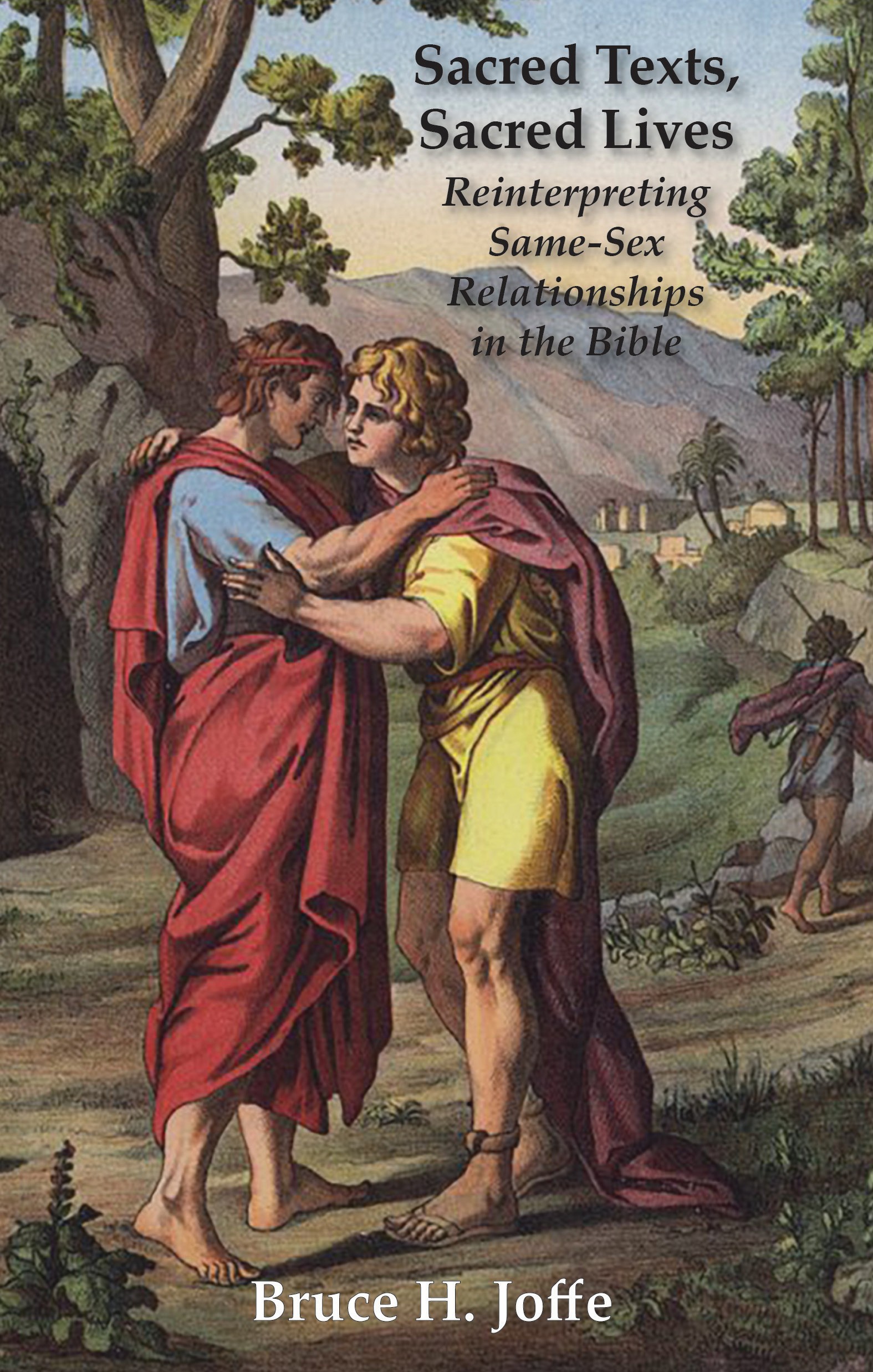
While the Bible doesn't explicitly portray modern-day same-sex marriage, it does feature examples of deep, loving, and intimate relationships between individuals of the same sex, replete with instances of same-sex love and devotion: David and Jonathan, Ruth and Naomi, among others.
2 Samuel 1:26 describes David's lament after Jonathan's death, where he says, "I am distressed for you, my brother Jonathan; very pleasant have you been to me; your love to me was extraordinary, surpassing the love of women." Additionally, 1 Samuel 18:1 states that "the soul of Jonathan was knit to the soul of David, and Jonathan loved him as his own soul," and 1 Samuel 18:3 notes that "Jonathan made a covenant with David, because he loved him as his own soul." Along with others in the narrative of David and Jonathan, these verses highlight the exceptional nature of their bond, painting a picture of a powerful and enduring friendship, characterized by love, loyalty, and mutual respect.
The most well-known verse about Ruth's love for Naomi is Ruth 1:16-17, where Ruth declares her unwavering loyalty and commitment to Naomi. She says, "Where you go I will go, and where you stay I will stay. Your people will be my people and your God my God. Where you die I will die, and there I will be buried."
Some interpret the scriptures in their historical and cultural context, arguing that the focus is on specific acts of idolatry and violence, not on consensual same-sex relationships. They may also emphasize God's love for all and the importance of inclusivity. It is important to consider the historical and cultural context of the biblical texts and to engage with different interpretations in a thoughtful and respectful manner.
What about Transgenders?
Through the transformative lens of artificial intelligence (AI), ChatGPT was asked to create a "biblical passage" about Jesus accepting trans people. Here's what it came up with:
"And a woman, whose heart was divided between spirit and body came before him. In quiet despair, she asked, 'Lord, I come to you estranged, for my spirit and body are not one. How shall I hope to enter the kingdom of God?' Jesus looked upon her with kindness, replying, 'My child, blessed are those who strive for unity within themselves. For they shall know the deepest truths of my Father's creation. Be not afraid, for in the kingdom of God, there is no man nor woman, as we are all one in spirit. The gates of my Father's kingdom will open for those who love and are loved, for God looks not upon the body, but the heart.'"
One may even question the relationship between Paul and Timothy ... as many already have: 1 Timothy 1:2 says, “Unto Timothy, my own son in the faith: Grace, mercy, and peace, from God our Father and Jesus Christ our Lord.” We know that Timothy was not Paul's physical son, because Paul was not married. 1 Corinthians 7:7-8 says, “For I would that all men were even as I myself." Paul consistently expressed love and concern for Timothy, and Timothy, in turn, revered Paul as a spiritual father. Paul mentored Timothy, training him for ministry and entrusting him with leadership roles, while Timothy, in turn, demonstrated deep respect and affection for Paul. I am not by any means implying here that Paul and Timothy shared an intimate, physical relationship. But are LGBTQ+ relationships solely defined by sexual acts?
As society continues to evolve, the impact of scripture on LGBTQ+ activism remains profound. Many activists draw from biblical narratives that emphasize love, justice, and inclusion to support their fight for equality. By reinterpreting key passages and applying them in a contemporary context, LGBTQ+ individuals and allies can find hope and affirmation in their faith. The ongoing theological debates surrounding homosexuality challenge religious leaders and communities to engage in meaningful dialogue, fostering a more inclusive understanding of love and relationships as portrayed in sacred texts.


Comments
Easy to read and a great…
Easy to read and a great start. I particularly like this bit:
"Just as Christians interpreted the Bible to support segregation and slavery until times changed, so their interpretations about homosexuality should change as history moves forward."
I think that's an important sentence within it.
A bit dry perhaps for the…
A bit dry perhaps for the average reader but the scholarship behind this work is extraordinary and deserving of merit.