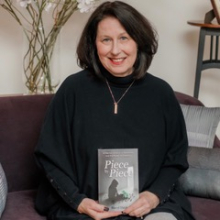
From Me to You
I didn’t write this book to be inspirational. I wrote it because the truth matters.
For most of my life, I was told not to talk. Not to tell. Not to write anything down. So, I stopped. But silence has a cost and I’ve paid it. In pain. In health. In years. This book is me breaking that silence.
I’ve tried to tell the truth the way I lived it: in layers, in fragments, with detours and side stories with moments of hard-won humor. Some chapters might make you laugh. Others may stop your breath. That’s how survival works—it doesn’t follow a script. It follows the path you carve through the dark.
This story begins in darkness because that’s where survival starts. If it feels heavy at first, keep reading. There is light. There is music. There are dogs.
The feelings, the events, the memories? They’re mine. I didn’t embellish them. I didn’t soften them. I didn’t try to turn them into something they weren’t. I lived them. I am still living them.
If you’re holding this book and you’ve ever been silenced—by fear, by shame, by someone else’s power—I hope you find something in these pages that helps you claim your own pieces. Not every story needs to be shared publicly. But every story deserves to be honored and heard, including yours.
We don’t get to choose all the pieces.But we do get to choose what we build.
Still building,
Sheryl
Writing Things Down
I was a music teacher for over forty years. The kind who kept cheese sticks in her office, spare bow ties in her purse, and broken-hearted teenagers in tune, at least most of the time. I taught music, but really, I taught survival. How to breathe through a panic attack during a solo. How to stand tall when the world keeps folding you in half. How to hold a note—and your dignity—when everything else is falling apart.
When I was younger, I wrote in a diary. It had a lock you know, those little pretend locks—the ones parents can easily break. Mine was broken by the person I was supposed to trust the most, and trusted the least—My Father.
There’s a lot to say about him, but first, the diary.
That diary was my one place to talk when I couldn’t confide in anyone else. The last time I wrote in it was during my senior year of high school. He found it again. This time, he was furious. He hit me. He smothered my face with a pillow so I couldn’t breathe.
Then he punished everyone around me, just for being there.
The lesson? Don’t write anything down. And yet… here I am. Writing something down.
It’s been over forty years from that moment and, since then, all my thoughts, fears, and light have lived in my head. So here I am now. Over sixty. A retired music teacher, director, mother, grandmother, sister, friend, and wife… SURVIVOR.
Describe me? I’m the most conservative liberal who’s ever lived. Yes, we do exist. I have been married for a very long time, with four grown children and five grandchildren. I live in the suburbs and cook dinner for my Husband every night. I silently pray for the ones I love and for the world.
What finally made me sit down and type? Well, I fell. Flat on my face.
For someone clinging to the idea that at a mature age one can still be attractive, eating pavement is downright horrifying. Two black eyes, cuts across my face and forehead, and a knee swollen like a round fruit no one wants to eat. I didn’t leave the house for weeks. I described myself as Frankenstein’s bride, although she looked better in James Whalen’s version of Mary Shelley’s character.
And that wasn’t even the big scare. It started with a routine X-ray, which led to a CT scan. Nodules—dozens of them. Something called “ground glass.” A radiologist glanced at the images, muttering that he wasn’t convinced it wasn’t a “fast-growing lung cancer.”
I’ve always taken the mismatched pieces—broken ones, discolored ones, odd ones—and snapped them together into something new. Something creative. Something better.
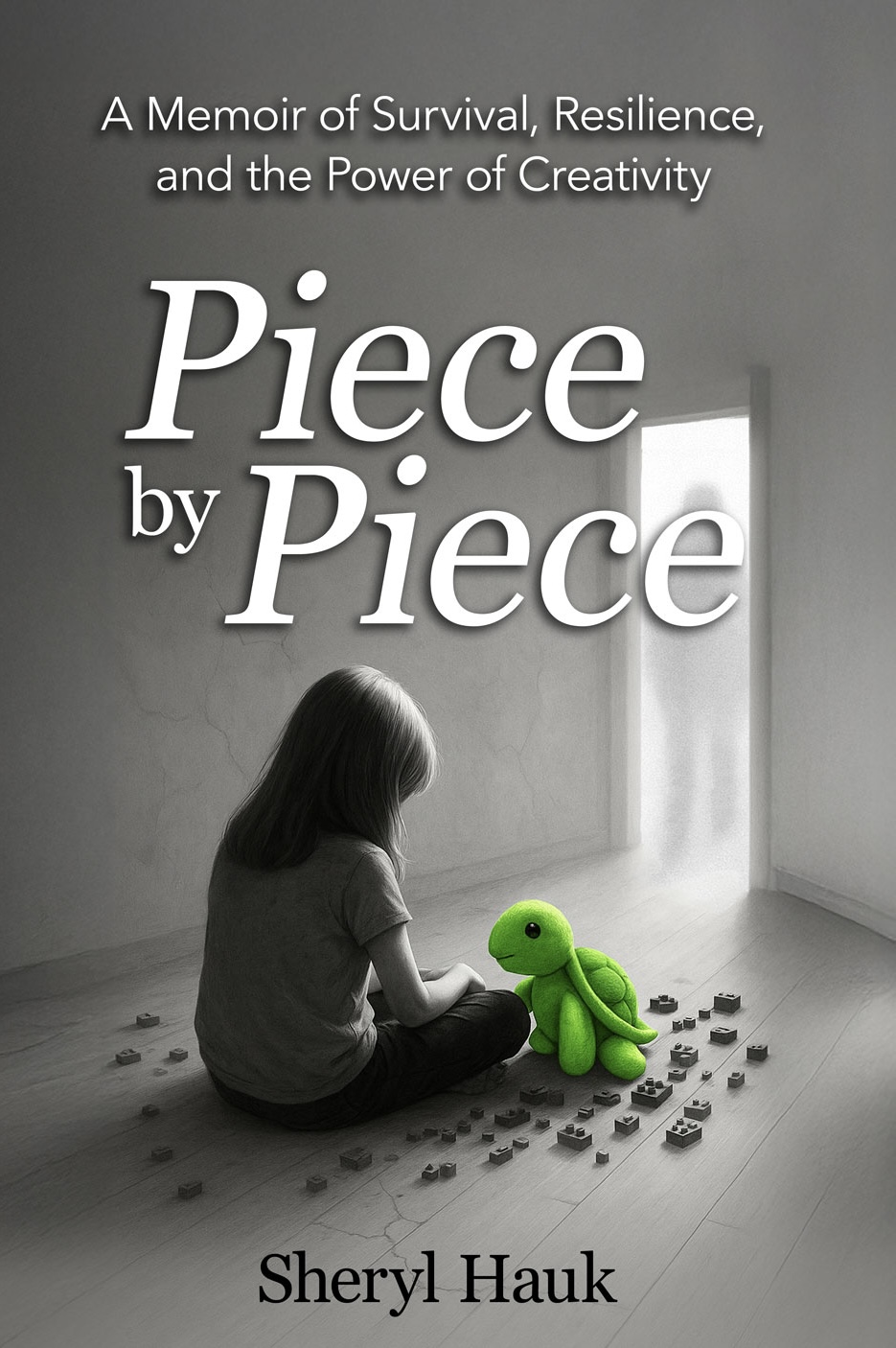
Which is exactly why I chose the title Piece by Piece—because I’ve spent my life snapping parts together. But that week? That week tested every single piece I’d ever placed. So maybe writing this is finally the project I’ve been designing in my head for years. That week nearly shattered me. But it didn’t. Because now I get to tell the story. Now I get to write.
ACT 1
Triage and Thresholds
Chapter 1
The Little Room
In 2003, I thought I was finally going to breathe a sigh of relief and, I mean, finally. I had a “real job,” with medical insurance, a retirement plan, and a wardrobe—both in my closet and in the school costume collection I was bequeathed.
My firstborn was graduating high school with honors and about to receive the National Gold Key from Scholastic for her art portfolio at the Kennedy Center in Washington, D.C.
My second child, first son, was simply and chaotically surviving high school and hockey. Not me, I’m a survivor, but never survived being the Goalie Mom. My youngest, the one who screamed anytime I left him with a friend to work at the co-op preschool—boy, that was fun—was finishing kindergarten. And Kai—my beautiful, brilliant, curious Kai was going in for a routine tonsillectomy.
Maybe it wasn’t a breath of relief, but life was somewhat “normalizing” in my head.
Being the multitasker I am, I sat in the hospital waiting room with a pen in one hand and a stack of graduation announcements in the other. Everything felt like it was landing where it should and then it all unraveled, again.
My Husband had disappeared, probably to get a cup of coffee—coffee deserves its own book in our house. And, come to think about it, maybe a book on relationships.
Sitting alone, ready to tackle handwritten, addressed graduation invitations, I was starting to let myself think, believe, feel, “Maybe…maybe this time we’re okay.” Then the doctor walked out.
White as a ghost. Eyes darting. Voice low. He asked me to come into “the little room.” NEVER trust the little room. This was not a tonsil problem.
The doctor didn’t know exactly what it was yet, even as brilliant as he considered himself to be. In fact, he did praise himself—yes, praised himself—for not cutting “a very vascular mass” two minutes into a routine tonsillectomy. He said if he’d cut it, Kai could have bled to death on the table.
Oh—and by the way—this thing? This giant tumor? He was supposed to catch it in his office by looking IN my son’s nose. But as a pediatric ear, nose and throat (ENT) doctor, apparently “looking carefully” wasn’t on his to-do list the day Kai was brought in to see the “specialist” for multiple and prolonged stuffy, bloody noses.
Honestly, I was too stunned, too deep in survival mode, when the doctor called to give us “referrals to specialists.” Wasn’t he the specialist? And, over the phone? To top it off, he wished me a cheery, “Good luck.” GOOD LUCK?
I didn’t even have the energy to think, “You misdiagnosed him, and maybe you should be paying for all the surgeries, the counseling, the stolen possibilities.”
Not to mention the LEGO kits.
An emergency CT scan soon revealed the diagnosis: Juvenile Nasal Angiofibroma. (JNA). It was a rare, benign tumor that had filled my son’s skull. It started in his nasal cavity, pushed through the bones, wrapped around both his optic nerves, and carotid artery. It destroyed the base of his skull and punched through the dura the protective membrane around the brain squashing his temporal lobe like a sponge. This was my child. My child. My baby.The world didn’t stop.
Not for a second.
This was the first year of my return to teaching full-time. The classes included middle school choir and music appreciation. We welcomed all the kids no one knew what else to do with.
I was driving thirty minutes between my school, three of my kids’ schools, hockey, soccer, piano lessons, going to graduate school, cooking, cleaning, homework, even mowing the lawn. You get the idea.
I was a little busy, like the rest of the over-achieving “extended” baby-boomer women.
Somewhere in between, I was meeting with doctors—plural, doctors—from the University Hospital Skull Base Clinic and watching my eight-year-old’s face grow paler by the day.
And still, the world kept turning. People still expected me to show up. Smile. Function. Participate.
My oldest was being celebrated—a big moment. Graduation, honors, all eyes on her. It was supposed to be HER moment. Instead, family flew in from all directions, even the in-laws—the “other side”—to witness both Kai’s surgery and my daughter’s graduation. They weren’t worried about him; they came because it was an event—something to be part of. My mother-in-law cried, primarily because of how hard it was for her.
My sister showed up with a camera and a mission. She was posing with Kai, just two hours after he survived nineteen hours of surgery. He was unconscious, head completely wrapped, jaw broken. She was smiling. His skull had been opened by six surgeons to remove a massive tumor. She needed that picture. Proof, I guess, that she was there.
In short, everyone had something to say, something to make themselves feel involved in what was happening, something for each of them to feel important about. I was determined not to let the noise of other people’s self-importance drown out what really mattered. My mission: helping Kai survive and, maybe, just maybe, thrive. That’s what survivors do.
I knew what it looked like from the outside—if anyone had bothered to look, which most didn’t. Just a family juggling milestones. This wasn’t a juggling act. This was triage.
Every moment I wasn’t focused on my son felt like a betrayal. Not to anyone else. To him.
From the outside, it might have looked organized, as if we had a system. Inside, it felt more like a giant mess of snap-together bricks spilled across the floor. No instructions. No picture on the box. Just broken pieces everywhere and no idea where to start.
So I did what I always did: I showed up. I hosted a graduation party. I held bloody noses. I taught school. I hired my own sub. I fielded questions from surgeons. I answered none from family.
And Kai? He kept building LEGO kits. I kept placing them on the shelves in his bedroom. Tiny bricks. One snap at a time. Because building with LEGO blocks made sense—when nothing else did.
The world didn’t pause. Neither did I. Not because I was strong. Because I had no choice.
Chapter 2
Hypervigilance(And Monte Carlo)
“How do you look so normal after all you’ve survived?” people ask. Believe me, there’s plenty behind that question— especially moments like when my son’s ENT doctor wished me, “Good luck!” after discovering a softball-sized tumor in his skull—yes, softball, not baseball.
Trauma doesn’t simply disappear—it reshapes itself. My childhood left me plenty of unexpected ‘gifts,’ not least of which is a constant state of hypervigilance.
“Hypervigilance is defined as a state of extreme alertness and watchfulness, often bordering on heightened awareness of potential threats or dangers. It’s characterized by being constantly on guard, even when there’s little actual risk.” The Google definition is much longer, but you get the idea.
I can always sense when things aren’t right—even the stuff I am not supposed to hear or see. I feel tension in a room before anyone else notices. Sometimes that’s useful. Sometimes it’s not. You hear things not meant for your ears. You see things others try to hide that you would rather not see. Sometimes, it makes people think you’re pupule.
Pupule is the Hawai‘ian word for crazy. Did I mention I grew up in Hawai‘i? Yes, I can be a “little pupule” —can’t we all? Like the time I jumped off a 50-foot bridge. Or the time I flew to Hawai‘i on Wednesday, testified and flew out Thursday in order to be back to teach on Friday. Not from California but from Michigan— ten hours away.
There are also hundreds of times when my teaching methods were a little different—trust me. I once got a gift from three graduating students, a conducting baton, in a wooden case, inscribed, “There is a method behind her madness.” Are you convinced? Case in point: Why I’m Not a Cruise Line VIP
Not long ago, my mother begged me to accompany her on a cruise to the French Riviera. The thought of going on yet another cruise with my MOTHER was pupule. I said YES? Truth be told, I wasn’t signing up for another mother- daughter cruise; I was signing up for a chance to knock off a couple of bucket-list items.
I set two personal objectives before we left port:
1. Wander among the ruins of Rome.
2. Play the roulette wheel at Monte Carlo’s Royal Casino—my one reliable winning game.
Goal #1: I booked a Vespa ride for my 87-year-old mother and me. She donned the helmet and slid into the sidecar. I climbed on behind the Roman teenager who was driving and whispered, “My mom likes to go fast.”
And fast we went. With her giggling, we tore through the streets of Rome, saw the ruins, and topped the evening off with a little gelato. Did I mention she requested to sit behind the young Roman, instead of in the sidecar, and finally won? She rode on the back, holding onto the eighteen-year-old, all the way to the Basilica in Vatican City.
Mission #1—Accomplished.
Goal #2: Our little sail yacht couldn’t dock in Monte Carlo as planned. The captain attributed the issue to the weather, but all the other, larger, and more expensive boats didn’t have a problem. A better explanation: The Monte Carlo Grand Prix was in full swing, and every trillionaire had already claimed the harbor. No room at the inn.
Instead of docking in Monte Carlo, we ended up four train stops away—in a town whose name still trips me up: Cagnes-sur-Mer. I can’t say it right yet, but I’m not giving up.
I woke early, dressed in my ‘French Best,’ and dragged my mother off the boat in her clothes of choice; capris and a fanny pack. Nothing screams ‘American Tourist’ more to Monte Carlo—one of the many challenges of traveling with my mother.
I dutifully followed her off the crowded train to the Hop-on-Hop-off bus. She was thrilled—her favorite way to visit a city. Although, I bet if there were a Vespa to rent, she might have gone
that route.
Finally, we hopped off at the square in front of the Royal Casino. To get inside—and yes, it included a gift shop—we had to go through security. I must’ve passed the Monte Carlo ‘what- to-wear’ checklist, because they didn’t check my bag and waved me through with a respectful nod. My mother? That was another story. They thoroughly searched her fanny pack. Must’ve been the capris.
The doors for the actual gambling hall did not open until 2 p.m. BUT I had thought ahead, joined the club, and was going to be allowed to enter at 1 p.m. However, like everything capris, the door ‘sentry’ took one look at my mother—in her fanny pack and capris—and turned us away.
With a couple that my mother had befriended on the cruise—latched onto is a better description —we had made it through the Hop-on-Hop-off bus tour and even lunch. According to my mother, lunch was too expensive for her taste. Who orders only soup and water at the Café de Paris? And smoking patrons? How dare the French do that.
By 1:45 p.m., it was time for Goal #2—roulette. But now, she said her legs hurt. She was tired. This was classic. Just like Amsterdam. There, she demanded a wheelchair, only to find out she might miss her flight because KLM was waiting for other passengers who needed assistance. She leaped off that van, sprinted through the airport with her carry-on in tow, cut to the front of the customs line, raced down ten gates, and made that flight.
Sure—now her legs hurt. Now she wanted a wheelchair. She made a big show of saying she’d head back to the boat alone—probably because her ‘friends’ had already disappeared toward the slot machines. Then she leaned in and whispered, “If I don’t get lost.” UGH. No roulette table for me.
Mission #2—Not so much accomplished.
We ran to the platform—my mother never walks—just as a train pulled in, headed to Cannes. Yes, the exact direction we were supposed to go. But my mother stopped under the list of destinations and announced we were on the wrong platform.
Unbelievable, Mom. My Husband proudly tells people I can remember every street I’ve ever been on—thanks to that lovely hypervigilance. He even claims I can find every Target in North America.
BUT this time? According to her, I was wrong. I ran to catch the train, but the doors wouldn’t open—because the loud lady in the capris wasn’t getting on that train. And apparently, this time…capris trumped my intuition.