

INTRODUCTION: FIRST MENTIONS
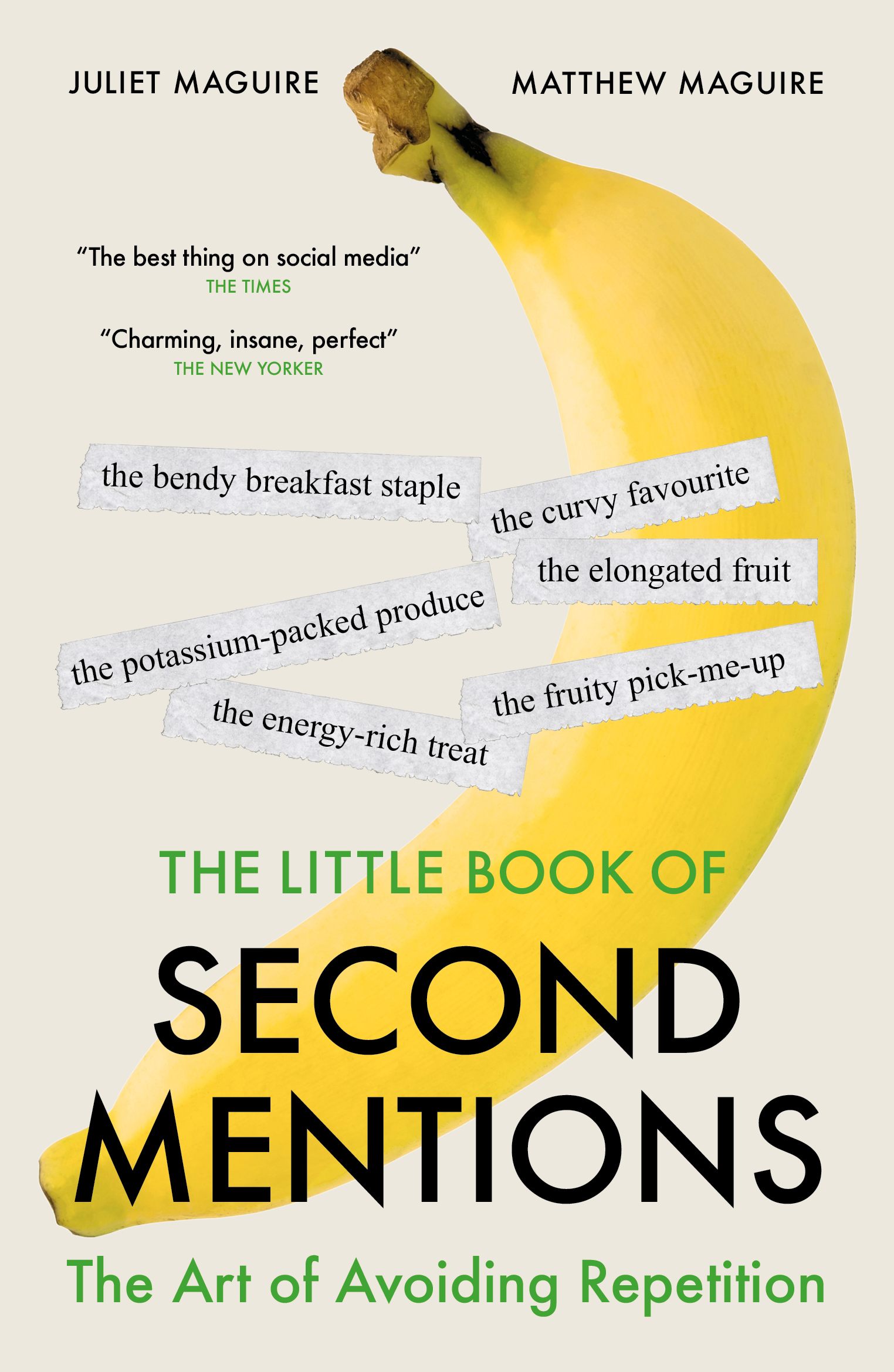
‘The elongated yellow fruit’
‘The curvy favourite’
‘The energy-rich treat’
These are all examples of second mentions, when a journalist deliberately tries to avoid repeating a word, name or phrase when referring to it for the second time. So we get things like the above for the word ‘banana’, which could be described somewhat plainly on its second mention in a news
story as ‘the fruit’, however, some journalists like to be a little more playful with their synonyms. Another example is the humble potato, which is transformed into ‘the carb-rich root vegetable’ or ‘the starchy spud’ at second mention.
For us, spotting second mentions started out as a hobby, but it rapidly became a passion. In 2013, we set up our Second Mentions account on X (back when it was called Twitter) to share examples we found in newspapers and magazines, with the purpose of ‘celebrating the wonderful descriptive ability of the world’s journalists’. We are a husband-and-wife team and, when we started out, Juliet was a digital content editor at a
national newspaper, having previously worked as a reporter for a local newspaper in London. Matthew worked in football and rugby (and now swimming), with a knack for spotting examples in sport journalism. Our interest was sparked by some of the first examples we found: ‘the Caribbean-accented star rodent star of CBeebies’ for Rastamouse, and ‘the minuscule subsoil parasites’ for nematodes. Now, whenever we read a news article, after we have read the headline, our gaze immediately turns not to the first sentence but to scan the article to find the second mention. This book is intended to be a celebration of our favourites that we have spotted, or have been sent to us, over the years since we started the Second Mentions account.
So where do we find second mentions? There are certain topics and stories that are usually rife with good examples, such as articles about food (as we have seen with bananas and potatoes) or animals (particularly pigs, pandas, giraffes and hedgehogs), and we often feel disappointed when they are lacking. One article about hedgehogs featured the word ‘hedgehog’ twenty-seven times, without even a single mention of ‘the spiky creature’ or ‘the prickly animal’. Equally, there is always creativity to be found even in otherwise fairly staid politics or business articles. Tabloid newspapers and magazines tend to be a good place to start due to their more relaxed and informal writing style, but broadsheets, radio and TV programmes can
also be a rich source of creative second mentions.
Second mentions have been around for hundreds of years. In ancient Greece, the poets of the time often used alternative names for gods and heroes as a way of highlighting their qualities and actions. In Homer’s epic, The Odyssey, the protagonist Odysseus is known as ‘the great tactician’ and ‘the sacker of cities’, while the goddess Athena’s eyes are the source of many epithets, as in ‘the bright-eyed goddess’. It is this tradition that journalists of today are emulating with their second mentions, though perhaps unwittingly.
Opinions on the usage of second mentions have been somewhat mixed: some people admire them for helping to animate a piece of writing, while others... let’s just say, do not. H.W. and F.G. Fowler in their 1906 book, The King’s English, wrote: ‘The use of pronouns is itself a form of variation, designed to avoid ungainly repetition; and we are only going one step further when, instead of either the noun or the pronoun, we use some new equivalent.’ They continue: Many writers of the present day abound in types of variation that are not justified by expediency, and have consequently the air of cheap ornament ... When the choice lies between monotonous repetition on the one hand and clumsy variation on the other, it may fairly be laid down that of two undesirable alternatives the natural is to be preferred to the artificial.
On the other hand, in an article about the Second Mentions account for the New Yorker, Naaman Zhou describes a more neurological reasoning to create ‘elegant variations’. He writes: What makes these substitutions so sublime? Kristen Syrett, a professor of linguistics at Rutgers University, told me that people are instinctively drawn to second mentions because of a well-documented concept called the repeated-name penalty. This is a cognitive phenomenon, part of the way human minds process language. ‘If I say to you, “Jane walked into the living room, Jane picked up a book, Jane started to read the book”... that causes a delay in reading time,’ Syrett said. Psycholinguists have conducted experiments with eye-tracking technology, where they have watched the eyes of their subjects stumbling over these names and scanning back. The body stutters. This response, Syrett said, is ‘encoded in our brain’ – it applies as much to Japanese as it does to Spanish.
It might just be fear that causes journalists to employ a second mention, as explained by the QI account in one of our favourite posts on X.
@qikipedia
Word of the day: MONOLOGOPHOBIA – a fear of using the same word more than once in a single sentence or paragraph.
Once we had looked past the fact that they had used the word ‘word’ twice in the same post, we realised that not only do we suffer from this, but so do many other writers around the world, judging from the responses.
A more modern name for second mentions is ‘knobbly monsters’, a term reportedly originating from a journalist at The Sun who was writing an article about a fatal crocodile attack. According to John Sturgis in The Spectator: ‘By his fourth or fifth paragraph he was groping for an alternative way of describing his deadly protagonist. He settled on describing it as “a knobbly monster”. And a legend was born.’
As you might imagine, journalists are a pretty competitive bunch and some consider second mentions to be a form of sport, vying for who can squeeze the most elaborate and exquisite second mentions into their articles. There is, however, one almighty figure standing in their way: the sub-editor. The role, which is sadly becoming increasingly endangered in newsrooms, is akin to a goalkeeper, but instead of stopping goals they prevent spelling and grammar errors or other mishaps from slipping through the net to publication. When an article arrives ready to be ‘subbed’, the game is officially on. Will ‘the popular orange vegetable’ make it through to publication? Or will the weary sub-editor give a sigh, roll their eyes and edit
out ‘popular’ and ‘orange’, leaving their readers only with a distinctly unsatisfying, ‘the vegetable’ or worse, just ‘it’ as the second mention for a carrot?
In Michael Frayn’s novel Towards the End of the Morning, the role of the sub-editor is described as ‘just a matter of checking the facts and the spelling, crossing out the first sentence, and removing any attempts at jokes’. While it can certainly seem like that at times, in their defence sub-editors are usually working to a house style guide that sets out the publication’s stance on spelling and grammar and often lists words or phrases that are deemed unacceptable. Indeed, The Guardian and Observer style guide has an entry specifically for ‘Pov’, which stands for ‘popular orange vegetable’, a ‘term coined by a Guardian journalist to depict laboured attempts to produce synonyms.’ In an article on the subject, entitled ‘My synonym hell’, Guardian sub-editor Jamie Fahey writes: ‘My first instinct is to get rid; sometimes, however, I revel in the writer’s inventiveness and
leave them be.’
Even if you’re not a journalist, it is likely that at some point you have consulted a thesaurus to find a different form of words to express the same thing. At school, it is drilled into us that it is boring to repeat the same word; in English lessons, we remember being taught how to liven up our creative writing with synonyms for ‘said’, ranging from more straightforward options such as ‘added’, ‘replied’ and ‘responded’, to more
expressive options such as ‘shouted’, ‘exclaimed’ and ‘hissed’.
Similarly, you would not continually refer to a person by their first and last names throughout an article, for example, ‘John Smith’ at the first mention becomes ‘Mr Smith’ at the second mention, and then perhaps ‘the over-zealous sub-editor’ at the third mention.
However, this book is much more than a thesaurus. If you have ever used one, you will know that sometimes the suggestions do not always fix the exact context for which you need them. If you are writing about ‘rain’ for example (a fairly common occurrence for UK-based journalists), ‘precipitation’ is of course a suitable synonym for the second mention, but there are many other ways to describe more precisely the type of rain that is falling. If the rain is light, then we can use ‘mist’, ‘drizzle’ or even ‘mizzle’; if it is heavier, then ‘downpour’, ‘deluge’ or ‘monsoon’; while if it is freezing, then ‘sleet’, ‘snow’ or ‘hail’.
Writing is a craft, and the examples we have chosen in this book demonstrate a much deeper understanding of words than a thesaurus is able to achieve. The joy of the English language is that there are so many different ways for writers to express themselves, and we embrace their creativity. This book is a celebration of their efforts. It is surely only a matter of time before AI catches up and can write entire articles, let alone second mentions, to the same standard as humans, but until then, rest assured that all the examples we have used havebeen written by real people.
Second mentions can be found everywhere, and while we’ve been searching for them for more than ten years, we have to thank our followers for helping us with our quest. Every day, we are sent examples spotted by journalists, who sometimes claim responsibility for their own, or by other readers who enjoy the simple pleasure of happening upon them while reading the news. Often, only a link is given to the article, leaving us with the same thrill of finding the second mention as if we had discovered it ourselves. They are always entertaining and can often be educational by introducing us to words and phrases that we have never heard before.
Though predominantly from the UK and other English-speaking countries, our fans share second mentions from all over the world. Some journalists are proud to appear on our Second Mentions account, while others speak of their fear of being featured inadvertently. Often writers contact us when they are stuck on a particular word and in need of creative inspiration, and our followers are always quick to step in with suggestions. Sometimes these will make it to print, and sometimes it is simply a chance to workshop ideas with fellow writers. For our followers and many readers, second mentions can provide a little light relief amid increasingly distressing news reports from around the world, and that’s how we see them, too.
We’re often asked about our favourite second mentions. Some that always raise a smile in the Second Mentions household include ‘the cod digits’ for fish fingers, ‘the famous black-and-white flightless birds’ for penguins, ‘the monochrome mammals’ for pandas and any time a pig is referred to as a ‘porker’. We’ll share more of our favourites in each of the following chapters, some of which we discovered ourselves but others that were sent to us, for which we’re very grateful.
As we seem to have become something of an authority on the subject, given that we’ve been doing this for more than a decade, we’re often sent submissions from followers asking, ‘Does this count...?’ as an official second mention. Therefore, we thought it would be useful to share a few of our house rules.
1. We call ourselves ‘second’ mentions, but we accept third, fourth, fifth and even sixteenth mentions.
2. They can appear in the headline or in the standfirst but are usually found in the main body of an article.
3. We look for creativity beyond ‘traditional’ second mentions, for example, Mars as ‘the Red Planet’.
4. We avoid examples that include repetition of any part of the first mention, for instance, a supermarket meal deal being ‘the sandwich, snack and drink deal’ is excluded for repetition of the word ‘deal’, whereas ‘the popular lunch option’ would qualify.
5. We award bonus points for alliteration, for example, ‘the bubbly beverage’ for champagne, or ‘the furry four-legged felines’ for cats.
6. Second mentions are often a simple construction of ‘definite article + adjective + noun’, but we admire longer ones with additional creativity.
7. We aren’t pedantic; in some cases, we include phrases where we deem these to be in the spirit of second mentions, even if they haven’t technically been used in that way.
8. We enjoy real-life examples beyond the media; they don’t have to come from newspapers, magazines, television or radio.
9. We appreciate second mentions in languages other than English.
10. We always aim to be sensitive, avoiding second mentions that are likely to cause serious offence.
If you are new to Second Mentions, then we hope this book inspires you to discover your own examples in the articles you read from now on (and to share them with us). If you’ve been following us for some time, then sit back and enjoy our top picks from the last ten years. Every day, the submissions that are sent to us have raised a smile, and putting together this book has allowed us to rediscover those moments over and over again.


Comments
This whole thing gave me the…
This whole thing gave me the giggles as a fiction book editor. It can definitely be difficult to find a balance between repetition of a word/name/phrase or going too over-the-top trying to avoid that.
Very interesting concept,…
Very interesting concept, but I am not exactly sure about the value this book might provide and what other topics might be discussed.
The 'value' of course of the…
The 'value' of course of the book is the same as many others: entirely subjective but entirely justified by the proliferation of writers today more than ever, many of whom could learn a great deal from a work of considerable scholarship that deals with a topic that we all struggle with.
A genuine delight!
A genuine delight, and the rare nonfiction submission that arrives with its audience already assembled. The ten house rules are the best thing here — awarding bonus points for alliteration is exactly the right tone, and grounding the whole thing in Homer's epithets gives a silly premise real intellectual footing. Two notes: the logline reads "a creative collection of creative linguistic curiosities," which is an unfortunate repetition in a book about avoiding exactly that; and the sample is all frame and no specimens — readers will want the examples arriving thicker and faster. For inspiration: Mark Forsyth's The Etymologicon and Susie Dent's Word Perfect for how to pace a browsable language book; both prove short entries can still build an argument.
Such a lot of fun
A celebration of the inventiveness of humans is refreshing and worthwhile! Delightfully community oriented. I will never read or write the same way again.
Great concept
This is such a fun and creative idea - refreshing!
An original premise, well…
An original premise, well researched and written. A very enjoyable read which made me laugh out loud!
A unique concept
A unique concept, for sure! I appreciate the comedic aspect of the writing style. I'd be interested to see how following chapters play out!
Delightful
I have nothing to say other than this was a delightful read.
Fun & Well-Researched!
I love this one! The tone is spot on, the content offers an interesting, fresh take, and now I definitely want to read the book!
Great work!
Delightful and SO true
I love the research performed, including the historic aspects, and the more far-fetched attempts not to be repetitive. Thumbs up!