

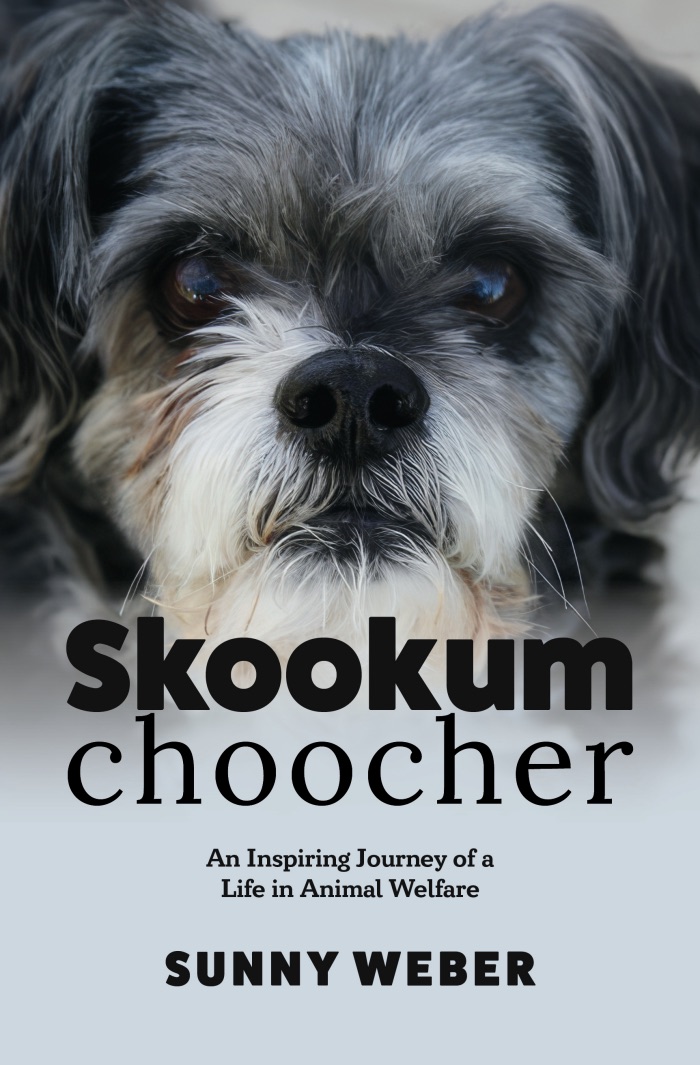
Skookumchoocher:
An Inspiring Journey of a Life in Animal Welfare
By Sunny Weber
How I Became an Animal Welfare Advocate
In March 1990, I had emergency surgery after four days of intense abdominal pain and a subsequent 106-degree temperature. A tumor the size of a baseball was found growing on a stem off the top of my colon. The tumor had been secretly growing for at least five years but had suddenly twisted on the stem, which was what caused the intense pain. A six-hour surgery left me with a large scar but a flatter tummy.
As I lay in the hospital on a morphine drip, I awaited the biopsy results. My hospital roommate was dying of uterine cancer. That was how I found out I was on the cancer floor. The shell shock of realizing none of us has control over what grows in our bodies made me sure a tumor that size had to be terminal.
I thought I was going to die. I thought about all the things I had not taken the time to do because I worked all the time. I had spent the last twenty-one years working six- to seven-day weeks. I created great plans for my future, but that future never seemed to arrive. Although I had cared for a series of cats, the most important thing I had missed was having a dog. I decided that if I lived, I would wait no longer. I would adjust my lifestyle to include a dog.
I was lucky; my biopsy was benign. The day of the final post-op check I scheduled a celebratory lunch with a friend who had just given birth to her first child after an extremely difficult pregnancy. We both had much to celebrate. When I arrived at her house, I found that not only was there a new baby—there were also six new puppies!
Meeting Miles
Our eyes locked and froze into a tunnel-like stare that made everything outside of its beam blurred and obsolete. His dark brown eyes were flecked with amber, and the shine of his black iris held me frozen until the expansion and contraction of his lens synchronized with the beat of my heart. He sat motionless, gazing at me, content to stay where he was. He seemed to have no need to approach me, and I felt unable to move toward or away from his paralyzing attention.
It seemed like ages until I once again became aware of my physical presence, standing on my friends’ backyard patio, the sun beating down on the top of my head. Slowly I became conscious of what seemed to be hundreds of needles being run up and down my bare legs and over the tops of my sandaled feet. With great effort, I tore my eyes from his and glanced down at the sources of my pain, cognizant of excited whines and whimpers. My focus cleared and I saw about me five puppies and their parents, vying for my attention by jumping up and clawing me with tiny yet razor-sharp claws.
I reached down to pet the dogs and, in an instant, my forearms and hands were wet with dog kisses. Magnetically my attention was again drawn back to him, the only puppy not joining the fray. “Who’s that?” I asked, nodding to the loner.
“Oh, that’s Spunky. He’s the ‘runt of the litter.’ He knows eventually it will be his turn to be made a fuss over. So he just sits until we go to him. He is slow to warm up to strangers, but once he gets to know you he is really friendly.”
I was so drawn to Spunky I extricated myself from the throng of squeals and yips by stepping over the heads of the little ones and around the parents. I slowly walked over to him. He sat motionless except for the raise of his head, keeping eye contact with me as I approached and towered over him. I reached for him and he stood up, then allowed me to slip my hands under his little potbelly and lift him to my chest. Immediately I was covered with licks, and he squirmed with excitement in my arms.
I was surprised at the pup’s confidence and patience at so early an age. He continued to cuddle, sniff, and lick me. I could not put him down. I felt a wave of rightness that had been absent in my life. I had never felt so attached to anyone or anything before, yet somehow felt the ancientness of our connection, as if we were great friends once again reunited after eons of separation. One week later I returned and brought him home with me. I renamed him Miles, for he was too stately for a baby name.
Over the next fifteen-and-a-half years, Miles taught me. He was my creative muse, my best friend, my reason for being. I studied animal behavior. I learned to train service dogs for the disabled. I met hundreds of people who shared a similar human/animal bond with their own pets. When Miles died in my arms in 2005, once more I felt my life was over.
Learning to Live Again
But it was not. I lived. The final years of nursing my old friend left me with unused hours when he was no longer physically with me. A month later I applied to volunteer at the largest animal shelter in the area. For twelve years I fostered, trained, and re-homed over one hundred dogs, cats, and horses. I taught humane education to thousands of children. I participated in special events, cleaned kennels, washed pet food bowls, administered medical care, and did mountains of shelter laundry. I attended fundraisers, ferried pets to television stations for adoption segments, manned (or “womaned”) phone banks during telethons, and transported pets to and from shelter partners.
I learned how to advocate for animals—how to read what pets tried to communicate, how to tend to the sick, how to screen adopters, and how to identify the needs neglected by humans. I became a specialist in rehabilitating fearful pets—especially dogs. A new pet family arrived, one by one—needy pets who craved what I had to give. My life regained meaning. Over the years I wrote books, blogs, and articles about animal welfare and humane education for children and adults. I opened a behavior business doing house calls for families and “problem” pets. I started a boarding business in my home for special needs pets who did not thrive in traditional boarding facilities. I designed and taught dog training courses, while continuing to study and advance my own knowledge. I studied to become a naturalist for state parks, where I educated campers on local wildlife. I became politically active with my state legislature through a special interest group that assisted in writing animal welfare laws. I spent hours and hours in management of, and fundraising for nonprofit animal welfare groups.
It has been thirty-five years since Miles changed my life. Through him—because of him—I have helped save unknown numbers of pet lives, encouraged humans to develop compassion for, and better relationships with domestic and wild animals, and helped create laws to safeguard all species in my state. Miles continues to be my spiritual partner and my motivator. My refrigerator magnet that says, “Be the kind of person your dog thinks you are,” is my mantra. Miles worshipped me and I will always strive to be worthy of that devotion.
Chapter 1
A New Family Forms
A sudden deafening chorus of squeals and barks arose when the kitchen phone rang. I waded my way through the wrestling of Bailey and Jessie, dogs I had recently adopted after fostering. Old Buddha, the Tibetan spaniel, waddled around the perimeter of the kitchen to keep from being stepped on. Three cats scuttled out of the way, under the antique Hoosier cabinet along the wall. Parakeets chirped over shrill dog yips. I navigated a path through stuffies and squeakies and lifted the receiver.
“Hello?”
“This is Melanie, the foster care manager at the shelter.” I was a volunteer, so I knew Melanie a bit. She was the newest of a long line of young women who headed that department. I had been active for several years and was familiar with the turnover.
“We have a small dog for fostering. He just had leg surgery and needs a high level of care.”
I specialized in needy pets that the average foster home could not handle—either medically or behaviorally or both. I took in high-risk medical patients as well as the traumatized.
“Fine,” I said. “When do you want him picked up?”
“Later this morning will work. He’s stressed from all the noise and activity here and needs a quiet place to recuperate before we put him up for adoption. I know you have ramps and a peaceful environment, plus the experience for this little guy.” Why was Melanie trying to sell me on this foster with her flattery?
“What’s his history?” I asked.
“He was a transfer from Memorial Charity Pet Hospital. He had a severely broken left femur and their docs couldn’t address it, so they transferred him here.” It was true, our large city shelter had the best veterinarians, and I knew that the orthopedic requirements of this little dog were not beyond our doctors’ abilities.
“I’ll be over at 11:00 a.m.” I turned to the dogs, shook my finger at their panting, smiling faces and said, “You guys need to be easy on this little dog I’m bringing home today. You’ll have to watch your feet and look out for him so you don’t hurt or frighten him.”
Jessie the lab and Bailey the Wheaten terrier wiggled their entire bodies in a doubtful promise and then charged out the dog door to give chase to the squirrels in the yard. Buddha ignored everyone and plopped down on his bed. The cats came out and weaved through my legs, purring. I sprinkled their morning treats on the floor and climbed the stairs to get dressed.
Before leaving for the shelter, I laid out a low plastic fencing pen from the garage. Throughout my years of working in animal care, I had collected a large assortment of supplies and equipment. I unfolded its full length across the kitchen floor, separating the eating nook from the family room. The eating nook French door opened to a long, gradually inclined ramp that descended to a small outside concrete patio constructed for situations like this. I placed a second wire pen around the small patio so the newcomer would be able to go in and out, without access to the entire yard.
After placing a medium-sized crate in the back of my old Volvo station wagon, I headed to the shelter. I parked at the back entrance, which was nearest the foster department, and walked into the office where Melanie had the usual paperwork ready.
“What are your care instructions?”
“Let’s have Dr. Jeff explain to you,” she replied. I was a bit taken aback—this must be an especially fragile case. My curiosity was piqued. We walked across the hall to the medical department, crossed through the main care area and entered the hospital.
I saw Dr. Jeff across the room, beyond the gleaming treatment tables and through the bright exam lights over each one. Technicians were bent over several sleeping bodies, prepping them for procedures. The two sterile surgery suites to the side of the large room were already in use with gowned medical humans working over green-sheeted animals on silver tables.
Dr. Jeff waved at us and went to one of the cages that encircled the medical area. He opened the barred door and reached in. Gingerly he brought out a mass of black hair. He stepped over cotton swabs, dropped instruments, and electrical cords as he made his way through the active area with his fuzzy load.
We greeted each other. Dr. Jeff and I had worked together on several medical issue dogs and cats and he knew I would understand and carry through on his instructions. “This little guy has two pins in his left femur, so you have to be careful how you pick him up and set him down.” Intrigued, I leaned closer. I could not tell which end was which. The only area not covered by the matted mess was the shaved left thigh. “Also, he has a broken back.”
What?
“They didn’t catch the back problem at Charity Hospital. We picked up on it when we repeated X-rays of his back leg. Because of where the break is, we didn’t think he would live, so we decided not to operate on his leg. We kept him in a cage for a couple of days and he continued to eat and drink. His tail kept wagging and he continued to poop and pee. So we thought we’d correct his leg and put him in foster care to see what happens because there’s nothing we can do about his back. Hopefully it will heal with time.” Dr. Jeff handed me the fuzz ball and it was only then that I saw where his face was, because he immediately looked up and licked my chin. At the other end a scraggly tail appeared and wagged.
“His name is Brillo.” He did indeed look like the pot scrubber —tangled, with dirty, wiry hair tied in knots down to his skin, even though I was unable to see his skin except for that thigh with the fresh incision on it. A foster volunteer toted the medicines and food Brillo needed as I carried him to my car. I placed him gently in the crate and left for home, not knowing if this minute dog would live or die in the next days.
But Brillo did not die. Over the following weeks, I kept him confined in the kitchen and took him outside on a leash. Jessie, Bailey, and Buddha kept him company and he sought their interactions through the pen fencing. At night they all slept in the kitchen and family room area. Each knew the others were near. During the day, classical music played throughout the house, and because I worked at home, we were together throughout Brillo’s recovery.
Haircuts and Sweaters
Combing through the tangled mess of Brillo’s hair and cutting the floor-length masses was a challenge. It took weeks to get all the knots snipped out. Some snarls had to grow out because they were tangled so close to his skin. The shelter listed Brillo as around eight months old. He was some kind of mix— possibly Lhasa apso/shih tzu/miniature schnauzer. Consequently, he had hair, not fur with an undercoat, so I asked a friend to make Velcro closing sweaters that did not need to be pulled over his little emaciated body and could be gradually let out as he filled out. I renamed him Brillo Pad.
Brillo Pad had to return to the shelter frequently for rechecks. Two months later an X-ray showed one of the pins in his thigh had slipped. I returned him for another surgery, wherein they removed the faulty pin. He returned home with a fresh incision and kennel cough. I nursed him and suffered with him as each cough spasm jerked his entire little body.
In the next months Brillo Pad put on weight, learned to walk without a limp, and enjoyed the other three dogs. His bossy and confident personality made it clear he was the king of the pack. Bailey and Jessie became his uncomplaining serfs. The cats swatted at him from under furniture, and his shrill bark of challenge shook the windows and my eardrums. Buddha, however, continued to ignore Brillo’s play bows and invitations to romp.
Four months after Brillo arrived on February 7, 2007, another call from the shelter required me to return him for neutering before he became an adoption candidate. He had yet another surgery and again came home with kennel cough. Because Buddha, Bailey, and Jessie had been in a home, not a stressful shelter for over a year, their immune systems were strong enough to avoid contamination and they gently helped me nurse Brillo to health once again.
Chapter 2
Before Brillo
Bailey had come to me in the springtime of 2006, after extreme fear had made her catatonic in the shelter. In the “behind the scenes” kennel she was housed in, she curled up into a fetal ball and would not eat or drink. She pooped and peed on herself and still remained coiled. The adoption manager asked the foster department to get her out of the chaos of the shelter and into a private foster home to see if she would become a dog again or if she should be euthanized. They called me because of my dog behavior expertise.
Behavior was a separate discipline from training. Not many trainers at the time understood why pets did what they did; trainers only made attempts to teach good behaviors and remedy bad ones. When the field of behavior began to permeate dog and cat shelters, creating deeper comprehension of the way the canine brain worked, trauma, neglect, and cruelty in past pet lives were able to be addressed. I knew that trust was the crucial element to being able to teach. Without a relationship between an animal and handler, teaching often failed. Clearly Bailey had been failed in some enormous way, and it became my challenge to try to reach her.


Comments
This subject is so near and…
This subject is so near and dear to my heart, but that isn't why I gave it a high rating. It's well written, and you clearly have the expertise in this subject matter. Excellent opening to the book.
Everyone on the planet needs…
Everyone on the planet needs to read books like these. Books written by people with empathy in spades and a genuine love for all animals. Heartwarming and inspiring.