
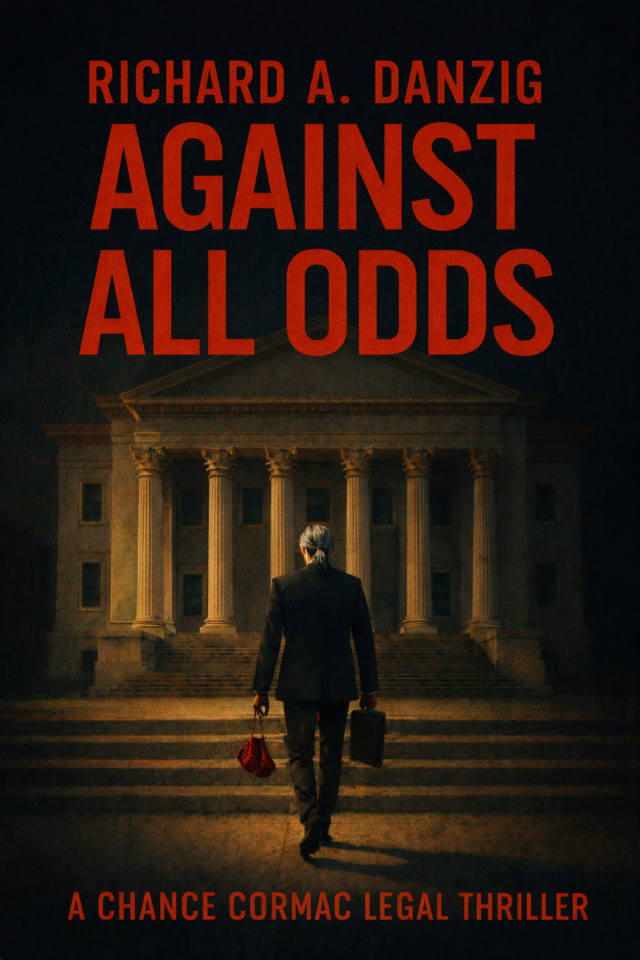
AGAINST ALL ODDS
CHAPTER ONE
“Justice, good to see you!”
“Mornin’, Mr Fogarty. How you been?”
“Excellent. Just got back from Montauk.”
“You catch any fish on your boat?”
“Yes. I catch them and throw them back in. They’re like my clients, eventually they all get caught again.”
Justice laughed. “Ain’t that the truth.”
“What do you hear from Chance?”
“I think he’s doing better. After Costa Rica and Sally’s marriage, he sorta’ lost his direction for a minute. But he’s back on track now. He’s volunteering with the Immigrant Defense Project, filing habeas petitions for immigrant prisoners ICE has imprisoned. Every day he’s in a courthouse in a different state. It’s a calling. I miss him, but I’m happy ’cause Tort’s been living with me ’til Chance finds his way home.”
“I’m not surprised about Chance. We were both educated by Jesuits and they have no patience for despair. I was sorry to hear about JR’s death. He could never quite seem to get a break. How is Damian doing?”
“He’s got a lot of metal holding him together, but he is out of rehab. He’s volunteering at the VA hospital in DC. I don’ worry about Damian. He’s made of the right stuff. So who are the bad guys today?”
“Some hedge fund kids who are too smart for their own good. Stanford and Harvard grads. They met at Goldman. Both investment bankers. Made an obscene amount of money, but for these fucking
“My Moms told me, ‘Greed is not a money issue. It’s a heart issue.’ What are the charges? Insider trading?”
“Sort of. But not in the way you would think. The grand jury returned a twenty-count indictment, including five RICO counts, for fixing games.”
“Fixing games? How did they do that?”
“They’ll be here soon. I’m not too sure. I’ll let these geniuses explain it to us when they get here. I’ve done some research. People have tried to fix games for as long as they could bet on them. They say there are a hundred ways to lose a horse race but only one way to win.”
“Never thought ’bout it, but that makes sense.”
“The Bible says the soldiers rolled dice for Jesus’ clothes after the crucifixion. I read there was cheating in the ancient Olympics. In Greece, if an athlete got caught, he would be publicly flogged. Today? They might get a suspension during the off season.”
“Don’t want to hurt business, I ’spose.”
“And sports are big business. Only the real business of sports today is gambling. When the Supreme Court in its wisdom ruled the prohibition against sports gambling was unconstitutional, the floodgates opened. The guys in the black robes ignored the obvious risks of organized crime controlling online gambling, the possible corruption of athletes in fixing games. The destruction of people addicted to gambling. It didn’t pass the red face test when the Supremes ruled that they had no authority to restrict state gambling.”
“I guess crime pays.”
“Yes, especially my fees. TV shows feature former players, with big smiles and salaries, touting the odds. Everyone is in a March Madness
knuckleheads, a lot is never enough.”
3
pool. College athletes earn over one million dollars a year for
“I never bet. Work too hard for my money.”
“Smart. And you figured that out without an MBA.”
endorsements while the other students lose their tuition money betting
online. Families are devastated.”
CHAPTER TWO
“Lyla, come to dinner!”
“Coming, Ummi.”
Lyla closed the chicken coop door. She had been gathering eggs and feeding the baby chicks. She loved to hold the newborn chicks and ruffle their downy feathers. Even at the age of seven she cared for the helpless babies. Often in the morning her mother would find Lyla sleeping with a small baby chick in her hand.
When she went inside the farmhouse, her father said, “Wash up, Lyla, and we will say our prayers before dinner.”
When the prayer was done, Lyla and her parents said, “Alhamdulillah” and after praising Allah, they sat down to eat. Her mother had cooked her favorite meal, lamb kibbeh served with hummus, tabbouleh and warm pita bread. She basked in the warmth of the fire in the fireplace and the love of her parents.
Her father said, “Lyla, you care for the chicks as if they are your babies. Inshallah, you will have many children.”
“Baba, I know all their names. God willing, I would take care of all the children in the world.”
The farm where Lyla Abda was raised was in the mountains outside a small village in the Iqlim al-Kharoub District of southern Lebanon. Her parents grew olives and figs, as their parents and grandparents had done for generations.
Lyla had stunning features and jet black hair. Her intelligence shone
At dinner, she asked her mother, “Umi, why was our country named Lebanon?”
“Lebanon means ‘white’ and was named after the beautiful snow-covered mountains that we see from our farm. Allah has blessed us by letting us live in a paradise where the land provides for all our needs.”
Lyla’s parents were devout Sunni Muslims. They recited the Quran, and prayed five times a day. When she was a young child, she was taught the verses and found great peace and solace in the daily meditations and prayers. Her family went to services at the beautiful mosque in the center of the Barja village. The domed roof let light wash the curved white walls and the braided prayer mats covering the floor. When the call to prayer rang out each morning and evening, all their neighbors came together to the mosque, to be led by the Imam in prayer. They were more than neighbors, they were a community joined by a common faith and the belief in Allah. As they prayed together Lyla felt the presence of Allah.
Lyla attended the girls’ school at the mosque and the Imam soon recognized her remarkable intellect and dedication to her studies. They explored together the meaning of the Quran and how to live a good life.
Lyla asked, “Imam Rafic, how will I know the correct path for my life?”
in her eyes when she was learning something new. Which she did every day because she was curious and always wanted to know the answer to a new question. Growing up, she loved the beauty of the tiered rows of plants growing on the sides of the hills overlooking the beautiful valleys running to the horizon. She helped with the autumn harvest each year and enjoyed the sweet fruits freshly picked from the trees. Her family was not wealthy but they enjoyed a good life, insulated from the perpetual wars that are the history of Lebanon.
He replied, “Allah will guide you. It is not the path you choose but
They finished each lesson by reading together in Arabic from the Quran, “Who believe in God and the Last Day, who order what is right and forbid what is wrong, who are quick to do good deeds. These people are among the righteous.”
Lyla was an only child and the Imam was impressed with her love of children at such a young age. At his suggestion she volunteered at the orphanage in the village. She comforted the babies and read stories to the motherless children, who she called her little chicks. She studied the words of Prophet who said, “We must love our children because the little ones best understand the language of love.”
She had found her calling. Lyla got a scholarship to the American University in Beirut. There, she enrolled as a pre-med major and knew that she was destined to be a pediatrician. She had never traveled far from her village, but had faith in the path Allah had chosen for her and was not frightened. She was amazed at the tall city buildings sitting on the shore of the beautiful Mediterranean Sea that seemed to change its blue color each day. She immediately found a mosque near the school and attended prayers twice a day. She graduated with honors and attended The University College Medical School in London, along with many other Lebanese students, where she felt comfortable wearing her abaya and hijab. The bright lights of the bustling city did not distract her from her calling. During her pediatric rotation she often went back to the children’s beds in the evening after her shift was over and read stories to them. The children called her Amma, which is Arabic for aunt.
In accordance with the Prophet Mohammad’s instruction that “Every Muslim has to give to charity”, upon her graduation, now a new medical doctor, Dr. Abda volunteered to work with Doctors Without Boarders. She cared for the abandoned of the Third World . She saw a world she did not know existed. Her heart was broken by the pain and suffering of helpless children. Lula now had time to only pray in the evening after her twelve hour shifts. Her prayrt was always the same;
“Allah. please end the suffering of those who are helpless and innocent.”
She wrote an article in English and Arabic for the Journal of the American Medical Association describing the critical condition of children she treated, who were dying from malnutrition in Sudan, Haiti, and the Gaza Strip. Based upon her experience she proposed the establishment of a uniform protocol to treat the many medical complications caused by starvation. The article was well-received and was cited in many leading international medical journals.
After two years of volunteer work, Dr. Abda was offered a fellowship at the Yale School of Medicine, to research the best treatment protocols for malnutrition in children. When she arrived in New Haven, Dr. Abda was surprised to find the school located in a small tree-lined residential community in Connecticut, a far cry from London. There was a Middle Eastern restaurant owned by a Lebanese family a short walking distance from her apartment. She ate there often, ordering her favorite dishes, reminding her of home. She liked speaking in Arabic with the owners about their families in Lebanon. She felt safe and at home in the United States.
Dr. Abda worked at Yale with a remarkable research team that included pediatric cardiologists, neurologists, immunologists and public health experts to address the many medical complications caused by malnutrition. She took great pride in the dedication of her team and the progress of their research.
It was late in the evening when Dr. Abda was leaving the Yale New Haven Children’s Hospital after visiting with a two year old patient suffering from severe malnutrition. .Dr. Abda closed her eyes. She was concerned about the baby, who had been placed on TPN, Total Parenteral Nutrition, which gives nutrition by IV. It was the treatment of last resort and often proved ineffective. She shook her head at the cruel irony that a starving child suffering from malnutrition could no longer eat or drink in a country where food was so abundant.
She was waiting on the sidewalk for her friend and colleague , Dr. Dr. Kumar who often gave her a ride home.
Dr. Abda was tired and lost in her thoughts. She didn’t notice when a woman approached her from the shadows. She was wearing a black abaya and holding her hijab pulled around her face. She appeared like an apparition and said, “Salam Alaikum, sister.”
Dr. Abda was startled but said, “Wa Alaikum Assalam.”
“Sister, are you Dr. Lyla Abda?”
“Yes. Do you work at the hospital?”
“Are you from Lebanon?”
“Yes. Inty min lubnan?”
The woman in black said, “No. I am an American.”
She suddenly turned her back and took off her hijab as she walked away. That was the signal.Immediately a black SUV with blacked-out windows and no license plates pulled up next to Dr. Abda. Four men wearing black military fatigues without any insignias on them jumped out. They wore bulletproof vests and held automatic weapons. Their faces were covered by black bandanas tied in the back, as if they were acting in an old Western. Two of the men in black grabbed Dr. Abda by her arms. One said(:
“Lyla Abda, you are under arrest.”
“What? I am a doctor and fellow here at Yale. Why am I being arrested? What have I done?”
“You have engaged in activities which are a threat to Homeland Security and your visa has been revoked.”
“Revoked? When? I received no notice!” She started screaming “Who are you? Do you have a warrant for my arrest?”
When Dr. Kumar arrived in her car and saw Dr. Abda being restrained, she jumped out of her car and yelled, “Stop! Who are you? What are you doing to Dr. Abda? I am going to call the police.”
Before Dr. Kumar could dial 911, Dr. Abda was handcuffed and a black hood was placed over head. As she was forced into the back of the SUV, Dr. Kamar used her phone to record the masked captors abducting her friend. On the video Dr. Abda could be heard pleading, “Help me! Please! I can’t breathe! Airhamni.”
The black vehicle looked like a hearse as Dr. Lyla Abda vanished into the darkness.
CHAPTER THREE
There are three types of serves in tennis. The flat serve, the slice, and the kick serve. They are equivalent to throwing a fastball, curve, or sinker pitch in baseball. For junior tennis players, learning the kick serve is the most challenging. The server must arch her back, and hit up and on top of the ball so that it rotates and “kicks” up high in the air when it bounces. When done properly, the kick is very reliable and a hard serve to return because it bounces above the “sweet spot” where players can put pace on the ball. It’s almost impossible for a young girl to learn the kick. They’re just too short.
Melody’s tennis coach and biological father was James Stockton, a former professional tennis player. He was the anonymous sperm donor, and natural father, when Melody’s mother Sally decided to conceive by IVF. James was an anonymous donor but when he got cancer and his chemotherapy treatments stopped working, he sued Sally for custody in an attempt to determine if Melody was a potential donor for a stem cell transplant. She matched and Sally agreed, over her first love and Melody’s godfather, Chance Cormac’s objections, that Melody would be a donor, so that James could have a peripheral stem cell transplant, his last hope. Against all odds, the transplant was successful and James went into remission and became part of Melody and Sally’s life. He coached Melody, who became a talented nationally ranked junior tennis player by the time she was twelve.
Chance respected James but that all changed when Sally decided to marry James. She felt that Melody should know her real father and take his name. Chance couldn’t accept this decision and withdrew from their lives.
As is always the case when a cancer treatment inevitably stops working, the cancer was now free to run rampant. James was growing weaker and more debilitated. He had lost weight and although his arms and legs were still tanned, his face was pale. He was losing his stamina and most days trained Melody by standing next to her on the court while she hit with sixteen-year-old boys who rallied with her. When he saw the fierce determination in Melody’s green eyes and her red curls flying as she punished the ball, he appreciated the beauty and poise she had inherited from her mother.
“Dad, I know I can hit it. If I can kick it, the girls won’t know what hit them.”
“Melody, I have no doubt you can learn any shot you want. I think you should wait. It’s not worth the time and brain damage until you grow taller. Even if you can kick it, it will be unreliable, especially in a match. You could hurt your back.”
Melody smiled. “Hey, I have a good coach. He can teach me anything.”
“Okay, wise guy. Let’s talk about it at lunch.
After finishing her hit, and taking fifty serves, Melody packed her bag and they drove to their go to “go to “ lunch spot in Armonk called Nature’s Way.
Melody ordered a protein shake and a grilled cheese.She had stopped eating meat after reading a book called “Eating Animails.“
James got a smoothies and laid out pills in front of him.
Coach, what’s the brown stuff in the baggies?”
“Medicinal teas.”
What do they taste like?”
“Dirt.”
“Can I taste one?”
“Sure, but I warned you.”
Melody tasted one of the teas and made a gagging sound. “No way! How do you drink that stuff?”
James laughed. “It’s an acquired taste. There is a Chinese herbalist in Queens who was trained in Beijing. Chinese medicine is based upon balancing the yin and yang to remain healthy. They’re not really teas. They are made of plants and roots.”
“Will they help you?”
“Probably not. But they won’t hurt anything except your tastebuds.”
Melody drank her protein shake and ate her sandwich, enjoying every bite. “Wow, that was good!” She noticed that James had taken his pills but hadn’t touched his smoothie. “Dad, aren’t you hungry? Are you feeling all right?”
“I’ll save it for later. I’m glad you are getting your protein. Let’s sit together for a few minutes. I have a few things I would like to talk about.”
“My kick serve?”


Comments
Great premise and…
Great premise and interesting characters. I think it needs another edit to catch some grammatical errors, but sounds like a fun book!