
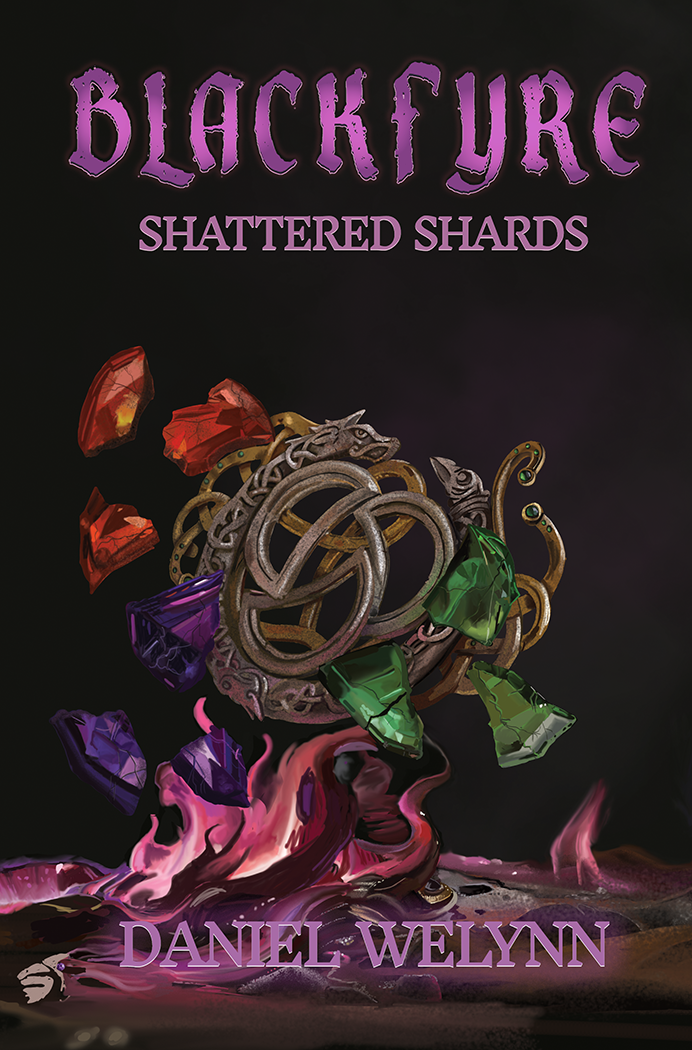
Chapter One
The Walk Home
The fog had always been kind to Branwen. It blurred faces, softened questions, and made it easier to pass for something she wasn’t.
Fifteen. Ordinary. Harmless. The latest lie.
Once, seven had been enough. Then ten. Now fifteen.
The number changed. The hiding never did.
Late afternoon light struggled through the haze, leaving the streets half-empty as Branwen and Daphne walked side by side, their backpacks bumping lightly against their hips. They’d stayed after school—Daphne finishing notes in the library, Branwen quietly pretending to read.
Branwen looked like the fog had chosen her—pale-skinned and quiet, a ghost half pulled from the world she stood in. Her long black hair fell around a gray hoodie and black leggings, red sneakers scuffing softly against the pavement. Her green eyes had obviously seen too much, flicking from shadow to shadow with the wary habit of someone who had spent far too long watching for what might come next.
Beside her, Daphne seemed to carry warmth where the world had gone cold. Her light brown skin caught the fading sun in gold tones, while loose brown curls hung by her face, streaks of purple, pink, and orange flashing through them whenever her head moved.
She wore a black T-shirt beneath a green-and-black plaid overshirt, the flannel sleeves rolled to her elbows. Her green jeans were ripped at the knees, frayed threads brushing against her black-and-white sneakers with every step. Her almond-brown eyes carried one part mischief, one part curiosity—the kind that refused to leave things alone.
“Ms. Castillo gave us another essay,” Daphne groaned, adjusting her bag. “Like she actually thinks anyone wants to write three pages about MacBeth’s ‘interior storm.’” She threw a hand over her heart dramatically, her voice rising in mock anguish. “Interior storm! Bran, I can barely survive algebra, let alone Shakespeare’s emo crisis.”
Branwen smiled faintly, eyes flicking toward her before dropping again. “Maybe she just wants to see who survives the semester.”
“Ha. Then I’m already doomed,” Daphne said, laughing.
Daphne glanced sideways, her tone softening. “We’ve known each other since the first day of school this year, and it’s like I barely know you. You never tell me anything real, Bran. Don’t you trust me?”
Branwen slowed, her breath misting faintly in the cold. “I do.
More than you think.”
Daphne tilted her head, squinting with mock suspicion. “What are you — some secret spy for a shadowy secret society? Or maybe a long-lost Russian princess in hiding?”
Branwen’s lips twitched, her voice low. “Definitely not a
princess.”
But the look that crossed her face was strange — too quick, too close to the mark, flickering through her eyes before she could hide it.
Daphne caught it, brow furrowing. “Seriously. Then why all the mystery? What about your mom? I know you live with your uncle and all, but you’ve never really talked about your parents. At all.”
Branwen hesitated, the fog breathing around them. “I haven’t seen her in…” she murmured, almost under her breath. “Four hundred years.”
Daphne blinked. “What?”
Branwen caught herself instantly, forcing a crooked smile.
“Forever,” she corrected quickly. “I meant forever.”
Daphne snorted. “You’re so weird.”
Branwen’s smile faltered, the ghost of that laugh dying before
it could form. Words snagged in her throat until she forced them out, quiet and uneven. “It’s not you. I’ve never been good at letting people get close. But you…” She hesitated, glancing at Daphne before looking away again. “…with you, it feels different. I’m sorry if I’ve seemed distant.”
Daphne slowed, her expression softening. She bumped Branwen’s arm again, voice quiet but steady. “It’s okay. I get it. Really. But I’m glad you trust me, even if it’s only a little more than everyone else.” She held her thumb and forefinger slightly apart in a teasing pinch, making Branwen crack the faintest smile.
Branwen glanced back at Daphne, a shy smile tugging at her lips. Then, heart thudding, she slipped a small pouch from inside her jacket. From it, she drew the Wayfairer: a silver pendant of Celtic design, its round ends sculpted into a stag with branching antlers, a raven with folded wings, and a hound. Between them gleamed three long crystals — garnet red, amethyst violet, and aventurine green.
Daphne’s eyes widened. “Holy crap, Bran. It’s gorgeous.” She traced the patterns carefully with one finger, making sure not to smudge the stones. “This looks so cool… how old is it? Where did you get it?”
Branwen shrugged, her voice dropping to a whisper. “I don’t know how old it is—or where it came from. I found it in the attic. Bram saw me with it and just told me not to lose it.” She hesitated, then smiled shyly. “I think giving it to you will make sure it’s never lost.”
Daphne shook her head instantly, pushing it back toward her. “No way, it’s yours! Put it away unless you wanna get bipped?
But… can I see it later? Please?” Branwen blinked. “Bipped?”
Daphne smirked, hooking her fingers around one backpack
strap. “Robbed. Mugged. Beaten up. Y’know—bipped.”
Branwen’s cheeks flushed hot with embarrassment for not knowing the word. She nodded quickly and tucked the Wayfairer carefully back into its pouch, holding it close as though it might vanish if she let go. For a moment, the fog seemed heavier. But Daphne’s easy grin and the warmth of her presence kept it from pressing too close.
They kept walking, the silence between them no longer heavy, but fragile — the kind of quiet that could become trust, if either dared to break it. As they turned up the next block, the fog thickened, swirling around their legs like low smoke. The streetlights flickered weakly above, halos of gold dissolving into gray.
Daphne grinned. “You know, if I didn’t have you to walk with, I’d probably be murdered by now. This fog is giving total ghost movie vibes.”
Branwen glanced at her with a quiet smirk. “You’d talk the
ghost to death before it got the chance.”
“Facts,” Daphne said, bumping her shoulder. “I’m way too charming to haunt.”
Their laughter lingered in the mist, warm and human. Then Branwen slowed.
They passed a row of darkened shopfronts that looked abandoned but still caught passing lights. In one, a cracked mannequin leaned behind dusty glass, its painted eyes staring blankly at the street.
Branwen’s gaze caught the reflection — her own outline beside Daphne’s, blurred by fog. But behind them, faint and distant, something else moved.
At first glance, the two at the front looked like children no older than eight or ten. The longer Branwen looked, the more wrong they seemed.
One wore a coat that dragged at her ankles, too big for her narrow frame. Her hair hung in wet strands over her face, and when she tilted her head, her smile curled thin and uneven — as though she had learned it from watching someone else.
Beside her perched a boy on the rim of a dumpster, knees drawn up to his chest. His limbs were spindly, brittle as sticks, his hollow eyes fixed without blinking. He might have passed for no more than a child — if not for the way his stare clung like cobwebs.
Behind them stood a taller figure: a girl’s outline at first glance, jagged pink mohawk bristling against the fog. A shredded tutu sagged over ripped tights, boots bound with coiled wire biting into the leather. In her hands dangled long loops of wire, whispering against themselves with each shift of her grip. She tilted her head ever so slightly, as if weighing and choosing, her smile calm, assured. Her fingers tightened once on the wire — a small, deliberate flex, like a promise.
Branwen blinked. The glass cleared — and they were gone. She swore she could hear laughter.
“Hey,” Daphne said softly, noticing Branwen had stopped. “You good?”
Branwen hesitated, forcing her voice to steady. “Yeah. Thought I saw… never mind.”
“You sure?” Daphne asked.
Branwen nodded, pulling her jacket tighter. “Let’s just get home.”
And behind them, in the still reflection of the darkened glass, something stirred once more — not moving forward but waiting. Watching.
And smiling.
Chapter Two
Daphne’s Apartment
The stairs groaned as the girls climbed, narrow and uneven, the sound echoing faintly up the old Mission District building. The air smelled faintly of sea salt and old plaster. Somewhere below, a television murmured in another apartment — a low, steady noise that made the silence between them feel thinner.
Inside, the apartment was warm but cluttered. Nautical charts covered the kitchen table beneath a battered laptop, coffee rings marking continents that didn’t exist. Several were working charts—depth soundings circled, current lines penciled in, their margins crowded with Elaine’s notes. On the laptop, a half-finished oceanographic survey glowed beside layers of coastal maps. Elaine had spent years turning depth, tide, and current into something other people could navigate. She sat there, her red hair pulled loosely over one shoulder, glasses sliding down the bridge of her nose.
She looked up from her screen as they entered — tired, but smiling. “Hey, sweetie,” she said softly. Then her gaze shifted to Branwen. The weariness melted for a moment. “Hi, Branwen.”
“Hey, Mom,” Daphne said, slinging her backpack off one
shoulder. “We’re gonna hang in my room for a bit.”
“Of course,” Elaine replied, brushing a curl from her face. “Just try not to make too much noise, all right? I’m trying to finish this report before dark.”
Daphne grinned. “Got it.” She was already pulling Branwen down the hall before Elaine could add anything else.
Daphne’s room was a kind of beautiful chaos — glowing monitors casting blue light over a battlefield of books, tangled cords, and crumpled clothes. Posters curled at the corners, half-fallen, their colors dulled by time. A faint hum came from somewhere — a fan, a computer, maybe both.
Daphne flopped onto the bed with her usual ease, chin resting on her folded arms. Branwen perched on the edge, her posture stiff and careful, the mattress dipping beneath her.
Daphne turned toward her, eyes bright. “Okay, Bran. Can I see it again? Please?”
Branwen hesitated — just a heartbeat — then reached inside her jacket and pulled out the small pouch. She unwrapped it with reverence, like she was afraid of the air itself touching what lay inside. “Of course,” she murmured. “I wanted to give it to you anyway.”
Daphne lit up, sliding off the bed to tug her desk lamp closer.
Its amber light pooled across the wooden surface. She set the Wayfairer beneath it, tracing the stag’s antlers, the curve of the raven’s wings, the carved hound at their base. “It’s so intricate,” she breathed. “I wonder how old it is.”
Branwen didn’t answer. The lamp’s glow caught dust motes drifting through the air — except they weren’t drifting right. They spun too slowly, twitching midair as though something unseen brushed against them. The light trembled.
The corners of the room deepened, the shadows thickening into shapes that shouldn’t have had depth. The air cooled, the kind of cold that crawled up the spine instead of across the skin.
The desk lamp flickered. The air pressed close. Somewhere
beneath the sound of their breathing came a faint, rhythmic creak
— wood bending under a weight that wasn’t there.
Her skin prickled. The posters on the wall rustled like leaves, though the window was shut.
“Girls?” Elaine’s voice cut through from the kitchen. “Do you want me to make something before I head out?”
Branwen flinched. The sound was too loud, too sharp. Daphne
looked up, oblivious to the tremor in her friend’s face.
“I—uh, yeah, thanks!” she called back. Then, turning to Branwen, her brow furrowed. “You okay? You look kinda pale.”
Branwen forced a breath. “I just… need a minute.
Before Daphne could ask, Branwen slipped off the bed, her footsteps whispering across the old boards as she made for the hall. She shut herself in the bathroom and leaned against the sink, her pulse hammering.
The mirror caught her reflection — wide green eyes, pupils blown, hair clinging to her temples. Her hands shook as she fumbled her phone out of her pocket.
She dialed Bram.
The call clicked, static whispering in her ear. “Something’s wrong,” she breathed. “I can feel it.” The line went dead.
Branwen shoved the phone back into her pocket and pushed open the door — only to nearly collide with Daphne.
“Bran, what’s wrong?” Daphne whispered, clutching the Wayfairer to her chest like a lifeline.
Branwen shook her head, her throat too tight to explain. “We need to get to your mom. Now.”
They ran.
The hallway seemed longer than before — the shadows thicker, clinging to their legs like smoke. The air grew heavy, humming with the faint sound of wires under strain.
When they burst into the living room, Elaine looked up from the table, startled by the panic in their faces. “What on earth—” She didn’t finish.
The air behind her shimmered — just a ripple, like heat distortion. Then the charts on the table began to curl, their ink bleeding into spreading black lines. The laptop screen flickered, and went dark.
A breath — cold and ancient — slid through the room.
Branwen froze. She felt it before she saw it: something vast, unseen, brushing the edge of her mind like the sweep of a tide.
Daphne’s fingers tightened around her arm. “Bran…”
Elaine stood slowly, eyes darting toward the window. “Girls,” she said, voice suddenly steady, too calm. “Get behind me.” The apartment lights dimmed to nothing.
And somewhere inside that silence, a whisper crawled through the dark — soft, patient, hungry.
The window by the sofa didn’t just break — it screamed.
The sound tore through the room, a living shriek as glass burst inward in a spray of silver shards. They rained across the carpet like thrown knives, scattering light and dust into a storm.
Elaine stumbled back from the table, hand to her chest. Daphne cried out, instinct pulling her toward her mother, while Branwen
— caught behind them — fought to move forward, heart pounding. There was no space to run, no time to think.
The air shifted.
It thickened, became wet, heavy, almost viscous — a pulse of rot and iron spilling in through the shattered frame. The fog didn’t crawl; it poured, curling low along the floor like a living tide.
Shapes formed within it. Three of them.
At first, they looked like lost kids — strays from the street, shadows given shape. A girl in a tattered tutu. A boy crouched low. Another behind them, too still, too calm. But the longer the light touched them, the less human they became.
Their disguises peeled back like melting wax. Glamour died screaming.
The stench hit first — not simple rot but the deep, oceanic reek
of drowned things, old graves, and wet rust.
The first creature was small, feral, her skin the color of drowned
moss stretched too tight over bones that wanted out. Her grin was split wide — crooked, hungry — and from her hands jutted knives that were part of her, grown instead of forged, bone fused to corroded metal. They clicked when she flexed, a sound like
insect mandibles. Her eyes were pits rimmed in red, gleaming with delight.
Beside her crouched something thinner — a boy, or what might once have been. His limbs bent backward, his skin fissured like bark. His smile stretched too far, splitting his cheeks until
it seemed he might come apart at the seams. His shadow moved wrong, crawling up the walls even when he stood still.
And then the last stepped through the broken frame — slow, deliberate.
The air changed around her. The Fourth Handmaiden.
Her jagged pink mohawk caught the dim light like a crown of rusted thorns. The tutu hung in tatters over shredded leggings, black as soot. Wire coiled around her boots, biting into pale flesh. In her hands dangled something grotesque — a Kyoketsu-Shoge of wire so thin it shimmered when it moved, studded with razors that flashed in the light. An iron weight spun lazily between her fingers, whispering against her palm.
She didn’t rush. She didn’t need to. She simply tilted her head—
and the room filled with the promise of pain.
Elaine froze in the doorway, knuckles white around the edge of the counter. Daphne’s hand found Branwen’s arm, fingers digging in, trembling. The air pressed down, ancient and expectant, as if something unseen had paused to listen.
The feral girl — Jonni — bared her teeth in a grin too wide for her face. “Hiding behind humans,” she hissed. “Hand over the Wayfairer, and maybe I’ll let your pet live.”
The room went still. Branwen’s brow furrowed. Her voice was low, careful. “The Wayfairer?” she asked, pulse quickening. “I don’t know what that is—”
Then she took a step forward. The hesitation cracked, replaced by something harder, brighter. “You are not touching my friends.”
The Fourth smiled. A small, knowing curve of her lips. Her
wrist flicked once.
The iron ball blurred through the air.
It struck Branwen square in the ribs — a dull, brutal crack — and the world tilted. She slammed into Daphne, knocking the breath from both of them. The Wayfairer slipped from Daphne’s hands.
The pendant hit the hardwood with a sound like a bell tolling underwater.
The stag, raven, and hound blazed — garnet red, amethyst violet, aventurine green — each light bleeding into the next until the room was drenched in color.