

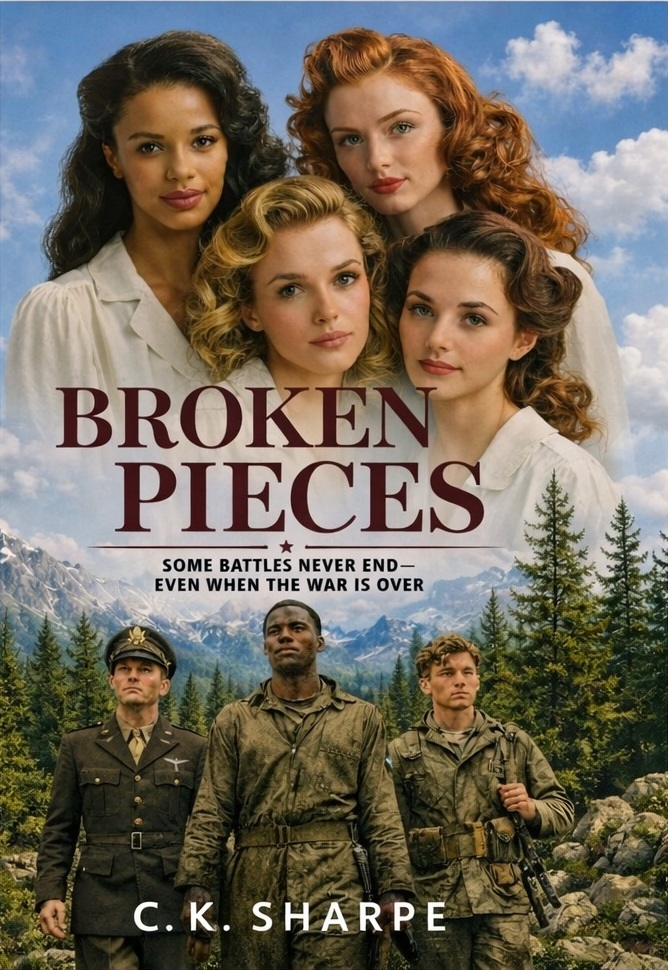
BROKEN PIECES
IN MEDIA RES
Jack Delaney―Phoenix Islands―Fall, November 21, 1943
The first Marine Jack Delaney saw die at Tarawa didn’t have time to scream.
Gunfire’s sharp crack split the air, a flat, metallic sound ripping across the bow. The young man crumpled instantly, folding as if a puppet whose strings were brutally severed. Silence descended, a void where a scream should have been. The sickeningly wet thud of his body striking the steel deck vibrated through Jack’s ribs, a final, heavy punctuation mark.
Jeez... He was eating eggs a few minutes ago. He was laughing.
Jack’s fingers locked around the rail, knuckles bone‑white, as the Higgins boat bucked under them. Ahead, the shoreline boiled with smoke…raging, indifferent, and hungry. A place that didn’t care how young you were or how many letters from home you carried in your pack.
“Down,” he shouted, but the engines shredded the word, turning it into a useless vibration in his throat. Shells slammed into the water, throwing walls of spray against them. Smoke crawled low and oily, burning his eyes, coating his tongue with a metal taste.
The reef caught them with a grinding jolt. Men lurched. Some cursed when the ramp clanged open too soon.
Chest‑deep water swallowed them.
For a heartbeat, everything held, men, sky, sea, as if the island itself inhaled.
… then hell exhaled.
Jack and the squad pushed ahead. Jack’s boots crunched on the sharp coral, it cut at his boots, while the icy water squeezed at his lungs. Men thrashed beside him, rifles overhead, packs dragging them under like hands from the deep. Rounds cracked into the surf. White spray exploded. Red mist bloomed and vanished. The ocean churned with pieces of men who’d been alive seconds ago.
A mortar burst to his left, a blinding flash followed by a concussive boom that slammed into him. The shock wave, a physical blow, punched his ribs, shoving him under the water. It stole his breath, and the sharp sting of salt scorched his raw throat. When he broke the surface, gasping, the chaotic world had narrowed to a single, piercing, high-pitched ring that vibrated in his skull. Yet, despite the ringing and the cold, he felt expectation settle on him. He still had to lead.
Chunk Patterson, beside him, fired in tight bursts, his face streaked with sweat and fear making him look older. Baxter O’Malley slogged on his other side, gripping the map case as if it was the only thing keeping him tethered to the world.
A Marine cried out. Jack lunged toward him and grabbed the Marine by the collar…dragging him toward a half‑submerged log. Blood spilled against Jack’s thigh, blooming pink before the waves tore it apart. The Marine’s eyes were glassy.
The ocean doesn’t care. None of this place cares.
The leader… gone. He counted. Six men left from the squad. His pulse hammered against his skull. The weight behind him wasn’t gear; it was the eyes of boys who needed someone to follow. And the terrible truth was he was the one still standing.
He raised his rifle.
“Next bunker. Move it—”
They burst from the water and drove for the beach. Sand erupted around them as rounds tore it open. The air turned hostile with the oil stinging his throat, smoke scraping his lungs, and the copper taste of blood thick on his lips. Heat and grit pressed against his skin. Jack’s hands shook and he forced himself to stop shaking.
Baxter opened the map, the paper soft with sweat and seawater. Jack leaned over it, finger tracing their next move while grit clung to his palms.
He didn’t feel like a leader. He wasn’t yesterday. He was a farm kid now standing where a man should be.
“We keep going,” he said. “Bunker to bunker. ‘Til we get a foothold.”
They moved. Gunfire rose. Sand kicked upward. Voices cut through the smoke.
And somewhere in the chaos, though Jack didn’t know it yet, a bullet already found his name and was cutting its way toward him.
Chapter 1
The Corner Stones
Jack Delaney―Perry County, IL―Spring, 1940
The rooster’s crow knifed through the predawn hush of the Delaney farmhouse.
Jack Delaney jerked awake, muscles stiff from yesterday’s work. For a moment he stayed still, staring at the cracked plastered ceiling, letting the ache settle into him the way it always did… deep, familiar, and inescapable.
The rooster crowed again.
“One of these days, Old George,” Jack muttered, “you’re gonna be dinner. But I won’t be here to witness it. I’ll be gone before your feathers fly.”
His gaze fell on the worn, flimsy Farmer’s Almanac on the nightstand, its binding nearly broken. Every year when Pa received the new pamphlet he and Jack walked the fields. Pa pointed to its pages and speculated how to tend the fields using the pamphlet’s predicted weather. Pa never failed to point out the barns and remind him, “It’s a tradition for each Delaney generation to add fresh layers of red paint to those barns. It’s our legacy, roots and duty, Jack.”
As Jack turned onto his shoulder, he groaned. His mind churned the residual ache from his mother’s cutting remarks the night before. Her harshness echoed in his mind as she berated him over nothing and everything. He wasn’t sure which hurt worse: the muscles pulled tight from work, or the way her disapproval lingered long after the house went still.
He pushed aside the gunnysack curtain and wrestled the window open. The frame resisted, and paint peeled beneath his fingers. His reality drifted along with the smell of damp earth and cow manure seeping through the cracked window frame.
A rush of early morning wind carried the scent of rain. He leaned into the sill, arms braced, shoulders broad from years of hauling hay and driving posts. He knew what people saw when they took notice of him: a strong, steady, dependable boy. Girls at Perry High whispered sometimes when he passed, but romance was meant for other boys with time and choices. But high school belonged with memories of the past.
Jack scanned the horizon. Pa said the world was changing. He said it with a matter‑of‑fact certainty whenever the world felt to big. Trouble overseas. War in Europe. Jack noticed Pa was speaking of it more often.
A week earlier at Ray’s Feed & Supply, he overheard Ray talking in hushed tones with a man he called Neal. Draft rumors. Lists being drawn. Boys leaving town in uniforms he hoped still fit them by the time they came home. Pa figured every Perry family sensed something was shifting under their feet.
His pulse kicked hard against his ribs. “Soon,” he whispered, not sure who he was speaking to… the sky, the fields, or himself. “Soon it’ll be my turn to fly.”
From the open window, the same wind stirring Jack’s room, was sweeping across the yard, bending the grass around Ma’s ankles. King’s tail thumped against the dirt waiting for the food scraps Ma carried in her hands.
Ma’s steps were clipped as she walked back to the house, carrying the weight of her life on her shoulders. Ma gave her youth to this place; all her early mornings and late nights, year after year. Her hand brushed a loose strand of graying hair from her face. She’s done that a thousand times without thinking. Duty shaped her more than choices.
Ma’s voice echoed in his head. ‘Before the sun scorches the earth, farm boys rise early to tend their chores.’ He was sure she’d invented the saying.
Jack exhaled, stepped back from the window, and reached for his clothes in the small pantry converted to a bedroom. Ma considered the space ‘good enough’ for him… close to the back door, close to work. He pulled on his jeans, stiff with yesterday’s sweat, and shoved his socked feet into his boots.
The radio crackled the moment Jack stepped into the kitchen. He caught snatches of words slipping through the static… conflict… draft… uncertainty. The world was pressing into their small, rural town.
Pa sat at the table with his hat resting beside his plate, posture loose with the same steadiness Jack was accustomed. Jack curled his fingers around his coffee mug and let his gaze settle on the family.
Ma moved at the stove with sharp, deliberate motions. The eggs sizzled, edges crisping too fast. She always burns them. Jack sighed as the tin spatula slammed against the pan, the sound cracking through the room like one of her reprimands.
“Jack,” she snapped, “you’d better get the sagging fence wire tightened in the side pasture. And, clean out the shelter before the sun turns this place into Hades.”
“I know.” Jack met her eyes, jaw tight. “I’ll get it done.” Never enough. He could fix every fence on the property, and she’d still find fault. The wire would sag again by next week.
Allen and Andy tore into their biscuits, butter knives scraping chipped porcelain. Pa watched them from the end of the table, his narrow frame bent by decades of labor, his blue eyes sharp with pride and expectation.
Ma filled the twins’ plates first, giving them the best portions. Bitterness settled in Jack’s chest. His turn. He chewed, the crunch loud in his ears, and pictured his married sisters… Emma, Nancy, and Eva… burning the whites of eggs in kitchens of their own, same as Ma.
Pa’s fingers brushed the dent in the table as he spoke. Jack remembered at seven years old, clutching a hammer too big for his hand, determined to help. Pa’s praise landed like sunlight.
Jack pushed his chair back. Its legs scraped loud against the worn floorboards. He hitched his pants… a nervous habit he’d never broken.
“I’m going to be the first Delaney to leave this farm,” he said.
Pa lifted his eyes from his plate. “This place is our legacy, Jack. It’s what we stand on,” he said. His voice sounded proud and matter-of-fact.
Jack’s fingers tightened around his mug. “Maybe I’m after more than standing still, Pa. Maybe I want to see what’s past the county line.” The words tumbled now, pulled from somewhere deep. “The fences, the fields, the name… there’s a weight to it. I can’t carry it the rest of my life.”
A gust of wind rattled the windowpanes, as if the house itself bristled at Jack’s news.
Ma set her fork on her plate, her voice thin but firm. “Independence isn’t all it’s cracked up to be. Times are lean. There’s talk of war spreading overseas. You’re lucky to have steady work and a roof.”
“I don’t want the farm,” Jack said. “Let Allen and Andy take it on.”
Pa’s jaw released the smallest tell of disappointment before he smoothed it away.
“Allen. Andy. Go on upstairs,” Ma ordered. The twins took off, their footsteps taking the stairs two at a time, eager to escape the tension thickening in the kitchen.
“Don’t be foolish, Jack,” she said. “Jobs are scarce. Town folk are expecting conscripted boys will be called into service this fall. … can’t wait for it, huh? You think the world is waiting for you with open arms?”
Jack swallowed. “Ma, did you ever enjoy farming?”
The question hit the table harder than any slammed fist.
Pa pushed his chair back, the scrape sharp in the quiet. “That’s enough,” he said. “Daylight’s wasting. Let’s get to work.” The words settled over the kitchen; inevitable and impossible to sweep away.
Jack stood, the weight of Pa’s silence clinging to him. At the door, he paused. Behind him lay duty, disappointment, and his life mapped out for him. Ahead promised the same: heat, labor, and the ache of wanting more than this place ever allowed.
Jack stepped into the Illinois spring morning and the air hit him first. The coolness revitalized the parts of him that the coffee had failed to awaken. Under the waking sky, the fields stretched in endless rows, in an order imposed on the land by generations of Delaney’s.
The cows were already bawling, long, impatient cries rolling across the yard like they meant to shove him into motion. He rubbed the heel of his hand across his eyes, grit and sleep still clinging there, then hitched his pants and started toward the barn.
May and June didn’t care if a man was bone‑tired. The months came on like a fist. Wheat heads already heavy with dew. Alfalfa sweet and sharp in the air. The kind of morning where the sun wasn’t even awake but the work was.
He swung the barn door open; the hinges groaned louder than he did. Warm, animal‑thick air rushed out, smelling of hay, manure, and the sour tang of yesterday’s sweat. He grabbed the scraper and set to clearing the stalls. The metal rasped against the straw-filled dirt, each pull sending a tremor up his arms. His shoulders burned by the third row.
Feed sacks waited next; heavy canvas that bit into his palms no matter how he shifted his grip. He hauled them one by one, boots slipping in the straw, breath puffing in short bursts. A gate sagged off its hinge, so he wrestled it upright, shoulder braced, jaw clenched, the stubborn thing fighting him like it had a mind of its own.
By the time he finished one job, another leaned in, tapping him on the shoulder. Sweat soaked through his shirt even though the morning still held a chill. His muscles felt carved out of the work.
In town, he had caught his reflection in the feed‑store window: Auburn hair, broad shoulders, thick forearms, and a jawline he didn’t remember earning. The farm was shaping him, whether he wanted it to or not.
The rising heat pressed in on Jack. With a determined grunt, Jack seized the wire stretcher. His eyes burned with sweat and his jeans clung damply to his waist. He used the wire-stretcher to push and pivot around the post until the wire was tight. He grabbed a square nail to secure the wire.
Pa’s tractor rumbled along the fence line toward him. Dust rose behind it in slow, choking clouds. Jack paused and watched his father’s hunched posture, moving as if the land carved him to fit its shape.
Am I betraying him by refusing to disappear into the same ground?
Pa lifted a hand. “I’ll tackle the stump in the front field. You finish here with the fence.
Jack nodded. The clang of the hammer rang sharp in his ears, and each strike reminded him of the life he was expected to inherit.
Near midday, the cast‑iron triangle rang out a warning from the porch. It sounded sharp, urgent, and wrong. The sound sliced clean through him. Jack’s heart slammed against his ribs. He dropped the hammer and ran. He stopped short. Blood streaked the metal side of Pa’s tractor. Dark. Wet. Unmistakable.
Ma was already running from the garden, carrots and beans spilling from her apron. “What happened?” Her voice cracked on the last word.
“Andy got run over,” Allen blurted. “Pa took him to the doctor.”
Ma’s face drained white as she drew a sharp breath. “What were you boys doin’ near the tractor?”
Allen’s finger shot out, quick and sure. Jack felt the blame hit before the words formed.
Ma turned on him. “You left them alone with the tractor running? What were you thinkin’?”
“I was working the side field,” Jack’s hands curled into fists. “I can’t be everywhere.”
Allen folded his arms. “Not my fault. He’s supposed to watch us.”
Jack rounded on him. “You’re old enough to know better.”
“Allen,” Ma snapped. “Go to your room.” The twin didn’t hesitate.
The belt hung on its hook inside the screened porch. Jack didn’t flinch when Ma reached for it. The leather cracked across his back hot and blinding. He bit hard, refusing to make a sound. The blows were fast, with harsh words landing between strikes.
Later, he lay on his narrow bed staring at the ceiling. His back burned, and drops of blood coated his tongue where he bit to suppress the pain.
“Why can’t Pa wear a belt instead of bib overalls?” he muttered.
Pa’s words pressed through the silence. If you children misbehave, it reflects on Ma. Farmer’s wives take care of the child rearin’. That’s the way it’s been, and reckon that’s the way it will stay.
The house answered with its own tired groans, boards settling and pipes ticking. The whole place was closing around him: the land, Ma’s voice, and the rules he’d breathed his whole life.
“Enough,” Jack whispered into the dark.
By morning, a subtle change occurred within him. His decision moved beyond thought and into bone. For the first time, the farm legacy didn’t feel like the stinging welts left by his mother’s rough, calloused hands wielding Pa’s belt.
It was the place he was already stepping away from.
Chapter 2
Thunder Comes Disguised
Titus Williams―Perry County, IL―Spring, 1940
White folks stepped off the curb without looking, drifting in front of the truck as if he wasn’t there. One man waved lazily for Titus to slow, as if Titus were the one in the wrong. Titus eased his foot off the gas, jaw tightening. Some days it was as if the whole town pressed a hand to the top of his head, keeping him submissive.
He crept along Main Street, the old truck rattling over ruts. His sweaty shirt clung to his back. A woman with a basket glanced at him, before stepping directly into his lane. Titus tapped the brake, the truck lurching. She never turned her head.
Above the storefronts, starlings burst from a telephone wire... a sudden black shimmer. They wheeled hard left, carving the sky like they owned it. Titus let his eyes follow their sweep. They were unburdened. Free in a way he couldn’t imagine.


Comments
This has a terrific hook,…
This has a terrific hook, jumping right into the action. It's very well written, drawing the reader into the story so we feel as if we're there. Great job.
Broken Pieces... reply to Jennifer's comments
In reply to This has a terrific hook,… by Jennifer Rarden
Thank you for your kind comments, Jennifer. You put me on cloud nine and made my day perfect! Blessings to you and yours, Cheryl.
The submission creates a…
The submission creates a vivid setting with strong emotional stakes and immersive action.
Broken Pieces...reply to Falguni's comment
Wow! I feel like the luckiest woman/writer/dreamer/wishful-thinker in the world. Thank you so much for your comment, Falguni. Blessings to you and yours, Cheryl.
A very engaging excerpt. The…
A very engaging excerpt. The powerful hook delivered immediately like a killer punch. It's not easy to re-create an experience we can never have but the writer does it with realism and shocking clarity. We've all seen the appalling newsreels. What comes after provides the perfect relief for the reader and allows us a moment for reflection and wonder at what comes next. Excellent.