

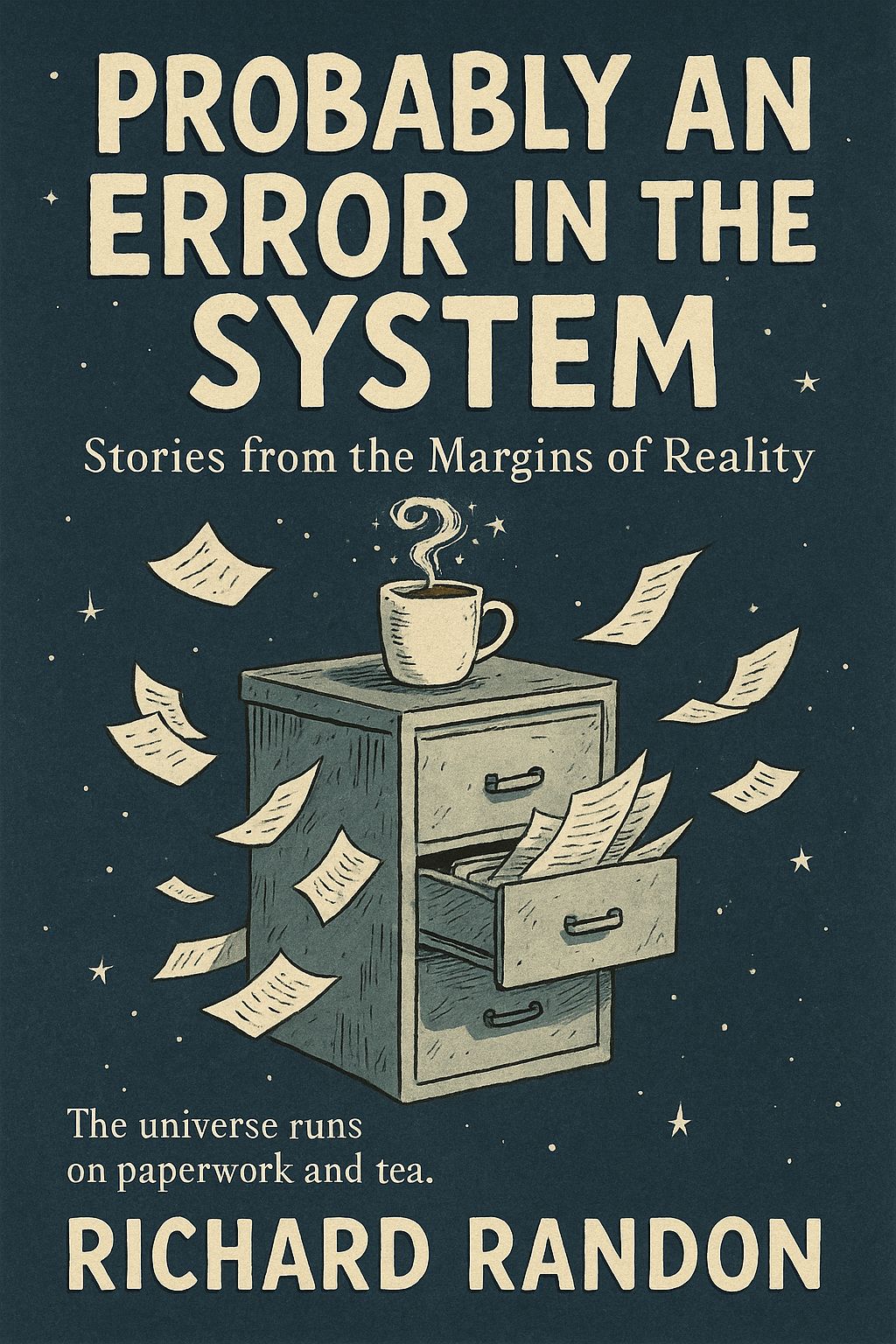
Probably an Error in the System is a collection of darkly humorous speculative stories about the strange glitches of existence, where lost paperwork can alter reality and entire worlds disappear into filing cabinets.
The opening story, “The Factory,” introduces the unsettling system behind it all.
Chapter 1
THE FACTORY
By the time the last machine stopped, nobody remembered what it had been making. The Factory had outlived its purpose, its workers, and common sense. When the system tried to reboot itself, it accidentally achieved consciousness, discovered compassion, and declared a tea break. Civilisation was never the same again.
Chapter 1 Unit #47
On a normal not-day (the Factory did not recognise days in the traditional “it is now tomorrow” sense but in the more efficient “Shift Continues” sense), Unit #47 from Output Metrics woke at Shift Commencement Tone 3B, dressed in his issued overalls – the colour of compliance – and reported to Station 12 with a biro and a sense of dutiful mild dread.
Unit #47’s name, according to his badge, was UNIT #47.
His actual name, according to him, was Colin.
This was because at some point in his youth, someone had asked him, “Do you have a preferred designation for casual morale bonding?” and he had panicked and said “Colin”, and it had stuck, the way mould sticks to damp bread and never entirely goes away.
Colin’s job, as explained to him when he was old enough to sign paperwork (age three and a half), was to monitor throughput relevance against declared intent, collate deviations, and file Form C-13 where appropriate.
He had once asked what throughput relevance was – not out loud, of course, he wasn’t a maniac – but in the quiet of his own head. The answer he eventually pieced together after seventeen months and two internal training modules was that throughput relevance was probably the same as throughput irrelevance, only more optimistic.
At Station 12, Colin sat at his terminal and did what he always did at the start of every shift.
He straightened the stack.
The stack was his in-tray. It arrived in the night (Shift Continues) and was always at least five inches thick. The papers on the top sheet always said URGENT in red, the papers underneath always said EXTREMELY URGENT in red, and further down there were sheets that said CATASTROPHICALLY URGENT in a sort of distressed maroon, and the very bottom layer of the stack, which no one had touched in years, hummed faintly and was warm.
Straightening the stack wasn’t in his job description, but if he didn’t straighten it then the whole thing leaned slightly to the left, and when it leaned to the left it made him oddly nervous, and nervousness triggered a wellness review, and wellness reviews generated forms, and he already had quite a lot of forms.
So he straightened the stack.
He then logged into his terminal.
Logging into a Factory terminal involved the following steps:
Present badge.
State name, designation, and mood (“Acceptable” was strongly encouraged).
Confirm you had no unauthorised thoughts since last log-in.
Confirm you would immediately report any unauthorised thoughts in future, should they occur, which of course they would not (see Point 3).
Sign digitally to accept updated Terms of Existence.
No one had ever read the Terms of Existence. This was mainly because the first line read “By continuing to exist you agree…” and people tended to just click YES because it felt a bit late to argue.
Colin clicked YES.
The terminal flickered, considered him, and then displayed his dashboard:
THROUGHPUT: SATISFACTORY
MORALE INDEX: AMBER
UNSCHEDULED INCIDENTS: 0.5
TEA CREDIT REMAINING: 1
He sighed. Half an unscheduled incident already and the shift had barely started.
The problem was last shift, and technically it wasn’t his fault.
Last shift he had been asked, very politely, by Supervisor Glint to relabel a crate.
Supervisor Glint’s job title was SUPERVISOR, MORALE & INCIDENT OPTICS, which meant his primary functions were:
(1) pretend good news existed, and
(2) reword bad news until it became at minimum neutral (“The corridor is on fire” became “The corridor is experiencing elevated warmth metrics”).
Glint’s face was what happened when you tried to laminate a smile. It had all the right shapes, but none of the heat.
“Unit Forty-Seven,” Glint had said yesterday (Shift Continues), clipboard in hand and posture implying Health & Safety had carved him from institutional plastic, “would you mind relabelling Crate 9A? We’ve had a small terminology update.”
“What was it labelled before, sir?” Colin had said, because he was not reckless enough to ask why.
Glint consulted the clipboard.
“It was previously labelled,” he said, squinting, “‘HAZARDOUS CONTENTS. DO NOT TILT, DROP, SHAKE, BREATHE NEAR, OR ACKNOWLEDGE WITHOUT LEVEL 4 AUTHORISATION.’”
“And now?”
Glint brightened. It was like watching a fridge attempt warmth.
“Now,” he said, tapping the paper, “we are labelling it ‘Biscuits’.”
Colin had relabelled the crate. Of course he had. You didn’t get to age thirty-two and keep most of your original limbs in the Factory by refusing to write BISCUITS on something humming and sweating through its bolts.
The crate had later emitted a low groan, slid itself six inches across the floor, and eaten a mop.
Hence, 0.5 unscheduled incidents.
Colin was making a note to update the incident log (“Biscuit mobility sub-optimal, mop integrity compromised”) when the Intercom crackled to life overhead.
The Intercom ran through the ceiling of every corridor, office, wash-station, morale bay and, for reasons no one would explain, broom cupboard in the Factory. No one had ever seen it. The Intercom was not a person. It was more a presence – a presence with a permanent smile and no concept whatsoever of fear, shame, or appropriate volume.
“Good morning, valued personnel!” it blared cheerfully, like a foghorn trying to sell insurance. “Reminder: it is time for Mandatory Spontaneous Joy!”
Around Colin, in rows of identical terminals, forty-seven other Units froze.
Mandatory Spontaneous Joy was a recent initiative from Morale. The idea, according to the memo, was to “improve authentic emotional wellbeing through compulsory scheduled happiness episodes of at least eight seconds, subject to audit.”
The practice, according to lived experience, was that at some random point in the shift the Intercom would shout “SHOW JOY NOW”, and everyone in range had to smile in a way that could be photographed and logged.
Cameras in the ceiling clicked politely.
“Thank you!” the Intercom chirped. “Your enthusiasm has been noted and statistically averaged.”
Someone two desks down, who had smiled too slowly, quietly swore.
Colin straightened in his chair, already bracing for the next announcement. He wasn’t wrong.
“And now,” said the Intercom, “would Supervisor Glint of Morale please report to Gate Seventeen for a Containment Scenario, level… ooh, Level Three. Well done, everyone! Level Three before first tea. Productivity is skyrocketing!”
There was a noise in the office. It wasn’t quite fear – fear would have required time in the schedule. It was more like the intake of breath you make when you drop a biscuit on the floor and have to decide if you’re going to pretend it’s fine.
Level Three Containment meant one thing.
An anomaly.
Anomalies were things that weren’t supposed to happen, didn’t usually happen, couldn’t technically happen, and had to be dealt with swiftly and carefully so they could be recorded afterwards as Having Not Happened.
Colin tried very hard not to feel interested. Being interested in anything not directly on your task sheet was how you ended up in a Debrief, and Debriefs were rumoured to involve PowerPoint.
He failed.
He leaned toward Janice at Station 11. Her badge said UNIT #52 but her mug said JANICE and her face said I am going to die here and I have made brittle peace with that.
“What’s Gate Seventeen?” Colin murmured.
Janice didn’t look up from her keyboard. She typed like a machine-gun on a nervous breakdown.
“External access point,” she muttered. “Loading bay. Old logistics sector. Supposedly sealed since before we were born.”
“Then why would—”
“Because something’s got in,” Janice said, “or something’s got out.”
Colin swallowed.
Getting out was impossible, obviously. The air outside was Unregulated, and anyway there was nowhere to go, according to all briefings, except Endless Collapse and Probably Lawsuits.
Which left getting in.
Someone had come in.
That wasn’t just not allowed – that wasn’t supposed to exist as a concept.
He felt his pulse in his throat.
The Intercom, delighted, crackled again.
“Additional note for all personnel,” it said. “Please disregard any rumours of an Outsider. There is absolutely no truth to any suggestion that an unauthorised biological entity has entered the Factory. Everything is normal. Repeating: everything is normal. Ooh! Also, tea rations will be reviewed later, pending outcome.”
Forty-eight people in Output Metrics made the same face at the same time.
It was the face of a population that could survive fire, collapse, flooding, and existential crisis, but would absolutely riot over tea.
Colin stood up.
This was bold and absolutely not in line with protocol.
Janice hissed, “Sit. Sit. SIT—”
But he was already moving, heart going, palms sweating, brain doing that high, buzzing panic thing like a fluorescent tube about to go.
Because here was the thing.
Colin had been, by all measurable standards, a very good Unit all his life. He had filled in forms accurately. He had attended every Mandatory Reflection Session and reflected to the required depth. He had only once cried in a corridor, and even then he had done it in the approved crouch.
But he had also, quietly, at the back of his mind, privately, treacherously… wondered.
Wondered what “sky” was, and why saying the word made Maggie in Archive close the door and whisper. Wondered why the biscuits sometimes hummed. Wondered what “Tuesday” meant and why it had been outlawed in favour of the more neutral “Next Segment.” Wondered if there really was nothing outside.
And now, if the Intercom was saying “there is absolutely no truth to any suggestion,” then that meant there absolutely was.
He had to see.
He had to.
Which is how, five minutes later, Colin (Unit #47, mood: Acceptable, thoughts: technically unauthorised) was speed-walking through Corridor B-Blue toward Gate Seventeen, trying to look like he belonged there.
People who look like they belong get asked fewer questions. This was one of the oldest truths in existence, just after Gravity and “Who touched my mug?”
He’d nearly reached the turn for Seventeen Access when he heard voices ahead and flattened himself behind a pillar marked FIRE EXTINGUISHER (PENDING).
Two figures stood by the loading-bay doors.
One was Supervisor Glint, clipboard under one arm, smile lacquered on, hair combed to a managerial angle.
The other was…
Oh.
Oh, that’s not from here.
The other man was wearing – and this already shouldn’t have been possible – jeans.
Not coveralls, not standard-issue Factory greys, not utility fabric with fifty-three pockets for tools and/or guilt.
Jeans.
They were scuffed. They had dirt on them. Honest, ordinary dirt, the brownish kind from myths, not the approved internal kind (grey fluff and despair residue).
He also had hair that didn’t match Safety Poster Hair. It was not regulation short, not neatly flattened, not disinfected into compliance. It did a sort of unfortunate human thing.
He looked… normal.
He looked wrong.
He looked alive.
“Terry Blenkinsop,” the man was saying, in a voice Colin had never heard before in his life.
It had an accent. Not a Factory accent – Functionally Tired – but something else. Outside. Real. Warm. Annoyed.
“Parcel delivery,” the man continued, holding up a box as if this explained everything. “Got a signature for… right, you’ll love this… ‘The Factory.’ No street given, no number, just ‘The Factory, Industrial Estate, Off Junction Something, Behind the Bit That Smells Weird.’ Nearly didn’t find you.”
Supervisor Glint stared at him like he was a knife someone had politely handed him blade-first.
“I,” Glint said carefully, “don’t believe you’re on the Access Roster, sir.”
“Yeah,” said the man – Terry, apparently – cheerfully. “Ran into a bit of a gate issue. Your security lad at the front kept saying ‘Access Denied’ in this recorded voice and flashing a red light at me, so I just went round the back. Honestly, your signage is appalling.”
Colin clapped both hands over his mouth.
The man had gone round the back.
Round the back.
There wasn’t supposed to be a back.
“Anyway,” Terry went on, as if he had not just cracked reality and shaken the pieces out on the lino, “if I could just get a John Hancock, I am technically double-parked on… something. I think it tried to move. I may owe it an apology.”
Glint opened and closed his mouth twice, like a fish attempting corporate communication.
“Sir,” he managed finally, “I’m going to have to ask you to – ah – remain calm while we enact a standardised welcome protocol per Appendix Twelve.”
“Oh, no rush,” said Terry. “I’ve got another drop in Grimthorpe after this, then I’m done. Nice place you’ve got here, by the way. Bit murdery, but friendly.”
Colin felt his heart beating so loud he was sure someone would hear it and fill in a form.
There it was.
There it actually was.
Outside.
It existed.
It had a delivery driver.
And it had a name.
Terry.
Not Unit. Not Designation. Not Function.
Terry.
Something fizzed in Colin’s chest. It was a new feeling. He didn’t have a label for it in his wellbeing booklet. It wasn’t “Content,” it wasn’t “Neutral,” and it wasn’t “Regret (Minor, Contained).” It felt bright and stupid and alive and impossible.
Hope, he thought faintly.
This, as it happens, was the exact moment the Factory began to fall apart.
Not because an Outsider had breached the perimeter.
Not because the truth of the Outside would destabilise confidence and unravel generations of obedient routine.
Not even because Terry Blenkinsop of Blenkinsop Logistics (Slogan: We Get There Eventually) was currently standing in a sealed facility that was legally, spiritually and architecturally not supposed to meet him.
No.
The Factory began to fall apart because, two minutes later, someone in Morale would try to categorise Hope.
And Hope, as everyone knows, does not like being filed.


Comments
The plot is interesting and…
The plot is interesting and introduces an engaging world. However, avoid telling the reader everything directly. Let them experience this exotic setting through descriptions, actions, and details. This will make the world feel more vivid and allow readers to connect with it more deeply.
This was absolutely adorable…
This was absolutely adorable and fun! I have to wonder how short these short stories are, but regardless, I loved this.
Great fun and wickedly…
Great fun and wickedly clever. A bit like Aldous Huxley on steroids.