
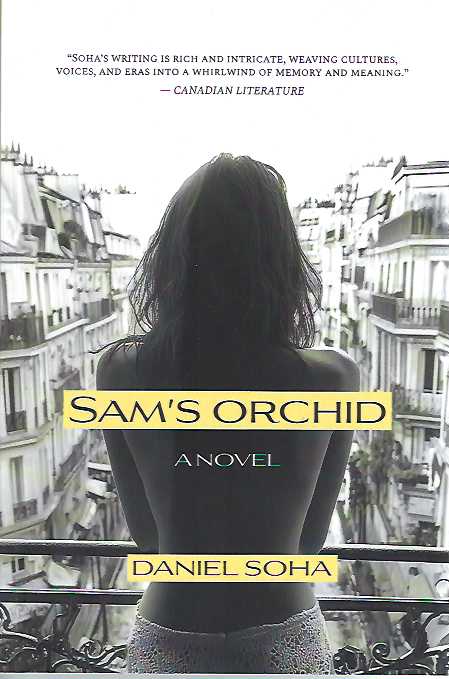
I. Sam
In her hiding place behind a pillar of that palatial Milanese café in the summer of 2007, Samantha Chadwick quickly touched up her lipstick, while scrutinizing the awkward little man who was finishing his third sambuca at a corner table by the window. He was not really a little man, it was just, for some reason, the first thing that came to her mind when she saw him. In Italian – piccolo uomo – it sounded a lot prettier than in her native British English, the wide, overblown vowels of which she often found offensive. She smiled, wondered why she saw in him some kind of dormant, gnarled vine tendril, vaguely reminiscent of a type of humanity she may have known in a distant past. At least, if she was now discon- nected from that past and that humanity, it was by choice, she was sure of that.
Why on earth had she accepted to meet him? Because of a single sentence which puzzled her when she read the little note he had left in her mailbox. “I beg you, do not disappoint me”, he had written on an obsolete European-style “calling card” of unknown, unmanageable format. It was the kind used by the bourgeoisie to scribble a few elegant words of salutation or introduction in an era when time and space were not at a premium – and for that matter, he probably never even saw its value.
What a nerve!
For months, the stranger had gone out of his way to establish contact, explored every disruptive means of breaking through to her. He had shamelessly reached out to her friends, contacted neighbours, approached second-rate actors who knew her in her heyday, and even spoken to her husband, without ever disclosing the purpose of the meeting he sought with so much heroic fervour. In another one of his ever-so-short but ever- so-flowery notes, he had claimed: “A first encounter with you might well
3
4 | SAM'S ORCHID
annihilate this whole undertaking”, and added: “It will probably be all over after the only decisive minute: the first one.” Then, little by little, she started thinking that after all, if it just took probably one minute to discourage him, then maybe she might as well...
The stranger’s name was Péter Thomas, with an odd little accent on the first “e” of “Peter”, and he claimed to be a professor of literature in New York, and a writer – probably self-proclaimed. His first attempt at seeing her was through Vicente, an old photographer friend who now lived in the United States and with whom she had lost all contact fifteen years before. She first thought that Péter was one of those innumerable stalkers to whom the Internet had given great power of nuisance in the 90s, before it all seemed to subside and the fanaticism of her fan club began to temper down. As she suspected, when you are a former actress turning fifty, you do not get as many aficionados and anybody, from a birth date, can do the ordinary mathematical operation leading to discouragement. Now the opportunities she had of rebuking such intrusions were few and far apart, mostly from foolhardy, teenagerish characters pursuing an evanescent dream that she only had to shake up a little or simply ignore to let it crumble and collapse. Oh, of course, there was still that thirty-five-year-old Argentinian who had been pursuing her with extraordinary tenacity for almost half his life in the futile hope he would get her permission to launch her “official website”, but she showed equal tenacity to do nothing, say nothing, write nothing. Her past was just in its rightful place: dead and buried, and the old magazines still going around on e-bay, the few half-forgotten videocassettes circulating covertly, only revealed the obsessions of a handful of fanatics. In one of her conversations with her husband Guido, Sam had given them a name. She called them her “dear necrophiles.”
*******
She stepped out of the shadow, started walking towards him. Péter saw her at the last moment, stiffly attempted to stand up to salute her, tipped his glass over and noisily fell back into his chair. She did not mean to smile. She smiled anyway. He held out his hand, tried to charge it with as much warmth as possible. She gave it a quick perfunctory squeeze. He vaguely stuttered something about the sambuca... “not refreshing... too sugary...”, and ordered himself a grappa, too loudly, avoiding her glance, not addressing anyone in particular. Out of the corner of her eye, she watched a few drops of the spilled sambuca trickle on to his trousers,
DANIEL SOHA | 5
wondered when he would notice, smiled again. Maybe he will take it as a sign of congeniality, she thought, and that did not please her.
He raised his eyes and looked at her for the first time, at length and with great intent, almost forcefully. His eyes were strange and penetrating, at once dark and sparkling, velvety and fierce, surprisingly young-looking, in stark contrast with the overall way he projected himself. For a second, they reminded her of something confusingly familiar, maybe a situation, or an ancient dream, who knows... That feeling eluded her as quickly as she tried to grasp it.
Péter’s features relaxed suddenly.
––You look exactly like I thought you would, he said.
His English was a tad affected, with a hint of an undefined accent,
maybe “continental”, for lack of a better qualifier, but certainly not American. He went on.
––It’s not as simple, you know... People get older... and it’s been a quarter of a century since anyone has seen a picture of you... well, in the general public... you know what I mean...
His mouth was dry, he had trouble swallowing. He saw that she noticed.
––I am sorry, I’m just a little emotional, well, nervous at least... It’s not every day that... well... let’s say that... It’s never happened to me before... Today is a big day for me, believe me...
And he repeated, his eyes lost in some remote thoughts:
––... a big day...
The dark stain on his trousers was getting bigger, the smell of the
spilled sambuca stronger. Péter must have noticed because he suddenly changed his posture and brushed his leg with the side of his hand. He went on slowly, controlling his tone, attempting to give some solemnity to an unimaginative formal salutation.
––I am very honoured to make your acquaintance.
––Likewise, I’m sure.
She had replied automatically, didn’t mean to. That damn British
courtesy!... But wasn’t it the kind of absurdity Americans would say in a hopeless attempt to sound distinguished?
Another pregnant silence. Long. Heavy. Loud. Samantha decided not to break it this time. She would offer absolutely no collaboration. She had to give the worst possible impression during this first minute... the exact opposite of an audition, she thought, and furtively smiled again, then quickly pulled herself together.
6 | SAM'S ORCHID
––As you might expect, I saw you in Orgies of the Borgias, he said
“There it is!... It didn’t take long!”, she thought... The cursed movie, the one that could have made it all possible, that should have made it all possible – instead it launched her career and her life on a disastrous spin, right at the time when she was beginning to walk the walk, believing in the whole charade, feeling ambitious.
But even at the age of twenty-something, she had had the right intuition and expressed it, albeit timidly: how could anybody take a title like Orgies of the Borgias seriously? The assonance was grotesque, almost as ludicrous as Georgie Porgie, or argie bargie, but what else could the world expect from a producer by the name of Tony Giacalone, an eerily vulgar American who claimed the title of porno king, a prophet of total, direct, unrestrained, no-frills sex? Mockingly, she had nicknamed him Tony Bologna, but thirty years later, the memory of that man and “his” movie still disturbed her. She craved so much for a title like Lucrezia, it would have been so elegant! Even if the movie itself was trash, at least she would be able to mention the title without blushing. But Cesare was the hero, not she. Or rather: it was Oliver Reed, not Samantha Chadwick.
It took a while before Sam noticed that no word was being exchanged. ––Oh, it’s an old story, she said, feigning detachment.
He stared at her again. His gaze was hard, piercing, steel-like. Suddenly,
the man was no longer so little. ––Not to me.
The waiter was passing by. She waved at him. She too had a dry mouth.
––Lo stesso, per favore – The same, please, she ordered, pointing at his grappa. She did not really like grappa, but she sensed that reality as she knew it was no longer on the agenda.
She might as well relax and take her time. She had just flunked the one-minute test.
II. The Argument
“So it IS true, she did get her teeth fixed”, Péter thought.
Her teeth... upper incisors slightly overlapping, one of the two minuscule imperfections that used to give her a “girl next door” look, so she could be freely coveted since her raison d’être was obviously to be ravished on a kitchen counter when her parents were downstairs in the family room watching Mary Poppins and teaching her younger sister how to be a princess. The other imperfection, maybe even more insignificant, was the slight thickness of her ankles, but her movies hardly ever showed that part of her, and always randomly, or so it seemed. There are parts of the body – feet, ankles, elbows, hands – on which even the most openly erotic movies hardly spend any time or money, as though desire or beauty could only gravitate around breasts, buttocks or genitalia. But it was those two imbalances, those two exquisite weaknesses that had made Samantha a splendid creature of truth instead of the piece of candy stuffed with plastic by-products which Hollywood or Cinecittà were selling as a model to which everyone should aspire. Of those two beloved flaws there was only one left. Quite instinctively, Péter slid down his chair ever so slightly to look under the table. The glimpse he got reassured him. It made Samantha change her posture too. She promptly crossed her legs and pointed her knees away from Péter.
*******
It was more than a year before his encounter with Samantha that Péter accidentally came across a new “Collector’s Release” of the Orgies on DVD. After many years of scorn, then near-oblivion, it had become a cult movie for the next generation, and he immediately purchased it.
7
8 | SAM'S ORCHID
Shayne had left him a few weeks before, or rather had him thrown out of their Westchester home after an uncharacteristic fit of rage in their long-lived marriage caused him to slap her face rather hard and lock her up in a broom closet. Unfortunately, she was carrying her cell phone and managed to call 911, and the rest is history: the big sweaty cop with a foul breath who showed up at the door, his sleek partner with the reflective sunglasses in the patrol car, the police report, the emergency lights, the noise, the neighbours, the shame... Maybe to symbolically fend off the ravages of time he moved to a little studio, back in Greenwich Village where he thought his life had really started after a foggy infancy lost in the prehistory of the post-Stalinist world. The protracted derailment of his past life with Shayne, in retrospect, soon appeared to him like a mere wrinkle in time. He was whole again, and that’s what mattered.
Or had he ever been whole?
Shortly after they got married, it was Orgies of the Borgias that triggered their first domestic row. When they first met, Shayne was a kind of Jewish Madonna, a miraculous extrapolation of Botticelli, literally “out of this world” – a bright smile emerging from a cascade of reddish blond hair in surreal harmony, miraculous equilibrium, blessed weightlessness, she was pure aesthetics made flesh. All her volumes and features seemed stylized in the deliberate intent to prevent anything unwelcome or even unnecessary from standing between Péter and her as the object of his worship. Oh yes, she was beautiful, so beautiful he could have screamed, and he immediately wanted to see in her the kind of love he had always looked for, before which he had always aspired to grovel. Naturally, he wondered what that beautiful divorcée had seen in him, a penniless, ruthless, lawless immigrant with a seemingly bottomless sex drive, but he was immensely grateful for that flawed choice and showed it to her every chance he got. That usually left her panting, dripping with sweat and other humours, a rag doll crucified between the comforter embroidered by his mother and the long-haired, zebra-patterned bedside rug where some of their most enthusiastic embraces had spilled over into a few patches that invariably turned dry and coarse.
Péter hated the cannibalistic degradation of intercourse but he loved the moments that followed, when desire temporarily released its grip and let the warrior enjoy the poppies around the battlefield. Only then could he relish, genuinely because dispassionately, the texture of her skin, the fragrances that her weary motions released in random whiffs, the purity of her lines in the dusty dusk of their pleasure chamber, before the next
DANIEL SOHA | 9
unpredictable flareup took a hold of him again, preceded by the anxiety of expectation. That was how he managed to survive: through a few moments of lucidity where he had to pack every single social and rational imperative of a normal life in between frequent, intense fits created by the uncontrollable, existential insanity of his desire.
One evening, as they were leaving the Bloomingdale’s department store of which Shayne was a regular, they saw a crowd in front of a movie theatre on Third Avenue. What drew Péter’s attention was not so much the eye-catching sign which announced “a descent into sensual hell” in naïve, pop-art style, nor the gathering of beautiful people in evening wear, as the list of stars leading the cast: Oliver Reed, James Mason, Richard Harris, no less. And when he saw the title, he simply thought: “After all, a little vicarious sex never hurt anybody.”
––Shall we go?
––Where?
––To see the movie, where else?
––Are you out of your mind?
––Why?
––Well, it is obviously a première, by invitation only I would guess.
And besides, it is a porno flick, and I wouldn’t be caught dead watching such trash!
––But my darling, this is not Times Square, we are in the Upper east Side – posh, distinguished, intellectual. Only British actors made it to this plush theatre across the street from Bloomie’s, and in this country, anything British always evokes refinement...
––You are out of your mind. Did you read the reviews?
––No.
––A whole page in the New York Times last week. Avoid it like the
plague, it said, and not just for the sexual depravity, which incidentally also dabbles in incest among other monstrosities, apparently it’s all blood and guts, torture, stabbings, poisonings... Don’t ask me why such great actors ended up in a dud like this.
Péter looked at her in amazement. She was really indignant, her cheeks all flushed. Amusing, he thought, that she should get into such a state just for a movie. He decided to joke about it and it backfired.
––But I’m also told it’s all tits-and-ass, so that should make the violence more bearable.
––What? Is that really what you want? You’re not getting enough at home, I take it...
10 | SAM'S ORCHID
––Come on, I was just kidding! You know that it’s not my M.O., that I can only find my pleasure in the pleasure of others...
––Hey, buster, I’m not just “others”... and your insistence to see this horrible show makes me suspicious. If this is the way you are as a newly married young man, what will you be in thirty years? A peep-show addict? Groping housewives in supermarkets, maybe – or worse: an old lecher watching “alternate lifestyle” videos behind locked doors...
The mediocrity of the argument appalled him. This was 1980 New York, she was a grown-up Jewish woman twice married, and she was acting like an Eye-talian matron from Joysey. He decided to spice things up.
––Let’s put it to the test, go to Times Square and watch Deep Throat together. You can keep pawing me off and on, see if porn has an effect on me...
Touché. They had gone through the experience already, a couple of months before, with Emmanuelle, which was not even that salacious, and ended up with a rather decent romp in the sack. But what had aroused him was not so much the picture on the screen as Shayne’s... bemused amusement, the contradiction between the air of perfect innocence on her face and her desire to be in on it, her fear of missing out. Here, the context was different, though.
Her eyes narrowed. He sensed her anger.
––You know how much I hate vulgarity. You’ve just dug your own grave, my dear hubby. I will decline, of course, and don’t expect to have me play the role of the geisha again, attentive to all your fetishes.
––You want to punish me for a crime I did not commit?
––Let’s say that I’m discovering a rather disturbing side of you which does not make me feel much like satisfying your desires. Perversion makes me uncomfortable, and to make love I need to be relaxed, laid back. Pleasure has to go both ways, doesn’t it? Why should I give it without getting some myself?... and please stop smiling like an idiot and look at me when I’m speaking to you!
Unaccustomed to the blackmail and compulsive score-settling of some females, Péter was completely disconcerted. For a moment, he felt the urge to champion the obvious cause of fun, humour and the unexpected in the game of love, but his heart was not really into it. He had heard Shayne raise her voice to an irksome pitch before and retreated many times at that smoky, trumpeting squeal accented by a Brooklyn drawl, but he never let it take center stage in his perception of her. Now it was the only thing he could hear and think about – an immense irritation.


Comments
Movie script
I could not find how to apply for the best movie screenplay. Here it is.
SAM'S ORCHID
Written by
Daniel Soha
Based on the novel by Daniel Soha
An imaginary biography inspired by Teresa Ann Savoy
"She was a Southern soul — an entity that had lost its bearings and should by right live in a place where the weather is always nice and the colours are vivid."
— D. Soha
FADE IN:
INT. GRAND CAFÉ IMPERIALE — MILAN — LATE AFTERNOON
Summer 2007. Marble columns, chandeliers, the particular hush of a room that has always known its own value.
Behind a pillar near the entrance: SAMANTHA CHADWICK, 52, English. Extraordinarily composed. She is touching up her lipstick with one hand, without looking at the mirror, and watching, across the room, a small awkward man finishing his third sambuca at a corner table. She holds in her other hand an oversized calling card that reads: "Péter Thomas, Professor, writer," with a little accent on the e of Peter. Beneath it, in his handwriting: "It will only take a minute. I beg you, do not disappoint me."
PÉTER THOMAS, 67. He will speak with a very faint accent, a little affected, "continental." Not actually a small man — but something about him reads small. A dormant, gnarled quality, like a vine tendril that hasn't decided whether to climb or wither.
Sam studies him with the detachment of a woman doing an inventory of something she already suspects she'll regret.
SAMANTHA
(to herself, in Italian)
Piccolo uomo...
Little man. In Italian it sounds almost affectionate. In English it would sound like an insult. She prefers the Italian.
She steps from the shadow. Crosses the room. Péter sees her at the last possible second — lurches up to greet her — tips his glass — falls back into his chair as the sambuca spreads across the white linen.
She did not mean to smile. She smiles anyway.
He holds out his hand, charges it with as much warmth as he can manage. She gives it a quick, perfunctory squeeze and sits.
PÉTER
(too loud, to no one in particular)
The sambuca — not refreshing. Too sugary.
He orders a grappa, avoiding her eyes. Out of the corner of her own, Sam watches a few drops of spilled liqueur trickle toward his trousers. She wonders when he'll notice. Maybe, she thinks, he'll take her smile as a sign of warmth. That would not please her.
A silence. Sam crosses her legs, points her knees away from him.
SAMANTHA
Why did you want to see me?
He starts to answer, stops, starts again.
PÉTER
I don't entirely know. I've wondered, without finding an obvious reason. Maybe to complete something left unfinished. Maybe to get an answer, although I don't know the question. On second thought — maybe I'm relying on you to help me ask the right one.
SAMANTHA
Why me?
PÉTER
Because you had a considerable effect on me. Life-changing, I would say. And that can't be a random thing. It has to mean something.
A beat.
PÉTER (CONT'D)
I saw you in Orgies of the Borgias.
SAMANTHA
(a tired half-smile)
Oh, of course. Here we are again.
SAMANTHA (CONT'D)
But it wasn't me. Or rather — the woman I am today has almost nothing in common with whatever image changed your life. That image is a memory. A trick of light that the wizardry of film extended into something that looks like a life.
She catches herself.
SAMANTHA (CONT'D)
God. You're making me sound like you.
Péter waves this away with a limp gesture.
PÉTER
I can't address the cause of what I felt directly. So I have no choice but to grasp whatever of it I still can, in whatever modern form it survives in. The risk is enormous. But the shock was too great — the kind I've felt only once or twice in my whole life. At my age, you don't let a miracle pass. You hold onto what part of it you can. Even rubbing against a dream can give you some warmth.
SAMANTHA
And what exactly do you want from me, having found me?
PÉTER
I want to understand the essence of things. Why a life goes one direction instead of another. What we miss by not taking the few miraculous moments we're given. Where we'd be if we'd done something differently.
Sam waits.
PÉTER (CONT'D)
In my case — on at least two occasions — I could have gone the other way. If I'd followed my intuition instead of letting chance, or laziness, or a failure of imagination take over.
A beat. Something flickers behind his eyes — caution, almost — as if he's deciding how much to say.
PÉTER (CONT'D)
In New York once, near a cinema, there was a girl smiling at me. I could have walked over. Taken her from the unpleasant man she was with. Left my wife on the spot, instead of waiting thirty years to lock her in a broom closet.
Sam smiles slightly — Péter notices her teeth, the faint overlap of the front two. Not so terrible after all, he thinks.
SAMANTHA
Why didn't you?
PÉTER
I have no idea. That's what's driving me mad. Maybe I thought I loved my wife. Maybe I just didn't have the will in that exact second. I might have had it two seconds earlier, or three seconds later. I went back to the same spot the next day — in the absurd hope she'd be there. Waiting. I still think about it. I'm always thinking about it. And in a sense, I am still waiting.
SAMANTHA
(dry)
And is that what you're hoping from me? That I'll announce I've spent thirty years waiting for you, without ever having met you, and thirty years older than I was? A faintly ridiculous idea, don't you think?
PÉTER
But that's precisely what's happening. You're here. Your presence is all that matters to me, and you've granted it — recluse or not. To some extent you've been waiting for me, even without knowing it.
SAMANTHA
Listen, sir. I'm already finding it difficult to picture myself — a forgotten actress from an obsolete corner of the adult film industry — reincarnated as Guinevere, waiting her whole life for an elderly Lancelot. Forgive me. As for thinking it was you I was waiting for, without knowing it — that's obviously a ridiculous proposition.
She glances, briefly, at the stain spreading on his trousers.
SAMANTHA (CONT'D)
Isn't it?
PÉTER
I won't try to convince you. Not tonight. I'm past the age of proselytizing. Only the intensity of truth is convincing — and truth is never ridiculous.
SAMANTHA
Truth depends entirely on the light you shine on it, doesn't it?
PÉTER
Indeed. You were exquisite in the Orgies. Downright ugly in Nazi Horrors. Same director, both films. My only ambition tonight is to look good — figuratively, since I can no longer count on my physique. So I'll have to rely on other means. Candour. Honesty. Elegance, especially elegance.
SAMANTHA
In my case, after thirty years, I should think there's a statute of limitations. I've fought hard to keep anyone from rubbing up against me ever again, and with some success. So whatever beauty you think you see in me — supposing it ever existed — fetched a price. And I paid it. Believe me. I've seen things you can't imagine.
PÉTER
That was the Seventies. Anything was possible. And in my opinion, you didn't pay nearly enough.
SAMANTHA
How brazen of you. Do you honestly think that's helpful?
PÉTER
My apologies — I've failed my own vow of elegance, but kept faith with candour. With respect, I won't shed a tear over someone who enjoyed an enormous, unfair privilege and is now complaining it made her suffer. Prévert wrote that beauty is an insult to an ugly world — that men don't love it, they hunt it down to destroy it. You could have been ground down, absorbed, dead of an overdose at thirty-six like Marilyn Monroe. That would have been real suffering. Instead you're sitting here with a grappa in a Milanese café, in the company of a reasonably civilized man who wishes you nothing but well.
SAMANTHA
It's because I wanted it this way. I planned it.
She hears herself say it and thinks: I sound pathetic.
CUT TO:
INT. PÉTER'S GREENWICH VILLAGE APARTMENT — NIGHT (2005) — FLASHBACK
A small studio crowded floor to ceiling with books and second-hand furniture from a flea market that calls itself an antique store. The home of a man recently and easily separated, surprised by how little thirty years seem to have weighed.
Péter pours a bourbon. Settles into an old leather armchair shaped, by decades of use, exactly to him.
On the table: a DVD, recently purchased from a rare-film store that has taken over a defunct bookshop on Sixth Avenue. The cover shows a religious figure surrounded by naked women. ORGIES OF THE BORGIAS.
He inserts it.
On screen: a forest, dappled light, Donizetti playing somewhere distant. A man — Cesare — chases a young woman — Lucrezia — through the trees, both of them laughing, half a costume slipping from her shoulder. We don't yet see her face.
Cesare catches her. Pushes her gently against a rock. She laughs like a child, breathless. He lifts her hair, kisses her neck. A shaft of sunlight finds her face.
Péter lets out a small, helpless sound.
He stops the disc. Rewinds. Watches the same four seconds again. And again.
PÉTER
(to himself, in Hungarian, almost involuntarily)
Gyönyörü... Gyönyörü...
Magnificent. He says it the way a man recites something he's afraid will vanish if he stops.
He sits very still for a long time. He has the strange, total conviction that he has been carrying this woman's face inside him for years without knowing her name — that she has been there, in the dark, behind every choice he ever made.
He sleeps twelve hours. Wakes with a sense of purpose he hasn't felt in years.
He has to know more.
BACK TO:
INT. GRAND CAFÉ IMPERIALE — CONTINUOUS (2007)
PÉTER
We are at the heart of the problem. You're beginning to raise the right questions.
SAMANTHA
I haven't asked anything.
PÉTER
You will. Do you know what anthropomorphism is?
SAMANTHA
The tendency to give human qualities to something that isn't human.
PÉTER
Precisely. It's a similar process that makes a man look at a beautiful woman and assign her every moral virtue in the world — by fusing the form with the substance. It's the kind of illusion that makes a man fall in love. I am claiming the right to love you tonight. So even if I happen to be exactly the sort of man who'd ordinarily annoy you — leave me the illusion. At least for a while. Try not to disappoint me.
SAMANTHA
Not for the time being.
PÉTER
Thank you for the reprieve. I'll use it to redraft our agenda — a process made more fascinating by being in a permanent state of gestation.
SAMANTHA
(almost smiling)
What is it currently?
PÉTER
After that long detour on beauty, I'd like to take on three further mysteries. First — the mystery of your sudden disappearance. Second — since you've agreed to be a beautiful, virtuous woman in my imagination — how that same nature is compatible with showing your backside to several million strangers for money. The myth of the Madonna and the whore.
SAMANTHA
Easy enough. And the third?
PÉTER
Why I felt, from the very first minute of watching that dreadful film, that you — your image, whatever it is — had been part of me forever. As though our genetic fabric had been merged somewhere, in an experiment whose purpose got lost.
A pause.
PÉTER (CONT'D)
With one supplementary question. Was there a purpose.
Sam holds his gaze. She doesn't yet know what to do with this. She files it, the way she files most things he says — interesting, possibly unhinged, not yet alarming.
SAMANTHA
If you want me to be the only one revealing herself in this — what did you call it — chairmanship of yours, you'll have to start giving up some of your own mysteries.
PÉTER
Where should we start?
SAMANTHA
Something simple. Why the accent? On the first e of Péter.
CUT TO:
INT. TAMÁS FAMILY HOME — BUDAPEST SUBURB — NIGHT (NOVEMBER 1956) — FLASHBACK
A comfortable house in a Party official's neighbourhood. ZOLTÁN TAMÁS, late 40s, paces. His wife ILONA stands very still in the center of the room, having already moved past argument into decision.
In the distance: tanks. Closer than yesterday.
Behind the door: PÉTER, 10, and his sister.
ZOLTÁN
Austria. You're out of your mind.
ILONA
They're hanging Party members from lampposts, Zoltán.
ZOLTÁN
I gave those men jobs. I was at their weddings. I am one of them.
ILONA
You are a senior Party official, and tonight that is all they will see.
ZOLTÁN
My father chose to be a prisoner of the Romanians rather than retreat in the Great War. He chose. Do you understand the dignity of a choice kept?
ILONA
Your father's choice proved nothing and changed nothing. I am choosing differently. I am choosing our children.
A long silence. Then Ilona moves through the house with sudden purpose.
Later: a van in the dark street. Péter at the doorstep, turning back. His father crouches, takes his face in both hands.
ZOLTÁN
(in Hungarian, barely audible)
Isten áldjon meg.
God bless you. Péter tries to speak. His throat closes. He is ten years old and he already knows, with a child's total certainty, that this is the last time.
BACK TO:
INT. GRAND CAFÉ IMPERIALE — CONTINUOUS
PÉTER
When I turned eighteen, I had the paperwork ready to reclaim my Hungarian citizenship — the consulate, the name restored properly. I got off the subway in Brooklyn, walked toward the building, and somewhere on Jay Street I understood that I no longer spoke the language properly. That I had lost it. That I belonged to neither country. So I went to the Civil Court instead and had a clerk type one accent mark onto the first e of my name. That is the entire extent of my compromise with the country that made me.
SAMANTHA
That's not a compromise. That's poetry.
PÉTER
(genuinely surprised)
That may be the kindest thing you've said to me all evening.
SAMANTHA
I've barely said anything to you.
PÉTER
Haven't you? I didn't notice.
PÉTER (CONT'D)
Your turn. Where were you born?
SAMANTHA
Chelsea. A perfectly respectable borough that thought it was better than it was.
Something in her voice shifts — softer, further away.
CUT TO:
EXT./INT. WILKINSON MEWS — CHELSEA, LONDON — LATE 1960S — FLASHBACK
A narrow cobblestone lane, gentrified in name only — Wilkinson Mews — pressed against the back gardens of a row of respectable upper-middle-class houses. Cat smell. Working-class poverty refusing politely to leave.
SAMANTHA, 10, leans on her bedroom windowsill two floors up, watching: an old man tending three stunted plants in the half-dark, a Jamaican man polishing a Mini Cooper with religious devotion, a mangy squirrel excavating cobblestones for no evident reason.
She studies it all the way she studies everything — as evidence of a world she does not yet belong to, looking for the door out.
V.O. (SAMANTHA, NARRATING)
My father wore a bowler hat. He believed the poor were proliferating specifically to spite him.
Behind the wooden slats of a carless garage at the end of the lane: a motionless silhouette. Watching her.
She does not signal that she's seen him. She has been watching him watch her for weeks.
DISSOLVE TO:
EXT. WILKINSON MEWS — DUSK — SEVERAL YEARS LATER — FLASHBACK
SAMANTHA, now 16, stands at the same window. CAPSTICK, 18 now, lurks in the same garage — taller, awkwardly so, his shoes too big for a body that hasn't finished growing.
She has decided something tonight. She does not entirely understand the decision herself. She simply knows there is a gift owed, and a clock running out.
She goes down. Crosses the alley. Capstick freezes — caught, after years of hiding, in the open.
She says nothing. There's a balance here that words would break.
She comes close. Takes his rough hands. Lays them against herself.
[The scene continues with discretion — held in close, fragmented images: a held breath, a hand in hair, the alley wall, his face crumpling with something closer to grief than pleasure. We do not see more than the emotion requires.]
CAPSTICK
(breaking, almost a sob)
I love you. God, I love you. I love you so much! I'll always—
Sam holds him as the words come apart in his mouth. She is sixteen and she already understands, with a clarity that frightens her, the speed at which everything that matters disappears, and how little of it can be kept except as memory, fading.
She comforts him without knowing how. She leaves. He calls after her, once, brokenly — and she will hear those words for the rest of her life.
V.O. (SAMANTHA, NARRATING)
When they said All you need is love, is that all they meant?
BACK TO:
INT. GRAND CAFÉ IMPERIALE — CONTINUOUS
SAMANTHA
There was a boy. Capstick. He used to watch me from an alley behind our house. I never told him I knew. We had a kind of understanding that needed no words.
PÉTER
Did you love him?
SAMANTHA
I gave him something, once, before I left. I'm not sure it was love. I'm not sure, at sixteen, I knew the difference between love and the desire to be generous with something I didn't yet value.
PÉTER
And then you left.
SAMANTHA
Three days after I met the man who took me. I was always going to leave. London never had a chance with me.
CUT TO:
INT. CARNABY STREET BOUTIQUE — LONDON — 1970 — FLASHBACK
'Je t'aime... moi non plus' on the radio — still banned in France and Italy, which is precisely why everyone in London plays it.
SAMANTHA, 16, behind the counter. LUIGI FERRARA, 32 — dark, confident, carrying a Leica like a badge of office — approaches with the worst Italian-accented English ever attempted on purpose.
LUIGI
Scusa me, Missa, which way is-a Harrod's-a?
Sam smiles. Runs her tongue across her front teeth.
SAMANTHA
Bit difficult to explain. But I live close by, and I'm off in a few minutes — if you'd like to drive me back.
Luigi's red scooter is parked half a block away.
CUT TO:
INT. THE WHEATSHEAF PUB — CARNABY STREET — CONTINUOUS — FLASHBACK
Caught in the rain. Sam orders chips and a ginger beer. Luigi works through four glasses of house wine in the time it takes her to drink half her ginger beer.
He does not know she is sixteen. He thinks the ginger beer means she doesn't drink. He sees, in the half-light of the pub, what he believes is a vivid aesthetic revelation. He does not see the child. Only the beauty.
LUIGI
(on his fourth glass, magnificent)
God said: let there be light. That is not poetry — that is a technical specification. With light, we hold a piece of divine power. The photographer is a kind of Messiah. I can show you the flower of your own soul.
Sam listens to every word. She has been waiting her whole life — ten years of it, anyway — for someone to speak those nonsensical lines.
LUIGI (CONT'D)
I come from a land of ancient luminescence. The blue of the sea. The green of the trees. All of it saturated, alive — because light is what makes colour possible. Without light, without colour, the world itself does not exist.
He speaks her language. She is won.
They meet several more times. The second time, she decides he is the instrument of her destiny. The third time, she has already packed.
BACK TO:
INT. GRAND CAFÉ IMPERIALE — CONTINUOUS
PÉTER
Three days. From a clothing store to the back of a scooter.
SAMANTHA
My mother found my packed bag under the bed. She didn't argue. Gave me my passport, a little cash, and a parental consent form. 'Drop us a line, and don't forget your sister' — that was the whole of her goodbye. I only understood years later what that cost her.
PÉTER
And you never looked back.
SAMANTHA
Why would I have? I was riding into the sun with my thighs spread on the seat of a Vespa. I thought I was meeting my destiny. I thought the top speed of that idiotic little machine was something like the speed of light.
PÉTER
(a strange stillness in him)
Tell me about the road.
CUT TO:
EXT. ROUTE NATIONALE — SOUTHBOUND FRANCE — DAWN (1970) — FLASHBACK
The red Vespa hammers south. Sam stands on the foot pegs behind Luigi, arms wide, singing Beatles into the wind. She doesn't yet know what she's driving toward. She only knows the grey of England is finally, finally behind her.
She remembers the customs men at Dunkirk, mistaking their jeers for friendliness. The flat grey of the Pas-de-Calais, greyer somehow than London. Luigi wanting to stop in Paris; her refusing, wanting only south, more south, faster south.
Something changes in the light past a certain point on the map. Sam doesn't know yet that the place is called Lyon. She only knows the trees start doing something different to the air.
V.O. (SAMANTHA, NARRATING)
It's only past a certain city that the green changes. Decouples into sun and shadow. Multiplies into a hundred different greens I'd never seen in England.
She becomes wilder. High-strung. Feral with joy.
A gas station. Luigi fills the tank. Across the road — a ragged, road-worn American man, mid-twenties, an arm around a girl, hitching. His eyes find Sam's.
She doesn't know his name. Doesn't know if she'll ever think of this again. She unbuttons her blouse — slowly, without performance — and gives him a glimpse that means nothing and everything, a piece of pure generosity, just because she is happy.
His face: astonishment. A little boy's wonder on a Christmas morning.
Car horns. Luigi waves her back onto the bike, oblivious. She buttons up. Gives the stranger one last look, and is gone.
She will not remember this moment in any specific detail for thirty-five years. To her it is one bright second among thousands from that summer — indistinguishable, eventually, from all the others.
BACK TO:
INT. GRAND CAFÉ IMPERIALE — CONTINUOUS
SAMANTHA
There isn't much more to it. We rode south. The light changed. I felt, for the first time in my life, completely comfortable in my own skin. That's the whole story.
Péter looks at her carefully. Something is working behind his eyes — something he is choosing, for now, not to say.
PÉTER
(carefully, almost too casually)
Do you remember the road itself? Anything specific?
SAMANTHA
Not really. It was thirty-five years ago and after roughly four hundred kilometres of road. I remember the light. I remember being happy in a way I didn't yet have a name for. The rest is just texture.
Péter nods slowly. He does not push it. Not yet. He files something away — the same careful, patient filing he has done for fourteen months.
PÉTER
Of course.
A silence. Outside, the light is starting its long Milanese decline toward evening.
INT. GRAND CAFÉ IMPERIALE — LATE AFTERNOON — CONTINUING
PÉTER
No. It's because you went into hiding. You shied away from your responsibilities.
SAMANTHA
Responsibilities? What responsibilities?
PÉTER
The scandalous privilege you were given comes with a duty attached. You owe me something. Don't shake your head — you do. You owe me, and a few others. Possibly the whole human race.
SAMANTHA
And what exactly do I owe you?
PÉTER
To start with — you have to let me love you. Or love your ghost, since you can't prevent it and you can't deprive me of the elegance of the feeling either; that would be pure cruelty. You're a creature of exception, fine. Show some leniency. I want to be one too. My way. You didn't have to do anything to be exceptional — you just had to inhabit your own skin. I have to work at it. That's one more injustice.
SAMANTHA
If you're trying to seduce me, you're well off the mark.
PÉTER
Not at all. First, I'm not a womanizer — I don't have the gift. Second, I used to think beauty's purpose was sexual. It isn't. All beauty wants is to be consumed, and sex is just one way — a naïve, brutal way — of consuming one form of it. I thought, once, that I'd married beauty. That she and I were the same thing, and we could feast on each other endlessly. I woke up one day from that particular hallucination with a hangover. And she was gone.
PÉTER (CONT'D)
Where did she go, do you think?
Péter doesn't wait for an answer. He drinks the rest of his grappa in one motion, eyes closed, head tipped back. There is beauty in this too, he thinks. In the glass. In the swallowing.
CUT TO:
INT. SMALL APARTMENT — NEW YORK — NIGHT (1975) — FLASHBACK
SHAYNE, 28, comes home exhausted from a long shift as a dental assistant — fending off, all day, the moustached attentions of her employer, a divorced dentist entirely incompatible with her in every way that matters.
PÉTER, 29, is waiting. He has had two drinks already. He needs them — the mere thought of seeing her tonight is, to him, unbearably stimulating, in a way he can't entirely explain even to himself.
She is slender. Delicate. Achingly beautiful in the specific way of someone who hasn't yet been asked to carry very much.
[The scene plays without explicit content — held in the texture of the room, the desperation in his hands, her exhaustion absorbed into something that looks, from outside, like passion.]
Later. Péter lies very still, watching her sleep. He thinks: I will ruin this, eventually. He has no idea, yet, how right he is.
DISSOLVE TO:
INT. WESTCHESTER HOUSE — EVENING (2003) — FLASHBACK
Thirty years later, almost to the week. The house is large and mostly empty — the children are grown, the rooms too quiet for two people.
Péter and Shayne at the dinner table. She is still beautiful, in the way that a familiar painting is still beautiful — seen so many times it has stopped being seen at all.
They are not arguing, exactly. But something has been building for hours, the way certain nights build without either person naming what's happening.
SHAYNE
(her voice rising)
Twenty-eight years, Péter. Twenty-eight years I funded your degree on a dental assistant's wage, and you sit there like I've interrupted something.
PÉTER
(flat, exhausted)
Interrupted? No, I'm listening.
SHAYNE
You have a way of listening that feels exactly like you’re not.
Her voice, her pitch, are unbearable. Something rises in him — fast, disproportionate, frightening even to himself. He stands. His hand moves before his mind has finished the thought.
[We do not see the blow. We see Shayne's face after it — shock, not pain, the specific shock of thirty years collapsing into one ugly second. We hear, distantly, a door. A lock.]
Later: red and blue light through the curtains. A large sweating policeman with bad breath at the door. His sleek partner in the patrol car, sunglasses on at night. The report. The shame, total and exact.
Péter never tells anyone — not the police, not himself, not really — that the thing which finally broke wasn't an argument about money. It was the sound of her voice. The same sound that had once seemed merely loud now sounded, after thirty years, like an accusation he could no longer survive hearing.
BACK TO:
INT. GRAND CAFÉ IMPERIALE — CONTINUOUS
Péter puts down his empty glass. For a moment he looks every one of his sixty-seven years.
PÉTER
I considered myself guilty of depleting her. Squandering her — irretrievably, through some alchemy I couldn't explain but could absolutely verify. It never once occurred to me that I stopped loving her because she'd become ugly. I was certain she'd become ugly because I had spent thirty years exhausting everything in her worth loving. Using it up. Squeezing every drop of beauty out of her and leaving a wrinkled husk behind. That kind of love, at least, turns out to be finite.
SAMANTHA
That's a very tidy theory for a very untidy thing to have done to someone.
PÉTER
(after a silence)
Yes. I'm aware of that.
CUT TO:
EXT. AGAY, FRENCH RIVIERA — NIGHT (1970) — FLASHBACK
A modest hotel room a stone's throw from the sea. Sam, 16, undresses without ceremony, folds everything neatly, finds a radio station playing the Beatles. Across the Universe.
She lies down. Looks at Luigi's sudden, uncharacteristic shyness, and laughs — a girl's laugh, easy, unafraid.
SAMANTHA
Come.
[The scene that follows is held with discretion: the radio playing, the window open to the sea air, fragments of motion and breath. What the camera holds on, instead, is Sam's face — astonished, awakening, nothing like the practiced calm she showed with Capstick.]
Afterward, half-delirious, she stammers something disjointed about a flower — an orchid — growing inside her. Luigi, frightened and moved in equal measure, has no idea what she means. Neither, fully, does she.
DISSOLVE TO:
INT. LUIGI'S LOFT — MILAN — MONTHS LATER — FLASHBACK
The loft, as before — vast, warm, chaotic with photographs and art books and the rotating cast of Luigi's friends: GIORGIO the fashion photographer, MARCELLO the black-and-white specialist, VICENTE with his American dreams, GUIDO the quiet Yugoslav who watches more than he speaks.
They argue, late into the night, about politics and cinema and the working class. Sam — speaking almost no Italian yet — sits on the floor in her favourite pose, on her stomach, wiggling her toes, smiling whenever she thinks she's understood something. She is absorbing every word without anyone noticing. It will take years before anyone realizes what's been quietly accumulating in her.
GIORGIO
(trying and failing to say 'Samantha')
Sam. I'll call her Sam.
It sticks instantly. She will be Sam for the rest of her life.
One by one, the men photograph her. Some ask for nudes — simply ask, plainly, and she agrees as plainly as she's asked, the way she'd agree to have her picture taken at all. Luigi, who ought to mind, finds that he doesn't. He's flattered. He doesn't yet see what this means.
CUT TO:
INT. LUIGI'S LOFT — MORNING — FLASHBACK
Luigi opens an envelope. Reads it twice. His face does something complicated — pride colliding with something closer to vertigo.
LUIGI
Ecce Uomo is interested in the photographs. If you agree, of course.
Sam looks up from her magazine, entirely unbothered.
SAMANTHA
Why wouldn't I agree?
She goes back to her magazine. To her, this is simply confirmation that her body has been judged worthy of being shared with the world — the same logic, in her mind, as an actress's face being committed to film. She writes her mother a cheerful letter that evening. Found a job as a model, she says.
Three months later, a casting agent calls. Cinecittà. A small part alongside the established Sylva Koscina.
SAMANTHA
(alarmed)
My love, you know my Italian is terrible.
LUIGI
Taken care of.
SAMANTHA
How?
LUIGI
S.O.C.
SAMANTHA
Meaning?
LUIGI
A silent part.
BACK TO:
INT. GRAND CAFÉ IMPERIALE — EARLY EVENING — CONTINUING
PÉTER
And then the neighbours started asking questions.
SAMANTHA
A photograph fell out of his portfolio in the staircase, and the neighbours saw it. After that there was no containing it. He told everyone I'd been sent by my mother to do some modelling in Milan. He had a friend near Naples — Giovanni — running something between an ashram and a commune. I went to wait out the scandal there until I was legally an adult.
PÉTER
And Luigi?
SAMANTHA
Went back to Milan without me. I thought I'd be fine. I wasn't prepared for how much it would hurt.
CUT TO:
EXT./INT. GIOVANNI'S COMMUNE — NEAR NAPLES — SUMMER 1971 — FLASHBACK
Olive trees. Heat that slows everything to the pace of thought. SWAMI GIOVANNI, 50s, presides over thirty wealthy young seekers with the gentle authority of a man who has found an elegant solution to Italy's divorce laws: abolish marriage instead.
Sam, alone among strangers, discovers that grief arrives without warning. The little twinge she feels as Luigi's car vanishes becomes, over days, something close to mourning. The sun that used to feel like a friend starts to burn her skin.
She tries cannabis — it only sharpens the incoherence. She tries Giovanni's pills, promised to reveal 'the true colours of the universe' — they deliver a brief euphoria and then a long, frightening unraveling.
She tries, with a kind of clinical honesty very unusual in a sixteen-year-old, to answer a single question: is it Luigi she misses, or only what he gave her? And could anyone else give her the same thing?
[The experiments that follow are suggested, not shown — a held look, a door closing, Giovanni's reluctant and complicated participation. Nothing and no-one give her what she's looking for. She is, underneath all of it, still a child trying to solve an adult's grief with a child's tools.]
V.O. (SAMANTHA, NARRATING)
I told myself it was honesty. That cheating on him, even like this, was a way of loving him more clearly. It wasn't much. But it was enough to keep the orchid alive. Barely.
DISSOLVE TO:
INT. LUIGI'S LOFT — MILAN — NIGHT — FLASHBACK
Luigi alone. Unwashed sheets he refuses to launder, so the smell of her stays a little longer. A photograph of Sam on his stomach as he falls asleep, a bottle of Campari beside the bed.
LUIGI
(to a photograph, barely audible)
Ti amo.
He has discovered, the hard way, the only cure for a desire this large: work. He photographs truffles and veal scallopini for a cooking magazine, channeling a hunger he can't otherwise feed.
BACK TO:
INT. GRAND CAFÉ IMPERIALE — CONTINUOUS
PÉTER
How long were you there?
SAMANTHA
A few months. Until I turned eighteen and the legal problem solved itself. Luigi came to collect me like a parcel that had finally cleared customs.
PÉTER
(a small, surprised laugh)
That's a very ungenerous way to describe a reunion.
SAMANTHA
It's an accurate one. I'd grown up rather a lot in those few months, and not entirely in ways he was prepared for.
CUT TO:
INT. NEW YORK UNIVERSITY — VARIOUS — EARLY 1960S — FLASHBACK MONTAGE
PÉTER, early 20s, newly arrived in American adulthood with a new name and an appetite to match. A lecture hall. A girl. A different lecture hall. A different girl. He moves through them less like a conqueror, as he likes to think of himself, and more like a man trying urgently to outrun something he can't name.
V.O. (PÉTER, NARRATING)
I thought I was Attila. In fact I had a gentle face and an accent women found irresistible for reasons I never understood, and I let them seduce me because it required nothing of me at all.
A library carrel, late at night. Péter surrounded by Dylan Thomas. He discovers, with the shock of recognition, a poet publicly careless and privately terrified — a man who used alcohol the way Péter is already beginning to use it, as a ladder to somewhere calmer.
He graduates Summa Cum Laude. He has, by now, developed an exact and considered taste in spirits, arrived at through years of careful experimentation, the way another man might develop a taste in wine.
CUT TO:
EXT. TANGIER, MOROCCO — DAY (1965) — FLASHBACK
Péter, 24, lost in the white heat and noise of the medina, sweating, assailed by panhandlers, dust in every crease of his clothing. He came looking for Burroughs and Bowles. He is finding only an overwhelming, immediate hatred of the South.
V.O. (PÉTER, NARRATING)
I caught myself longing for the clean, grey North. For an Indo-European language spoken at a reasonable volume. I think I finally understood why Hungary spent four centuries trying to repel the Turks.
BACK TO:
INT. PÉTER'S GREENWICH VILLAGE APARTMENT — NIGHT (2005) — FLASHBACK
Weeks after the Orgies. A new DVD: NAZI HORRORS. The third film Sam ever made, the second Péter has managed to find.
He pours a vodka. Presses play with the eager dread of a man approaching a relic he's afraid won't survive the light.
On screen: a brothel. Garish costumes. Sam — twenty-one, twenty-two — in a red corset and dark stockings, dubbed into someone else's flat American voice. The camera angles are unkind. Her face looks chubby, her mouth painted into a permanent smirk.
Péter leans forward, horrified.
PÉTER
(to the screen, devastated)
What have they done to you.
A scene with an actress named Christine — meant to be erotic, plays instead as two exhausted women going through motions neither of them wants. Péter watches Sam's face for any sign of the woman in the forest, in the dappled light, four seconds long. He finds her only twice, briefly, and each time the camera moves on before he can hold onto it.
He starts to cry. Finds, in the kitchen, a half-gallon of white wine gone tepid and slightly sour. Drinks it anyway. Cries again.
He leaves the disc paused on a frame of Sam and Christine, mid-kiss, two sad clowns performing an intimacy that clearly belongs to neither of them.
BACK TO:
INT. GRAND CAFÉ IMPERIALE — CONTINUOUS
PÉTER
Nazi Horrors. I have to ask. What happened on that set?
SAMANTHA
(a short, humourless laugh)
Zoff happened. He had a costume fetish and very little interest in the women wearing them. I looked exactly the way he wanted me to look, which is to say: not like myself at all.
PÉTER
I cried watching it. Twice. Once during, once over a glass of spoiled wine afterward.
SAMANTHA
(genuinely startled)
You cried over Nazi Horrors? That's possibly the strangest tribute anyone's ever paid me.
PÉTER
I wasn't crying for the film. I was crying because for ninety minutes I couldn't find you in it. And I'd only just found you to begin with.
Sam looks at him for a long moment. Something in her readjusts — very slightly — like a piece of furniture shifted an inch in a room she thought she knew by heart.
INT. PÉTER'S GREENWICH VILLAGE APARTMENT — NIGHT (2006) — FLASHBACK
A small ceremony of preparation: a tweed jacket, a bottle of Moët he doesn't trust enough on its own, two large glasses of Scotch poured alongside it just in case. After weeks tracking down a single forgotten cassette — eBay, a three-week wait, a Greek transfer shop in Astoria that converts mostly wedding videos — Péter holds the only watchable copy in North America of a film called L'Amore è muto. Love Is Mute. That’s the first movie in which Samantha ever acted.
He closes his eyes before pressing play, the better to feel the Scotch move through him. A small, anticipatory tightening in his chest. He attributes it to excitement.
He presses play.
On screen: SAM, 19, plays Clorinda — deaf, mute, severely disabled, sexually insatiable, beloved by an aging Italian seducer who finds in her total inability to lie the only honest love of his life.
Péter watches, increasingly astonished — not by the plot, which is grotesque, but by what Sam does. There is total commitment in her. No irony, no self-protection. He has never seen an actor give a performance with absolutely nothing held back.
V.O. (PÉTER, NARRATING)
She played a girl who could only tell the truth. It took me years to understand that this was the role she'd been training for her entire life.
BACK TO:
INT. GRAND CAFÉ IMPERIALE — CONTINUOUS
PÉTER
It was early the next morning, still in my armchair, soaked in pálinka, that I decided I had to meet you. There'd been flashes before. Then that sick, exhausting déjà vu.
SAMANTHA
Sick?
PÉTER
A little. Too intense, too familiar — like a smell that reminds you of something you can't name. Until then, what I knew about you was enough to fascinate me. Not enough to act.
SAMANTHA
And what tipped it over into action?
PÉTER
The feeling that you'd reached into my past. Not my personal past — the historical one. The one I rejected but that stayed with me anyway, like a quiet proof of how unfinished I am. From that film onward, the Austro-Hungarian world stopped wearing my father's face. It started wearing yours.
Sam doesn't answer immediately. She glances away, toward the long perspective of Via Dante outside, trying to avoid his eyes.
V.O. (SAMANTHA, NARRATING)
Back to the Orgies again. It always comes back to the Orgies.
She thinks: maybe I should just tell the whole wretched story once and exorcise it. He hasn't flinched from himself all evening. He's earned that much.
She signals the waiter.
SAMANTHA
Pinot Grigio. A bottle, please.
PÉTER
Excellent idea.
CUT TO:
INT. SMALL APARTMENT — NEW YORK — NIGHT (1976) — FLASHBACK
Péter and Shayne, newly married. Through the wall: the unmistakable rhythm of celebration. Péter, freshly graduated, his first small novel praised by a critic nobody had heard of yet.
V.O. (PÉTER, NARRATING)
I told myself I'd found in her, condensed into one person, every woman in the world. Making love to her felt like a kind of exclusive religion. No other woman tempted me — not because I was virtuous, but because I genuinely believed she'd made temptation unnecessary.
Years pass in this single held frame — a child's cry from another room, then a second, then a third. Péter, slightly greyer each time, still in the same chair.
DISSOLVE TO:
INT./EXT. NEAR BLOOMINGDALE'S — THIRD AVENUE — NIGHT (1980) — FLASHBACK (REPRISE)
The same moment we've already half-seen. Shayne mid-tirade about the film, the marquee, the crowd. Péter's eyes catching the girl on Giacalone's arm. The smile. The shrug. The crowd swallowing him.
That night — for a few minutes, in the dark, with his wife — her face blends with the stranger's. He never tells anyone this. He barely admits it to himself.
V.O. (PÉTER, NARRATING)
I never found out if that night changed anything. I only know that afterward, Shayne stopped talking about her cycles and started talking about their absence.
BACK TO:
INT. GRAND CAFÉ IMPERIALE — CONTINUOUS
PÉTER
(very quietly, almost to himself)
My daughter Felicity was conceived that month.
A silence. Sam looks at him — really looks, for the first time all evening without any irony in it.
SAMANTHA
You're telling me you may have made a child while thinking of a stranger on a sidewalk.
PÉTER
I'm telling you I've never been able to decide if that's the worst thing I've ever done, or the only honest thing I did in thirty years of marriage.
Sam doesn't have an answer for that. For once, neither does she try to find one.
V.O. (PÉTER, NARRATING)
Three children in five years. A house in Westchester. A wife who'd had her nose filed and her eyes lifted, paradoxically requiring more and more of me to want her, while wanting less and less of me in return. And one day, for no reason I could name even to myself, my hand moved before my mind had finished its sentence.
PÉTER (CONT'D)
Thirty years is not a whim, Samantha. It's a lifetime. I've spent a great deal of that lifetime trying to decide whether I married her for the right reasons and simply ran out of road, or whether I never actually saw her at all.
SAMANTHA
And which is it?
PÉTER
(a long pause)
I used to think it was the former. Tonight I'm no longer sure.
CUT TO:
INT. LUIGI'S LOFT — MILAN — DAY (1972) — FLASHBACK
Magazine tear-sheets spread across the table — Italian Playboy, Sam reconstructed in staged, lavish colour, more icon now than photograph. Luigi was never consulted.
LUIGI
(trying and failing to sound reasonable)
Millions of people, Samantha. You're going too far.
SAMANTHA
But you wanted this. You set it all in motion. I only ever really undress for you — you know that.
LUIGI
Except you're doing it in front of the entire world.
SAMANTHA
You didn't understand the film, then. My character's a symbol. Practically a Valkyrie.
LUIGI
A Valkyrie with an aberrant growth where her spear should be.
SAMANTHA
Since when did you get religious? Your own little watering can hasn't complained, sprinkling me day in and day out with something that isn't exactly holy water.
Despite himself, Luigi almost laughs. He doesn't let himself.
LUIGI
I'm asking you to stop while there's still something of you left to protect.
Sam's face changes.
SAMANTHA
You groomed a beautiful plant in me, and let it grow. I'll be grateful for that forever. But whether people love me for my colour, my shape or my fragrance is not my business to control. And whether I turn out to be edible, sedative, or poisonous — neither of us gets a vote in that.
She leaves. Luigi sits alone with the magazine spreads, surrounded by an image of her he had no part in making.
DISSOLVE TO:
INT. LUIGI'S LOFT — MILAN — LATER (1976) — FLASHBACK
A different argument, the same room, four years on. Sam is telling Luigi about a script.
LUIGI
The whole film is shot in a brothel?
SAMANTHA
A house of ill repute.
LUIGI
And you're playing a prostitute.
SAMANTHA
A woman of loose morals. It's a transposition of Mata Hari — it's political, Luigi, it's a denunciation of dictatorship—
LUIGI
Gonorrhea leading the people.
SAMANTHA
Don't you see the continuity in what I've been doing? The first film, love as innocence. The second, love as allegory and revolution. The third—
LUIGI
The third, love as a paycheck. I see the continuity too. A first film that's an excuse to show your backside while not allowing you to speak. A second where your body gets ideologically rearranged. And now a third where you're simply selling it. There's consistency, Samantha. It's a consistency of increasing degradation. And you call it a career. What's your talent, exactly? Eloquence from below?
Sam goes very still. Her face goes red, then blotchy. She picks up her purse.
At the door, she stops. Turns back.
SAMANTHA
(quiet, controlled, devastating)
You groomed a beautiful plant in me. I will forever be grateful. But what I am is not yours to keep approving.
She leaves. The door does not slam. It closes very softly, which is somehow worse.
BACK TO:
INT. GRAND CAFÉ IMPERIALE — CONTINUOUS
PÉTER
Eloquence from below. That's a vicious thing to say to someone you love.
SAMANTHA
It was also, unfortunately, rather clever. Luigi could be cruel the way only truly gentle men can be — rarely, and devastatingly, when they finally let themselves.
PÉTER
Did you forgive him?
SAMANTHA
Eventually. By then it didn't much matter. I'd already met Christine on the Nazi Horrors set, and Christine had a villa in Rome, and Christine was about to show me an entire world Luigi could never have taken me to, however many lectures on light he gave me.
CUT TO:
EXT. CHRISTINE'S VILLA — ROME — BALCONY — DAWN (1976) — FLASHBACK
A monumental villa near the Vatican — caryatids, frescoes, antique Greek vases with figures too explicit for polite company. CHRISTINE, early 30s, leans on the balcony rail in a robe that isn't quite closed, smoking, watching the white dome in the distance with evident pleasure.
CHRISTINE
(to the dome, conversationally)
Who knows. Maybe the Pope himself.
A low, melodious laugh. Sam, newly arrived, has never seen anyone this beautiful, or this entirely unbothered by her own beauty.
CUT TO:
INT. CHRISTINE'S VILLA — VARIOUS ROOMS — NIGHT (1976) — FLASHBACK MONTAGE
The villa in full operation — a permanent, rotating salon of European cinema's brightest and most damaged. Famous faces drift through corridors half-dressed, deep in conversation or something stranger. Sam moves among them, dazzled, unable later to say with certainty which of the people she met were real and which were inventions of the wine and the smoke.
A striking woman in her forties starts a conversation with Sam.
ELEGANT WOMAN
(accented, grand)
Are you English? I know many English people. Dirka Bogarda. Terence Stampa. Joseph Losey.
She drifts away before Sam can answer. Christine appears at her shoulder, amused.
CHRISTINE
Be careful with her. The most frightening woman in Italy. Also the kindest.
SAMANTHA
Frightening how?
CHRISTINE
She knows precisely what she wants. In this business, that is the most terrifying quality a person can have. Her name is Monica Vitti.
DISSOLVE TO:
EXT. CHRISTINE'S VILLA — BALCONY — LATE NIGHT — FLASHBACK
CHRISTINE
Tell me about Luigi.
SAMANTHA
What do you want to know?
CHRISTINE
Did you love him?
Sam thinks about this with the seriousness she brings to everything.
SAMANTHA
He was the first person to tell me the truth about how I looked — not as flattery, as a fact about the world. I found that extraordinary. Whether that's love, I genuinely don't know.
CHRISTINE
It isn't. But it's where love usually starts.
Christine lights another cigarette. Considers Sam carefully.
CHRISTINE (CONT'D)
Go back to him.
SAMANTHA
I've gone too far. We both have.
CHRISTINE
That isn't a reason. That's cowardice wearing the rags of reason.
She stubs out the cigarette.
CHRISTINE (CONT'D)
Drifting is what ugly people do with a life, chérie. You don't have that excuse.
BACK TO:
INT. GRAND CAFÉ IMPERIALE — CONTINUOUS
PÉTER
Did you take her advice?
SAMANTHA
No. I did almost exactly the opposite. I stayed at Christine's. I let myself be softened by the wine and the company and the general sense that nothing mattered very much except being beautiful in a room full of beautiful people. I thought of Luigi often. Always fondly. I knew, even then, that he was no longer a match for me. That made me sad in a way I couldn't quite comprehend.
CUT TO:
INT. TONY GIACALONE'S OFFICE — ROME — 1976 — FLASHBACK
A black leather Cassina armchair. TONY GIACALONE, curly red hair, a heavy gold cross resting on bare chest hair, pointed Cesare Paciotti shoes with tiny daggers stitched into the sides. He has the bearing of a man who built an empire out of peep shows and sex shops and never once doubted himself while doing it.
Sam sits across from him — she fought for seven or eight meetings with Zoff just to get here. Sylvia Kristel walked off this picture in protest. Sam intends to prove she's made of sterner material.
GIACALONE
(expansive, evangelical)
Money makes the world go round, they sang in Cabaret. Maybe. But what is money without pleasure? And what's the most democratic pleasure on Earth — the one that costs nothing, needs no education, no class? Sex. And yet it's the most repressed, underrepresented thing in human life. Why? Because society knows that real liberation would end the status quo. So they invented sin to keep us afraid of our own bodies.
Sam watches him. Polished. Total. Self-evidently true to himself, in the way only certain dangerous men manage.
GIACALONE (CONT'D)
In your case, Signorina, I hesitated. You're extraordinary — but you've only ever used sex to illustrate something else. A thesis. A philosophy. Sex with an ulterior motive. I don't want ideas from you. I want you to strip your mental universe until what’s left is the thing itself, proving itself, again and again, like an erection that never has to apologize for existing. I'm going to make love as ordinary as drinking coffee. And you — you, Samantha — are going to be my spearhead.
Sam says nothing. She has been looked at by men her whole life. This is different — a clinical, itemizing gaze that drifts to parts of her the way a buyer's eye drifts over livestock.
V.O. (SAMANTHA, NARRATING)
I realized, sitting there, that for some men desire and beauty have nothing to do with each other. I never worked out what it was that moved them instead. Something darker. Something with no light in it at all.
She says yes anyway.
CUT TO:
INT. PIETRO ZOFF'S OFFICE — CINECITTÀ — DAY (1976) — FLASHBACK
ZOFF, 60s, watches Sam with the protective fondness of a man who has two adult daughters of his own.
SAMANTHA
Look. I’m ready to take a chance. What's the worst that can happens? That I walk off the set like Sylvia Kristel?
SAMANTHA (CONT’D)
This movie’s budget is going to match Cleopatra’s, I hear. Any actress would dream of playing Cleopatra.
ZOFF
This movie is NOT going to be Cleopatra…
Zoff bites his lip. He cannot finish his sentence : “… and you are not – strictly speaking – an actress.” He doesn't have the heart.
SAMANTHA
Please, Zio. Tell him how well we worked together on The Horrors.
Zoff looks at her — young, sure of herself, lit up entirely by her own dream of glory — and says nothing at all.
BACK TO:
INT. GRAND CAFÉ IMPERIALE — CONTINUOUS
PÉTER
Zoff knew.
SAMANTHA
Zoff knew everything. He just didn't have the courage to be the one who told me. Very few people do, when you're twenty-one and certain you've finally found your Cleopatra.
PÉTER
And Christine?
SAMANTHA
Christine told me to go back to Luigi. I didn't listen to her either.
A silence. Outside, the Milanese evening has gone fully gold, then ochre, sliding toward the deep red that precedes real dark.
INT. LUIGI'S LOFT — MILAN — NIGHT (1976) — FLASHBACK
Pastries on the table, two bottles of Moët, one of Amarone in case she wants red with the chocolate. Luigi has taken down a Helmut Newton print and replaced it with the Love Is Mute poster — Sam at nineteen, sitting loose on the floor, one sock lower than the other. He thinks: I should have taken that photograph. He didn't.
Sam enters, head tilted, a mist of tenderness in her eyes. She gives him a long, tender kiss.
SAMANTHA
You need a haircut.
LUIGI
I'm starting to look like a sadhu. I was supposed to leave for Asia. I stayed for you.
Bohemian Rhapsody on the turntable. Later, in bed, a script open between them.
SAMANTHA
So. What do you think?
LUIGI
You already know what I think.
SAMANTHA
I know you don't want me in this kind of film any more. I've already promised this is the last one. Just tell me what the script is worth.
LUIGI
Oh, it's very promising. That's certainly true.
She hears the sarcasm and doesn't love it.
SAMANTHA (CONT'D)
I have a strange feeling about this one. You'll laugh.
LUIGI
Try me.
SAMANTHA
What’s the word?... magical, only in a bad way.
LUIGI
Evil?
SAMANTHA
Something like that, yes. I know that sounds absurd. Everyone in Rome is congratulating me, I’m being honoured, invited everywhere, they all tell me that this will be a classic. Everyone is celebrating but me.
LUIGI
Even though you fought for the part.
SAMANTHA
It doesn't matter anymore. That's not what matters.
LUIGI
What does, then?
SAMANTHA
Integrity. Staying clean.
Something tightens in Luigi's jaw — not quite a smile.
LUIGI
Do you really want to know what I think?
SAMANTHA
Yes. I really do.
LUIGI
Mud isn't dirty for a pig. You were a beautiful plant just waiting to grow. So choose your manure carefully.
SAMANTHA
(stung)
You're so mean.
LUIGI
Because I won't bless another descent into obscenity? Your films have given me a bad feeling too, you know. Did you ever once ask if I found them evil?
SAMANTHA
No. But you'd set the course, and I was happy to please you. I never thought twice. I even enjoyed the game.
LUIGI
Beyond my wildest dreams, apparently.
SAMANTHA
But you're wrong: for a pig, mud is mud, not strawberry jam — a pig loves mud because it's a pig. And pain, even to a masochist, is still pain. So when I say clean, I'm not afraid of sinking into my own mud and loving it. I'm afraid of getting splashed by someone else's filth.
LUIGI
Then please. Don't make this film.
SAMANTHA
Why not? You didn’t like the script?
LUIGI
It's not that the script's bad — it's sharp, even. The corruption of power becoming absolute, ending in madness and murder. A Greek tragedy, potentially.
SAMANTHA
Potentially?
LUIGI
There's also incest, mutilation, vampirism, necrophilia, bestiality — all crammed into one orgy, all on a Guinness Book of Records scale. And from what you've told me about your producer, his actual dream is to take human sexuality hostage and make it the only hero of the picture. Where do you fit in that machine, Samantha? Are you ready for the improvisations that come once those scenes get written? Because that's how the filth starts landing on you — and knowing you, you'll insist on proving you can outdo everyone else.
Sam goes quiet. She's thinking of Giacalone — “strip your mental universe” — and of Luigi, and the thought that surfaces, unbidden: it's you I actually want to prove something to. She doesn't say it.
Luigi knows what that silence means. Her mind is made up. He lies back, stares at the ceiling.
LUIGI (CONT'D)
(wearily)
You've got chocolate on your chin.
DISSOLVE TO:
INT. CINECITTÀ — VARIOUS SETS — 1976-77 — FLASHBACK MONTAGE
Mussolini's old studios, rebuilt with scrupulous fraudulence — palaces, forged Raphaels, forged Michelangelos. ZOFF directs the dialogue scenes like filmed theatre and the orgy scenes like a grotesque, twirling ballet, deliberately undercutting any real eroticism. He has made one private promise: to protect Sam from the worst of it. Her Lucrezia drifts above the chaos, remote, dreamlike — visibly elsewhere.
GIACALONE arrives after months away, watches a cut, turns to Zoff and Puzo with real fury.
GIACALONE
What is all this chinwag about the Church, about morality? I didn't pay this much money for art. I paid for sex. Put it back at the center. Make it the hero. Everything else — power, the papacy, history itself — is just the excuse sex needed to assert its dominance.
Months pass. The sets coarsen. Giacalone's 'personal friends' arrive first as background, then closer, then everywhere. Rumours circulate about strange “performers” slipping among the extras. Giacalone himself, more than once, simply steps into a scene as a participant, calls it research, calls it leadership by example.
Sam, untouched by design, watches it all from Zoff's careful remove — present, naked, increasingly uneasy, a witness to a kind of sex she has never previously believed existed: ugly sex, sex with nothing of beauty left in it.
CUT TO:
INT. SAM'S DRESSING ROOM — CINECITTÀ — DAY — FLASHBACK
A bare concrete box. Sam alone. A voice from the unlit corner near the door.
GIACALONE
(quiet, almost reasonable)
Sooner or later you'll have to go through it too. Roll up your sleeves, like everyone else. The theory of frustration is only as good as the release it promises. Sooner or later, the writer will have to write that scene. The director will have to stage it. And sooner or later, to earn what I'm paying you, you'll have to come down to our level. Get a little dirty. Show some respect — for me, for your colleagues, for the audience.
He crosses to her. Brushes the curve of her breast with two fingertips — unhurried, proprietary, the gesture of a man checking a surface he already considers his.
GIACALONE (CONT'D)
(leaving)
Sooner or later.
CUT TO:
INT. CHRISTINE'S VILLA — MORNING — FLASHBACK
Sam takes a small handful of pills — green, white, red — that Christine keeps on hand for difficult shoot days. Today she doubles the dose. Christine says nothing. Pours wine instead.
V.O. (SAMANTHA, NARRATING)
She knew something was happening. She didn't ask. That was the kindest thing about her.
CUT TO:
INT. CINECITTÀ — A NEIGHBOURING SET — DAY — FLASHBACK
Sam, numb from the dosage, hair braided into something like a crown that's started to feel more like thorns, drifts onto a set where one of Giacalone's orgy scenes is in progress. The young assistant director shooting it looks up, startled, flattered.
Sam scans the crowd. Picks a face that isn't unkind. Sits astride him.
[What follows is held at a distance — the noise of the set continuing around her, her face the only thing the camera stays close to. We see her decide to do this. We see, almost immediately, that it is a mistake — her face changing, the numbness failing her, something closer to grief than pleasure rising in her expression. She perseveres anyway. The scene does not need to show more than this to land its full weight.]
V.O. (SAMANTHA, NARRATING)
I thought I'd made myself numb enough. I hadn't. It felt like sand thrown into the one part of me that was always oiled for pleasure. I thought of Luigi, and somehow that made it worse, not better.
CUT TO:
INT. GIACALONE'S OFFICE — DAY — FLASHBACK
Through the glass door: Giacalone, livid.
GIACALONE
(screaming, off-screen)
Those cuts are useless! Who cries during sex? And who's going to pay to watch THAT? That's not a movie, that's garbage!
He storms out, passes Sam in the corridor without breaking stride. Raises a finger. Mouths it, silently, almost threatening.
GIACALONE (CONT'D)
(silent, mouthed)
Sooner or later.
BACK TO:
INT. GRAND CAFÉ IMPERIALE — NIGHT — CONTINUING
A long silence. Péter doesn't say anything. For once, he has the sense not to.
SAMANTHA
(finally)
I don't tell that story often.
PÉTER
I won't pretend I know what to say about it.
SAMANTHA
Good. Most men feel obliged to comment.
CUT TO:
INT. GIACALONE'S CLOSING PARTY — ROME — SUMMER 1977 — FLASHBACK
A glittering dinner. Giacalone, against every expectation, plays the perfect host — courtly, restrained, almost princely. Sam sits at his left, which needles Luigi more than he'd like to admit. He's seen Malizia. He knows what happens under tables in this country.
GIACALONE
(to Luigi, across the table, faintly amused)
You don't mind, do you? If I… borrow your fiancée?
Fiancée, in his American mouth — feeeahntsay — landing with a deliberate little twist of irony.
LUIGI
Prego?
GIACALONE
New York. That’s where the premiere will be. A surprise — the final cut's been locked for two months. Plane tickets are booked for all the stars. I'd like Samantha to be my personal guest. Let me show her my city before she's too famous to be able to walk down a street without being hassled .
Sam looks directly at Luigi. Something in her face he can't quite read.
LUIGI
(carefully)
I suppose — if Sam's all right with it.
She looks away first.
GIACALONE
(delighted, raising a finger)
Settled, then. Sooner or later, hippie or not, revolutionary or not — you have to roll up your sleeves and get the job done yourself.
All week, Luigi waits for a phone call that doesn't come.
DISSOLVE TO:
INT. LUIGI'S LOFT — MILAN — NIGHT — FLASHBACK
Luigi alone, pacing a room that feels simultaneously too big and too small. Old photographs of Sam spread across the bed. Her gaze, in these, is different — open, hungry for the world, ready to be surprised by it. He picks up a paperback at random. A bottle of grappa close at hand.
By the third page, he understands he isn't reading a novel any more. He's watching his own life from the outside, he is in a movie himself, and he knows exactly which film it is.
V.O. (LUIGI, NARRATING)
Contempt. Godard. Bardot was my first infatuation, before Samantha — she retired from acting the same year Sam made her first film. I am Paul Javal, and I have just handed my wife to a producer because I was too proud, too afraid of looking possessive, to keep her for myself.
He argues with himself, half-aloud.
LUIGI
(to himself)
I didn't sell her. I just did not see it coming.
V.O. (LUIGI, NARRATING — A COLDER VOICE, HIS OWN)
You sold her photographs first. Then her first film. Giacalone only came along three pictures later — late, because life doesn't follow the script exactly. But he always comes, and you sold her to him. There's always a producer waiting in the wings… sooner or later.
Luigi sits up. Something in him hardens into resolve.
LUIGI
(aloud, almost laughing at himself)
If my life insists on being a film, I'll choose which one. And I'll be the hero.
He thinks of trains, bouquets, a man arriving at the very last second as the music swells. He calls the airport. There's still a flight tonight.
CUT TO:
EXT./INT. FIUMICINO AIRPORT — ROME — NIGHT — FLASHBACK
The old Fiat 500 dies, smoking, in the car park — exactly on schedule, as far as Luigi's concerned. This is, after all, how the scene is supposed to go. He leaves it, lets the engine die, and runs.
In his head: strings building, something heroic and absurd, John Williams maybe, no — Nino Rota, a piccolo and light brass, more like Fellini than he expected.
He reaches the escalator to the gate. A SECURITY GUARD blocks him.
GUARD
Biglietto, per favore.
LUIGI
(breathless, incoherent)
There's a woman up there — I have to—
Two CARABINIERI close in, smelling the grappa from a body length away. They take him by the arms.
LUIGI (CONT'D)
(shouting, half-laughing at his own absurdity)
You're not going to ruin my life over a technicality? You're not going to change the ending of the movie, are you? She was sixteen — sixteen — and we slipped past you for years, and it's only now, NOW, you decide to catch up? You're pathetic, all of you!
At the top of the escalator: Sam. Looking back at the noise. One look, that's all there's time for, before they drag him away.
In his eyes: a grief gone past words. The look of a boy facing the first truly irreversible thing in his life.
Capstick's look.
Sam turns away. Boards the plane.
BACK TO:
INT. GRAND CAFÉ IMPERIALE — CONTINUOUS
PÉTER
So it wasn't Luigi you married.
His voice has slowed. He's begun, very slightly, to slur.
SAMANTHA
No. I spent a few months in America. When I came back, he was gone. Goa, eventually, I heard. A restaurant, supposedly. I never checked.
PÉTER
You never wrote? Called?
SAMANTHA
Who knows what either of us was thinking? We were probably both trying to punish the other, and the years did the rest. All I know is I hated him for being one minute late.
PÉTER
One minute.
SAMANTHA
Not a minute like other minutes. The one minute that couldn't be spared. Maybe that's why I agreed to give you yours tonight — a kind of repayment.
PÉTER
Then I owe my luck to someone else's catastrophe. I'll take it gratefully regardless. Why so furious, though? He'd seen exactly how harmful that film would be. He was right.
SAMANTHA
I know he was right. At the time, I had no interest in being right. I wanted him to save me — to come and pull me out of it, the way he had in London. Instead he let me go, in the name of my own freedom, which was the very last thing I actually wanted from him. We missed each other completely. Two blind people reaching for the each other’s hand, and eventually missing each other in the dark.
PÉTER
And so, Giacalone.
SAMANTHA
And so Giacalone. I thought, if I went all the way to the bottom, I'd come out the other side of it changed. Cleansed, almost. What I loved had hurt me — so I decided to drink the whole cup to the dregs, and see what would be left of me afterwards.
PÉTER
(his accent thickening with the alcohol)
You wanted to sleep with ugliness. Hoping for a — kaathaarteek experience.
Despite herself, she almost smiles at the pronunciation.
SAMANTHA
Maybe. Or maybe I was simply bored, and wanted something unimaginable to happen to me. Like Esmeralda. Everyone needs their Quasimodo eventually.
INT./EXT. NEW YORK CITY — 1977-1980 — FLASHBACK MONTAGE
Giacalone parades her through the city for months — parties, journalists, strangers she'll never see twice. The Orgies is already a flop, but Giacalone himself has never been more famous, more prosperous, more outrageous.
Sam, strapped into harnesses and five-inch heels she didn't choose, picks at vol-au-vents and crab cakes at parties that blur into one another. She meets, in passing, half of New York's gilded decade — actors, singers, a food critic who once spent four thousand dollars on a single dinner, a deputy governor with growing ambitions. None of it touches her.
V.O. (SAMANTHA, NARRATING)
Almost felt pleasure in his company. Almost — which means not at all.
CUT TO:
INT. SOHO GALLERY — NEW YORK — WINTER (1978) — FLASHBACK
A group show of South American exiles. Giacalone has been invited by a deputy governor with big plans. The art is red and black, fierce.
In the half-dark near the largest canvas: JOSÉ, 40s, a Chilean painter who fled after Allende's assassination. He watches Sam from across the room with eyes like embers. When she catches him looking, he doesn't look away — he simply waits.
She crosses to him.
SAMANTHA
Your painting.
JOSÉ
Yes.
SAMANTHA
What happened to the man in it?
JOSÉ
Taken. 1973. I wasn't there to stop it.
Sam looks at the painting — red and black, like the other pieces, in violent contrasts. Something in her has been starved of intensity for months.
DISSOLVE TO:
INT. JOSÉ'S STUDIO — SOHO — SEVERAL MONTHS LATER — FLASHBACK
Canvases everywhere, the same red and black. Sam and José together — something darker here than anything she's known. Not Luigi's worship. Not Giacalone's clinical hunger. Something with real gravity in it.
[The relationship is suggested rather than shown: marks on skin neither of them apologizes for, a fierceness in her that frightens her as much as it satisfies something in her. For the first time, she finds herself really losing control.]
V.O. (SAMANTHA, NARRATING)
I had to dig deeper every time to find whatever was left to give in me. Eventually I couldn't reach it any more. I was twenty-six and I thought my life was over.
BACK TO:
INT. GRAND CAFÉ IMPERIALE — CONTINUOUS
PÉTER
What happened to him?
SAMANTHA
Nothing. I simply couldn't be what he needed me to be — and once I had left his darkness the world outside was worth coming back to.
PÉTER
And so?
SAMANTHA
Another Playboy job came along — the American one this time, David Hamilton himself. London, not New York. It let me leave Tony without either of us making a scene. I told myself it would start everything over again.
PÉTER
I saw those pictures. Technically extraordinary.
SAMANTHA
They weren't me. They were David Hamilton. He had one real subject — light itself — and the girls in his photographs were just vessels for it, interchangeable, all the same blonde wisps. I went looking for myself in those pictures and found only his signature.
PÉTER
So you went home.
SAMANTHA
I went to Milan first. To surprise Luigi. Have a pastry, nothing more elaborate, no afterthought.
CUT TO:
EXT./INT. LUIGI'S BUILDING — MILAN — DAY — FLASHBACK
Empty. Government notices glued to the windows. Sam searches for anyone from the old group, finally finds GUIDO, who tells her, gently, that Luigi took a lucrative contract in Asia and won't be back any time soon. The whole circle has scattered. She was, she realizes only now, the cement that held it together.
V.O. (SAMANTHA, NARRATING)
I realized that outside Italy I'd never actually had a life. Only a childhood. And while I wasn't looking, my childhood left without me. The next thing would have been my life, lost in regrets.
CUT TO:
INT. CHRISTINE'S VILLA — ROME — DAY — FLASHBACK
Christine hands Sam an envelope. Inside: a photograph. Sam, not quite seventeen, struggling to pronounce an Italian word, naked and entirely unaware of it — all concentration, all reaching forward. Luigi never sold this one. Never showed anyone.
On the back, in his hand:
INSERT — LUIGI'S HANDWRITING:
"The happier we are, the less we pay attention to our happiness." Not my line — Moravia's. Forgive me for being such a bad actor, unable to give you your cue. But the film, even without a director, had some very beautiful scenes in it. I'll keep my own copy. You can throw out the last reel.
Sam reads it once. Then again. She cannot stop crying. Christine sits with her through the night, wipes her face, says nothing. At the end, she gives Sam a long, tender kiss on the mouth — the kiss from The Horrors, except entirely real this time — and walks out without a word.
BACK TO:
INT. GRAND CAFÉ IMPERIALE — CONTINUOUS
Sam is quiet for a long moment.
SAMANTHA
Why do Italians always say too much? It was unbearable. In the best possible way, like a redeeming pain.
PÉTER
(quietly)
Did you ever go to Goa?
SAMANTHA
No. I prefer not knowing whether the man who saw Godliness in a single light exposure ended up photographing menus.
CUT TO:
INT./EXT. VARIOUS — EUROPE — 1979-80 — FLASHBACK MONTAGE
Sam picks herself up. Two films, taken almost simultaneously — Tibor Rejtö, who hasn't forgotten her despite the Orgies disaster, and a small, artless adaptation of a Moravia parable. Neither film has much nudity in it. Both feel, to her, like an attempt to prove that she was always something more than just aesthetics and an object of desire.
Sets in London, Rome, Budapest. A co-star, MARC POREL, married now to an actress Sam's own age, his eyes strange and feverish, his lines slipping. She doesn't know yet that what she's watching in his face is death, paying an early visit before striking.
A radio, somewhere, playing the news. Sam stops to listen, the way you stop walking when something registers before you understand why.
RADIO V.O.
...Centerfold of the Year Dorothy Stratten, twenty years old, shot and killed by her husband in Los Angeles...
Sam stands very still. A piece of the girl's finger had been missing — she'd raised her hand, at the end, in the oldest, most useless reflex of self-protection there is.
DISSOLVE TO:
INT. SAM'S APARTMENT — MILAN — NOVEMBER 1980 — FLASHBACK
A new record on the turntable — Double Fantasy. John Lennon's voice, older now, gentler. Starting Over. Sam closes her eyes and for three minutes her whole childhood comes back to her all at once, complete, undamaged.
She finds herself looking for shadows in doorways without quite knowing why. Hoping, absurdly, to find Capstick's eyes on her one more time.
CUT TO:
EXT. THE DAKOTA — WEST 72ND STREET, NEW YORK — NIGHT (DECEMBER 8, 1980) — FLASHBACK
Sam isn't there. We don't need her to be. A crowd gathering in the cold, police tape, the specific dazed quiet of a city absorbing a wound it doesn't yet have language for.
V.O. (SAMANTHA, NARRATING)
The world of ugliness had finally caught up with me. It had started hunting beauty wherever it found it, and killing it, one name at a time.
BACK TO:
INT. GRAND CAFÉ IMPERIALE — DEEP NIGHT — CONTINUING
The bottle of Pinot Grigio stands empty, upside down in the ice bucket. The patio lights have come on without either of them noticing. Sam has gone quiet — a little embarrassed, perhaps, at how much she's said tonight to a complete stranger.
The silence between them is entirely peaceful. It hides nothing.
PÉTER
(his voice gone hoarse)
And then?
SAMANTHA
Then what?
PÉTER
What happened?
SAMANTHA
(more curt than she intends)
What do you think happened? Nothing. I settled down. Married. Had children. Like most people eventually do.
PÉTER
With whom?
SAMANTHA
Guido. The Yugoslav, since you're asking. The quiet one. He'd stayed. He'd waited. Ten years, in the end. He never even photographed me — said it made him uncomfortable, though he could never say why. But when the moment came, he was there. He had always been there. Some people can't make use of a single minute. Others can wait ten years. Sooner or later you have to draw the line — assets on one side, liabilities on the other — and add it all up.
PÉTER
Sooner or later. Yes.
She reaches for her purse. Maybe it's time. She searches for the right exit line — “It was lovely meeting you, but”— But what?
He raises one finger.
PÉTER (CONT'D)
Just one more minute. Please.
She sees it coming and laughs — the clear, irrepressible, almost teenagerish laugh that she’s let out all night.
SAMANTHA
Again? That minute I already gave you, in repayment for the other one — that was hours ago.
PÉTER
Guido waited ten years and you gave him your whole life. I've waited thirty — more than half of mine — and I'm not here to take anything from you. Not like Luigi. Not like Tony. Not even like Capstick. I'm here to give, Samantha.
He's called her by name for the first time. She notices.
SAMANTHA
Give what?
PÉTER
Conversation. Good wine. A few truths. I want to give out, give up, give in, whatever. My heart, more or less, on a platter.
She recognizes the line — The Lion in Winter, lifted shamelessly. He's performing again. She decides, this once, to let him.
SAMANTHA
I didn't ask for your heart on a platter, Péter.
PÉTER
Think of it as a diamond ring, then.
SAMANTHA
What a thought. Why?
PÉTER
Because even if you did not ask for it, it has value. It cost me something to be honest tonight. Every small lie I might have told you would have clouded it. The clearer the stone, the more it's worth.
SAMANTHA
So the more a person lies, the more worthless they become.
PÉTER
Exactly. I knew the only way to learn the truth about you was to tell you the truth about myself first. You don't even have to lie to fail that test. Omission is enough. I didn't omit anything.
SAMANTHA
Did I?
PÉTER
You have an excuse. You never promised me your heart on a platter.
SAMANTHA
My heart isn't crystal like yours. It's more like a tangle of strings — light, a little dizzying. Saffron, maybe. You need a different sense to appreciate it.
PÉTER
Aren't saffron diamonds the rarest kind?
She almost smiles.
SAMANTHA
You never did get an answer to your first question. Why I disappeared. Why I made myself impossible to find.
PÉTER
No. I haven't. And there's still the other matter — why you feel so entirely familiar to me. As though I'd been carrying you inside myself this whole time, without even knowing your name.
SAMANTHA
I'm not sure I can help with that one. I can't see through your particular diamond. It's too cloudy.
PÉTER
Try anyway. Talk to me a little longer, and maybe the cloud will clear. Maybe my crystal will finally appeal to you.
He waves at the waiter.
PÉTER (CONT'D)
Due bicchieri del vostro miglior whisky, per favore.
Sam sighs. Sits back. Sets her purse back down on the floor. Something is clearly about to happen.
INT. PÉTER'S GREENWICH VILLAGE APARTMENT — NIGHT — FLASHBACK
An earlier evening — before tonight, before any of this. A DVD case: Camicia Rossa. “The Red Shirt”. A Garibaldi biopic, entirely in Italian, no subtitles.
Péter watches without understanding a word. Sam plays a member of the Austrian ruling class — older, tired, looking sickly, with a small wart on her forehead. No nudity. Barely any acting required of her at all. He fast-forwards through most of it.
V.O. (PÉTER, NARRATING)
She looked extinct. A burned-out star going through motions she no longer believed in. There was no point to any of it, and I think she knew that better than I did.
DISSOLVE TO:
INT. PÉTER'S GREENWICH VILLAGE APARTMENT — NIGHT (2006) — FLASHBACK
A different evening — the last one before tonight. The three-piece suit he hasn't worn in fifteen years. He's bought every spirit he could think of, unable to risk falling short of the occasion. This is, he knows, Sam's last film. If there are answers anywhere, they're here.
He pours himself a gin martini. Waits. Drinks it. Presses play. The movie is called LADY AT THE RAILROAD CROSSING.
Another film he can't follow — a small Italian village, a railroad crossing, Sam as the gatekeeper living in the cottage beside it. She's badly lit. Her ankles look thick, almost like a plaster statue’s. Her teeth, he notices for the first time, have been straightened — and something in her face is wrong because of it, some essential asymmetry corrected into blandness.
He drinks through the gin, then switches to Scotch straight from the bottle, hoping for something deeper to meet what's on the screen. Nothing helps. The film is, by any measure, bad. He keeps watching anyway. He owes her that.
And then — the final scene.
Night. The little cottage. A man already in bed. Sam enters, undresses in the dark without ceremony, turns to face the camera.
A moonbeam finds her. Three or four seconds, almost black and white. She is thin — thinner than in the Orgies — but her body carries something neither the Orgies’ girl nor the Hamilton photographs ever had. Her shoulders are magnificent. Her neck is long, swan-like. She moves toward the bed like a woman who has made her peace with everything she's ever been.
The camera holds on her back as she lies down — the architecture of her spine, the line of one breast just visible beneath her arm, her hair spilling across the pillow.
A very slow fade to black.
Péter is weeping.
PÉTER
(to himself, almost angry, moved)
You're drunk again, you old fool!
He plays it again. Cries again. The next morning, stone sober, he plays it once more over breakfast. The coffee tastes salty.
BACK TO:
INT. GRAND CAFÉ IMPERIALE — VERY LATE NIGHT — CONTINUING
Two glasses of the best Scotch the house has. Sam has been listening to Péter's account of the last film without comment. Now she speaks.
SAMANTHA
I have known a great many women in my life — including, apparently, several versions of myself. But you still haven't told me why you feel I'm woven into your own architecture.
PÉTER
I've had what I call a flash of passion exactly four times in my life. Once was caused by my wife — which disqualifies that event immediately, even though it lasted 30 years. The last was watching you in the Orgies. Are you following?
SAMANTHA
Perfectly.
PÉTER
Until I saw that film, I could still picture the other two faces clearly. Now, whenever I try to remember them, it's your features that appear instead. Every time.
SAMANTHA
My current face? Or hers — the woman from the Orgies?
PÉTER
Hers. But it hardly matters. Your current face is now superimposed over it regardless.
SAMANTHA
That could mean any number of things. Most of them say more about the wiring of your brain than about me.
PÉTER
Certainly. But there's another possibility. I'd like you to at least consider it.
SAMANTHA
Go on.
He takes a slow sip, holds it the way a man taking his time with something he's afraid to finish.
PÉTER
What if the other two times — it actually was you. You were there, after all. Third Avenue, the premiere, standing close to Giacalone.
SAMANTHA
(a short laugh, swallowing too fast)
You're stretching this rather far. There were thousands of people on that sidewalk. If you think I remember anything specific from that period, you'll be sorely disappointed — I'd taken every pill available to me and most of a Thai stick before I left the hotel.
PÉTER
But it's not impossible.
SAMANTHA
Not in the absolute. Just extremely unlikely, and entirely unverifiable even if it were true. What about the first one? You haven't told me about that flash.
Péter sets his glass down very carefully.
PÉTER
I was a student. Just left Morocco, after a fairly miserable stretch there. I was hitching north on a French road. And I saw a girl across the highway. Very young. Extraordinarily beautiful. She looked straight at me, and in the middle of heavy traffic, she unbuttoned her blouse. Slowly. For no reason except, as far as I could tell, to please me.
Sam goes very still. Reaches for her Scotch too quickly. Swallows too much of it at once.
PÉTER (CONT'D)
If it were you again — that would change everything for me.
SAMANTHA
(her voice not quite steady)
How so?
PÉTER
Then maybe, despite all the useless noise and wastefulness of my life, it had a meaning, a shape after all. Maybe I was pursuing the same vision the entire time without knowing it. And maybe my “real illusion” — the whole thirty years of it — was Shayne. A mere construction. A woman I wanted badly and blindly enough to mistake her for that miraculous sight I'd barely glimpsed on a French road. Maybe, in some way I never allowed myself to understand that it was you I stayed faithful to the entire time.
Sam takes another long drink. To her own surprise, she feels remarkably calm. Perhaps Scotch is simply good for this particular kind of conversation. Maybe it is part of the language of love.
SAMANTHA
(trying for lightness, missing)
You're not seriously telling me that one glimpse of a stranger's breasts thirty-five years ago has kept you in a state ever since. You've seen a great many other women's chests since then. Go to the Riviera in August — black, white, red, every shape there is. Take your pick.
PÉTER
Don't. Please don't try to take the poetry out of it just because the words embarrass you. It wasn't a stranger’s breasts. It was a vision — disarming, spontaneous, a whole large flood of joy and generosity offered to a total stranger on a cold morning in the midst of exhaust fumes, when my only other option was to be with my girlfriend of the moment: a girl who had a wart on her tongue. The world lit up for exactly one second and stopped. I'm honestly not certain it ever started moving again. Maybe everything that's happened to me since has just been an elaborate hallucination I built to stay close to that one miracle.
A silence. Sam studies him — really studies him, the way she hasn't allowed herself to all evening.
SAMANTHA
I still don't fully understand how a mind can keep a single image for thirty-five years. But let me ask you something else.
PÉTER
I'm listening.
SAMANTHA
This girl who's haunted you for thirty—
PÉTER
Thirty-five.
SAMANTHA
Thirty-five years. Was she alone on that road? Just walking?
PÉTER
No. That would have been too easy. She was with an older man. He was filling a tank at a petrol station.
Sam takes another sip — slower this time, deliberately, to steady her own voice before she speaks again.
PÉTER (CONT'D)
Do you remember what he was driving?
A pause. Sam looks at him. Something is moving behind her eyes that wasn't there a moment ago — not memory exactly, more like memory's shadow, a preview of it.
SAMANTHA
(clearly, before she can stop herself)
Oh — clearly. It was a scooter. A red scooter.
The café goes silent around them. Sam stares at Péter, astonished — at herself as much as at him. That unease she's felt all evening, the eyes she kept avoiding — of course. Of course.
She grips the edge of the marble table. Forces herself to stay calm. Calls the waiter — anything to buy a few seconds to think.
SAMANTHA (CONT'D)
Cameriere, un altro!
WAITER
Sì, signora.
PÉTER
(not to be outdone)
E uno anche per me.
A silence falls over the café. For one absurd second Sam feels as though every remaining customer has somehow been following the conversation. They haven't. It's simply quite late, and very quiet.
She looks at Péter again. The same eyes. Dark, too youthful for his face. Now she's reading something different in them — warmth, plus something edgy.
PÉTER
(wary now, his voice gone slightly hollow)
...Never mind. You're right, of course. That scooter went to the scrap heap decades ago, along with everything else — your films, which I dug up to feel close to you one last time. This conversation, which I've been trying to stretch out unreasonably, just to keep you a little longer…
He looks down at his glass.
PÉTER (CONT'D)
I know it was a blasphemous thing to do — dragging up ghosts you'd silenced on purpose, with good reason. In a sense I was using you twice over — once by finding you, and once just now, by making you remember something you'd rather have left buried. You know perfectly well that the odds of you being the one who comforted me at every turn of my life, of us crossing paths as many times as I've built this evening around — they're infinitesimal. But please. Let me believe they aren't totally out of the question. I can't fully believe it myself, any more than you can. It's just the one illusion I've actually managed to hold on to for decades, and I intend to keep it going, even now.
He straightens slightly. Tries, with visible effort, to recover his earlier lightness.
PÉTER (CONT'D)
So — I'll beg you one last time. No, don't answer. Just let me have the final word in this conversation. It's a word of pure gratitude, in any case, so you should not feel it too hard to accept it.
SAMANTHA
Which is?
PÉTER
That time never actually applied to any of this. It didn't exist. Right now, talking to you, I can see the girl on the French road, and then the one in New York—
SAMANTHA
(recovering some composure)
Young and attractive, I assume.
PÉTER
The very same. My eyes have simply adjusted — a small tuning of the lens, that's all.
Sam almost laughs. Despite everything, despite the vertigo of the last ninety seconds, she finds that there's something genuinely funny in watching a septuagenarian still insist, with total sincerity, that he isn't a womanizer.
He attempts to stand — too fast — puts a hand to his chest, sinks back into his chair. Whether it's his heart or simply the Scotch is hard to tell.
SAMANTHA
(raising a finger, taking back the floor)
Just one more minute. Please.
He falls back into his seat, grinning now, delighted to have the tables turned on him this time.
SAMANTHA (CONT'D)
Our conversation isn't quite finished. You never let me answer your very first question — why I disappeared, and made certain no one could ever find me again.
PÉTER
True. I got distracted by my own chairmanship, and somewhere along the way I lost control of the agenda entirely.
SAMANTHA
You did rather make a mess of it.
PÉTER
Don't be so English. Real answers were never going to arrive through a properly chaired meeting, peace will never happen jus because your parliament had debated it in a decent manner.
SAMANTHA
Let me tell you a story instead. A secret, actually — a little girl's private fantasy.
PÉTER
(delighted, clapping his hands once, almost boyishly)
Yes. Please.
For the first time all evening, something in his face opens completely — younger, unguarded, his eyes finally a part of the rest of him. Sam finds, to her surprise, that this pleases her enormously.
SAMANTHA
When I was a little girl, my father told me that little girls carry a flower inside them. That they're flowers themselves, really — wrapped in something translucent, their beauty visible precisely through their fragility. I believed him completely. The way children believe in Santa Claus.
PÉTER
A flower? That’s charming.
She looks at him briefly, goes on.
SAMANTHA
I felt her growing in me, little by little. I talked to her when I was lonely. Long stretches where she showed no sign of life at all — dormant, like the orchid my mother kept in our bathroom. And then, without warning, she would bloom.
PÉTER
Did she make you leave Luigi?
SAMANTHA
Not exactly. She gave me a sense that whatever path I was on, I couldn’t fight it — something in me was simply choosing in my place, and there is no arguing with a plant. For a long time, she and I were in complete harmony.
PÉTER
And then?
SAMANTHA
Then it all turned ugly. Death started circling closer. Mary. Luigi's own slow self-immolation, which was a kind of ending too, even if no one died of it. Then Dorothy Stratten. John Lennon. Marc Porel, an overdose in Casablanca. Freddie Mercury, years later. It never really stopped — by the time the plague came through, I'd lost count. Christine was the most recent prey. 'A victim of her lifestyle,' the papers called it, as if her lifestyle were the disease.
A pause.
SAMANTHA (CONT'D)
I started to believe my orchid was cursed. Or simply unkind.
PÉTER
You still believed in her by then?
SAMANTHA
Somewhere underneath, yes. It's the only way I can explain what happened to me after the Orgies. This dark, completely irrational compulsion to kill the thing in me by starving her. Whatever I did, the mirror showed me something swollen, something fat and wrong, and I couldn't make the swelling stop, so I stopped eating instead. I wasn't suffering. I wasn't even hungry. I simply didn't mind dying, if that's what it cost.
PÉTER
(very gently)
How did you come back from it?
SAMANTHA
I don't fully know. One day I realized I could no longer feel her moving in me at all — I'd finally killed her, I think, or she'd simply gone quiet for good. So I chose to live instead. My children filled the space she left — first quite literally, in my body, and then by becoming their own people, separate from me, out in the world.
PÉTER
And the films stopped.
SAMANTHA
I belonged to an era of movies that had already ended. I tried the serious, independent pictures — total failures, just quieter ones, nobody noticed enough to even call them flops. I wasn't really an actress, in a way. I was something else. A hybrid. A creature too busy with living to bother performing, and not tangled-up enough inside to be genuinely good at pretending.
PÉTER
A beautiful plant.
SAMANTHA
(a small, real smile)
Maybe. One day the flame simply went out, and I had no wish to light it up again. I was thirty. There was still a great deal of life left to spend on something else.
Péter has gone quiet too. Sam studies him more carefully now, trying to locate exactly what's shifted in how she sees him.
Those eyes.
V.O. (SAMANTHA, NARRATING)
And it occurred to me — entirely possible, really, that on that day, in front of that theatre, in that absurd and intense and irrational stretch of my life — I might have done it on purpose. Teased a stranger for the simple pleasure of it, the way I was still, for a few more minutes, allowed to be the superstar of tomorrow. And this man, with his enormous, undisciplined heart, may have taken one smile — polite, possibly even mocking — and built thirty-five years of meaning on top of it. Or maybe I'd been faithful to him too, in my own unconscious way, all this time, without either of us knowing it.
V.O. (SAMANTHA, NARRATING — CONT'D)
Maybe we simply had the same story. Told from two different angles.
SAMANTHA
So. Did I finally answer your first question?
PÉTER
Yes. I'm afraid you did.
SAMANTHA
Do you wish I hadn't?
PÉTER
A little. Because now our conversation has reached its end. I'm going to miss you, Samantha. A great deal.
She looks at him properly — and there, plainly, is the thing she's spent her whole life learning to recognize and dreading every single time: the look of someone about to be devastated by her, helplessly, the way Luigi looked at the top of that escalator, the way a boy once looked at her from inside a dark garage in Chelsea.
She thinks: maybe, this once, I could end the pattern instead of repeating it. Be the one who protects, for a change, instead of the one who leaves.
And then — something happens.
It arrives the way an old, familiar feeling arrives from very far away — a small warmth, an intimate churning, low and sweet, the unmistakable saffron fragrance of something she thought she'd killed years ago. She doesn't fight it. She's too surprised, and too moved, to want to.
V.O. (SAMANTHA, NARRATING)
It was the sort of thing Péter would absolutely notice.
Without entirely deciding to, she reaches for the top button of her blouse. Undoes it. Hesitates.
Changes her mind.
She straightens, uncrosses her legs, brings her knees back together — composed again, or something close to it — and gives him a wide, unguarded smile instead, letting the warmth keep moving through her, knowing already that it will need, eventually, somewhere to go.
Sooner or later.
But not now.
Not on the first date.
FADE OUT.
THE END
Movie script
I could not find how to apply for the best movie screenplay. Here it is.
SAM'S ORCHID
Written by
Daniel Soha
Based on the novel by Daniel Soha
An imaginary biography inspired by Teresa Ann Savoy
"She was a Southern soul — an entity that had lost its bearings and should by right live in a place where the weather is always nice and the colours are vivid."
— D. Soha
FADE IN:
INT. GRAND CAFÉ IMPERIALE — MILAN — LATE AFTERNOON
Summer 2007. Marble columns, chandeliers, the particular hush of a room that has always known its own value.
Behind a pillar near the entrance: SAMANTHA CHADWICK, 52, English. Extraordinarily composed. She is touching up her lipstick with one hand, without looking at the mirror, and watching, across the room, a small awkward man finishing his third sambuca at a corner table. She holds in her other hand an oversized calling card that reads: "Péter Thomas, Professor, writer," with a little accent on the e of Peter. Beneath it, in his handwriting: "It will only take a minute. I beg you, do not disappoint me."
PÉTER THOMAS, 67. He will speak with a very faint accent, a little affected, "continental." Not actually a small man — but something about him reads small. A dormant, gnarled quality, like a vine tendril that hasn't decided whether to climb or wither.
Sam studies him with the detachment of a woman doing an inventory of something she already suspects she'll regret.
SAMANTHA
(to herself, in Italian)
Piccolo uomo...
Little man. In Italian it sounds almost affectionate. In English it would sound like an insult. She prefers the Italian.
She steps from the shadow. Crosses the room. Péter sees her at the last possible second — lurches up to greet her — tips his glass — falls back into his chair as the sambuca spreads across the white linen.
She did not mean to smile. She smiles anyway.
He holds out his hand, charges it with as much warmth as he can manage. She gives it a quick, perfunctory squeeze and sits.
PÉTER
(too loud, to no one in particular)
The sambuca — not refreshing. Too sugary.
He orders a grappa, avoiding her eyes. Out of the corner of her own, Sam watches a few drops of spilled liqueur trickle toward his trousers. She wonders when he'll notice. Maybe, she thinks, he'll take her smile as a sign of warmth. That would not please her.
A silence. Sam crosses her legs, points her knees away from him.
SAMANTHA
Why did you want to see me?
He starts to answer, stops, starts again.
PÉTER
I don't entirely know. I've wondered, without finding an obvious reason. Maybe to complete something left unfinished. Maybe to get an answer, although I don't know the question. On second thought — maybe I'm relying on you to help me ask the right one.
SAMANTHA
Why me?
PÉTER
Because you had a considerable effect on me. Life-changing, I would say. And that can't be a random thing. It has to mean something.
A beat.
PÉTER (CONT'D)
I saw you in Orgies of the Borgias.
SAMANTHA
(a tired half-smile)
Oh, of course. Here we are again.
SAMANTHA (CONT'D)
But it wasn't me. Or rather — the woman I am today has almost nothing in common with whatever image changed your life. That image is a memory. A trick of light that the wizardry of film extended into something that looks like a life.
She catches herself.
SAMANTHA (CONT'D)
God. You're making me sound like you.
Péter waves this away with a limp gesture.
PÉTER
I can't address the cause of what I felt directly. So I have no choice but to grasp whatever of it I still can, in whatever modern form it survives in. The risk is enormous. But the shock was too great — the kind I've felt only once or twice in my whole life. At my age, you don't let a miracle pass. You hold onto what part of it you can. Even rubbing against a dream can give you some warmth.
SAMANTHA
And what exactly do you want from me, having found me?
PÉTER
I want to understand the essence of things. Why a life goes one direction instead of another. What we miss by not taking the few miraculous moments we're given. Where we'd be if we'd done something differently.
Sam waits.
PÉTER (CONT'D)
In my case — on at least two occasions — I could have gone the other way. If I'd followed my intuition instead of letting chance, or laziness, or a failure of imagination take over.
A beat. Something flickers behind his eyes — caution, almost — as if he's deciding how much to say.
PÉTER (CONT'D)
In New York once, near a cinema, there was a girl smiling at me. I could have walked over. Taken her from the unpleasant man she was with. Left my wife on the spot, instead of waiting thirty years to lock her in a broom closet.
Sam smiles slightly — Péter notices her teeth, the faint overlap of the front two. Not so terrible after all, he thinks.
SAMANTHA
Why didn't you?
PÉTER
I have no idea. That's what's driving me mad. Maybe I thought I loved my wife. Maybe I just didn't have the will in that exact second. I might have had it two seconds earlier, or three seconds later. I went back to the same spot the next day — in the absurd hope she'd be there. Waiting. I still think about it. I'm always thinking about it. And in a sense, I am still waiting.
SAMANTHA
(dry)
And is that what you're hoping from me? That I'll announce I've spent thirty years waiting for you, without ever having met you, and thirty years older than I was? A faintly ridiculous idea, don't you think?
PÉTER
But that's precisely what's happening. You're here. Your presence is all that matters to me, and you've granted it — recluse or not. To some extent you've been waiting for me, even without knowing it.
SAMANTHA
Listen, sir. I'm already finding it difficult to picture myself — a forgotten actress from an obsolete corner of the adult film industry — reincarnated as Guinevere, waiting her whole life for an elderly Lancelot. Forgive me. As for thinking it was you I was waiting for, without knowing it — that's obviously a ridiculous proposition.
She glances, briefly, at the stain spreading on his trousers.
SAMANTHA (CONT'D)
Isn't it?
PÉTER
I won't try to convince you. Not tonight. I'm past the age of proselytizing. Only the intensity of truth is convincing — and truth is never ridiculous.
SAMANTHA
Truth depends entirely on the light you shine on it, doesn't it?
PÉTER
Indeed. You were exquisite in the Orgies. Downright ugly in Nazi Horrors. Same director, both films. My only ambition tonight is to look good — figuratively, since I can no longer count on my physique. So I'll have to rely on other means. Candour. Honesty. Elegance, especially elegance.
SAMANTHA
In my case, after thirty years, I should think there's a statute of limitations. I've fought hard to keep anyone from rubbing up against me ever again, and with some success. So whatever beauty you think you see in me — supposing it ever existed — fetched a price. And I paid it. Believe me. I've seen things you can't imagine.
PÉTER
That was the Seventies. Anything was possible. And in my opinion, you didn't pay nearly enough.
SAMANTHA
How brazen of you. Do you honestly think that's helpful?
PÉTER
My apologies — I've failed my own vow of elegance, but kept faith with candour. With respect, I won't shed a tear over someone who enjoyed an enormous, unfair privilege and is now complaining it made her suffer. Prévert wrote that beauty is an insult to an ugly world — that men don't love it, they hunt it down to destroy it. You could have been ground down, absorbed, dead of an overdose at thirty-six like Marilyn Monroe. That would have been real suffering. Instead you're sitting here with a grappa in a Milanese café, in the company of a reasonably civilized man who wishes you nothing but well.
SAMANTHA
It's because I wanted it this way. I planned it.
She hears herself say it and thinks: I sound pathetic.
CUT TO:
INT. PÉTER'S GREENWICH VILLAGE APARTMENT — NIGHT (2005) — FLASHBACK
A small studio crowded floor to ceiling with books and second-hand furniture from a flea market that calls itself an antique store. The home of a man recently and easily separated, surprised by how little thirty years seem to have weighed.
Péter pours a bourbon. Settles into an old leather armchair shaped, by decades of use, exactly to him.
On the table: a DVD, recently purchased from a rare-film store that has taken over a defunct bookshop on Sixth Avenue. The cover shows a religious figure surrounded by naked women. ORGIES OF THE BORGIAS.
He inserts it.
On screen: a forest, dappled light, Donizetti playing somewhere distant. A man — Cesare — chases a young woman — Lucrezia — through the trees, both of them laughing, half a costume slipping from her shoulder. We don't yet see her face.
Cesare catches her. Pushes her gently against a rock. She laughs like a child, breathless. He lifts her hair, kisses her neck. A shaft of sunlight finds her face.
Péter lets out a small, helpless sound.
He stops the disc. Rewinds. Watches the same four seconds again. And again.
PÉTER
(to himself, in Hungarian, almost involuntarily)
Gyönyörü... Gyönyörü...
Magnificent. He says it the way a man recites something he's afraid will vanish if he stops.
He sits very still for a long time. He has the strange, total conviction that he has been carrying this woman's face inside him for years without knowing her name — that she has been there, in the dark, behind every choice he ever made.
He sleeps twelve hours. Wakes with a sense of purpose he hasn't felt in years.
He has to know more.
BACK TO:
INT. GRAND CAFÉ IMPERIALE — CONTINUOUS (2007)
PÉTER
We are at the heart of the problem. You're beginning to raise the right questions.
SAMANTHA
I haven't asked anything.
PÉTER
You will. Do you know what anthropomorphism is?
SAMANTHA
The tendency to give human qualities to something that isn't human.
PÉTER
Precisely. It's a similar process that makes a man look at a beautiful woman and assign her every moral virtue in the world — by fusing the form with the substance. It's the kind of illusion that makes a man fall in love. I am claiming the right to love you tonight. So even if I happen to be exactly the sort of man who'd ordinarily annoy you — leave me the illusion. At least for a while. Try not to disappoint me.
SAMANTHA
Not for the time being.
PÉTER
Thank you for the reprieve. I'll use it to redraft our agenda — a process made more fascinating by being in a permanent state of gestation.
SAMANTHA
(almost smiling)
What is it currently?
PÉTER
After that long detour on beauty, I'd like to take on three further mysteries. First — the mystery of your sudden disappearance. Second — since you've agreed to be a beautiful, virtuous woman in my imagination — how that same nature is compatible with showing your backside to several million strangers for money. The myth of the Madonna and the whore.
SAMANTHA
Easy enough. And the third?
PÉTER
Why I felt, from the very first minute of watching that dreadful film, that you — your image, whatever it is — had been part of me forever. As though our genetic fabric had been merged somewhere, in an experiment whose purpose got lost.
A pause.
PÉTER (CONT'D)
With one supplementary question. Was there a purpose.
Sam holds his gaze. She doesn't yet know what to do with this. She files it, the way she files most things he says — interesting, possibly unhinged, not yet alarming.
SAMANTHA
If you want me to be the only one revealing herself in this — what did you call it — chairmanship of yours, you'll have to start giving up some of your own mysteries.
PÉTER
Where should we start?
SAMANTHA
Something simple. Why the accent? On the first e of Péter.
CUT TO:
INT. TAMÁS FAMILY HOME — BUDAPEST SUBURB — NIGHT (NOVEMBER 1956) — FLASHBACK
A comfortable house in a Party official's neighbourhood. ZOLTÁN TAMÁS, late 40s, paces. His wife ILONA stands very still in the center of the room, having already moved past argument into decision.
In the distance: tanks. Closer than yesterday.
Behind the door: PÉTER, 10, and his sister.
ZOLTÁN
Austria. You're out of your mind.
ILONA
They're hanging Party members from lampposts, Zoltán.
ZOLTÁN
I gave those men jobs. I was at their weddings. I am one of them.
ILONA
You are a senior Party official, and tonight that is all they will see.
ZOLTÁN
My father chose to be a prisoner of the Romanians rather than retreat in the Great War. He chose. Do you understand the dignity of a choice kept?
ILONA
Your father's choice proved nothing and changed nothing. I am choosing differently. I am choosing our children.
A long silence. Then Ilona moves through the house with sudden purpose.
Later: a van in the dark street. Péter at the doorstep, turning back. His father crouches, takes his face in both hands.
ZOLTÁN
(in Hungarian, barely audible)
Isten áldjon meg.
God bless you. Péter tries to speak. His throat closes. He is ten years old and he already knows, with a child's total certainty, that this is the last time.
BACK TO:
INT. GRAND CAFÉ IMPERIALE — CONTINUOUS
PÉTER
When I turned eighteen, I had the paperwork ready to reclaim my Hungarian citizenship — the consulate, the name restored properly. I got off the subway in Brooklyn, walked toward the building, and somewhere on Jay Street I understood that I no longer spoke the language properly. That I had lost it. That I belonged to neither country. So I went to the Civil Court instead and had a clerk type one accent mark onto the first e of my name. That is the entire extent of my compromise with the country that made me.
SAMANTHA
That's not a compromise. That's poetry.
PÉTER
(genuinely surprised)
That may be the kindest thing you've said to me all evening.
SAMANTHA
I've barely said anything to you.
PÉTER
Haven't you? I didn't notice.
PÉTER (CONT'D)
Your turn. Where were you born?
SAMANTHA
Chelsea. A perfectly respectable borough that thought it was better than it was.
Something in her voice shifts — softer, further away.
CUT TO:
EXT./INT. WILKINSON MEWS — CHELSEA, LONDON — LATE 1960S — FLASHBACK
A narrow cobblestone lane, gentrified in name only — Wilkinson Mews — pressed against the back gardens of a row of respectable upper-middle-class houses. Cat smell. Working-class poverty refusing politely to leave.
SAMANTHA, 10, leans on her bedroom windowsill two floors up, watching: an old man tending three stunted plants in the half-dark, a Jamaican man polishing a Mini Cooper with religious devotion, a mangy squirrel excavating cobblestones for no evident reason.
She studies it all the way she studies everything — as evidence of a world she does not yet belong to, looking for the door out.
V.O. (SAMANTHA, NARRATING)
My father wore a bowler hat. He believed the poor were proliferating specifically to spite him.
Behind the wooden slats of a carless garage at the end of the lane: a motionless silhouette. Watching her.
She does not signal that she's seen him. She has been watching him watch her for weeks.
DISSOLVE TO:
EXT. WILKINSON MEWS — DUSK — SEVERAL YEARS LATER — FLASHBACK
SAMANTHA, now 16, stands at the same window. CAPSTICK, 18 now, lurks in the same garage — taller, awkwardly so, his shoes too big for a body that hasn't finished growing.
She has decided something tonight. She does not entirely understand the decision herself. She simply knows there is a gift owed, and a clock running out.
She goes down. Crosses the alley. Capstick freezes — caught, after years of hiding, in the open.
She says nothing. There's a balance here that words would break.
She comes close. Takes his rough hands. Lays them against herself.
[The scene continues with discretion — held in close, fragmented images: a held breath, a hand in hair, the alley wall, his face crumpling with something closer to grief than pleasure. We do not see more than the emotion requires.]
CAPSTICK
(breaking, almost a sob)
I love you. God, I love you. I love you so much! I'll always—
Sam holds him as the words come apart in his mouth. She is sixteen and she already understands, with a clarity that frightens her, the speed at which everything that matters disappears, and how little of it can be kept except as memory, fading.
She comforts him without knowing how. She leaves. He calls after her, once, brokenly — and she will hear those words for the rest of her life.
V.O. (SAMANTHA, NARRATING)
When they said All you need is love, is that all they meant?
BACK TO:
INT. GRAND CAFÉ IMPERIALE — CONTINUOUS
SAMANTHA
There was a boy. Capstick. He used to watch me from an alley behind our house. I never told him I knew. We had a kind of understanding that needed no words.
PÉTER
Did you love him?
SAMANTHA
I gave him something, once, before I left. I'm not sure it was love. I'm not sure, at sixteen, I knew the difference between love and the desire to be generous with something I didn't yet value.
PÉTER
And then you left.
SAMANTHA
Three days after I met the man who took me. I was always going to leave. London never had a chance with me.
CUT TO:
INT. CARNABY STREET BOUTIQUE — LONDON — 1970 — FLASHBACK
'Je t'aime... moi non plus' on the radio — still banned in France and Italy, which is precisely why everyone in London plays it.
SAMANTHA, 16, behind the counter. LUIGI FERRARA, 32 — dark, confident, carrying a Leica like a badge of office — approaches with the worst Italian-accented English ever attempted on purpose.
LUIGI
Scusa me, Missa, which way is-a Harrod's-a?
Sam smiles. Runs her tongue across her front teeth.
SAMANTHA
Bit difficult to explain. But I live close by, and I'm off in a few minutes — if you'd like to drive me back.
Luigi's red scooter is parked half a block away.
CUT TO:
INT. THE WHEATSHEAF PUB — CARNABY STREET — CONTINUOUS — FLASHBACK
Caught in the rain. Sam orders chips and a ginger beer. Luigi works through four glasses of house wine in the time it takes her to drink half her ginger beer.
He does not know she is sixteen. He thinks the ginger beer means she doesn't drink. He sees, in the half-light of the pub, what he believes is a vivid aesthetic revelation. He does not see the child. Only the beauty.
LUIGI
(on his fourth glass, magnificent)
God said: let there be light. That is not poetry — that is a technical specification. With light, we hold a piece of divine power. The photographer is a kind of Messiah. I can show you the flower of your own soul.
Sam listens to every word. She has been waiting her whole life — ten years of it, anyway — for someone to speak those nonsensical lines.
LUIGI (CONT'D)
I come from a land of ancient luminescence. The blue of the sea. The green of the trees. All of it saturated, alive — because light is what makes colour possible. Without light, without colour, the world itself does not exist.
He speaks her language. She is won.
They meet several more times. The second time, she decides he is the instrument of her destiny. The third time, she has already packed.
BACK TO:
INT. GRAND CAFÉ IMPERIALE — CONTINUOUS
PÉTER
Three days. From a clothing store to the back of a scooter.
SAMANTHA
My mother found my packed bag under the bed. She didn't argue. Gave me my passport, a little cash, and a parental consent form. 'Drop us a line, and don't forget your sister' — that was the whole of her goodbye. I only understood years later what that cost her.
PÉTER
And you never looked back.
SAMANTHA
Why would I have? I was riding into the sun with my thighs spread on the seat of a Vespa. I thought I was meeting my destiny. I thought the top speed of that idiotic little machine was something like the speed of light.
PÉTER
(a strange stillness in him)
Tell me about the road.
CUT TO:
EXT. ROUTE NATIONALE — SOUTHBOUND FRANCE — DAWN (1970) — FLASHBACK
The red Vespa hammers south. Sam stands on the foot pegs behind Luigi, arms wide, singing Beatles into the wind. She doesn't yet know what she's driving toward. She only knows the grey of England is finally, finally behind her.
She remembers the customs men at Dunkirk, mistaking their jeers for friendliness. The flat grey of the Pas-de-Calais, greyer somehow than London. Luigi wanting to stop in Paris; her refusing, wanting only south, more south, faster south.
Something changes in the light past a certain point on the map. Sam doesn't know yet that the place is called Lyon. She only knows the trees start doing something different to the air.
V.O. (SAMANTHA, NARRATING)
It's only past a certain city that the green changes. Decouples into sun and shadow. Multiplies into a hundred different greens I'd never seen in England.
She becomes wilder. High-strung. Feral with joy.
A gas station. Luigi fills the tank. Across the road — a ragged, road-worn American man, mid-twenties, an arm around a girl, hitching. His eyes find Sam's.
She doesn't know his name. Doesn't know if she'll ever think of this again. She unbuttons her blouse — slowly, without performance — and gives him a glimpse that means nothing and everything, a piece of pure generosity, just because she is happy.
His face: astonishment. A little boy's wonder on a Christmas morning.
Car horns. Luigi waves her back onto the bike, oblivious. She buttons up. Gives the stranger one last look, and is gone.
She will not remember this moment in any specific detail for thirty-five years. To her it is one bright second among thousands from that summer — indistinguishable, eventually, from all the others.
BACK TO:
INT. GRAND CAFÉ IMPERIALE — CONTINUOUS
SAMANTHA
There isn't much more to it. We rode south. The light changed. I felt, for the first time in my life, completely comfortable in my own skin. That's the whole story.
Péter looks at her carefully. Something is working behind his eyes — something he is choosing, for now, not to say.
PÉTER
(carefully, almost too casually)
Do you remember the road itself? Anything specific?
SAMANTHA
Not really. It was thirty-five years ago and after roughly four hundred kilometres of road. I remember the light. I remember being happy in a way I didn't yet have a name for. The rest is just texture.
Péter nods slowly. He does not push it. Not yet. He files something away — the same careful, patient filing he has done for fourteen months.
PÉTER
Of course.
A silence. Outside, the light is starting its long Milanese decline toward evening.
INT. GRAND CAFÉ IMPERIALE — LATE AFTERNOON — CONTINUING
PÉTER
No. It's because you went into hiding. You shied away from your responsibilities.
SAMANTHA
Responsibilities? What responsibilities?
PÉTER
The scandalous privilege you were given comes with a duty attached. You owe me something. Don't shake your head — you do. You owe me, and a few others. Possibly the whole human race.
SAMANTHA
And what exactly do I owe you?
PÉTER
To start with — you have to let me love you. Or love your ghost, since you can't prevent it and you can't deprive me of the elegance of the feeling either; that would be pure cruelty. You're a creature of exception, fine. Show some leniency. I want to be one too. My way. You didn't have to do anything to be exceptional — you just had to inhabit your own skin. I have to work at it. That's one more injustice.
SAMANTHA
If you're trying to seduce me, you're well off the mark.
PÉTER
Not at all. First, I'm not a womanizer — I don't have the gift. Second, I used to think beauty's purpose was sexual. It isn't. All beauty wants is to be consumed, and sex is just one way — a naïve, brutal way — of consuming one form of it. I thought, once, that I'd married beauty. That she and I were the same thing, and we could feast on each other endlessly. I woke up one day from that particular hallucination with a hangover. And she was gone.
PÉTER (CONT'D)
Where did she go, do you think?
Péter doesn't wait for an answer. He drinks the rest of his grappa in one motion, eyes closed, head tipped back. There is beauty in this too, he thinks. In the glass. In the swallowing.
CUT TO:
INT. SMALL APARTMENT — NEW YORK — NIGHT (1975) — FLASHBACK
SHAYNE, 28, comes home exhausted from a long shift as a dental assistant — fending off, all day, the moustached attentions of her employer, a divorced dentist entirely incompatible with her in every way that matters.
PÉTER, 29, is waiting. He has had two drinks already. He needs them — the mere thought of seeing her tonight is, to him, unbearably stimulating, in a way he can't entirely explain even to himself.
She is slender. Delicate. Achingly beautiful in the specific way of someone who hasn't yet been asked to carry very much.
[The scene plays without explicit content — held in the texture of the room, the desperation in his hands, her exhaustion absorbed into something that looks, from outside, like passion.]
Later. Péter lies very still, watching her sleep. He thinks: I will ruin this, eventually. He has no idea, yet, how right he is.
DISSOLVE TO:
INT. WESTCHESTER HOUSE — EVENING (2003) — FLASHBACK
Thirty years later, almost to the week. The house is large and mostly empty — the children are grown, the rooms too quiet for two people.
Péter and Shayne at the dinner table. She is still beautiful, in the way that a familiar painting is still beautiful — seen so many times it has stopped being seen at all.
They are not arguing, exactly. But something has been building for hours, the way certain nights build without either person naming what's happening.
SHAYNE
(her voice rising)
Twenty-eight years, Péter. Twenty-eight years I funded your degree on a dental assistant's wage, and you sit there like I've interrupted something.
PÉTER
(flat, exhausted)
Interrupted? No, I'm listening.
SHAYNE
You have a way of listening that feels exactly like you’re not.
Her voice, her pitch, are unbearable. Something rises in him — fast, disproportionate, frightening even to himself. He stands. His hand moves before his mind has finished the thought.
[We do not see the blow. We see Shayne's face after it — shock, not pain, the specific shock of thirty years collapsing into one ugly second. We hear, distantly, a door. A lock.]
Later: red and blue light through the curtains. A large sweating policeman with bad breath at the door. His sleek partner in the patrol car, sunglasses on at night. The report. The shame, total and exact.
Péter never tells anyone — not the police, not himself, not really — that the thing which finally broke wasn't an argument about money. It was the sound of her voice. The same sound that had once seemed merely loud now sounded, after thirty years, like an accusation he could no longer survive hearing.
BACK TO:
INT. GRAND CAFÉ IMPERIALE — CONTINUOUS
Péter puts down his empty glass. For a moment he looks every one of his sixty-seven years.
PÉTER
I considered myself guilty of depleting her. Squandering her — irretrievably, through some alchemy I couldn't explain but could absolutely verify. It never once occurred to me that I stopped loving her because she'd become ugly. I was certain she'd become ugly because I had spent thirty years exhausting everything in her worth loving. Using it up. Squeezing every drop of beauty out of her and leaving a wrinkled husk behind. That kind of love, at least, turns out to be finite.
SAMANTHA
That's a very tidy theory for a very untidy thing to have done to someone.
PÉTER
(after a silence)
Yes. I'm aware of that.
CUT TO:
EXT. AGAY, FRENCH RIVIERA — NIGHT (1970) — FLASHBACK
A modest hotel room a stone's throw from the sea. Sam, 16, undresses without ceremony, folds everything neatly, finds a radio station playing the Beatles. Across the Universe.
She lies down. Looks at Luigi's sudden, uncharacteristic shyness, and laughs — a girl's laugh, easy, unafraid.
SAMANTHA
Come.
[The scene that follows is held with discretion: the radio playing, the window open to the sea air, fragments of motion and breath. What the camera holds on, instead, is Sam's face — astonished, awakening, nothing like the practiced calm she showed with Capstick.]
Afterward, half-delirious, she stammers something disjointed about a flower — an orchid — growing inside her. Luigi, frightened and moved in equal measure, has no idea what she means. Neither, fully, does she.
DISSOLVE TO:
INT. LUIGI'S LOFT — MILAN — MONTHS LATER — FLASHBACK
The loft, as before — vast, warm, chaotic with photographs and art books and the rotating cast of Luigi's friends: GIORGIO the fashion photographer, MARCELLO the black-and-white specialist, VICENTE with his American dreams, GUIDO the quiet Yugoslav who watches more than he speaks.
They argue, late into the night, about politics and cinema and the working class. Sam — speaking almost no Italian yet — sits on the floor in her favourite pose, on her stomach, wiggling her toes, smiling whenever she thinks she's understood something. She is absorbing every word without anyone noticing. It will take years before anyone realizes what's been quietly accumulating in her.
GIORGIO
(trying and failing to say 'Samantha')
Sam. I'll call her Sam.
It sticks instantly. She will be Sam for the rest of her life.
One by one, the men photograph her. Some ask for nudes — simply ask, plainly, and she agrees as plainly as she's asked, the way she'd agree to have her picture taken at all. Luigi, who ought to mind, finds that he doesn't. He's flattered. He doesn't yet see what this means.
CUT TO:
INT. LUIGI'S LOFT — MORNING — FLASHBACK
Luigi opens an envelope. Reads it twice. His face does something complicated — pride colliding with something closer to vertigo.
LUIGI
Ecce Uomo is interested in the photographs. If you agree, of course.
Sam looks up from her magazine, entirely unbothered.
SAMANTHA
Why wouldn't I agree?
She goes back to her magazine. To her, this is simply confirmation that her body has been judged worthy of being shared with the world — the same logic, in her mind, as an actress's face being committed to film. She writes her mother a cheerful letter that evening. Found a job as a model, she says.
Three months later, a casting agent calls. Cinecittà. A small part alongside the established Sylva Koscina.
SAMANTHA
(alarmed)
My love, you know my Italian is terrible.
LUIGI
Taken care of.
SAMANTHA
How?
LUIGI
S.O.C.
SAMANTHA
Meaning?
LUIGI
A silent part.
BACK TO:
INT. GRAND CAFÉ IMPERIALE — EARLY EVENING — CONTINUING
PÉTER
And then the neighbours started asking questions.
SAMANTHA
A photograph fell out of his portfolio in the staircase, and the neighbours saw it. After that there was no containing it. He told everyone I'd been sent by my mother to do some modelling in Milan. He had a friend near Naples — Giovanni — running something between an ashram and a commune. I went to wait out the scandal there until I was legally an adult.
PÉTER
And Luigi?
SAMANTHA
Went back to Milan without me. I thought I'd be fine. I wasn't prepared for how much it would hurt.
CUT TO:
EXT./INT. GIOVANNI'S COMMUNE — NEAR NAPLES — SUMMER 1971 — FLASHBACK
Olive trees. Heat that slows everything to the pace of thought. SWAMI GIOVANNI, 50s, presides over thirty wealthy young seekers with the gentle authority of a man who has found an elegant solution to Italy's divorce laws: abolish marriage instead.
Sam, alone among strangers, discovers that grief arrives without warning. The little twinge she feels as Luigi's car vanishes becomes, over days, something close to mourning. The sun that used to feel like a friend starts to burn her skin.
She tries cannabis — it only sharpens the incoherence. She tries Giovanni's pills, promised to reveal 'the true colours of the universe' — they deliver a brief euphoria and then a long, frightening unraveling.
She tries, with a kind of clinical honesty very unusual in a sixteen-year-old, to answer a single question: is it Luigi she misses, or only what he gave her? And could anyone else give her the same thing?
[The experiments that follow are suggested, not shown — a held look, a door closing, Giovanni's reluctant and complicated participation. Nothing and no-one give her what she's looking for. She is, underneath all of it, still a child trying to solve an adult's grief with a child's tools.]
V.O. (SAMANTHA, NARRATING)
I told myself it was honesty. That cheating on him, even like this, was a way of loving him more clearly. It wasn't much. But it was enough to keep the orchid alive. Barely.
DISSOLVE TO:
INT. LUIGI'S LOFT — MILAN — NIGHT — FLASHBACK
Luigi alone. Unwashed sheets he refuses to launder, so the smell of her stays a little longer. A photograph of Sam on his stomach as he falls asleep, a bottle of Campari beside the bed.
LUIGI
(to a photograph, barely audible)
Ti amo.
He has discovered, the hard way, the only cure for a desire this large: work. He photographs truffles and veal scallopini for a cooking magazine, channeling a hunger he can't otherwise feed.
BACK TO:
INT. GRAND CAFÉ IMPERIALE — CONTINUOUS
PÉTER
How long were you there?
SAMANTHA
A few months. Until I turned eighteen and the legal problem solved itself. Luigi came to collect me like a parcel that had finally cleared customs.
PÉTER
(a small, surprised laugh)
That's a very ungenerous way to describe a reunion.
SAMANTHA
It's an accurate one. I'd grown up rather a lot in those few months, and not entirely in ways he was prepared for.
CUT TO:
INT. NEW YORK UNIVERSITY — VARIOUS — EARLY 1960S — FLASHBACK MONTAGE
PÉTER, early 20s, newly arrived in American adulthood with a new name and an appetite to match. A lecture hall. A girl. A different lecture hall. A different girl. He moves through them less like a conqueror, as he likes to think of himself, and more like a man trying urgently to outrun something he can't name.
V.O. (PÉTER, NARRATING)
I thought I was Attila. In fact I had a gentle face and an accent women found irresistible for reasons I never understood, and I let them seduce me because it required nothing of me at all.
A library carrel, late at night. Péter surrounded by Dylan Thomas. He discovers, with the shock of recognition, a poet publicly careless and privately terrified — a man who used alcohol the way Péter is already beginning to use it, as a ladder to somewhere calmer.
He graduates Summa Cum Laude. He has, by now, developed an exact and considered taste in spirits, arrived at through years of careful experimentation, the way another man might develop a taste in wine.
CUT TO:
EXT. TANGIER, MOROCCO — DAY (1965) — FLASHBACK
Péter, 24, lost in the white heat and noise of the medina, sweating, assailed by panhandlers, dust in every crease of his clothing. He came looking for Burroughs and Bowles. He is finding only an overwhelming, immediate hatred of the South.
V.O. (PÉTER, NARRATING)
I caught myself longing for the clean, grey North. For an Indo-European language spoken at a reasonable volume. I think I finally understood why Hungary spent four centuries trying to repel the Turks.
BACK TO:
INT. PÉTER'S GREENWICH VILLAGE APARTMENT — NIGHT (2005) — FLASHBACK
Weeks after the Orgies. A new DVD: NAZI HORRORS. The third film Sam ever made, the second Péter has managed to find.
He pours a vodka. Presses play with the eager dread of a man approaching a relic he's afraid won't survive the light.
On screen: a brothel. Garish costumes. Sam — twenty-one, twenty-two — in a red corset and dark stockings, dubbed into someone else's flat American voice. The camera angles are unkind. Her face looks chubby, her mouth painted into a permanent smirk.
Péter leans forward, horrified.
PÉTER
(to the screen, devastated)
What have they done to you.
A scene with an actress named Christine — meant to be erotic, plays instead as two exhausted women going through motions neither of them wants. Péter watches Sam's face for any sign of the woman in the forest, in the dappled light, four seconds long. He finds her only twice, briefly, and each time the camera moves on before he can hold onto it.
He starts to cry. Finds, in the kitchen, a half-gallon of white wine gone tepid and slightly sour. Drinks it anyway. Cries again.
He leaves the disc paused on a frame of Sam and Christine, mid-kiss, two sad clowns performing an intimacy that clearly belongs to neither of them.
BACK TO:
INT. GRAND CAFÉ IMPERIALE — CONTINUOUS
PÉTER
Nazi Horrors. I have to ask. What happened on that set?
SAMANTHA
(a short, humourless laugh)
Zoff happened. He had a costume fetish and very little interest in the women wearing them. I looked exactly the way he wanted me to look, which is to say: not like myself at all.
PÉTER
I cried watching it. Twice. Once during, once over a glass of spoiled wine afterward.
SAMANTHA
(genuinely startled)
You cried over Nazi Horrors? That's possibly the strangest tribute anyone's ever paid me.
PÉTER
I wasn't crying for the film. I was crying because for ninety minutes I couldn't find you in it. And I'd only just found you to begin with.
Sam looks at him for a long moment. Something in her readjusts — very slightly — like a piece of furniture shifted an inch in a room she thought she knew by heart.
INT. PÉTER'S GREENWICH VILLAGE APARTMENT — NIGHT (2006) — FLASHBACK
A small ceremony of preparation: a tweed jacket, a bottle of Moët he doesn't trust enough on its own, two large glasses of Scotch poured alongside it just in case. After weeks tracking down a single forgotten cassette — eBay, a three-week wait, a Greek transfer shop in Astoria that converts mostly wedding videos — Péter holds the only watchable copy in North America of a film called L'Amore è muto. Love Is Mute. That’s the first movie in which Samantha ever acted.
He closes his eyes before pressing play, the better to feel the Scotch move through him. A small, anticipatory tightening in his chest. He attributes it to excitement.
He presses play.
On screen: SAM, 19, plays Clorinda — deaf, mute, severely disabled, sexually insatiable, beloved by an aging Italian seducer who finds in her total inability to lie the only honest love of his life.
Péter watches, increasingly astonished — not by the plot, which is grotesque, but by what Sam does. There is total commitment in her. No irony, no self-protection. He has never seen an actor give a performance with absolutely nothing held back.
V.O. (PÉTER, NARRATING)
She played a girl who could only tell the truth. It took me years to understand that this was the role she'd been training for her entire life.
BACK TO:
INT. GRAND CAFÉ IMPERIALE — CONTINUOUS
PÉTER
It was early the next morning, still in my armchair, soaked in pálinka, that I decided I had to meet you. There'd been flashes before. Then that sick, exhausting déjà vu.
SAMANTHA
Sick?
PÉTER
A little. Too intense, too familiar — like a smell that reminds you of something you can't name. Until then, what I knew about you was enough to fascinate me. Not enough to act.
SAMANTHA
And what tipped it over into action?
PÉTER
The feeling that you'd reached into my past. Not my personal past — the historical one. The one I rejected but that stayed with me anyway, like a quiet proof of how unfinished I am. From that film onward, the Austro-Hungarian world stopped wearing my father's face. It started wearing yours.
Sam doesn't answer immediately. She glances away, toward the long perspective of Via Dante outside, trying to avoid his eyes.
V.O. (SAMANTHA, NARRATING)
Back to the Orgies again. It always comes back to the Orgies.
She thinks: maybe I should just tell the whole wretched story once and exorcise it. He hasn't flinched from himself all evening. He's earned that much.
She signals the waiter.
SAMANTHA
Pinot Grigio. A bottle, please.
PÉTER
Excellent idea.
CUT TO:
INT. SMALL APARTMENT — NEW YORK — NIGHT (1976) — FLASHBACK
Péter and Shayne, newly married. Through the wall: the unmistakable rhythm of celebration. Péter, freshly graduated, his first small novel praised by a critic nobody had heard of yet.
V.O. (PÉTER, NARRATING)
I told myself I'd found in her, condensed into one person, every woman in the world. Making love to her felt like a kind of exclusive religion. No other woman tempted me — not because I was virtuous, but because I genuinely believed she'd made temptation unnecessary.
Years pass in this single held frame — a child's cry from another room, then a second, then a third. Péter, slightly greyer each time, still in the same chair.
DISSOLVE TO:
INT./EXT. NEAR BLOOMINGDALE'S — THIRD AVENUE — NIGHT (1980) — FLASHBACK (REPRISE)
The same moment we've already half-seen. Shayne mid-tirade about the film, the marquee, the crowd. Péter's eyes catching the girl on Giacalone's arm. The smile. The shrug. The crowd swallowing him.
That night — for a few minutes, in the dark, with his wife — her face blends with the stranger's. He never tells anyone this. He barely admits it to himself.
V.O. (PÉTER, NARRATING)
I never found out if that night changed anything. I only know that afterward, Shayne stopped talking about her cycles and started talking about their absence.
BACK TO:
INT. GRAND CAFÉ IMPERIALE — CONTINUOUS
PÉTER
(very quietly, almost to himself)
My daughter Felicity was conceived that month.
A silence. Sam looks at him — really looks, for the first time all evening without any irony in it.
SAMANTHA
You're telling me you may have made a child while thinking of a stranger on a sidewalk.
PÉTER
I'm telling you I've never been able to decide if that's the worst thing I've ever done, or the only honest thing I did in thirty years of marriage.
Sam doesn't have an answer for that. For once, neither does she try to find one.
V.O. (PÉTER, NARRATING)
Three children in five years. A house in Westchester. A wife who'd had her nose filed and her eyes lifted, paradoxically requiring more and more of me to want her, while wanting less and less of me in return. And one day, for no reason I could name even to myself, my hand moved before my mind had finished its sentence.
PÉTER (CONT'D)
Thirty years is not a whim, Samantha. It's a lifetime. I've spent a great deal of that lifetime trying to decide whether I married her for the right reasons and simply ran out of road, or whether I never actually saw her at all.
SAMANTHA
And which is it?
PÉTER
(a long pause)
I used to think it was the former. Tonight I'm no longer sure.
CUT TO:
INT. LUIGI'S LOFT — MILAN — DAY (1972) — FLASHBACK
Magazine tear-sheets spread across the table — Italian Playboy, Sam reconstructed in staged, lavish colour, more icon now than photograph. Luigi was never consulted.
LUIGI
(trying and failing to sound reasonable)
Millions of people, Samantha. You're going too far.
SAMANTHA
But you wanted this. You set it all in motion. I only ever really undress for you — you know that.
LUIGI
Except you're doing it in front of the entire world.
SAMANTHA
You didn't understand the film, then. My character's a symbol. Practically a Valkyrie.
LUIGI
A Valkyrie with an aberrant growth where her spear should be.
SAMANTHA
Since when did you get religious? Your own little watering can hasn't complained, sprinkling me day in and day out with something that isn't exactly holy water.
Despite himself, Luigi almost laughs. He doesn't let himself.
LUIGI
I'm asking you to stop while there's still something of you left to protect.
Sam's face changes.
SAMANTHA
You groomed a beautiful plant in me, and let it grow. I'll be grateful for that forever. But whether people love me for my colour, my shape or my fragrance is not my business to control. And whether I turn out to be edible, sedative, or poisonous — neither of us gets a vote in that.
She leaves. Luigi sits alone with the magazine spreads, surrounded by an image of her he had no part in making.
DISSOLVE TO:
INT. LUIGI'S LOFT — MILAN — LATER (1976) — FLASHBACK
A different argument, the same room, four years on. Sam is telling Luigi about a script.
LUIGI
The whole film is shot in a brothel?
SAMANTHA
A house of ill repute.
LUIGI
And you're playing a prostitute.
SAMANTHA
A woman of loose morals. It's a transposition of Mata Hari — it's political, Luigi, it's a denunciation of dictatorship—
LUIGI
Gonorrhea leading the people.
SAMANTHA
Don't you see the continuity in what I've been doing? The first film, love as innocence. The second, love as allegory and revolution. The third—
LUIGI
The third, love as a paycheck. I see the continuity too. A first film that's an excuse to show your backside while not allowing you to speak. A second where your body gets ideologically rearranged. And now a third where you're simply selling it. There's consistency, Samantha. It's a consistency of increasing degradation. And you call it a career. What's your talent, exactly? Eloquence from below?
Sam goes very still. Her face goes red, then blotchy. She picks up her purse.
At the door, she stops. Turns back.
SAMANTHA
(quiet, controlled, devastating)
You groomed a beautiful plant in me. I will forever be grateful. But what I am is not yours to keep approving.
She leaves. The door does not slam. It closes very softly, which is somehow worse.
BACK TO:
INT. GRAND CAFÉ IMPERIALE — CONTINUOUS
PÉTER
Eloquence from below. That's a vicious thing to say to someone you love.
SAMANTHA
It was also, unfortunately, rather clever. Luigi could be cruel the way only truly gentle men can be — rarely, and devastatingly, when they finally let themselves.
PÉTER
Did you forgive him?
SAMANTHA
Eventually. By then it didn't much matter. I'd already met Christine on the Nazi Horrors set, and Christine had a villa in Rome, and Christine was about to show me an entire world Luigi could never have taken me to, however many lectures on light he gave me.
CUT TO:
EXT. CHRISTINE'S VILLA — ROME — BALCONY — DAWN (1976) — FLASHBACK
A monumental villa near the Vatican — caryatids, frescoes, antique Greek vases with figures too explicit for polite company. CHRISTINE, early 30s, leans on the balcony rail in a robe that isn't quite closed, smoking, watching the white dome in the distance with evident pleasure.
CHRISTINE
(to the dome, conversationally)
Who knows. Maybe the Pope himself.
A low, melodious laugh. Sam, newly arrived, has never seen anyone this beautiful, or this entirely unbothered by her own beauty.
CUT TO:
INT. CHRISTINE'S VILLA — VARIOUS ROOMS — NIGHT (1976) — FLASHBACK MONTAGE
The villa in full operation — a permanent, rotating salon of European cinema's brightest and most damaged. Famous faces drift through corridors half-dressed, deep in conversation or something stranger. Sam moves among them, dazzled, unable later to say with certainty which of the people she met were real and which were inventions of the wine and the smoke.
A striking woman in her forties starts a conversation with Sam.
ELEGANT WOMAN
(accented, grand)
Are you English? I know many English people. Dirka Bogarda. Terence Stampa. Joseph Losey.
She drifts away before Sam can answer. Christine appears at her shoulder, amused.
CHRISTINE
Be careful with her. The most frightening woman in Italy. Also the kindest.
SAMANTHA
Frightening how?
CHRISTINE
She knows precisely what she wants. In this business, that is the most terrifying quality a person can have. Her name is Monica Vitti.
DISSOLVE TO:
EXT. CHRISTINE'S VILLA — BALCONY — LATE NIGHT — FLASHBACK
CHRISTINE
Tell me about Luigi.
SAMANTHA
What do you want to know?
CHRISTINE
Did you love him?
Sam thinks about this with the seriousness she brings to everything.
SAMANTHA
He was the first person to tell me the truth about how I looked — not as flattery, as a fact about the world. I found that extraordinary. Whether that's love, I genuinely don't know.
CHRISTINE
It isn't. But it's where love usually starts.
Christine lights another cigarette. Considers Sam carefully.
CHRISTINE (CONT'D)
Go back to him.
SAMANTHA
I've gone too far. We both have.
CHRISTINE
That isn't a reason. That's cowardice wearing the rags of reason.
She stubs out the cigarette.
CHRISTINE (CONT'D)
Drifting is what ugly people do with a life, chérie. You don't have that excuse.
BACK TO:
INT. GRAND CAFÉ IMPERIALE — CONTINUOUS
PÉTER
Did you take her advice?
SAMANTHA
No. I did almost exactly the opposite. I stayed at Christine's. I let myself be softened by the wine and the company and the general sense that nothing mattered very much except being beautiful in a room full of beautiful people. I thought of Luigi often. Always fondly. I knew, even then, that he was no longer a match for me. That made me sad in a way I couldn't quite comprehend.
CUT TO:
INT. TONY GIACALONE'S OFFICE — ROME — 1976 — FLASHBACK
A black leather Cassina armchair. TONY GIACALONE, curly red hair, a heavy gold cross resting on bare chest hair, pointed Cesare Paciotti shoes with tiny daggers stitched into the sides. He has the bearing of a man who built an empire out of peep shows and sex shops and never once doubted himself while doing it.
Sam sits across from him — she fought for seven or eight meetings with Zoff just to get here. Sylvia Kristel walked off this picture in protest. Sam intends to prove she's made of sterner material.
GIACALONE
(expansive, evangelical)
Money makes the world go round, they sang in Cabaret. Maybe. But what is money without pleasure? And what's the most democratic pleasure on Earth — the one that costs nothing, needs no education, no class? Sex. And yet it's the most repressed, underrepresented thing in human life. Why? Because society knows that real liberation would end the status quo. So they invented sin to keep us afraid of our own bodies.
Sam watches him. Polished. Total. Self-evidently true to himself, in the way only certain dangerous men manage.
GIACALONE (CONT'D)
In your case, Signorina, I hesitated. You're extraordinary — but you've only ever used sex to illustrate something else. A thesis. A philosophy. Sex with an ulterior motive. I don't want ideas from you. I want you to strip your mental universe until what’s left is the thing itself, proving itself, again and again, like an erection that never has to apologize for existing. I'm going to make love as ordinary as drinking coffee. And you — you, Samantha — are going to be my spearhead.
Sam says nothing. She has been looked at by men her whole life. This is different — a clinical, itemizing gaze that drifts to parts of her the way a buyer's eye drifts over livestock.
V.O. (SAMANTHA, NARRATING)
I realized, sitting there, that for some men desire and beauty have nothing to do with each other. I never worked out what it was that moved them instead. Something darker. Something with no light in it at all.
She says yes anyway.
CUT TO:
INT. PIETRO ZOFF'S OFFICE — CINECITTÀ — DAY (1976) — FLASHBACK
ZOFF, 60s, watches Sam with the protective fondness of a man who has two adult daughters of his own.
SAMANTHA
Look. I’m ready to take a chance. What's the worst that can happens? That I walk off the set like Sylvia Kristel?
SAMANTHA (CONT’D)
This movie’s budget is going to match Cleopatra’s, I hear. Any actress would dream of playing Cleopatra.
ZOFF
This movie is NOT going to be Cleopatra…
Zoff bites his lip. He cannot finish his sentence : “… and you are not – strictly speaking – an actress.” He doesn't have the heart.
SAMANTHA
Please, Zio. Tell him how well we worked together on The Horrors.
Zoff looks at her — young, sure of herself, lit up entirely by her own dream of glory — and says nothing at all.
BACK TO:
INT. GRAND CAFÉ IMPERIALE — CONTINUOUS
PÉTER
Zoff knew.
SAMANTHA
Zoff knew everything. He just didn't have the courage to be the one who told me. Very few people do, when you're twenty-one and certain you've finally found your Cleopatra.
PÉTER
And Christine?
SAMANTHA
Christine told me to go back to Luigi. I didn't listen to her either.
A silence. Outside, the Milanese evening has gone fully gold, then ochre, sliding toward the deep red that precedes real dark.
INT. LUIGI'S LOFT — MILAN — NIGHT (1976) — FLASHBACK
Pastries on the table, two bottles of Moët, one of Amarone in case she wants red with the chocolate. Luigi has taken down a Helmut Newton print and replaced it with the Love Is Mute poster — Sam at nineteen, sitting loose on the floor, one sock lower than the other. He thinks: I should have taken that photograph. He didn't.
Sam enters, head tilted, a mist of tenderness in her eyes. She gives him a long, tender kiss.
SAMANTHA
You need a haircut.
LUIGI
I'm starting to look like a sadhu. I was supposed to leave for Asia. I stayed for you.
Bohemian Rhapsody on the turntable. Later, in bed, a script open between them.
SAMANTHA
So. What do you think?
LUIGI
You already know what I think.
SAMANTHA
I know you don't want me in this kind of film any more. I've already promised this is the last one. Just tell me what the script is worth.
LUIGI
Oh, it's very promising. That's certainly true.
She hears the sarcasm and doesn't love it.
SAMANTHA (CONT'D)
I have a strange feeling about this one. You'll laugh.
LUIGI
Try me.
SAMANTHA
What’s the word?... magical, only in a bad way.
LUIGI
Evil?
SAMANTHA
Something like that, yes. I know that sounds absurd. Everyone in Rome is congratulating me, I’m being honoured, invited everywhere, they all tell me that this will be a classic. Everyone is celebrating but me.
LUIGI
Even though you fought for the part.
SAMANTHA
It doesn't matter anymore. That's not what matters.
LUIGI
What does, then?
SAMANTHA
Integrity. Staying clean.
Something tightens in Luigi's jaw — not quite a smile.
LUIGI
Do you really want to know what I think?
SAMANTHA
Yes. I really do.
LUIGI
Mud isn't dirty for a pig. You were a beautiful plant just waiting to grow. So choose your manure carefully.
SAMANTHA
(stung)
You're so mean.
LUIGI
Because I won't bless another descent into obscenity? Your films have given me a bad feeling too, you know. Did you ever once ask if I found them evil?
SAMANTHA
No. But you'd set the course, and I was happy to please you. I never thought twice. I even enjoyed the game.
LUIGI
Beyond my wildest dreams, apparently.
SAMANTHA
But you're wrong: for a pig, mud is mud, not strawberry jam — a pig loves mud because it's a pig. And pain, even to a masochist, is still pain. So when I say clean, I'm not afraid of sinking into my own mud and loving it. I'm afraid of getting splashed by someone else's filth.
LUIGI
Then please. Don't make this film.
SAMANTHA
Why not? You didn’t like the script?
LUIGI
It's not that the script's bad — it's sharp, even. The corruption of power becoming absolute, ending in madness and murder. A Greek tragedy, potentially.
SAMANTHA
Potentially?
LUIGI
There's also incest, mutilation, vampirism, necrophilia, bestiality — all crammed into one orgy, all on a Guinness Book of Records scale. And from what you've told me about your producer, his actual dream is to take human sexuality hostage and make it the only hero of the picture. Where do you fit in that machine, Samantha? Are you ready for the improvisations that come once those scenes get written? Because that's how the filth starts landing on you — and knowing you, you'll insist on proving you can outdo everyone else.
Sam goes quiet. She's thinking of Giacalone — “strip your mental universe” — and of Luigi, and the thought that surfaces, unbidden: it's you I actually want to prove something to. She doesn't say it.
Luigi knows what that silence means. Her mind is made up. He lies back, stares at the ceiling.
LUIGI (CONT'D)
(wearily)
You've got chocolate on your chin.
DISSOLVE TO:
INT. CINECITTÀ — VARIOUS SETS — 1976-77 — FLASHBACK MONTAGE
Mussolini's old studios, rebuilt with scrupulous fraudulence — palaces, forged Raphaels, forged Michelangelos. ZOFF directs the dialogue scenes like filmed theatre and the orgy scenes like a grotesque, twirling ballet, deliberately undercutting any real eroticism. He has made one private promise: to protect Sam from the worst of it. Her Lucrezia drifts above the chaos, remote, dreamlike — visibly elsewhere.
GIACALONE arrives after months away, watches a cut, turns to Zoff and Puzo with real fury.
GIACALONE
What is all this chinwag about the Church, about morality? I didn't pay this much money for art. I paid for sex. Put it back at the center. Make it the hero. Everything else — power, the papacy, history itself — is just the excuse sex needed to assert its dominance.
Months pass. The sets coarsen. Giacalone's 'personal friends' arrive first as background, then closer, then everywhere. Rumours circulate about strange “performers” slipping among the extras. Giacalone himself, more than once, simply steps into a scene as a participant, calls it research, calls it leadership by example.
Sam, untouched by design, watches it all from Zoff's careful remove — present, naked, increasingly uneasy, a witness to a kind of sex she has never previously believed existed: ugly sex, sex with nothing of beauty left in it.
CUT TO:
INT. SAM'S DRESSING ROOM — CINECITTÀ — DAY — FLASHBACK
A bare concrete box. Sam alone. A voice from the unlit corner near the door.
GIACALONE
(quiet, almost reasonable)
Sooner or later you'll have to go through it too. Roll up your sleeves, like everyone else. The theory of frustration is only as good as the release it promises. Sooner or later, the writer will have to write that scene. The director will have to stage it. And sooner or later, to earn what I'm paying you, you'll have to come down to our level. Get a little dirty. Show some respect — for me, for your colleagues, for the audience.
He crosses to her. Brushes the curve of her breast with two fingertips — unhurried, proprietary, the gesture of a man checking a surface he already considers his.
GIACALONE (CONT'D)
(leaving)
Sooner or later.
CUT TO:
INT. CHRISTINE'S VILLA — MORNING — FLASHBACK
Sam takes a small handful of pills — green, white, red — that Christine keeps on hand for difficult shoot days. Today she doubles the dose. Christine says nothing. Pours wine instead.
V.O. (SAMANTHA, NARRATING)
She knew something was happening. She didn't ask. That was the kindest thing about her.
CUT TO:
INT. CINECITTÀ — A NEIGHBOURING SET — DAY — FLASHBACK
Sam, numb from the dosage, hair braided into something like a crown that's started to feel more like thorns, drifts onto a set where one of Giacalone's orgy scenes is in progress. The young assistant director shooting it looks up, startled, flattered.
Sam scans the crowd. Picks a face that isn't unkind. Sits astride him.
[What follows is held at a distance — the noise of the set continuing around her, her face the only thing the camera stays close to. We see her decide to do this. We see, almost immediately, that it is a mistake — her face changing, the numbness failing her, something closer to grief than pleasure rising in her expression. She perseveres anyway. The scene does not need to show more than this to land its full weight.]
V.O. (SAMANTHA, NARRATING)
I thought I'd made myself numb enough. I hadn't. It felt like sand thrown into the one part of me that was always oiled for pleasure. I thought of Luigi, and somehow that made it worse, not better.
CUT TO:
INT. GIACALONE'S OFFICE — DAY — FLASHBACK
Through the glass door: Giacalone, livid.
GIACALONE
(screaming, off-screen)
Those cuts are useless! Who cries during sex? And who's going to pay to watch THAT? That's not a movie, that's garbage!
He storms out, passes Sam in the corridor without breaking stride. Raises a finger. Mouths it, silently, almost threatening.
GIACALONE (CONT'D)
(silent, mouthed)
Sooner or later.
BACK TO:
INT. GRAND CAFÉ IMPERIALE — NIGHT — CONTINUING
A long silence. Péter doesn't say anything. For once, he has the sense not to.
SAMANTHA
(finally)
I don't tell that story often.
PÉTER
I won't pretend I know what to say about it.
SAMANTHA
Good. Most men feel obliged to comment.
CUT TO:
INT. GIACALONE'S CLOSING PARTY — ROME — SUMMER 1977 — FLASHBACK
A glittering dinner. Giacalone, against every expectation, plays the perfect host — courtly, restrained, almost princely. Sam sits at his left, which needles Luigi more than he'd like to admit. He's seen Malizia. He knows what happens under tables in this country.
GIACALONE
(to Luigi, across the table, faintly amused)
You don't mind, do you? If I… borrow your fiancée?
Fiancée, in his American mouth — feeeahntsay — landing with a deliberate little twist of irony.
LUIGI
Prego?
GIACALONE
New York. That’s where the premiere will be. A surprise — the final cut's been locked for two months. Plane tickets are booked for all the stars. I'd like Samantha to be my personal guest. Let me show her my city before she's too famous to be able to walk down a street without being hassled .
Sam looks directly at Luigi. Something in her face he can't quite read.
LUIGI
(carefully)
I suppose — if Sam's all right with it.
She looks away first.
GIACALONE
(delighted, raising a finger)
Settled, then. Sooner or later, hippie or not, revolutionary or not — you have to roll up your sleeves and get the job done yourself.
All week, Luigi waits for a phone call that doesn't come.
DISSOLVE TO:
INT. LUIGI'S LOFT — MILAN — NIGHT — FLASHBACK
Luigi alone, pacing a room that feels simultaneously too big and too small. Old photographs of Sam spread across the bed. Her gaze, in these, is different — open, hungry for the world, ready to be surprised by it. He picks up a paperback at random. A bottle of grappa close at hand.
By the third page, he understands he isn't reading a novel any more. He's watching his own life from the outside, he is in a movie himself, and he knows exactly which film it is.
V.O. (LUIGI, NARRATING)
Contempt. Godard. Bardot was my first infatuation, before Samantha — she retired from acting the same year Sam made her first film. I am Paul Javal, and I have just handed my wife to a producer because I was too proud, too afraid of looking possessive, to keep her for myself.
He argues with himself, half-aloud.
LUIGI
(to himself)
I didn't sell her. I just did not see it coming.
V.O. (LUIGI, NARRATING — A COLDER VOICE, HIS OWN)
You sold her photographs first. Then her first film. Giacalone only came along three pictures later — late, because life doesn't follow the script exactly. But he always comes, and you sold her to him. There's always a producer waiting in the wings… sooner or later.
Luigi sits up. Something in him hardens into resolve.
LUIGI
(aloud, almost laughing at himself)
If my life insists on being a film, I'll choose which one. And I'll be the hero.
He thinks of trains, bouquets, a man arriving at the very last second as the music swells. He calls the airport. There's still a flight tonight.
CUT TO:
EXT./INT. FIUMICINO AIRPORT — ROME — NIGHT — FLASHBACK
The old Fiat 500 dies, smoking, in the car park — exactly on schedule, as far as Luigi's concerned. This is, after all, how the scene is supposed to go. He leaves it, lets the engine die, and runs.
In his head: strings building, something heroic and absurd, John Williams maybe, no — Nino Rota, a piccolo and light brass, more like Fellini than he expected.
He reaches the escalator to the gate. A SECURITY GUARD blocks him.
GUARD
Biglietto, per favore.
LUIGI
(breathless, incoherent)
There's a woman up there — I have to—
Two CARABINIERI close in, smelling the grappa from a body length away. They take him by the arms.
LUIGI (CONT'D)
(shouting, half-laughing at his own absurdity)
You're not going to ruin my life over a technicality? You're not going to change the ending of the movie, are you? She was sixteen — sixteen — and we slipped past you for years, and it's only now, NOW, you decide to catch up? You're pathetic, all of you!
At the top of the escalator: Sam. Looking back at the noise. One look, that's all there's time for, before they drag him away.
In his eyes: a grief gone past words. The look of a boy facing the first truly irreversible thing in his life.
Capstick's look.
Sam turns away. Boards the plane.
BACK TO:
INT. GRAND CAFÉ IMPERIALE — CONTINUOUS
PÉTER
So it wasn't Luigi you married.
His voice has slowed. He's begun, very slightly, to slur.
SAMANTHA
No. I spent a few months in America. When I came back, he was gone. Goa, eventually, I heard. A restaurant, supposedly. I never checked.
PÉTER
You never wrote? Called?
SAMANTHA
Who knows what either of us was thinking? We were probably both trying to punish the other, and the years did the rest. All I know is I hated him for being one minute late.
PÉTER
One minute.
SAMANTHA
Not a minute like other minutes. The one minute that couldn't be spared. Maybe that's why I agreed to give you yours tonight — a kind of repayment.
PÉTER
Then I owe my luck to someone else's catastrophe. I'll take it gratefully regardless. Why so furious, though? He'd seen exactly how harmful that film would be. He was right.
SAMANTHA
I know he was right. At the time, I had no interest in being right. I wanted him to save me — to come and pull me out of it, the way he had in London. Instead he let me go, in the name of my own freedom, which was the very last thing I actually wanted from him. We missed each other completely. Two blind people reaching for the each other’s hand, and eventually missing each other in the dark.
PÉTER
And so, Giacalone.
SAMANTHA
And so Giacalone. I thought, if I went all the way to the bottom, I'd come out the other side of it changed. Cleansed, almost. What I loved had hurt me — so I decided to drink the whole cup to the dregs, and see what would be left of me afterwards.
PÉTER
(his accent thickening with the alcohol)
You wanted to sleep with ugliness. Hoping for a — kaathaarteek experience.
Despite herself, she almost smiles at the pronunciation.
SAMANTHA
Maybe. Or maybe I was simply bored, and wanted something unimaginable to happen to me. Like Esmeralda. Everyone needs their Quasimodo eventually.
INT./EXT. NEW YORK CITY — 1977-1980 — FLASHBACK MONTAGE
Giacalone parades her through the city for months — parties, journalists, strangers she'll never see twice. The Orgies is already a flop, but Giacalone himself has never been more famous, more prosperous, more outrageous.
Sam, strapped into harnesses and five-inch heels she didn't choose, picks at vol-au-vents and crab cakes at parties that blur into one another. She meets, in passing, half of New York's gilded decade — actors, singers, a food critic who once spent four thousand dollars on a single dinner, a deputy governor with growing ambitions. None of it touches her.
V.O. (SAMANTHA, NARRATING)
Almost felt pleasure in his company. Almost — which means not at all.
CUT TO:
INT. SOHO GALLERY — NEW YORK — WINTER (1978) — FLASHBACK
A group show of South American exiles. Giacalone has been invited by a deputy governor with big plans. The art is red and black, fierce.
In the half-dark near the largest canvas: JOSÉ, 40s, a Chilean painter who fled after Allende's assassination. He watches Sam from across the room with eyes like embers. When she catches him looking, he doesn't look away — he simply waits.
She crosses to him.
SAMANTHA
Your painting.
JOSÉ
Yes.
SAMANTHA
What happened to the man in it?
JOSÉ
Taken. 1973. I wasn't there to stop it.
Sam looks at the painting — red and black, like the other pieces, in violent contrasts. Something in her has been starved of intensity for months.
DISSOLVE TO:
INT. JOSÉ'S STUDIO — SOHO — SEVERAL MONTHS LATER — FLASHBACK
Canvases everywhere, the same red and black. Sam and José together — something darker here than anything she's known. Not Luigi's worship. Not Giacalone's clinical hunger. Something with real gravity in it.
[The relationship is suggested rather than shown: marks on skin neither of them apologizes for, a fierceness in her that frightens her as much as it satisfies something in her. For the first time, she finds herself really losing control.]
V.O. (SAMANTHA, NARRATING)
I had to dig deeper every time to find whatever was left to give in me. Eventually I couldn't reach it any more. I was twenty-six and I thought my life was over.
BACK TO:
INT. GRAND CAFÉ IMPERIALE — CONTINUOUS
PÉTER
What happened to him?
SAMANTHA
Nothing. I simply couldn't be what he needed me to be — and once I had left his darkness the world outside was worth coming back to.
PÉTER
And so?
SAMANTHA
Another Playboy job came along — the American one this time, David Hamilton himself. London, not New York. It let me leave Tony without either of us making a scene. I told myself it would start everything over again.
PÉTER
I saw those pictures. Technically extraordinary.
SAMANTHA
They weren't me. They were David Hamilton. He had one real subject — light itself — and the girls in his photographs were just vessels for it, interchangeable, all the same blonde wisps. I went looking for myself in those pictures and found only his signature.
PÉTER
So you went home.
SAMANTHA
I went to Milan first. To surprise Luigi. Have a pastry, nothing more elaborate, no afterthought.
CUT TO:
EXT./INT. LUIGI'S BUILDING — MILAN — DAY — FLASHBACK
Empty. Government notices glued to the windows. Sam searches for anyone from the old group, finally finds GUIDO, who tells her, gently, that Luigi took a lucrative contract in Asia and won't be back any time soon. The whole circle has scattered. She was, she realizes only now, the cement that held it together.
V.O. (SAMANTHA, NARRATING)
I realized that outside Italy I'd never actually had a life. Only a childhood. And while I wasn't looking, my childhood left without me. The next thing would have been my life, lost in regrets.
CUT TO:
INT. CHRISTINE'S VILLA — ROME — DAY — FLASHBACK
Christine hands Sam an envelope. Inside: a photograph. Sam, not quite seventeen, struggling to pronounce an Italian word, naked and entirely unaware of it — all concentration, all reaching forward. Luigi never sold this one. Never showed anyone.
On the back, in his hand:
INSERT — LUIGI'S HANDWRITING:
"The happier we are, the less we pay attention to our happiness." Not my line — Moravia's. Forgive me for being such a bad actor, unable to give you your cue. But the film, even without a director, had some very beautiful scenes in it. I'll keep my own copy. You can throw out the last reel.
Sam reads it once. Then again. She cannot stop crying. Christine sits with her through the night, wipes her face, says nothing. At the end, she gives Sam a long, tender kiss on the mouth — the kiss from The Horrors, except entirely real this time — and walks out without a word.
BACK TO:
INT. GRAND CAFÉ IMPERIALE — CONTINUOUS
Sam is quiet for a long moment.
SAMANTHA
Why do Italians always say too much? It was unbearable. In the best possible way, like a redeeming pain.
PÉTER
(quietly)
Did you ever go to Goa?
SAMANTHA
No. I prefer not knowing whether the man who saw Godliness in a single light exposure ended up photographing menus.
CUT TO:
INT./EXT. VARIOUS — EUROPE — 1979-80 — FLASHBACK MONTAGE
Sam picks herself up. Two films, taken almost simultaneously — Tibor Rejtö, who hasn't forgotten her despite the Orgies disaster, and a small, artless adaptation of a Moravia parable. Neither film has much nudity in it. Both feel, to her, like an attempt to prove that she was always something more than just aesthetics and an object of desire.
Sets in London, Rome, Budapest. A co-star, MARC POREL, married now to an actress Sam's own age, his eyes strange and feverish, his lines slipping. She doesn't know yet that what she's watching in his face is death, paying an early visit before striking.
A radio, somewhere, playing the news. Sam stops to listen, the way you stop walking when something registers before you understand why.
RADIO V.O.
...Centerfold of the Year Dorothy Stratten, twenty years old, shot and killed by her husband in Los Angeles...
Sam stands very still. A piece of the girl's finger had been missing — she'd raised her hand, at the end, in the oldest, most useless reflex of self-protection there is.
DISSOLVE TO:
INT. SAM'S APARTMENT — MILAN — NOVEMBER 1980 — FLASHBACK
A new record on the turntable — Double Fantasy. John Lennon's voice, older now, gentler. Starting Over. Sam closes her eyes and for three minutes her whole childhood comes back to her all at once, complete, undamaged.
She finds herself looking for shadows in doorways without quite knowing why. Hoping, absurdly, to find Capstick's eyes on her one more time.
CUT TO:
EXT. THE DAKOTA — WEST 72ND STREET, NEW YORK — NIGHT (DECEMBER 8, 1980) — FLASHBACK
Sam isn't there. We don't need her to be. A crowd gathering in the cold, police tape, the specific dazed quiet of a city absorbing a wound it doesn't yet have language for.
V.O. (SAMANTHA, NARRATING)
The world of ugliness had finally caught up with me. It had started hunting beauty wherever it found it, and killing it, one name at a time.
BACK TO:
INT. GRAND CAFÉ IMPERIALE — DEEP NIGHT — CONTINUING
The bottle of Pinot Grigio stands empty, upside down in the ice bucket. The patio lights have come on without either of them noticing. Sam has gone quiet — a little embarrassed, perhaps, at how much she's said tonight to a complete stranger.
The silence between them is entirely peaceful. It hides nothing.
PÉTER
(his voice gone hoarse)
And then?
SAMANTHA
Then what?
PÉTER
What happened?
SAMANTHA
(more curt than she intends)
What do you think happened? Nothing. I settled down. Married. Had children. Like most people eventually do.
PÉTER
With whom?
SAMANTHA
Guido. The Yugoslav, since you're asking. The quiet one. He'd stayed. He'd waited. Ten years, in the end. He never even photographed me — said it made him uncomfortable, though he could never say why. But when the moment came, he was there. He had always been there. Some people can't make use of a single minute. Others can wait ten years. Sooner or later you have to draw the line — assets on one side, liabilities on the other — and add it all up.
PÉTER
Sooner or later. Yes.
She reaches for her purse. Maybe it's time. She searches for the right exit line — “It was lovely meeting you, but”— But what?
He raises one finger.
PÉTER (CONT'D)
Just one more minute. Please.
She sees it coming and laughs — the clear, irrepressible, almost teenagerish laugh that she’s let out all night.
SAMANTHA
Again? That minute I already gave you, in repayment for the other one — that was hours ago.
PÉTER
Guido waited ten years and you gave him your whole life. I've waited thirty — more than half of mine — and I'm not here to take anything from you. Not like Luigi. Not like Tony. Not even like Capstick. I'm here to give, Samantha.
He's called her by name for the first time. She notices.
SAMANTHA
Give what?
PÉTER
Conversation. Good wine. A few truths. I want to give out, give up, give in, whatever. My heart, more or less, on a platter.
She recognizes the line — The Lion in Winter, lifted shamelessly. He's performing again. She decides, this once, to let him.
SAMANTHA
I didn't ask for your heart on a platter, Péter.
PÉTER
Think of it as a diamond ring, then.
SAMANTHA
What a thought. Why?
PÉTER
Because even if you did not ask for it, it has value. It cost me something to be honest tonight. Every small lie I might have told you would have clouded it. The clearer the stone, the more it's worth.
SAMANTHA
So the more a person lies, the more worthless they become.
PÉTER
Exactly. I knew the only way to learn the truth about you was to tell you the truth about myself first. You don't even have to lie to fail that test. Omission is enough. I didn't omit anything.
SAMANTHA
Did I?
PÉTER
You have an excuse. You never promised me your heart on a platter.
SAMANTHA
My heart isn't crystal like yours. It's more like a tangle of strings — light, a little dizzying. Saffron, maybe. You need a different sense to appreciate it.
PÉTER
Aren't saffron diamonds the rarest kind?
She almost smiles.
SAMANTHA
You never did get an answer to your first question. Why I disappeared. Why I made myself impossible to find.
PÉTER
No. I haven't. And there's still the other matter — why you feel so entirely familiar to me. As though I'd been carrying you inside myself this whole time, without even knowing your name.
SAMANTHA
I'm not sure I can help with that one. I can't see through your particular diamond. It's too cloudy.
PÉTER
Try anyway. Talk to me a little longer, and maybe the cloud will clear. Maybe my crystal will finally appeal to you.
He waves at the waiter.
PÉTER (CONT'D)
Due bicchieri del vostro miglior whisky, per favore.
Sam sighs. Sits back. Sets her purse back down on the floor. Something is clearly about to happen.
INT. PÉTER'S GREENWICH VILLAGE APARTMENT — NIGHT — FLASHBACK
An earlier evening — before tonight, before any of this. A DVD case: Camicia Rossa. “The Red Shirt”. A Garibaldi biopic, entirely in Italian, no subtitles.
Péter watches without understanding a word. Sam plays a member of the Austrian ruling class — older, tired, looking sickly, with a small wart on her forehead. No nudity. Barely any acting required of her at all. He fast-forwards through most of it.
V.O. (PÉTER, NARRATING)
She looked extinct. A burned-out star going through motions she no longer believed in. There was no point to any of it, and I think she knew that better than I did.
DISSOLVE TO:
INT. PÉTER'S GREENWICH VILLAGE APARTMENT — NIGHT (2006) — FLASHBACK
A different evening — the last one before tonight. The three-piece suit he hasn't worn in fifteen years. He's bought every spirit he could think of, unable to risk falling short of the occasion. This is, he knows, Sam's last film. If there are answers anywhere, they're here.
He pours himself a gin martini. Waits. Drinks it. Presses play. The movie is called LADY AT THE RAILROAD CROSSING.
Another film he can't follow — a small Italian village, a railroad crossing, Sam as the gatekeeper living in the cottage beside it. She's badly lit. Her ankles look thick, almost like a plaster statue’s. Her teeth, he notices for the first time, have been straightened — and something in her face is wrong because of it, some essential asymmetry corrected into blandness.
He drinks through the gin, then switches to Scotch straight from the bottle, hoping for something deeper to meet what's on the screen. Nothing helps. The film is, by any measure, bad. He keeps watching anyway. He owes her that.
And then — the final scene.
Night. The little cottage. A man already in bed. Sam enters, undresses in the dark without ceremony, turns to face the camera.
A moonbeam finds her. Three or four seconds, almost black and white. She is thin — thinner than in the Orgies — but her body carries something neither the Orgies’ girl nor the Hamilton photographs ever had. Her shoulders are magnificent. Her neck is long, swan-like. She moves toward the bed like a woman who has made her peace with everything she's ever been.
The camera holds on her back as she lies down — the architecture of her spine, the line of one breast just visible beneath her arm, her hair spilling across the pillow.
A very slow fade to black.
Péter is weeping.
PÉTER
(to himself, almost angry, moved)
You're drunk again, you old fool!
He plays it again. Cries again. The next morning, stone sober, he plays it once more over breakfast. The coffee tastes salty.
BACK TO:
INT. GRAND CAFÉ IMPERIALE — VERY LATE NIGHT — CONTINUING
Two glasses of the best Scotch the house has. Sam has been listening to Péter's account of the last film without comment. Now she speaks.
SAMANTHA
I have known a great many women in my life — including, apparently, several versions of myself. But you still haven't told me why you feel I'm woven into your own architecture.
PÉTER
I've had what I call a flash of passion exactly four times in my life. Once was caused by my wife — which disqualifies that event immediately, even though it lasted 30 years. The last was watching you in the Orgies. Are you following?
SAMANTHA
Perfectly.
PÉTER
Until I saw that film, I could still picture the other two faces clearly. Now, whenever I try to remember them, it's your features that appear instead. Every time.
SAMANTHA
My current face? Or hers — the woman from the Orgies?
PÉTER
Hers. But it hardly matters. Your current face is now superimposed over it regardless.
SAMANTHA
That could mean any number of things. Most of them say more about the wiring of your brain than about me.
PÉTER
Certainly. But there's another possibility. I'd like you to at least consider it.
SAMANTHA
Go on.
He takes a slow sip, holds it the way a man taking his time with something he's afraid to finish.
PÉTER
What if the other two times — it actually was you. You were there, after all. Third Avenue, the premiere, standing close to Giacalone.
SAMANTHA
(a short laugh, swallowing too fast)
You're stretching this rather far. There were thousands of people on that sidewalk. If you think I remember anything specific from that period, you'll be sorely disappointed — I'd taken every pill available to me and most of a Thai stick before I left the hotel.
PÉTER
But it's not impossible.
SAMANTHA
Not in the absolute. Just extremely unlikely, and entirely unverifiable even if it were true. What about the first one? You haven't told me about that flash.
Péter sets his glass down very carefully.
PÉTER
I was a student. Just left Morocco, after a fairly miserable stretch there. I was hitching north on a French road. And I saw a girl across the highway. Very young. Extraordinarily beautiful. She looked straight at me, and in the middle of heavy traffic, she unbuttoned her blouse. Slowly. For no reason except, as far as I could tell, to please me.
Sam goes very still. Reaches for her Scotch too quickly. Swallows too much of it at once.
PÉTER (CONT'D)
If it were you again — that would change everything for me.
SAMANTHA
(her voice not quite steady)
How so?
PÉTER
Then maybe, despite all the useless noise and wastefulness of my life, it had a meaning, a shape after all. Maybe I was pursuing the same vision the entire time without knowing it. And maybe my “real illusion” — the whole thirty years of it — was Shayne. A mere construction. A woman I wanted badly and blindly enough to mistake her for that miraculous sight I'd barely glimpsed on a French road. Maybe, in some way I never allowed myself to understand that it was you I stayed faithful to the entire time.
Sam takes another long drink. To her own surprise, she feels remarkably calm. Perhaps Scotch is simply good for this particular kind of conversation. Maybe it is part of the language of love.
SAMANTHA
(trying for lightness, missing)
You're not seriously telling me that one glimpse of a stranger's breasts thirty-five years ago has kept you in a state ever since. You've seen a great many other women's chests since then. Go to the Riviera in August — black, white, red, every shape there is. Take your pick.
PÉTER
Don't. Please don't try to take the poetry out of it just because the words embarrass you. It wasn't a stranger’s breasts. It was a vision — disarming, spontaneous, a whole large flood of joy and generosity offered to a total stranger on a cold morning in the midst of exhaust fumes, when my only other option was to be with my girlfriend of the moment: a girl who had a wart on her tongue. The world lit up for exactly one second and stopped. I'm honestly not certain it ever started moving again. Maybe everything that's happened to me since has just been an elaborate hallucination I built to stay close to that one miracle.
A silence. Sam studies him — really studies him, the way she hasn't allowed herself to all evening.
SAMANTHA
I still don't fully understand how a mind can keep a single image for thirty-five years. But let me ask you something else.
PÉTER
I'm listening.
SAMANTHA
This girl who's haunted you for thirty—
PÉTER
Thirty-five.
SAMANTHA
Thirty-five years. Was she alone on that road? Just walking?
PÉTER
No. That would have been too easy. She was with an older man. He was filling a tank at a petrol station.
Sam takes another sip — slower this time, deliberately, to steady her own voice before she speaks again.
PÉTER (CONT'D)
Do you remember what he was driving?
A pause. Sam looks at him. Something is moving behind her eyes that wasn't there a moment ago — not memory exactly, more like memory's shadow, a preview of it.
SAMANTHA
(clearly, before she can stop herself)
Oh — clearly. It was a scooter. A red scooter.
The café goes silent around them. Sam stares at Péter, astonished — at herself as much as at him. That unease she's felt all evening, the eyes she kept avoiding — of course. Of course.
She grips the edge of the marble table. Forces herself to stay calm. Calls the waiter — anything to buy a few seconds to think.
SAMANTHA (CONT'D)
Cameriere, un altro!
WAITER
Sì, signora.
PÉTER
(not to be outdone)
E uno anche per me.
A silence falls over the café. For one absurd second Sam feels as though every remaining customer has somehow been following the conversation. They haven't. It's simply quite late, and very quiet.
She looks at Péter again. The same eyes. Dark, too youthful for his face. Now she's reading something different in them — warmth, plus something edgy.
PÉTER
(wary now, his voice gone slightly hollow)
...Never mind. You're right, of course. That scooter went to the scrap heap decades ago, along with everything else — your films, which I dug up to feel close to you one last time. This conversation, which I've been trying to stretch out unreasonably, just to keep you a little longer…
He looks down at his glass.
PÉTER (CONT'D)
I know it was a blasphemous thing to do — dragging up ghosts you'd silenced on purpose, with good reason. In a sense I was using you twice over — once by finding you, and once just now, by making you remember something you'd rather have left buried. You know perfectly well that the odds of you being the one who comforted me at every turn of my life, of us crossing paths as many times as I've built this evening around — they're infinitesimal. But please. Let me believe they aren't totally out of the question. I can't fully believe it myself, any more than you can. It's just the one illusion I've actually managed to hold on to for decades, and I intend to keep it going, even now.
He straightens slightly. Tries, with visible effort, to recover his earlier lightness.
PÉTER (CONT'D)
So — I'll beg you one last time. No, don't answer. Just let me have the final word in this conversation. It's a word of pure gratitude, in any case, so you should not feel it too hard to accept it.
SAMANTHA
Which is?
PÉTER
That time never actually applied to any of this. It didn't exist. Right now, talking to you, I can see the girl on the French road, and then the one in New York—
SAMANTHA
(recovering some composure)
Young and attractive, I assume.
PÉTER
The very same. My eyes have simply adjusted — a small tuning of the lens, that's all.
Sam almost laughs. Despite everything, despite the vertigo of the last ninety seconds, she finds that there's something genuinely funny in watching a septuagenarian still insist, with total sincerity, that he isn't a womanizer.
He attempts to stand — too fast — puts a hand to his chest, sinks back into his chair. Whether it's his heart or simply the Scotch is hard to tell.
SAMANTHA
(raising a finger, taking back the floor)
Just one more minute. Please.
He falls back into his seat, grinning now, delighted to have the tables turned on him this time.
SAMANTHA (CONT'D)
Our conversation isn't quite finished. You never let me answer your very first question — why I disappeared, and made certain no one could ever find me again.
PÉTER
True. I got distracted by my own chairmanship, and somewhere along the way I lost control of the agenda entirely.
SAMANTHA
You did rather make a mess of it.
PÉTER
Don't be so English. Real answers were never going to arrive through a properly chaired meeting, peace will never happen jus because your parliament had debated it in a decent manner.
SAMANTHA
Let me tell you a story instead. A secret, actually — a little girl's private fantasy.
PÉTER
(delighted, clapping his hands once, almost boyishly)
Yes. Please.
For the first time all evening, something in his face opens completely — younger, unguarded, his eyes finally a part of the rest of him. Sam finds, to her surprise, that this pleases her enormously.
SAMANTHA
When I was a little girl, my father told me that little girls carry a flower inside them. That they're flowers themselves, really — wrapped in something translucent, their beauty visible precisely through their fragility. I believed him completely. The way children believe in Santa Claus.
PÉTER
A flower? That’s charming.
She looks at him briefly, goes on.
SAMANTHA
I felt her growing in me, little by little. I talked to her when I was lonely. Long stretches where she showed no sign of life at all — dormant, like the orchid my mother kept in our bathroom. And then, without warning, she would bloom.
PÉTER
Did she make you leave Luigi?
SAMANTHA
Not exactly. She gave me a sense that whatever path I was on, I couldn’t fight it — something in me was simply choosing in my place, and there is no arguing with a plant. For a long time, she and I were in complete harmony.
PÉTER
And then?
SAMANTHA
Then it all turned ugly. Death started circling closer. Mary. Luigi's own slow self-immolation, which was a kind of ending too, even if no one died of it. Then Dorothy Stratten. John Lennon. Marc Porel, an overdose in Casablanca. Freddie Mercury, years later. It never really stopped — by the time the plague came through, I'd lost count. Christine was the most recent prey. 'A victim of her lifestyle,' the papers called it, as if her lifestyle were the disease.
A pause.
SAMANTHA (CONT'D)
I started to believe my orchid was cursed. Or simply unkind.
PÉTER
You still believed in her by then?
SAMANTHA
Somewhere underneath, yes. It's the only way I can explain what happened to me after the Orgies. This dark, completely irrational compulsion to kill the thing in me by starving her. Whatever I did, the mirror showed me something swollen, something fat and wrong, and I couldn't make the swelling stop, so I stopped eating instead. I wasn't suffering. I wasn't even hungry. I simply didn't mind dying, if that's what it cost.
PÉTER
(very gently)
How did you come back from it?
SAMANTHA
I don't fully know. One day I realized I could no longer feel her moving in me at all — I'd finally killed her, I think, or she'd simply gone quiet for good. So I chose to live instead. My children filled the space she left — first quite literally, in my body, and then by becoming their own people, separate from me, out in the world.
PÉTER
And the films stopped.
SAMANTHA
I belonged to an era of movies that had already ended. I tried the serious, independent pictures — total failures, just quieter ones, nobody noticed enough to even call them flops. I wasn't really an actress, in a way. I was something else. A hybrid. A creature too busy with living to bother performing, and not tangled-up enough inside to be genuinely good at pretending.
PÉTER
A beautiful plant.
SAMANTHA
(a small, real smile)
Maybe. One day the flame simply went out, and I had no wish to light it up again. I was thirty. There was still a great deal of life left to spend on something else.
Péter has gone quiet too. Sam studies him more carefully now, trying to locate exactly what's shifted in how she sees him.
Those eyes.
V.O. (SAMANTHA, NARRATING)
And it occurred to me — entirely possible, really, that on that day, in front of that theatre, in that absurd and intense and irrational stretch of my life — I might have done it on purpose. Teased a stranger for the simple pleasure of it, the way I was still, for a few more minutes, allowed to be the superstar of tomorrow. And this man, with his enormous, undisciplined heart, may have taken one smile — polite, possibly even mocking — and built thirty-five years of meaning on top of it. Or maybe I'd been faithful to him too, in my own unconscious way, all this time, without either of us knowing it.
V.O. (SAMANTHA, NARRATING — CONT'D)
Maybe we simply had the same story. Told from two different angles.
SAMANTHA
So. Did I finally answer your first question?
PÉTER
Yes. I'm afraid you did.
SAMANTHA
Do you wish I hadn't?
PÉTER
A little. Because now our conversation has reached its end. I'm going to miss you, Samantha. A great deal.
She looks at him properly — and there, plainly, is the thing she's spent her whole life learning to recognize and dreading every single time: the look of someone about to be devastated by her, helplessly, the way Luigi looked at the top of that escalator, the way a boy once looked at her from inside a dark garage in Chelsea.
She thinks: maybe, this once, I could end the pattern instead of repeating it. Be the one who protects, for a change, instead of the one who leaves.
And then — something happens.
It arrives the way an old, familiar feeling arrives from very far away — a small warmth, an intimate churning, low and sweet, the unmistakable saffron fragrance of something she thought she'd killed years ago. She doesn't fight it. She's too surprised, and too moved, to want to.
V.O. (SAMANTHA, NARRATING)
It was the sort of thing Péter would absolutely notice.
Without entirely deciding to, she reaches for the top button of her blouse. Undoes it. Hesitates.
Changes her mind.
She straightens, uncrosses her legs, brings her knees back together — composed again, or something close to it — and gives him a wide, unguarded smile instead, letting the warmth keep moving through her, knowing already that it will need, eventually, somewhere to go.
Sooner or later.
But not now.
Not on the first date.
FADE OUT.
THE END
Best screenplay
Please let me know if my submission is satisfactory: I have struggled to meet the deadline, but also to find my way through all your directions. I apologize, but I am practically bed-ridden with an extreme case of sciatica, so the process has been excruciating.
Please be lenient.
Kindest regards,
Daniel Soha
Engaging start with vivid,…
Engaging start with vivid, immersive descriptions that establish the setting and atmosphere effectively.
Interesting premise and fun…
Interesting premise and fun chatacters.
I'm a bit confused about…
I'm a bit confused about whether this is a novel or a script excerpt since the judging criteria differs. Either way, the writing itself is excellent but it's deeply introspective with many layers to it. Its literary nature suggests a niche reader, its commercial potential perhaps restricted by the short attention span of humans nowadays. Good luck with it and I hope you beat the crap out of that awful sciatica.
Many thanks, Mr. Carry!
Dear Mr. Carry,
It seems like confusion was the flavour of the month: Sam's Orchid is a novel. I originally intended to compete in both categories of Best Novel and Best Screenplay, since my book apparently follows the structure and style of a movie script (sometimes à la Quentin Tarantino, and sometimes à la Richard Linklater) and since the subject matter itself is the movie industry, and I was able to hastily put a screenplay together. As I was in quite a bit of pain, I simply could not find my way around the website and did not know how to go about it, so I ended up absurdly adding the screenplay in an email.
I think we can forget the screenplay idea, as in any case I was not able to perfect my script the way I wanted to.
To set the record straight, I would like to enter my book as a Novel, period, but also as a work of fiction "most adaptable to a screenplay", if the system lets me do it. (I don't have the heart to check whether I followed the process accordingly).
Lastly, as a non-native English speaker, I very much appreciate our comment on my writing. Thank you. And thank you also for your consideration in enquiring about my health. If I haven't really beaten the crap out of my sciatica, I have managed to make it retreat and keep it at bay, so I am almost limping with a smile.
Kindest regards,
Daniel Soha