

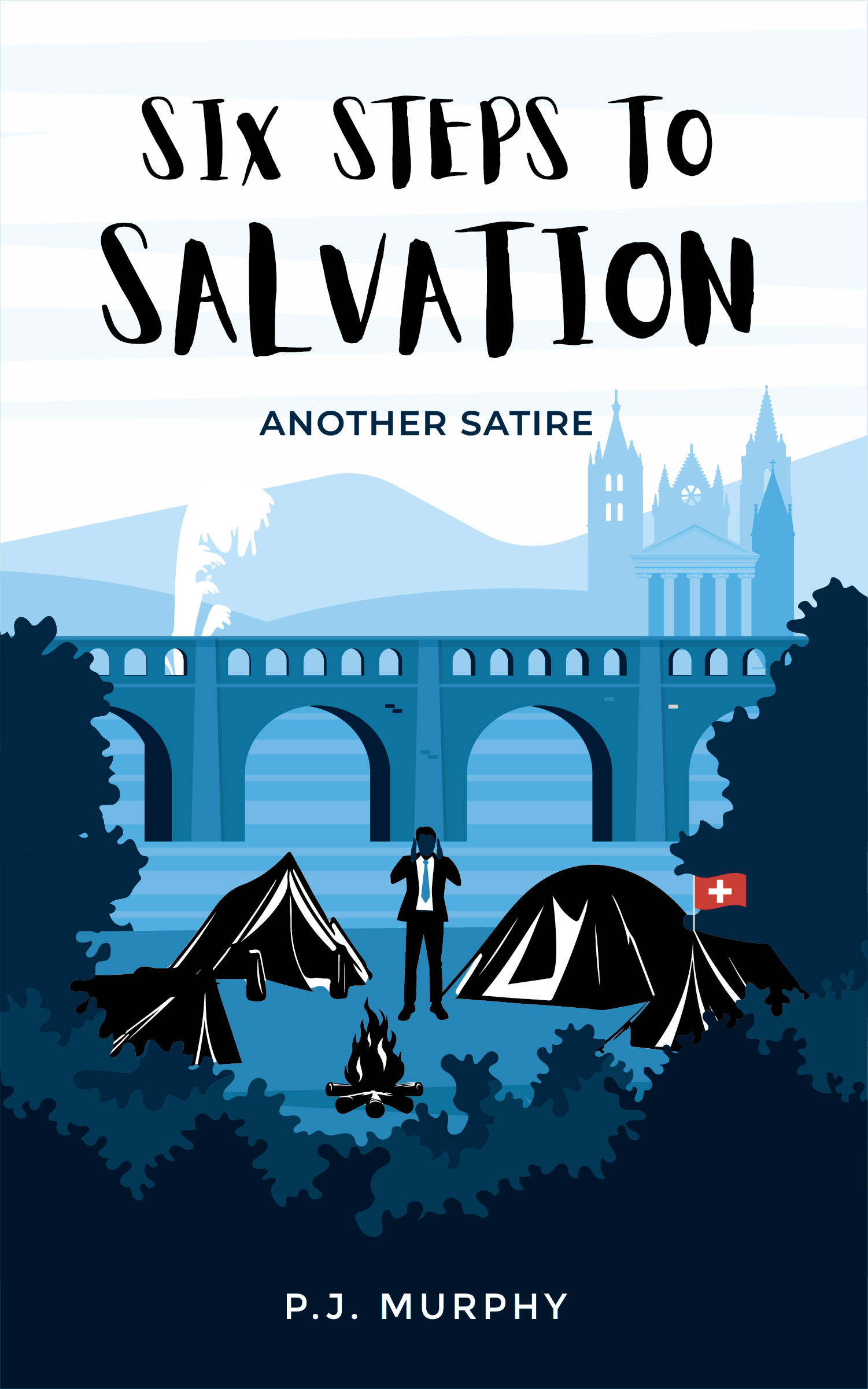
It was easy enough for Trent to identify the exact moment he hit rock bottom. It happened while he was vomiting his guts out beneath Geneva’s Pont Butin bridge, his sleeping bag clinging to his legs like a drowsy lover. He had never been able to hold down his beer, but the Coop’s Prix Garantie Lager Bier was the cheapest alcohol he could find in Switzerland’s overpriced supermarkets.
Trent was on his hands and knees, looking down at the vomit. As it soaked into the soil, he regarded it as a fortune-teller might divine tea leaves. The former contents of his stomach swirled, heralding a scathing message from beyond: ‘How the mighty have fallen!’
How did the great Trent Argent, celebrated entrepreneur and self-styled Community Troubleshooter, come to this?
‘You need a permit to camp here, mate.’
Trent glanced behind him. ‘Je ne comprends pas le français,’ he said by rote before realising that the stranger had spoken in English. The words had been drenched with a heavy Australian accent, but by most people’s interpretation, they were still English.
‘Just playing with you, mate. Welcome.’ The fair-headed young man standing above him thrust out a hand. ‘I’m Hobbs.’
Trent turned over and wriggled out of his sleeping bag, knocking aside discarded beer cans. He was a pale, skeletal thing, a consequence not just of the life he’d led during the previous five years but also of a general lack of interest in health and exercise. In another world, where he had a different personality, he might have been considered handsome, especially in that business suit he used to wear. But in jogging bottoms and a frayed T-shirt, every one of his forty-two years was evident, plus an advance instalment of others he had yet to live.
Trent wiped away the vomit from the corner of his mouth and proceeded to shake Hobbs’ hand. Then, he paused to contemplate whether he had used the same hand both times.
Hobbs didn’t blink. No disgust. No judgement.
‘Need a boost?’ Hobbs pulled Trent to his feet. ‘We noticed you pitch up yesterday. Came to say hello, but you were out. Important business?’ He glanced at the cans.
‘I was meeting my employment adviser,’ Trent mumbled.
Hobbs grinned. ‘Ah, you’re one of us, then? The great unwashed unemployed! Care to join us for breakfast?’
Trent was wary of company, but he needed a drink badly. To be more precise, he needed a non-alcoholic drink badly. He followed Hobbs to a collection of tents surrounding the embers of a campfire. He had seen figures crowded around it when sneaking back the previous night, but he hadn’t approached.
Above them towered Geneva’s Pont Butin, which spanned the gulley the Rhône had carved through the crumbling land. This river valley was a world away from the rest of the city, a haven of nature sandwiched between apartment buildings, tightly packed villas and endless construction sites. A footpath accompanied the river out of the city, squeezing between the water and the near-vertical slopes. In certain places, such as under the bridge, the gap was large enough for a small campsite. The relative privacy it afforded, and the shelter from the elements, meant this was precisely what had sprung up there.
The bridge was an impressive sight, connecting the two clifftops so traffic could travel seamlessly across one of Geneva’s few river crossings. Further into town, closer to the lake, there were more opportunities to get from one bank to the other, but the circulation there was clogged with spiteful traffic lights and incomprehensible one-way systems. The next crossing further out of town was the frequently gridlocked autoroute. The Pont Butin appeared quite aware of its importance. It was two bridges in one, a grand arch spanning the river, with a layer of smaller ones on top of it, supporting the road.
About fifty metres above Trent, traffic zipped by. Cars, trucks, bicycles and the dreaded e-bike, with which he had already suffered one near-death experience. There was even a decent amount of foot traffic, thanks in part to the view the bridge afforded of the city centre. The cathedral, old town and the lake were visible from there, as though someone had assembled them for a postcard photo. This wasn’t a prime tourist spot, though: it was far too busy with traffic, and to get an unimpeded view, you had to press your nose between closely spaced three-metre-high bars erected to stop people jumping. When the sun was low at the beginning or end of the day, it flickered between the bars like an old-style picture box. The suicide rate had plummeted since the fencing had been put in place, but Geneva was now a contender for the coveted title of “European capital of epileptic seizures”.
In the calm of the campsite, Trent could almost forget all that was above him.
Another young man was hunched over a gas stove. He had broad shoulders and wore an oversized puffer jacket, traffic-cone orange. All around him lay a collection of broken matchsticks, scattered as though he had dived into a vat of them. The air shimmered with whispered expletives. As Hobbs and Trent approached, he looked up. His face was covered in clumps of stubble, like a sun-parched lawn, but that wasn’t the first thing Trent noticed. No, it was the desperation in his eyes. Perhaps this was someone with whom he could find common ground.
‘Every morning!’ Hobbs cried. ‘Why do you put yourself through it, man?’
‘Why do you put me through it?’ the stubbled man replied. ‘That lighter only cost three francs. I still don’t get why you wouldn’t let me buy it.’
‘It would have meant three francs less for food.’
Another voice came from a nearby tent. ‘For heaven’s sake!’ The zipper unzipped aggressively, and a woman with wild hair in striped pastel pyjamas crawled out. ‘Why do you both put me through it?’
In one seamless motion, she snatched the box, grabbed one of the remaining matches and lit the flame on the gas stove. Then she disappeared into her tent, uttering, ‘Mine’s a coffee. And it had better be strong this time!’
The three men waited a few seconds until they were sure the storm had passed. Trent regarded Hobbs, trying to work him out. He had an honest-looking face, but Trent was well aware that this could not be relied upon in character assessment. His skin was tanned dark, not just from the Geneva summer, but with a depth that suggested a great many more spent outdoors.
‘This is Bong,’ Hobbs said, gesturing to his friend, who was now busy balancing a kettle on the stove.
‘Nice to meet you, Bong,’ Trent said.
Hobbs and Bong immediately keeled over in hysterics. Hobbs’ laugh was hearty; Bong’s was more of a snigger, but they both went on longer than Trent judged necessary. He waited patiently until they had settled down.
‘Your name’s not Bong, is it?’ he said.
Bong winked at Hobbs. ‘Absolutely, it’s Bong. That’s the truth.’
Trent had too much of a headache for such nonsense, but that cup of tea was tantalisingly close, so he bit his tongue.
‘And the other member of our group is Amara,’ Hobbs continued. ‘But we just call her A.’
‘No, we bloody don’t!’ Amara shouted from her tent.
‘You’ll have to excuse her,’ Hobbs said. ‘Wrong side of the bed, and all that.’
‘If I had a bed, I’d be a different woman!’
Hobbs sat down on an upturned crate and gestured towards a moss-ridden log. ‘Pull up a stump.’
Trent did as invited. They waited quietly for a few minutes while Bong made the drinks. There was such a look of concentration on his face that no one dared distract him. Besides, Trent wasn’t about to complain about a bit of peace and calm.
At the same moment that the drinks were ready, Amara emerged from the tent, a woman transformed. Whatever equipment she had in there had tamed that wild hair into a pristine plait. Trent guessed that she was of Indian heritage, and she carried it proudly, with ornate chandelier earrings and a long burgundy dress patterned with gold. She grabbed her coffee and perched on a tree stump on the other side of the small clearing from Trent without acknowledging him.
Trent regarded his tea with dispassionate interest. To call it “tea” was a bit of a stretch. The lukewarm water appeared supremely disinterested in being infused, and it didn’t help that they had shared one teabag between three cups. He didn’t bother asking for milk. One thing he’d learned since leaving the UK was that having milk in one’s tea was not just unusual on the continent, it was positively frowned upon – in the same vein as baked beans and Cadbury chocolate. Not that he would have been hugely confident about drinking milk left out on that campsite overnight anyway, not in July.
Slightly-brown-tinted water it was, then.
‘So,’ Hobbs said to Trent. ‘Are you interning here, too?’
Trent wasn’t sure whether to find that flattering. Even on his best day, he looked at least a decade over internship age – and his “best day” was years behind him. But this was an opportunity. He had travelled to Geneva seeking new beginnings, with the nonprofit organisations clustered around the UN headquarters like limpets to a ship’s hull. Time to start building his new identity.
‘Not exactly,’ Trent said. ‘I’m looking for work. I’ve got a few interviews lined up. I was a big deal back in the UK. I’ve come here to give something back.’
“A big deal”. Listen to yourself, man!
Trent battled the urge to tell them he used to be a millionaire. Back in the day, he hid this for professional and personal reasons, avoiding the scrutiny it brought with it. But now, he was ready to wave it around because it offered him... he wasn’t sure... a certain level of legitimacy, perhaps? In reality, it wouldn’t have offered him even that. If he’d have told these people about it, they would just have laughed at him, this drunk, sleeping rough under a bridge. Even if they’d believed him, what would it have proven? That he was stupid enough to lose a fortune. What legitimacy did that give anyone?
‘Too old, I guess,’ Hobbs said.
Trent failed to hide his flash of disappointment. He had a good two decades on these kids, although not everything that had happened in that period had been “good”. He had begun to warm to the idea of pretending they hadn’t happened.
‘We’re here interning,’ Hobbs continued. ‘Various gigs. At the moment, we’re doing a stint with the IRA.’
Trent coughed out his murky water.
‘International Refugee Agency,’ Hobbs said slowly. ‘Don’t tell me you haven’t heard of them. They do good work.’
Trent reflected that some acronyms apparently didn’t have as much international meaning as he might have thought.
‘I’ll add them to my list to look up,’ he said. ‘And you?’
He addressed Amara, not out of any particular interest in where she was interning but because she was glaring at him. In his experience, it was essential to involve the silent people in any group. It was the best way to influence what they might say after he’d gone, when they would start speaking their minds.
‘Reporters Everywhere,’ Amara said.
Trent almost spit out his tea again. Reporters Everywhere, that sounded like a fever dream. His experiences over the years with journalists had been – what was the word? – complicated. He certainly didn’t want to relive them right then, even for a fraction of a second.
‘She’s on the other side,’ Bong said. ‘Just reporting on things. She doesn’t get involved.’
Amara scoffed at that. ‘I’ll have you know that journalists have more impact on the world than any of your international organisations. We change minds. We mobilise people. All your people do is bureaucracy, bureaucracy, bureaucracy.’
These were Trent’s new neighbours, the first he’d had since childhood – unless you counted the fellow residents of the motorway hotels he used to frequent. Trent had rarely stayed in one place long enough to make roots. Anyone he had met had always been related to the job, and it had been critical to avoid getting too close to any of them. It was much harder to screw people over if you liked them, not if you wanted to keep any part of your soul. So, Trent had connected with no one.
Apart from the reporter.
Trent shook himself. He couldn’t let himself go there, not in front of others. Besides, he had just remembered about his job interview later that morning. He was still only halfway back to full consciousness. Just one thing would take him the rest of the way.
‘Thanks for the…’ Trent forced himself to say the next word, ‘tea. Where’s the best place for a shower around here?’
Bong pointed towards the river. ‘Shower, tap, toilet – all our needs in one!’
Trent sighed inwardly but feigned a smile. He thanked them again and made his excuses, backing away with a bow of his head.
He fished a shirt and trousers from his tent and descended to the river, stopping behind a bush to strip down to his underpants. The water glowed fluorescent turquoise, where the clear water from Lac Leman met the sediment from the Arve. Back in the UK, he would have assumed nuclear contamination; here, he accepted nature at work. Still, his body was ill-prepared for the cold.
As Trent tiptoed into the water, his calf muscles tensed. He gritted his teeth and forced himself to paddle deeper. He couldn’t turn up at a job interview smelling of beer, sweat and vomit. It was one of many trials he would endure on his path to redemption.
*****
Anton Fredevich watched, and he waited. And he drank Aperol Spritz.
The cafés of Geneva did not fully uphold the legend of European café culture. These were not the boulevards of Paris, with their chic names, fascinating history and general haughtiness. This terrace was little more than a collection of tables blocking half of the pavement, with a fine view of traffic waiting impatiently at one of Geneva’s perpetually red traffic lights. But this would do. He could go unnoticed out there, sipping cocktails with the international workers taking an early lunch break, and trying to ignore their self-involved conversation.
How he hated them. Their institution was their world. They spoke about going into “the field” like it was some game. It was his reality. He had fought his way to the top, clambering out of the mud. It had taken determination, strength and blood. More of other people’s blood, perhaps, than he cared to admit. But it certainly hadn’t taken paperwork.
That was the difference between him and them, not the label they had given him, which pursued him from country to country. Achievement, in his world, was something tangible, not just words on a screen.
Fredevich gulped his drink. He was used to stronger, so it did little to mute the interminable chatter from the next table.
He stared at the building across the street, as though that alone would liberate the object from its prison. He needed to find a weak point.
*****
Trent checked himself in the pizzeria window. Not bad, he thought, given the state he had been in an hour earlier. It hadn’t been the best of ideas to get inebriated the night before an interview, but it had felt necessary at the time. It was almost as though the old Trent, who thought this whole venture was a complete waste of time and money, was repeatedly pressing the self-destruct button. There was no point in trying to redeem himself; it wasn’t worth the effort.
Not that going back to the UK was really an option, either. He was a pariah there now, with his questionable business dealings exposed. This had been as big a reason for him leaving the country as the lure of Geneva’s nonprofits.
The man at the nearest table scowled at him. It was an intense stare from little eyes, which appeared to have sunken back into the face, recoiling from the things they had seen. He looked like a brawler, this one, with a square head, close-cropped hair and sturdy elbows. Trent didn’t wait around to find out what currency was funding that glare.
This part of town was known as Nations. It was dominated by the villa where the League of Nations had met between the First and Second World Wars. These days, this housed the European headquarters of the United Nations. The site was known for the array of flags out front, the three-legged chair sculpture outside (a victim of landmines or a carpentry mishap, no one was certain), the peacocks that roamed free on the grounds and the extensive queues for security. At the front lay a concrete square where fountains of water spurted up periodically from the ground, providing a diverting water feature / a nice game for the kids / a deterrent for crowds gathering to protest.
Trent’s interview was not with such a prestigious organisation. He was there to meet one of the NGOs scattered about town, above carpet stores, bakeries and homeware outlets. This one had the good sense or good fortune to be positioned at the heart of the action, opposite a pizzeria that served as an additional cafeteria for the UN workers. What better way to ensure you’re on the agenda of the international organisations that fund you than to be there during lunch? Accordingly, their front windows were covered with posters advertising their cause.
Sheltering from the glare of the man at the pizzeria, Trent crossed the road towards the Geneva headquarters of Halitosis International.


Comments
The premise has potential,…
The premise has potential, but the opening would benefit from a much stronger hook to immediately pull the reader in.
Really interesting premise…
Really interesting premise. The characters are fun and the dialogue feels natural. I'd love a little more description of his surroundings, but overall, it's an interesting start.
I like the idea and for some…
I like the idea and for some readers at least, the image of Trent divining the future in a pool of his own vomit should prove a strong enough hook to keep on reading. It's quirky and entertaining and the dialogue does a good job of establishing voice. In places it feels a little overwritten and I agree that a bit more descriptive detail would add another layer to the text. A good start.