
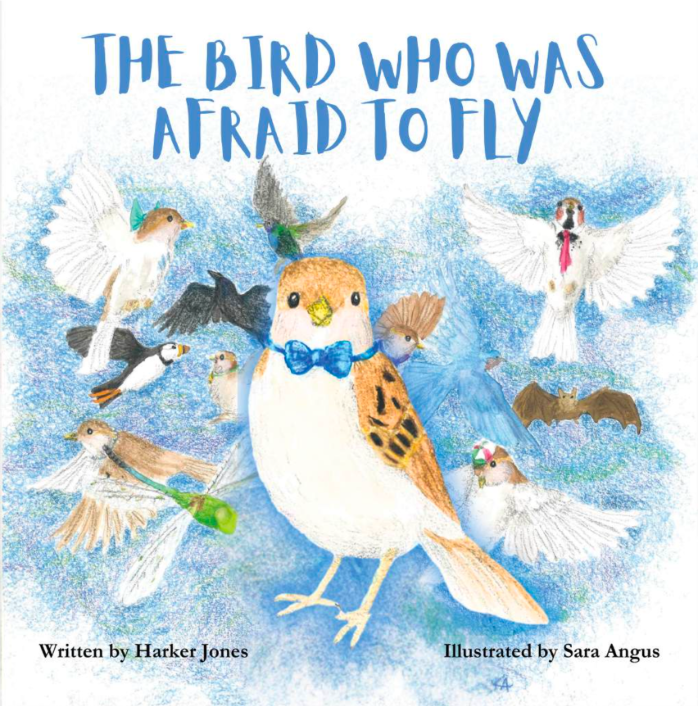
The Bird Who Was Afraid to Fly
by Harker Jones
Once upon a time, a sparrow hatched in Italy.
His name was Sam and he was born in Siena.
The first thing he remembered was the roar and rumble of thunder.
His nest, his nook, his world were quaking.
It frightened him.
He felt vulnerable outside his shell.
So he did what any sensible hatchling would do.
He threw his head back and cried.
Sam had four siblings: Sebastian, Seneca, Simona and Hazel. (Their parents liked alliteration but knew when enough was enough.)
They hatched in that order, with Sam squeezing in between Simona and Hazel.
Sparrows are mostly earth tones when they hatch.
Sam, Sebastian and Seneca had streaks of black and bronze, silver and smoke.
Simona was shaded with browns: caramel and chocolate, dusk and dust.
Hazel was different. She had pink in her beak and blue on her breast. Just streaks, but there they were.
She was the littlest and the loudest.
Their parents, Marcello and Gemma, wanted their children to understand how large and wonderful the world was so they had positioned their nest — made of feathers and paper, sticks and string — in the center of Siena in the plaza called the Piazza del Campo.
They were very high up, in an alcove at the top of the Torre del Mangia, a bell tower that looked out over all of Siena to the boundlessness of Tuscany, Italy’s wine country.
Marcello, his feathers shaded in russet and rosewood, loved to sit with his children and relate stories of the birds he and Gemma had heard tell of: puffins and ravens and starlings, the shining bluebird, the uniformed penguin, the kaleidoscopic peacock, birds who could swim and birds who couldn’t fly.
He also told them of the country — so different from the city they called home — the spangled rivers and the dappled vineyards and the dazzling seas of sunflowers, their heads bobbling hello at you as you rushed above them.
Sam was so captivated by his father’s tales that he’d struggle to stay awake to hear more of the capering sandpipers and fluttering hummingbirds and chittering magpies.
He envied the bluebirds their vibrancy, imagining pieces of sky swooping over the piazza and out to the vineyards, glints of azure and indigo and turquoise.
And the starlings! In his imagination they were stars dropped from the constellations, racing along streets and valleys and copses, leaving streaks of light in their wake.
He could see himself in the country, with the quiet of the wind and the watchfulness of the trees, soaring confidently, brazenly over immense meadows, iolite lakes, whispering prairies, until night fell and the fireflies came.
They would float and flit through the farms and fields, giving the night its glitter.
He longed to gleam and sparkle and shimmer like the bluebirds and the starlings and the fireflies, instead of being just an ordinary sparrow.
“In the country there are so many stars you can’t count them,” his father told him one night as Sam battled to keep his eyes open. “It’s so quiet you can hear the seeds grow.”
It was hard for him to imagine the limitlessness of space or such silence that he could hear seeds grow.
There, in the square, they could hardly see the stars at all, and they could hear scooters and the pops of champagne corks and cries of “Salut!” It was the soundtrack to his life.
The seeds and the stars fascinated Sam, but the idea of being so far down in the ground or so far up, away, into nothingness, boggled his mind.
It gave him a tickly feeling in his belly, like when the bells of the Torre del Mangia rang out. They were so loud they shook the nest when they pealed into the square and across the town, reminding him of the thunder he’d heard when he’d first hatched.
One of his earliest memories was the terror of the bells.
It was late afternoon and all of his siblings save Hazel were sleeping, and she was trying.
Thinking he was as alone as he could get, Sam let curiosity get the better of him and he hopped over to the edge of the nest, wanting to see what all the fuss in the square was about.
Standing near the edge (though still safely inside their roost) he swallowed hard,
counted to four (three never being quite enough)
then braved a look down to the busy little courtyard.
There were stores and restaurants and people, eating ice cream and buying mementos and taking photos. There was so much color his heart thrilled, and suddenly some of the smells and sounds he’d never known he knew made sense.
Then the bells, without warning, started clanging, echoing through the square and tremoring the tower.
Sam’s stomach turned over on itself and his legs started to shake.
He teetered.
He tottered.
And he feared in a rush of horror that he was going to fall.
He let out a cry and fell backward, safely into the nest, hiding his head under his wings and quaking like his heart would stop from fright.
He never wanted to look down, or up, or go to the edge ever again.
Every day at dusk, the swallows of Siena took to the sky, reeling and crying over the city.
Sam and his family were the minority in the town where the colorful swallows were prevalent. When they circled above, snatching insects from the air, Sebastian and Seneca and Simona and Hazel all threw back their heads and dreamed of the day they, too, would fly free.
“I want to fall,” Sebastian would say.
“I want to be fast,” Seneca would say.
“I want to be free,” Simona would say.
But for as much as he tried (and wanted!) to be like his siblings, to fit in, when Sam looked directly up, whether it was nothing but the cerulean of the sky or his neighbors careering above him,
his stomach would drop,
the nest would spin,
and he would feel the terror of dropping,
tumbling,
plunging to the earth so far below.
Then he would tear his eyes away and bury his head under his wings again until his heart was no longer addled.
He told no one about this, but Hazel gave him a couple of funny looks.
One cold, blustery night, after the others had fallen asleep, Sam squeaked out from between Simona and Hazel.
There was a brisk breeze, clouds creating a nimbus around the moon.
Lingering thunder grumbled and groused, and Sam huddled up against Gemma.
“Are you frightened of the thunder?” she queried.
Sam found the courage to nod. “It makes me think of when I hatched,” he told her. “It makes me feel like I’m going to fall.”
“Baby, there was no thunder when you hatched.” Then she understood and laughed. “Oh, you must mean the Palio!”
She told Sam that the Palio was a horse race that had been taking place in the Piazza del Campo for centuries. Twice a year, the people of Siena assembled in the plaza to support the ten contrade — districts that stretched outward from the piazza like spokes on a wheel — that had been chosen that year to compete in the courtyard contest.
The idea of horses heartened Sam.
“You must have heard the hoofbeats and the crowd,” Gemma told him. “The second race takes place in a few weeks. But by then you’ll be a big boy and will never need fear thunder again.”
This mysterious “Palio” was as glamorous to Sam as the bluebirds and the starlings and the fields of gold. He longed to soar over the horses and jockeys, cheering them on.
This fancy kept him awake later than usual.
So after the clouds cleared, he was still alert, huddled in the back of the nest, where he could look up from an angle, which didn’t ignite his fears, when a colony of shuddering, twitching bats took to the sky, their silhouettes quivering and quavering in front of the moon.
Because bats couldn’t see very well, they weren’t able to fly as fluidly as birds, which made birds feel superior to them. Bats had to maneuver through the air by sound, and that made Sam envious.
The bats may not be as graceful as birds, he thought, they may twitch and jerk and jolt, but if I couldn’t see, I might not be so afraid. So I think they’re marvelous.
One day Sam awoke to find his parents already gone, though the sky was still early-morning white.
Sebastian and Simona were standing on the edge of the nest, looking down upon the square.
“Come join us,” Sebastian beckoned.
Sam feigned a yawn so they would allow him to go back to sleep.
Simona gave him a queer, suspicious look. “How come you never come to the edge?” she asked.
“I’m there all the time.” Sam snuggled in next to Hazel.
“But you’re not.” Sebastian was realizing how true it was.
Then Simona did it. She asked, “Are you afraid?”
“Of course not!” Sam retorted as indignantly as he could.
“Then come to the edge,” Sebastian urged.
Sam didn’t know what to do.
He hadn’t been confronted before.
But at that moment he was more afraid of being found out a chicken than he was of falling, so he stood and, focusing on Sebastian’s face so he wouldn’t plummet into the sky, stepped toward them.
Nothing to it.
He felt a surge of bravery, of ambition, of hope.
When he was close, he hopped onto the edge and,
though his stomach got muddled and his knees woozy,
he held his own.
He stood that way for a few moments, working up his courage.
He swallowed once.
Blinked twice.
Counted to four.
Then tilted his head down.
He saw the busy-ness of the square, the merchants and the restaurants and the streets leading away from the plaza.
Everything was fine.
Then suddenly the ground came rushing toward him,
and the sky closed in on him,
and he felt himself start to slip.
He cried out in a panic before wrenching backward into the safety of the nest.
Seneca and Hazel awoke with the commotion, dodging out of the way just before he crashed into them.
Sebastian and Simona jumped down and they all exchanged glances, then turned to Sam, not demanding so much as curious.
But Sam was still fearful,
his stomach still jumpy,
his heart still jittery,
and he felt pressured, vulnerable and trapped,
so he blurted out the truth:
“I’m afraid I’ll fall!”
There was an audible gasp from the group.
Then Hazel started laughing, suddenly and loudly.
She fell to her knees and held her belly she was laughing so hard.
She had never laughed so hard in her life.
“But don’t you want to fall?” Sebastian questioned.
“Don’t you want to be fast?” Seneca queried.
“Don’t you want to be free?” Simona quizzed.
“Yes!” Sam sniffed.
“And I want to see the bluebirds.
And the fireflies.
And the starlings.
And I want to soar with the swallows
and race with the horses in the Palio.
I just … can’t.”
Hazel had gotten herself together enough to exclaim, “A bird who’s afraid to fly is like a fish afraid of the water!”
Then she promptly fell into another fit of giggles.
“Dodos couldn’t fly!” Sam argued, resentful.
“And look where it got them!” Seneca retorted.
“Well, penguins can’t either!”
“They fly through the water,” Simona countered.
“Ostriches, emus and kiwis can’t!”
“The difference,” Sebastian said simply, “is they can’t. You’re the only one who won’t.”
When Marcello and Gemma found out (there was no use trying to keep secrets in such a small home), they conferred worriedly. In all their experience, they had never heard of such a thing as a bird afraid to fly.
They approached Sam, who had taken to huddling against the far edge of the nest.
“Sam,” Gemma said gently. “Maybe you should just pretend. Practice. That’s a good way to learn.”
“Practice makes perfect,” Marcello added.
Seneca swooped past them, going through the motions of flying, flapping his wings to show Sam how easy it was.
“See? It’s simple.” Marcello nudged Sam. “Why don’t you give it a try?”
Sam eyed Seneca carefully, then slowly got up and followed suit, beating and fluttering his own wings.
He rose a couple of inches off the floor of the nest, and his heart thrilled, though he didn’t know if it was from exhilaration or anxiety.
The others clapped their wings in encouragement.
“Hop up on the edge,” Gemma urged. “Just to look.”
And then everyone — Gemma, Marcello, Sebastian, Seneca, Simona and Hazel — was looking at Sam.
With expectation.
“Don’t look down,” he heard Sebastian say as he moved to the edge of the nest.
“Don’t look up,” he heard Seneca say.
“Just look out,” he heard Simona say.
“There’s nothing but what’s in front of you,” he heard Hazel say.
And Sam liked the idea of that. Nothing but what lay before him.
So he stepped onto the edge of the nest.
He didn’t look down.
He didn’t look up.
He looked out, over the town, into the country, as far as he could see.
There were soft golds and rosy pinks and milky whites on the horizon,
and a mist skimmed the vineyards.
It wasn’t so scary.
So he took a breath.
Counted to four (three still not being quite enough).
Thought of the fireflies.
And the starlings.
And the horses in the Palio.
Yet still he hesitated.
Then he heard from behind him, “Oh, why not.”
And before he had time to consider it, he felt a small but firm nudge.
And Hazel was pushing him.
Off the nest.
Into the air.
He opened his eyes and saw the world rocketing forward,
the tower zooming by him,
the ground rushing toward him.
Time turned over, slowly, just as he was turning in the air.
And he realized the only option he had was to spread his wings.
And fly.
And so he did.
It wasn’t that the ground stopped surging toward him so much as he began moving parallel to it.
And once his wings caught the air, he could appreciate the potency of his body, the bright quickening in his heart at what it felt to be aloft.
He opened his eyes and delighted at the piazza, at the cafes and the shops and the people, and he wasn’t frightened.
He rose up on the breeze, his wings taking to the wind without his even understanding, and he knew he would never be afraid again.
He gazed out over Siena, and beyond it he could see the countryside — the vineyards and the farmhouses and the fields — bathed in the golden light of late afternoon.
Now he could go there.
He could bob with the bats.
He could flit with the fireflies.
He could soar with the starlings.
He could be fast, and he could be free.
But first, he had to return home.
When he landed on the nest in the bell tower, his family rushed to surround him, almost as thrilled as he was. Hazel was a little shy, afraid he’d be cross, but he gave her the biggest hug of all.
“It was brilliant!” he proclaimed.
“There are many things we can do on our own,” his father said. “But we all benefit from a helping wing now and then. And there’s no shame in that.”
“Nor in asking for help,” his mother added.
“You all helped me,” Sam said, “in your own way. Sebastian and Simona, you urged me to the edge. Seneca, you showed me how to fly. And you,” he said to Hazel, “you pushed me. And I flew.”
The next week, as Sam and his siblings readied to set off on their own — Sebastian would be Sam’s neighbor in the country, Seneca and Simona would remain in town, and Hazel was still deciding — Sam realized his heart was racing in anticipation of his freedom.
But as ready as he was for his new life to begin, he was sad to say goodbye to his family.
So he gave them all big hugs and there were boisterous promises to visit.
Then he and Sebastian took to the sky, soaring over majestic cathedrals and fertile fields and through gleaming Tuscan sunlight until they found a lovely thicket at the edge of a vineyard where Sam set about creating the perfect nest.
Weeks passed and Sam met twinkling fireflies,
and starlings (who were nothing like he’d imagined)
and bluebirds (who were much more so).
He wiggled and jiggled with the bats.
He sailed over seas of sunflowers.
He soared with the swallows over Siena.
He even swore sometimes he could hear seeds growing deep in the earth.
And at night the stars felt close enough to touch.
Then one day in mid August, he and Sebastian flew to the town square. They met Gemma and Marcello and Seneca and Simona and Hazel, and they had a merry reunion.
And when the bells rang out (their thunder no longer frightening to Sam),
signaling the start of the Palio,
he hopped onto the edge of the nest to see the colorful banners,
the flapping flags,
the lively people in the square,
and he took one step into the air (no need to count to four)
and dropped toward the horses and their riders,
until he was just above their heads.
He swooped and wheeled above them, racing with them, the hoofbeats and the cheering of the crowd deafening, until he was flying above the winner’s circle.


Comments
This is super cute! I…
This is super cute! I imagine the illustrations are just as good. I love the characters, and the imagery is great!
I love the premise. It's not…
I love the premise. It's not original but themes like this never fail to absorb the younger reader. Which I think is precisely the main problem here. Everything about it screams storybook with lovely colourful illustrations but the text itself is quite long and contains words I suspect are too difficult for what I think the age range should be for a story about a bird too afraid to fly. By cutting out unnecessary detail, simplifying the story and making the format more engaging, I'm sure that this would make a great experience for a young reader.
The tone feels playful and…
The tone feels playful and engaging, which makes it very enjoyable to read. It is especially encouraging for young readers and creates a fun reading experience that can easily hold their attention.