

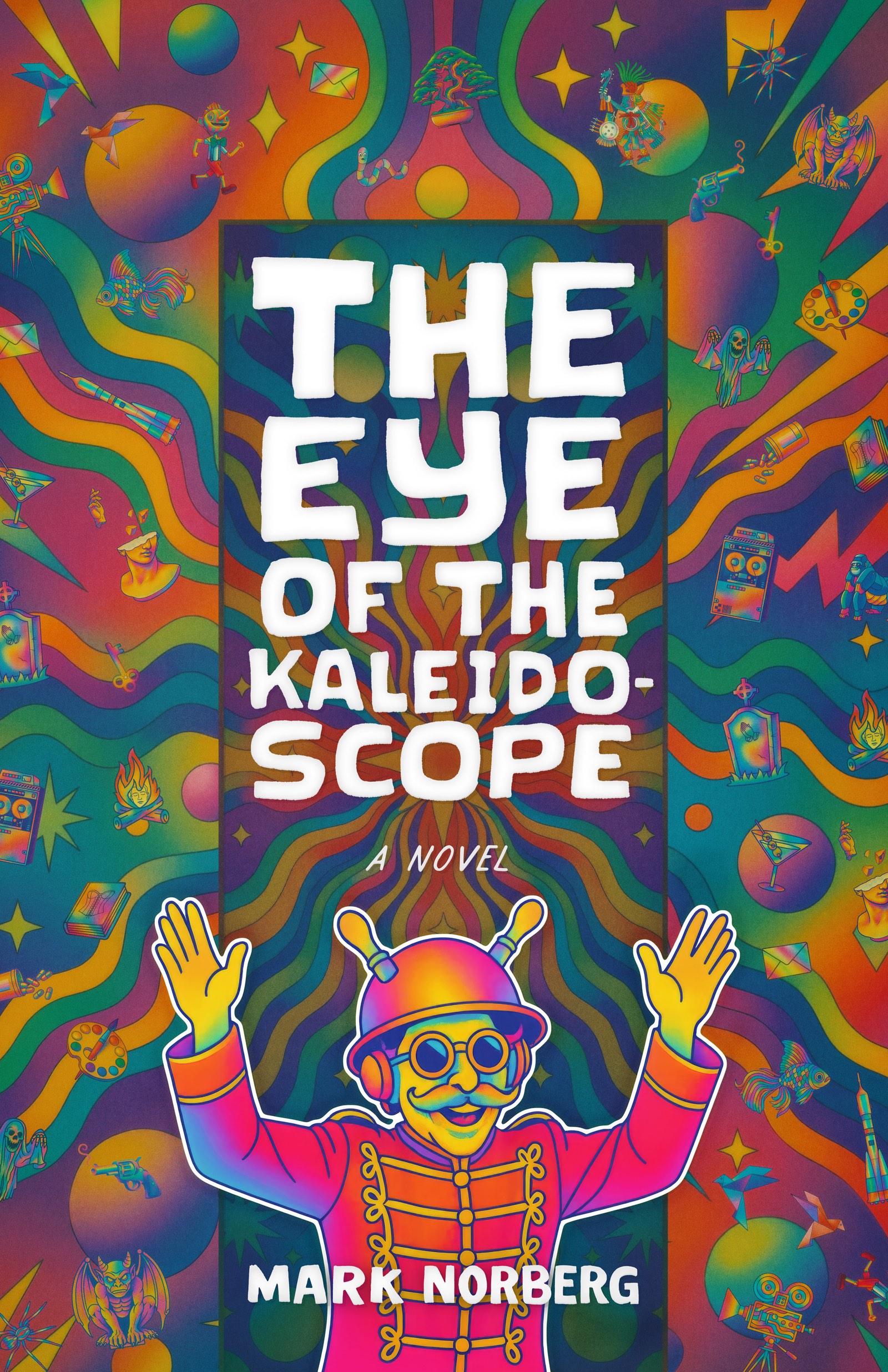
CHAPTER 1
The illumination from the skylight fell in pale shafts about the old man as he eased back against his chair and sighed. Resting a paint brush still wet from recent strokes onto a nearby table, he considered the thing which had consumed and weighed upon him and which he had tended to for the last time. The sensation the small painting evoked in him, as it had done almost from the very beginning, was like being in the presence of another person – although more potent than even that: it was, he thought, like sharing the room with a parallel self. Or, like gazing into an enchanted mirror with reflections that moved and brooded independent of the viewer. As he had worked the pigments across the canvas, wresting them into their final image, this parallel companion had slowly taken parts of his own self into it, emptied him out, and then grown ever more ravishing. Now it stood, braced to its easel, and called to him in that voice, rapturously pure, with which he could no longer contend. But, he thought, he need no longer try – for the painting was finally finished.
Rising, he turned from his creation, shuffling across the wooden floorboards as he passed through the attic studio, and then, exiting, closed and locked the door forever – keeping the key gripped tight throughout the evening and deep into the night. He held onto it as one who is suspended above a bottomless chasm might cling to a fraying cord – and while it tethered him for the moment, and comforted, in its way, as an anchor to an accustomed safe reality, he nevertheless felt the slow slip towards an impending fall. It was still held fast in his palm the morning of the next day when his housekeeper, coming to rouse him, found him dead.
***
After nearly two decades directing films in Hollywood, Jeff Tanner was living proof that while you get more flies with honey than you do with vinegar, you get the most with simply a big heaping pile of shit. His latest venture, the blockbuster Quarterback Commando – about an NFL star recruited to lead a team of Navy Seals into the heart of the Taliban – certainly qualified as the quintessence of this axiom.
“God damn, Jeff! Another stellar week!” shouted Murch, his long-time producer and partner, loud enough to incite looks of alarm from the secretaries pretending to work just beyond the glass walls. “Get a load of these numbers – we’re only down 15% from last weekend. Lewis has got to be popping his prostate!”
Jeff winced. Murch had a unique talent for turns of phrase that were often pornographic, usually misogynistic, but always disgusting. “Jesus, Murch, why are you so competitive with him? He’s doing his own thing now. Why do you care?”
Murch’s face jolted into a frieze of disbelief at the question. “Are you fuckin’ kidding me?” he scoffed. “We totally ass-fucked that pussy-picture of his, Finding Emily – and who the fuck cares about ‘finding Emily’ anyway? NO ONE. No one wants to watch bitches in hoop skirts. They want a flick with balls! And that, buddy, is what we’ve got up on those screens – big greasy, swollen, hairy balls – and the crowds are lining up to tea-bag it!”
Murch bellowed with delight – his standard reaction whenever concocting a metaphor even he considered ingeniously vulgar. As Jeff watched his partner devolve into a coughing fit and down another antacid, he was stopped by a peculiar sensation. It was a feeling that had begun recurring lately. Although he had known and worked with the man for years – their partnership had been insanely profitable – Jeff had always taken for granted that the two of them existed in distinct and separate artistic spheres: Murch made the only kind of movies he could, while Jeff (bowing to the practical) made the kind of movies he knew could get made. But today, at the head of this thought, as he stopped to actually consider exactly what separated the two of them – what it was that allowed him to feel so critical of Murch and so independent of him – he found he could not name a single thing.
***
“Okay, so it starts just like the real version – Pinocchio and his little grasshopper sidekick dancing around this dumpy village toy shop. Nothing but clocks and marionettes. Just put a bullet in my head, right? Hey, you listening?”
“Yeah, I’m listening,” Jeff groaned in exasperation, killing the last of his second martini. Diane sat half-turned from the both of them, rolling her eyes in exaggerated annoyance.
Jeff had agreed to meet his two friends after knocking off from the studio, but was now regretting not spending the night alone. His thoughts about Murch had set something in motion – ideas he could feel moving about at the fringes of his vodka-fuzzed consciousness. But Dirk was talking now – and both Jeff and Diane knew the general direction his story was sure to go. While Jeff’s partner Murch’s crassness had been a perpetual irritant to their friendship, somehow, Dirk’s sense of humor – while nearly just as perverse – had an innocent, hapless quality that Jeff found endlessly entertaining. Usually.
“So they’re dancing around and suddenly the Blue Fairy shows up – which is where I introduce my unique creative touches –” Dirk resumed with a boyish leer, restating his subject for the third time.
“Wait – is this a cartoon or what is this?” Diane suddenly interjected, having concluded that since Dirk was obviously going to finish the story she might as well get up-to-speed on what he had been babbling about the last several minutes.
“If by ‘cartoon’ you mean animated film, then yes, it’s a cartoon. It’s a re-edit I did of that stupid CG project they’ve got us working on,” Dirk answered archly. “Like I said, I made a secret copy of the original files. I just explained that like three times.”
“Well, I’m sorry,” Diane shot back. “All I can focus on is making sure you don’t break out into song.”
“What are you talking about?”
“You’re drunk and getting worked up. We all know what comes next.”
“But I’m a fantastic singer!”
“You don’t sing,” Jeff countered. “You yodel.”
“And at the top of your lungs. I’d like to be allowed back in here,” said Diane.
“Do you mind? Do you mind? May I finish, please?” Dirk said in comically exaggerated annoyance.
“Fine. Christ. We’re sorry. Continue,” said Diane, always the peacemaker.
“So, in my revised version, they’re dancing around, acting like idiots, singing about how honesty is the best policy,” Dirk reiterated, building back his momentum, “when suddenly, the Blue Fairy shows up. Well, first of all, she’s now topless — with massive areolas, nipples like plugs of bratwurst – ” pausing for dramatic effect, Dirk allowed just enough time for “Oh, god, no…” – this from both Jeff and Diane, which did nothing to slow Dirk’s accelerating enthusiasm: “And then we made Pinocchio go, ‘Oh, Hoppy!’ – that’s the grasshopper’s loser name – the brass were worried about copyright issues if you can believe it – ‘Oh, Hoppy! What’s happening?’ and then Hoppy the grasshopper – looking down at his friend’s crotch and to the sound of lederhosen ripping asunder – this grasshopper sez, ‘looks like your nose ain't the only thing growin’ Pinnoch!’”
“Uuuggg!” Diane groaned while Jeff managed a curt, “Jesus!”
“Wait, it gets worse,” Dirk continued, “without skipping a beat, the Blue Fairy lifts her skirt, and in the sleaziest Mae West voice sez, ‘you want yer dream to come true? Well, first you gotta make me ‘come true’ –”
“Stop!” interrupted Diane, “I don’t want to hear any more!” Both she and Jeff choked back their drinks, laughing at both the depth of Dirk’s depravity and the humiliation at finding it hilarious. “And so totally wrong,” Jeff added.
“I know – it’s horrible. But somehow brilliant at the same time,” Dirk beamed. “Except I’m probably going to get fired.”
“What do you mean?” Jeff asked.
Dirk pulled out a cigarette and ignited his lighter using that fascinating, off-handed side-swipe that Jeff still could not quite figure out – “I emailed the cut to some other animators at the studio. If I could have remained anonymous, the plan was to swap it into the shareholders’ private screening. But I think the CEO found out. He sent me a meeting request for Monday. I did it all on my own time – but I’m probably screwed. I know he thinks I’m a ringleader.”
Jeff made a half-assed attempt at consoling his long-time pal by asserting that Family Films, Ltd. could hardly afford to let one of their top animators go – and that at worst, he’d get some kind of warning. Who knew? They’d treated him with kid gloves before. After all, this was the guy who still had naked Barbie dolls at his desk with felt triangles of pubic hair pasted to their groins. What’s more, he’d yet to yodel even once that evening. All was not lost. The text from Jeff’s sister arrived just as they ordered another round: “call me. asap.” Perhaps he’d spoken too soon.
***
Three martinis were really not so bad, but he always forgot how tired he felt the next day. Jeff cut the ignition and popped an additional aspirin. Up and down the street, rows of oak cast a tattered flutter of shadow across lawns that stretched back to silhouettes of dark, mountainous homes. Across the street, and tight up against the crumbling sidewalk, a dense hedge ran for a good fifty yards in either direction, demarcating one of the larger properties in the neighborhood. Within its shaggy overgrowth, the ornamental grillwork of a black and rusted fence wended, leading the eye to a gate that sagged off-center at its eastern edge. The whole area was one of those strange backwaters, miles from Los Angeles, which had promised in its early days to be at the vanguard of exclusivity, where waves of elite had poured for a time, but then, when their fortunes had waned, their tide had receded – leaving behind this isolated heap of low-slung castles and mournful gardens. The spell of the place lifted for a moment and the reason for the trip returned to the forefront of Jeff’s mind. He stepped out of the car and walked toward the gate. Another surge of nostalgia overtook him and he welcomed the thousand tiny windows back into time that flew past and through him.
“Thirty years…and more surreal than ever,” Jeff thought. “Like something out of a lost Tennessee Williams play.”
Sharp movement at the edge of his vision arrested his attention and he turned in time to see his sister Ann arrive in her rental car. She hopped out and ran to him, cradling an assortment of large envelopes and fumbling with at least two oversized purses, her smile accompanied by eyes brimmed with tears.
“Well, here we are in Spain!” she said, wrapping him in a vigorous hug.
“Here we are in Spain,” he returned, squeezing her back, feeling drops fall from her cheek to his, while they both laughed at the greeting they’d shared since childhood.
“Christ, that flight was awful,” Ann gasped.
“You didn’t have to kill yourself getting here,” Jeff said, keeping his arms around her.
“No, I needed to come right away. I guess it wouldn’t have been so bad to arrive in a day or two, but it turned out there was a flight out of Boston last night,” she said, then adding while giving Jeff another embrace, “and I’m glad I rushed. I’m glad I’m here. With you.”
He hadn’t seen Ann in five years. They were both so busy now, and living on opposite coasts. Years ago, she had gone off to study English literature and creative writing and then moved to Massachusetts to teach while he went to California to make it in the movies. In those early days, when they had been off separately wrestling with their career tracks, Jeff had always felt that his sister had tried for less than she was capable. What had he wanted her to do? He couldn’t say. That she had a spark of greatness had been a certainty to him. And that gift came with obligations that demanded more than teaching at an obscure liberal arts college. He, in turn, had struggled to win the respect of his industry colleagues, which had taken more years than he had expected, and even now that respect was more grudging than anything. He wondered how much this reproof of his sister had been nothing more than anger that she hadn’t experienced his same frustrations.
In the end, with the advent of his immense success, this mild irritation towards Ann had eventually dissipated – although he had lived with it long enough for its presence to wear small but regrettable grooves into his consciousness. Now and again, he would brush up against them and feel shame at these tired criticisms. He needed no reminding of her true significance to him. Seeing her now, with her wonderfully harried demeanor, she gave him that unique sense of something, a kind of permanence that he had never been able to fully achieve since moving to the west coast.
“I’ve got the house key and the alarm codes if we need them. Jacob had it Fed-Ex-ed to the hotel,” she said, holding up one of the envelopes. “But Mrs. Doss said she should be here. Let’s go on in.”
“Ann – you didn’t get a hotel room. I mean, why aren’t you staying with me?”
“Oh, no,” Ann replied, and Jeff could see she had no interest in a debate, “this makes things much easier. There’s no way I want you to have to worry about me while you’ve got a studio to run. And it’s super close to the airport for my flight to San Francisco tomorrow. Really, it’s much easier this way.”
They opened the main gate and walked up the path to the house, making their way through the sculptured expansiveness of the Japanese gardens that encircled the grounds. It was a bit shaggier for the wear, though retaining much of its former glory – and if an iciness had crept in among its serenity, the blanket of dead leaves seemed to encourage restoration in the mind’s eye. Jeff remembered their first visit to the place, just after Uncle Aaron had really hit it big and was celebrated as a fantastic new talent, and then needed to be alone, and so had purchased the tucked-away estate. Back then, as children, they had bounded along this same path and had been struck by the sight of a slight, elderly man tending to a miniature tree. “That’s Mr. Lee,” their uncle had said. “He’s an artist.” The pronouncement had seared the image to the word and to this day Jeff associated it with the care of growing things. Passing over the bridge of the koi pond, the two were stopped short by a sudden and frantic perturbation across the surface of the water.
“Poor things! They haven’t been fed for days!” came a familiar voice and then the figure of Mrs. Doss, Uncle Aaron’s long-time housekeeper, bustling towards them from the house. Dozens of tiny gaping mouths opened and snapped beneath them as she threw food pellets over the side of the bridge.
Her task complete, she returned to her visitors with a weary, “Oh, my dears,” then reached out to wrap them both in her ample arms. For the second time that day, Jeff was home. The trio continued on into the house, holding on to each other, their voices low, speaking of the dead. They sat around the kitchen table that afternoon and talked until nightfall, the glow of the kitchen window spilling out into the quiet of the garden, its light running along the sleepy hedges, and landing in scattered flecks upon the pond whose waters had long since relaxed into a mirrored sheen.
CHAPTER 2
The fire that Mrs. Doss had started in the study before leaving had noticeably ebbed, but the leather club chair into which Jeff had burrowed and the wine which he and his sister had liberally divided – in honor of spending one last night in the home of their beloved uncle – stayed any efforts towards disturbing their tableau.
Uncle Aaron was dead.
It was still so strange to think. And now, Jeff and his sister had the task of wrapping up their uncle’s affairs, closing down the remains of a life that had loomed so large within theirs. But Ann was talking, and he had drifted.
“You’ve got it all wrong,” Ann continued, stretched out on the sofa and pivoting the stem of her glass between her fingers, “it all started because you were critiquing something I’d written – I was probably in fifth or sixth grade, by the way – and you told me that a true writer never states the obvious. I can’t believe you forgot.”
“Oh, yeah,” Jeff drawled along with a spreading grin, “that’s right…”
“And then, just to prove you wrong, I said it would be the first thing I uttered if I ever went to Spain.”
“And have you?”
“Of course! And, as a point of honor, it’s always directed to someone. Usually a flight attendant.”
At this, they both cracked up.
“And so you see,” Ann concluded, “you’re not the only one who has lived up to their childhood ambitions.”
“Oh, come on now,” Jeff responded earnestly, “you’re a published author. That’s a fantastic accomplishment.”
“Oh, god,” Ann said, chuckling with a roll of her eyes, “a collection of essays is hardly the brass ring – and any time you have to put ‘published’ in front of the word ‘author’…”
“What?” Jeff asked. “What’s wrong with saying ‘published’?”
“OK, yes, I am published. But so is a Sears catalog. No one ever puts ‘published’ in front of serious writers. They don’t need the extra assist.”
“But you’ve only just started. You’ve gotten your foot in the door. That’s more than most. And you have a second book on the way, right?”
“Yes, but –”
“Well, then…?” Jeff threw his hands up as if tossing the question back to her.
“I don’t know. It’s all so complicated,” Ann finally said, reflecting on the mess she’d left behind in Boston – her nearly-complete first novel being only part of the problem. She looked at her older brother with an exasperated, self-mocking sigh, then relaxed her head against several pillows and allowed her gaze to travel up to the ceiling toward the gentle play of shadows to be found there.
“This next book’s got me so twisted up into knots,” Ann continued after a moment, “I don’t know what to think of it.”
She’d wanted to add more, but nothing came to her that would have been in any way coherent. There was too much that needed unpacking – but it would all have to wait. Instead, she simply added, “No, you’re the one with the magic touch. You always have been.”
Jeff willingly ceded to her this last word, staring into the depths of his Merlot through which the fireplace rippled with luminescent feathers – and let the silence between them answer more honestly than anything he might say. Her final thought was, he knew, Ann’s way of acknowledging his past feelings towards her, while simultaneously forgiving them, and, somewhere along the way, softly questioning whether or not he had truly found what he had always claimed to be seeking.
“Well, yeah…I guess things are pretty great now,” Jeff finally brought out – addressed more towards the fire than to her. “Every day I – well, maybe not every day – but frequently I remind myself how very lucky I’ve been. And really, that’s what it’s been – luck. I seem to have a knack for ideas that are incredibly commercial. Sure, sometimes I wish that…” The sentence was left hanging. His mind, lulled by the drink into an unaccustomed recklessness, abruptly checked itself and reared back from the sentiment – like a driver, distracted by passing scenery, suddenly taking a wrong turn onto a street with which he is not only familiar, but has been at pains to avoid. Yet the words, having been spoken, brought the thought to the fore…sometimes I wish that…and then to the question of why exactly he had been avoiding completing the sentence. Why had he? In the past several days he’d been tripping over it, stumbling around it.
What frustrated Jeff the most was the underlying sense of just how elusive any resolution was going to be. Anyone coming to the problem from the outside would most certainly suggest that Jeff suffered from “guilt” at producing films clearly aimed at the lowest possible common denominator, rather than aiming for something more socially uplifting, more artistically sophisticated. This was utter crap. Jeff had no illusions about the quality of his movies or their function as anything other than a strict commercial product – his line about conjuring “flies to shit” had entered the Hollywood lexicon for a reason – he quoted it often and earnestly. He was no artist. He was a businessman – nothing more or less than what he wanted to be. But still, something hovered. And these two opposing dialogues met and repelled each other like magnets with identical poles. There was the feeling that in a moment these thoughts – which had been hidden for too long to quickly coalesce into a shape that could be recognized – would be finally grasped. But only, Jeff knew, were he to remain absolutely still and turn all the intensity of his concentration upon it.
A breath, a shift in his chair, and the room, his sister, the fire, all the sepia surroundings of Uncle Aaron’s study returned – and in that instant, he remembered nothing except that he had been on the verge of a thing terribly important. His voice, despite his awareness of a strike and deflection, pressed forward, “– well, nothing’s ever going to be perfect.” He segued from this remark to the various movie sequels he was considering as his next project, careful not to betray the immense inward shift, and observed, with relief, how Ann hadn’t seemed to have noticed.
“What is it?” she asked after a long pause, having turned over a quantity of competing ideas before adjusting her gaze towards Jeff’s face, set in profile, still transfixed by the fire.
“What do you mean?”
“Well…you were talking about how lucky you’ve been and then got that weird look like you were about to dive into something really deep and then decided not to – and then just changed the subject as if I wouldn’t notice.”
“Okay, alright, you got me,” Jeff laughed and took another gulp of wine. Ann continued to hold his face in her eyes, waiting for him to respond, but it was clear that, though he was gathering himself, he was lost in a labyrinth of tiny, disordered pieces. She looked down at the weave of her afghan, and began tracing a single thread of yarn as it moved about its looping, coiled pattern.
“Do you think he was lonely?” she asked, finally.
“Uncle Aaron? I don’t know. I guess I never thought about it.”
“I think he must have been.”
“Why?”
“Skipping the obvious – that he lived alone,” she said with a quiet smile, then more serious, “No, I think maybe because…because he cared. Maybe too much.”
The comment suspended itself between them momentarily before drifting down into darkness. Ann knew her brother well enough to sense that, though silent, they were in accord on the subject, yet she was also aware that a mutual reticence had appeared, something newly present that slowed their approach to the idea. For Jeff, these thoughts of who Uncle Aaron really had been, and whether he had been happy or not, had a shape that loomed too close to his recent anxieties, as if running on tracks parallel to, or, at the very least, towards the same destination – a course he found he was, at the moment, unable to take. For Ann, it meant that there had been things left undone, regrets at allowing a loved one to slip away long before he had died – and the ever present knowledge that there was a Thing, a Thing that would stand sentinel, glaring and mutely demanding, that was wrapped around Uncle Aaron and this whole trip and which would need to be dealt with before returning home. Regardless, ideas had been laid bare for both of them that each recognized as leading to other, more elaborate rooms that, perhaps, should be left undisturbed.
***
The steam from the morning’s coffee passed over Jeff’s face, collecting in beaded pearls along his cheeks, and the flagstones of the kitchen floor were cool against the soles of his naked feet. It helped the hangover, somewhat. The moment seemed as good as any to try to right his ship, to level a world which had begun to feel progressively off-kilter. The appearance of Ann, showered and dressed, juggling, as usual, multiple packages, bags and purses, and heading for the door, brought a welcome distraction from the array of thoughts Jeff had no desire to contend with this early in the morning.
“Okay, I should be back from San Francisco in two or three days,” she fluttered, scouting the kitchen distractedly and snatching her cell phone, car keys, notepad, and hairbrush all from disparate, implausible locations. “And, listen Jeff, if I call and leave a message, try not to take a week to get back to me. I know you’re the busiest man in Hollywood, but, just this once –”
“I promise, I swear it!” Jeff vowed, with a mock Boy Scout salute.
“And about the will…”
“Stop,” Jeff urged, “Uncle Aaron had a right to leave everything to whoever he wanted. I don’t need anything.”
“I know that. But I want to talk about it.”
“No. You’ll miss your flight.”
“I don’t care. When I get back, we’re talking about it. I love you. Bye.” And with that, she was gone.
***
After he’d showered and made himself some breakfast with what food still remained in the kitchen, Jeff had every intention of leaving – but the pull of the past proved too strong and he found himself drifting outside, yet again, to look at the expansive gardens where he and Ann had spent an entire summer so many years ago. He ambled along the shaggy hedges and under the trees whose trunks had thickened and whose arms had spread since last he saw them. The old gazebo came into view, its lattices now gray with age, and with it, the sound of two children playing within, intruded on his thoughts.
“So what’s this thing you need to show me?” Jeff had asked her, hanging from the rafters of the little summerhouse. Somewhere, off beyond the tall shrubberies that shaded the tiny structure from the rest of the garden, Mr. Lee’s clippers could be heard grooming leaves like the quiet beat of a metronome.
“Come down from there,” Ann had said, clumsily hiding the booklet behind her, “Come down and you’ll see.”
Jeff, dropping to the floor, accepted the carefully stapled pages, bound with a construction-paper cover. “The Butterfly Ring by Annabelle Tanner,” he said, reading the front page. Then, scrunching his nose and looking up, added, “Your...


Comments
The manuscript presents a…
The manuscript presents a great premise with strong potential for a young audience. However, the lengthy sentence structures may feel complex for the intended readers. Consider simplifying the prose and keeping the target age group in mind to make the story more accessible and engaging.
Question about review
In reply to The manuscript presents a… by Falguni Jain
Hi Ms. Jain --
Thanks so much for the wonderful feedback. However, I am confused by the comment about the book being intended for a young audience. It is an adult fiction novel. Is there a way for me to indicate the intended audience on any of the contest forms?
Thanks!
-Mark.
This has a great premise and…
This has a great premise and seems interesting so far, but i agree about the sentence length. A good editor is needed to help with that and other grammatical issues.
Hi Ms. Rarden -- Thank you…
In reply to This has a great premise and… by Jennifer Rarden
Hi Ms. Rarden --
Thank you so much for the feedback. Very much appreciated!
Best,
Mark
This has lots going for it,…
This has lots going for it, especially the plausible characters and dialogue that is vibrant and attention-grabbing. However, the pace flounders at times when the text becomes too dense and top-heavy. A bit of restructuring would work wonders and elevate the excerpt to the next level.
Mr. Carry -- Thank you so…
Mr. Carry --
Thank you so much for your kind feedback. Very much appreciated!!
Best,
Mark