
Introduction
Shabbat -- the Sabbath -- is a holy day and, in fact, one of the most important observances in Judaism. In essence, Shabbat is a lot like sleep. It’s a ritual that we’re so accustomed to, so embedded in the fabric of our lives, that we often forget how crucial it is. It’s like how sleep, the thing we take for granted every night, is so fundamental to our well-being, yet we don’t always give it the attention it deserves—until we don’t get enough of it.
Think about it: sleep is not just about closing your eyes and checking out for a few hours. It’s the body’s reset button. It’s essential, like food and water, for keeping us at our best— physically, mentally, emotionally. Imagine going a day without food, or a week without water. But many people do without sleep regularly. The thing is, lack of sleep doesn’t just make us irritable. It interferes with our health. It makes us more vulnerable, not just to physical ailments, but to emotional instability, too. It’s like trying to run a marathon without proper training—you’re not going to make it very far, and you’ll probably collapse before the finish line.
Here’s an interesting point. In Jewish tradition, sleep is equated to one-sixtieth of death—echad mi’shishim b'mitah, which is a bewildering, but poetic, way of saying that every time we sleep, a small part of us is touching the afterlife, haba olam – the world to come. It’s reminiscent of the film The Matrix, when Neo takes that deep dive into the unknown, crossing between reality and some greater truth. Sleep is the moment when our souls, according to tradition, leave the confines of the body. And death?
Well, it’s just that next step. The Angel of Death—the Malach HaMavet—is said to hover over us as we sleep, and if we happen to die in our sleep, it’s because he’s taken us. It’s a grim thought, but it speaks to how essential and fragile sleep really is.
*****
People say, “I'm going to sleep now,” as if it were nothing. But it's really a bizarre activity. For the next several hours, while the sun is gone, I'm going to become unconscious, temporarily losing command over everything I know and understand. When the sun returns, I will resume my life.
George Carlin, comedian
*****
Let’s consider it another way. Like in a superhero movie where the hero learns to harness their powers, we can use our understanding of sleep to enhance our lives. Just as taking care of our mental and physical health makes us more resilient, optimizing our sleep habits can improve not only the quality of our lives but the length of our lives as well. Ultimately, sleep isn’t just about rest; it’s a matter of life and death.
If we get this right, we can live longer, healthier lives—like a good story where the protagonist finally figures out the rules of the game. Getting our sleep right isn’t just about staving off the Angel of Death; it’s about thriving in life, fully present and alert, instead of going through the motions. Just like we consider that all life is holy, sleep too is sacred. It’s the pause we need, the moment to reset, recharge, and get ready for the next day.
In this book, we embark on a journey into the intersection between ancient Jewish wisdom and the modern science of sleep. It’s a fusion of the sacred and the mundane, an exploration of how two seemingly unrelated realms—the ethereal world of
spirituality and the tangible world of science—can converge in ways that shed light on our lives in profound ways. Think of it like the relationship between jazz and classical music. On the surface, they seem like polar opposites, but when you dig deeper, you see that both share a fundamental understanding of rhythm, timing, and harmony. The same can be said for sleep and spirituality.
Much like other ancient cultures, Jewish tradition has always recognized the hidden potential of quiet reflection—especially in the mysterious realms of sleep and dreams. This isn't trendy mindfulness; it's timeless wisdom woven deep into the fabric of the Torah and Talmud. For thousands of years, sleep wasn’t just downtime—it was sacred, a space for renewal, insight, and even prophecy. Think of it less as passive rest and more like Christopher Nolan's intricate dreamscapes in the 2010 film Inception, where each layer reveals deeper truths waiting to be discovered. In Jewish thought, the moments we spend asleep aren't merely lost hours; they're invitations into a labyrinth of hidden meanings, powerful revelations, and profound spiritual connection.
My inspiration through this exploration is one of my mentors, Maggid Yitzhak Buxbaum, of blessed memory, whose teachings remind us that almost any activity, even the most mundane like sweeping a floor, can become a spiritual pursuit when done with the right intention, or kavanah. In a way, he’s calling for a deeper engagement with the world and with divinity, like the way James Joyce, in Ulysses, invites us to see the extraordinary in the ordinary, to find transcendence in the routine. Since one-third of our lives is spent sleeping, is it not worth pondering how that time could also hold spiritual significance?
Now, let’s turn to what is meant by Jewish wisdom. It’s not just a set of religious beliefs or practices—it’s a living, breathing body of knowledge that has evolved and expanded over thousands of years and is continuing to grow. Jewish wisdom encompasses philosophy, ethics, law, and spirituality. It’s a framework built from sacred texts like the Torah and Talmud, sure, but it also includes the oral traditions passed down through the generations, the rituals, the customs, and the personal stories that capture the essence of Jewish life. Think of it as a treasure cache of insights, each layer adding depth and meaning to the human experience.
This wisdom can be found in many forms, much like a sprawling epic novel where each chapter offers something new. There are the sacred texts, of course—the Torah, the Talmud, the Midrash—which function as a guidebook, offering both concrete laws and allegorical interpretations of scripture. But there are also the ethical teachings, the spiritual practices like prayer and meditation, and the cultural practices, like eating latkes (potato pancakes) or sufganiyot (jelly donuts) during Chanukah, or coming together for a Passover seder, that bind a community together. It's the timeless quality of these stories and teachings that reminds us of their relevance. Much like the works of Homer or Dostoevsky, Jewish wisdom has endured and evolved, offering insight into the human condition across the ages.
When we discuss Jewish perspectives on sleep and dreams, we’re really diving into something much bigger than just closing our eyes for seven or eight hours. We’re exploring life itself— probing beneath the surface of daily routines to discover deeper meanings. Jewish wisdom is not some static artifact, frozen in the archives of religious texts. It’s a vibrant, ever-evolving tradition,
a centuries-old conversation continually adapted by new generations seeking guidance for how to live richer, more intentional lives.
Think of it this way: if we spend roughly a third of our existence asleep, shouldn’t we ask more meaningful questions about that time? Sleep isn’t just downtime; it’s sacred time. Rather than viewing it solely as a biological necessity, what if we embraced it as an opportunity, a nightly invitation, to connect with our inner worlds, wrestle with our subconscious challenges, and perhaps even glimpse the transcendent?
By reimagining sleep through this Jewish lens, we begin to appreciate it as a profound gateway. Each night becomes more than just recovery; it becomes renewal. Each dream becomes not just random imagery but a catalyst for insight, empathy, and creativity. In other words, how we sleep might tell us a lot about how we live. And by cultivating deeper mindfulness around our nighttime rituals, we open doors to richer days and more purposeful lives.
Jewish wisdom isn’t a fixed script—it’s an evolving conversation, dynamic and vibrant. Imagine it as a symphony, composed over millennia, with foundational melodies drawn from the Torah, the Talmud, and midrashic traditions. But the power of this symphony doesn't lie only in its carefully composed score; it's in the improvisation, the fresh interpretations, and bold variations that breathe new life into ancient notes. Just like jazz legend Miles Davis reshaped music with his entirely improvised masterpiece Kind of Blue, released in 1959, Jewish culture thrives on spontaneous innovation, weaving together ethical teachings, reflective prayer, and storytelling into an intellectual and spiritual tapestry. Each generation adds its
own rhythm, riffing on timeless themes—justice, compassion, community—infusing old traditions with fresh insight.
What makes Judaism particularly fascinating is its elasticity. Though its texts may appear immutable—etched like Michelangelo’s David in marble—the interpretations by our sages and even contemporary rabbis flow like jazz, adapting to new tempos and keys. Consider how Stanley Kubrick plays with perception in films like 2001: A Space Odyssey, transforming established conventions into something profoundly innovative. Similarly, Judaism thrives on applications and reinterpretation. Recent rabbinic debates on stem cell research, gender reassignment surgery, or the ethics of AI reflect this adaptability. The ancient and modern converge, creating a dynamic interplay akin to Shakespeare’s Hamlet, where questions of existence and morality continually evolve, defying easy resolution. Judaism thrives on this tension, this push and pull between certainty and curiosity—a restless drive to seek deeper truths.
Nowhere is this spirit more evident than in the Talmudic tradition of chavrusa, a study partnership that operates like a Platonic dialogue on steroids. Picture a scene from the 2010 film The Social Network, with Mark Zuckerberg and Eduardo Saverin locked in sharp, relentless debate. Or think of the ping-ponging ideas in The Big Bang Theory, where intellectual camaraderie and conflict push the characters to new heights of understanding. Chavrusa is not about reaching tidy conclusions; it’s about wrestling with complexity, much like the Talmud itself, which often ends with tantalizing “what-ifs” that invite further exploration. This method teaches us that the friction of debate doesn’t hinder progress—it drives it.
Shoshannah Brombacher and I have been study partners for
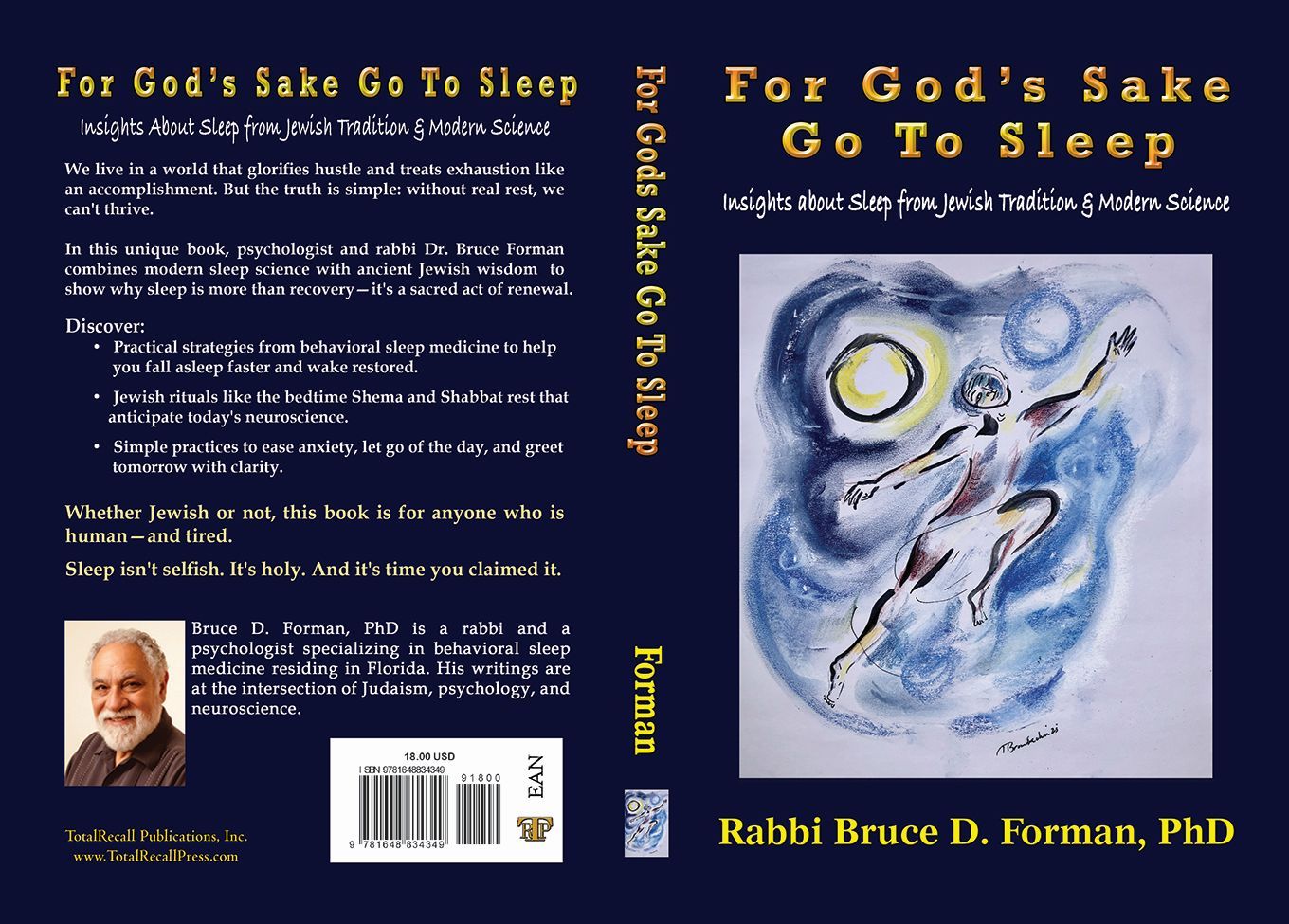
over 15 years. Shoshannah is a well-regarded Judaic artist and scholar who created the cover art for this book. Our back-and- forth discussions have culminated in six books, each richer than the last. Our varying perspectives and relationship dynamics align with psychologist Adam Grant’s concept of "synergy," where collaboration leads to outcomes that are not possible individually. In his 2023 book entitled Hidden Potential: The Science of Achieving Greater Things, Grant highlights how such partnerships foster innovation, whether in academic circles, tech startups, or creative endeavors like Taylor Swift’s reinvention of pop music through collaborations with artists across genres.
Here’s the fascinating part: this collaborative spirit doesn’t just live in intellectual discussions—it shapes how we move through everyday life. Take the science of sleep, for example. New research keeps unveiling how profoundly sleep influences our resilience, creativity, and decision-making. Sleep isn’t passive downtime; it's an active catalyst for insight and innovation. Neuroscientists have shown us that sleep deprivation dulls our cognitive sharpness and emotional well- being, leaving us as out-of-tune as a violin whose strings haven't been properly tightened. The parallels with Jewish wisdom here are remarkable. Just as rituals like prayer or Torah study refine the soul, intentionally managing our sleep rhythms fine-tunes our minds and bodies. In both realms—ancient traditions and modern science—the lesson is clear: intentionality transforms ordinary experiences into powerful tools for growth. Like a thoughtful ritual, great sleep isn't just restorative; it's transformative.
Consider the bedtime Shema, a nightly Jewish prayer that blends mindfulness with a sense of closure. Neuroscience now
tells us that rituals like this—grounding, reflective, repetitive— can enhance the quality of sleep, much like a lullaby harmonizes the chaotic notes of the day into a soothing melody. Here, science and spirituality intersect, reminding us that small, intentional acts—whether saying a prayer or setting a phone to “do not disturb”—can profoundly shape our lives.
Ultimately, Jewish wisdom and sleep science point us to the same truth: we are part of a larger, interconnected whole that thrives on balance and renewal. Like a jazz ensemble, the magic lies in the interplay of structure and improvisation, certainty and exploration. In the small, deliberate choices—whether debating a Talmudic text or fine-tuning our daily routines—we compose the symphony of a life well-lived.
Why write a book about sleep? Because sleep—or rather, the lack of it—has quietly become one of the defining health crises of our time. It's a hidden epidemic, lurking just below the surface of our hyper-connected lives. The numbers tell a stark story: poor sleep isn’t just a nightly inconvenience; it’s linked to a cascade of issues—physical illness, mental health struggles, and even life- and-death situations like car accidents. Psychologist and sleep expert Dr. Rubin Naiman (2016) captures it succinctly: “There’s an epidemic of wakefulness intruding into our sleep and dreams.” But this isn’t just about sleep; it’s about culture. Restlessness has become a badge of honor in a world obsessed with productivity. Sleep isn’t a refuge anymore—it’s another thing we hustle for. Imagine Sisyphus, not pushing a boulder, but scrolling through Instagram on his cell phone at midnight, endlessly searching for the sleep that remains just out of reach.
And yet, this crisis doesn’t affect everyone equally. As with so many public health challenges, the burden of sleep difficulties
is heavier for those who are already disadvantaged. Women, racial and ethnic minorities, and people in lower socioeconomic groups are more likely to face barriers to good sleep, whether it’s due to biases, physical health disparities, chronic stress, or limited access to medical care. It’s not just a bedtime problem; it’s a social justice issue.
There’s a second, more optimistic reason I wrote this book: because the wisdom of Jewish tradition offers a profound lens through which to understand sleep—a lens that has been, for too long, underestimated in Western discourse. Jewish teachings on rest offer a bridge—culturally rich yet scientifically informed — between communities that might otherwise have nothing in common. They remind us that sleep, like food or music, is a shared experience. And in a time when antisemitism is once again rearing its head—where even the simple acknowledgment of Jewish contributions is politicized—there is a quiet power in saying: this tradition has something to teach us. By exploring Jewish insights on sleep, we’re not just improving our nights; we’re affirming a shared humanity.
Jewish teachings on sleep are like an ancient thread woven into the fabric of world culture. They’ve shaped not only Judaism but also Christianity and Islam, the other two major Abrahamic faiths. All three traditions share a reverence for sleep as something sacred—a time for restoration, a nexus between the physical and the divine. You can hear echoes of this in the Bible and the Qur’an, where sleep is not just a biological necessity but a metaphor for resurrection, for renewal, for the soul’s nightly journey.
In fact, much of what we associate with Christian ideas about sleep has its roots in Jewish thought. Early Christian scholars,
steeped in the Hebrew Bible, drew on Jewish views of sleep as a restorative, even spiritual, act. Consider the nightly prayer of Compline, part of the Christian monastic tradition. It bears a striking resemblance to the Shema recited before bed. Both are intimate, deeply personal invocations for divine protection, as if to say, “Guard my soul as I slip into the vulnerable silence of sleep.” These parallels remind us that even in our differences, we’re often drawing from the same well
But here’s another pivotal thought. Sleep isn’t just about rest; it’s about meaning. It’s about connection. And this is something that Judaism, with its emphasis on ritual and reflection, understands better than most. The nightly Shema, on the surface, is a simple prayer. However, neuroscientists studying the power of nightly rituals have found that such practices can actually lower stress, prime the brain for rest, and create a sense of psychological safety. It’s the same reason so many people fall asleep to a familiar TV series—it’s not just entertainment; it’s comfort, a tether to something predictable in an unpredictable world.
Step back for a moment. The debate over sleep isn’t just about personal choices—it’s about the kind of culture we want to create. Jewish tradition teaches that rest is not indulgence or weakness; it’s a necessity, a way of aligning ourselves with something greater than ambition. Yet we live in a world that glorifies hustle. Beyoncé tells us to “work 9 to 5 and stay up until sunrise.” Elon Musk brags about 100-hour workweeks. And in a Wall Street Journal essay (August 19, 2025) titled “Work-Life Balance Will Keep You Mediocre,” Emil Barr—at just 22, created two companies worth $20 million and his sights set on billionaire status by age 30—boasts that he thrived in college on an average of just three
and a half hours of sleep a night. Exhaustion, for him, is proof of devotion. It’s a well-worn narrative. Like Henry Fleming in Stephen Crane’s 1895 novel The Red Badge of Courage, Barr conflates suffering with success. The hidden lesson: if you’re not burning out, you’re not working hard enough. Jewish wisdom offers a counterpoint—a manifesto of rest. It insists that sometimes the most radical, world-changing act is to stop, breathe, and pause.


Comments
Such an interesting and…
Such an interesting and relevant topic. Very well written.
Great start! I know some…
Great start! I know some Jewish beliefs and practices from following a couple of Hasidic couples on social media, so some of this I knew, but I learned some things as well, even in this beginning.
For one whose sleep patterns…
For one whose sleep patterns are sporadic at best, I found this thoroughly engaging and eminently readable. No posturing or overwhelming the reader with the heady paraphernalia of diagrams and statistic but rather down-to-earth analogies from literature and film that are totally relatable and easy to digest. A fabulous excerpt.
A concept I haven't read before
The central insight — that sleep can't be forced, only surrendered to, and that Shabbat is a weekly rehearsal for exactly that — is genuinely good and I haven't seen it made before. The rare combination of CBT-I and Jewish text gives you real authority. The obstacle is analogy overload: in ten pages the reader passes through The Matrix, superheroes, Inception, jazz, Miles Davis, Joyce, Homer, Dostoevsky, Michelangelo, Kubrick, Hamlet, The Social Network, The Big Bang Theory, Taylor Swift, Sisyphus and Beyoncé. Every idea arrives in costume, and the argument gets crowded out. Cut to three or four and the thesis will hit much harder. For inspiration: Tricia Hersey's Rest Is Resistance does what you want — rest as spiritual counterculture — with almost no scaffolding, and Judith Shulevitz's The Sabbath World shows how much a single tradition can carry on its own.
Fascinating Concept
The idea of finding the ordinary in the extraordinary resonates, and of course the topic of sleep is, as the writer points out, unifying and universal. The overall concept of the book is fascinating and unique.
At times, the submission is a bit redundant. The idea that we spend a third of our lives asleep and thus that time ought to be examined as spiritually significant is repeated more than once across several paragraphs in different words. While I enjoyed the many references to other works of art and film, it also felt a bit overdone to list so many.
The submission seems to have conflicting ideas about mindfulness, both embracing it and referring to it as a mere trend.
A fascinating re-examination of ancient themes
I loved the lens of this book - giving a fresh perspective on an aspect of life we often take for granted.
I found this incredibly…
I found this incredibly informative, thought provoking and gave a new perspective on sleep! I so enjoyed how you broke down what sleep is about in the opening paragraphs, and your ability to intertwine descriptions and similes throughout. Linking the spirituality to the science opens up a new world of possibility to the readers, and it is cleverly written, without blinding the reader by science or otherwise.
Thought-provoking and much needed!
The context around sleep being more than just a biological necessity is thought-provoking and much needed in this day and age of the hustle-and-grind mentality. I know many people who would benefit from reading a book like this. A solid start!
Informative and entertaining
I love the tone of this. It strikes a beautiful balance between being informative and entertaining without feeling preachy or like a consultation. As someone who struggles with sleeping, this was a very intriguing view on our overall relationship with sleep.
Great tone!
I liked this passage because it had such a nice blend of prescriptive nonfiction and direct reader access. It wasn't too rigid, and the writing flowed well. It felt casual-like, even thought it conveyed a lot of factual information. Well done~
Brilliant Braiding Together of Diverse Subjects
I loved learning more about the Jewish traditions, and I wholeheartedly believe our modern perspective of getting by with as little sleep as possible is actually harming us.