

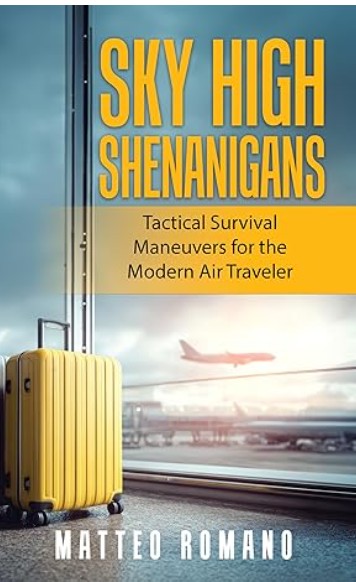
Sky High Shenanigans
– Tactical Survival Maneuvers for the Modern Air Traveler
Matteo Romano
2026
To Sofia,
Who stayed grounded in the world of the living,
while her dad became a ghost in the machine —
counting miles that cannot ever be redeemed.
SUMMARY
Introduction
Ch 1: The Luggage: Tetris, Quantum Physics, and Emotional Detachment
Ch 2: Pre-Flight Logistics – Because Packing Is War
Ch 3: Credit Cards & Points: Searching for the Holy Grail (and Free Gin)
Ch 4: The Budget Grift – Surviving the Spirit of the Skies
Ch 5: The Ritual of Queues – An Anthropological Study of Delays
Ch 6: Terminal Purgatory – The Gates of Hell
Ch 7: The Style of Invisibility: How to Pass Security Without a Strip Search
Ch 8: The Boarding Scramble – Hunger Games at the Gate
Ch 9: The Upgrade Grift – Climbing the Social Ladder
Ch 10: The Safety Briefing – High-Altitude Fiction
Ch 11: Cabin Fever – Survival at 35,000 Feet
Ch 12: Biological Warfare – Blue Juice and the Coffee Ban
Ch 13: The Infantry of the Aisle – Surviving Children and Other Creatures
Ch 14: The Corporate Zombie – Jet Lag for the Global Elite
Ch 15: The International Gambit – Aerolook and Landing Applause
Ch 16: The Duty Free Mission – The Grandma Tax and 1-Liter Trophies
Ch 17: Not-Funny Places (and the U.S.) – The Autocrat’s Welcome
Ch 18: The Pilot Didn’t Wait for Me – The Art of the Lost Connection
Ch 19: Landing & Legacy – The Mystery of the Box
Ch 20: Final Best Practice: Redeeming Yourself
Appendix 1: The Pilot’s Lexicon: Decoding the Sky
Appendix 2: The Glossary of High-Altitude Absurdity
Selected Bibliography
INTRODUCTION
For thirty years, I have been a student of the sky. Not in the meteorological sense — I leave the clouds to the poets and the meteorologists — but in the sociological sense. I have spent many decades navigating the pressurized tubes of global news, moving between the coverage of international events, academic seminars, and the occasional coup d’état in the Levant.
I remember the 1990s. It was a time of relative dignity, when air travel still felt like a miracle rather than a chore. You could arrive at the terminal twenty minutes before departure, keep your shoes on your feet, and be treated with the respect due to a sentient human being. Since the aircraft was invented (the Wright Brothers said that they did it first; the French saw Santos-Dumont over the Champs-Elysées — but I won’t dig into this geopolitical rabbit hole), we have been told that air travel is a marvel.
But the turn of the century brought a violent end to that era. We owe a debt of eternal frustration to Osama bin Laden; his contribution to the modern travel experience is a legacy of repetitive checks and the ritual humiliation of the airport security. Today, any five-year-old is required to undergo a virtual strip-search before crossing the threshold of the gate. We have traded our time and our dignity for the illusion of safety.
As the security lines grew, airlines began a race to the bottom. They have commoditized the very air we breathe. We live in an age of "unbundling," where the base fare is merely an entry fee into a theater of hidden costs. They charge for bags, for water, for a seat that doesn't put your knees in your chin. I am convinced that oxygen is the next item on the Extra Services menu, likely priced at $15 per cubic liter for "Premium Breathability."
What began as a series of tactical dispatches for my weary colleagues has evolved into the document you hold now: a definitive treatise on the modern indignity of flying. This book is written with the granular, insider directness of someone who has navigated the system’s darkest corridors and survived to tell the tale. It is an autopsy of one of the most over-regulated and under-inspired industries in the global economy — a labyrinthine nightmare of airport authorities, predatory airlines, exhausted crews, and the invisible, grinding machinery of handlers and caterers. Once you perceive that air carriers are under the perpetual vice of logistical strain and environmental mandates, it becomes evident why services are declining; and that they do not truly run on kerosene—they operate on the optimistic prayer that the next bankruptcy judge will be as submissive as a passenger denied an upgrade. For the modern airline, a Chapter 11 filing is no longer a financial failure; it is merely a scheduled maintenance stop for the balance sheet. All of this immense, multi-layered infrastructure exists for one purpose: to deposit you, dear dehydrated and diminished passenger, into a pressurized tube at thirty thousand feet, where you are expected to marvel at the beauty of the skies through a scratched, three-inch-thick window of acrylic.
You should read this book because no practical gold should be left on the tarmac. Whether you are a corporate titan or a solo insurgent, you must survive the trip. Even after being "aero-abused." This is your field manual for the resistance. It is the tactical guide to reclaiming your time, your money, and your sanity from a multi-billion-dollar machine that views you as a data point.
Welcome to the Resistance. Put your phone in airplane mode, ensure your tray table is in its upright and locked position, and prepare to take back the sky.
Chapter 1: The Luggage: Tetris, Quantum Physics, and Emotional Detachment
Your suitcase is nothing more than a physical inventory of your internal chaos. To achieve total mastery over the bag is to finally impose order upon the self; fail, and you’re just another amateur struggling at the scale.
Organizing a suitcase for an international expedition is a high-stakes performance piece that sits at the intersection of Tetris, quantum physics, and a brutal session of Marie Kondo-inspired psychological purging. In my time documenting the collapse of various minor political regimes, I’ve noticed a universal truth: the person who can fit their life into a twenty-two-inch carry-on is usually the person who survives the coup.
Most people view a suitcase as a void to be filled until the zippers scream for mercy. I view it as a curated archive. If you want to avoid paying excess weight fees — which are essentially a tax on your inability to prioritize — you need to learn the Art of the Burrito. You must treat the hollow interior of your shoes like prime real estate in Manhattan. You must, in short, stop packing like a Victorian explorer and start packing like a tactical insurgent.
Tip #1: The Burrito Method (Rolling vs. Folding)
Forget everything you learned about folding clothes at the Gap during your college years. In the pressurized cabin of a 787, a folded shirt is just a flat invitation for wrinkles. Traditional folding creates dead air, and air is the enemy of efficiency. To truly maximize your volume, you must adopt the following philosophy.
- The Technique: Lay your garments flat, fold the sleeves in, and roll them into tight, structural cylinders. This isn’t just about space; it’s about physics. Rolled clothes resist the accordion effect that turns your wardrobe into a cloth soup after a single layover.
- Ninja Level: Use packing cubes. Think of them as portable drawers for your luggage. They keep your socks from fraternizing with your dress shirts and ensure that when you open your bag to find your passport, your laundry doesn't spill out like a textile explosion.
- The Material Law: Roll the heavy items (jeans, knits) and place them near the wheels to maintain the bag’s center of gravity.
Pro Tip: If you have a delicate item that absolutely cannot be rolled, place it in a dry-cleaner plastic bag before folding it flat on top of the rolls. The plastic creates a layer of frictionless air that prevents creases.
Fail Story: I once traveled with a traditionalist who insisted on folding his suits as if he were being presented to the Queen. By the time we landed in Beirut, his luggage had shifted so much that his tuxedo looked like it had been through a paper shredder. He spent the entire press conference looking like a man who had slept in a hamper.
If your suitcase looks like a Mexican food truck’s inventory, you’ve done it right.
Tip #2: Manual Vacuuming (The Puffer Pancake)
Traveling from a tropical humidity to a sub-zero climate is a logistical nightmare. That emergency puffer jacket is essentially a bag of trapped air that takes up half your suitcase. However, you don't need a vacuum cleaner to defeat the volume; you just need gravity and a lack of shame.
- The Compression Bag: Purchase the roll-up style vacuum bags. No pump required.
- The Pancake Process: Stuff the coat in, seal the top, and sit on it with the full weight of your university education until the air is hissed out of the one-way valve.
- The Result: Your bulky winter gear is now a dense, polyester pancake. You’ve just gained enough room to bring back those three bottles of Port you found in Lisbon.
Pro Tip: Don’t use these for natural fibers like down or wool for long periods; they need to breathe eventually. Use them for the transit phase only.
Fail Story: I once used a vacuum bag for a high-end down jacket and left it compressed for a three-month stint in the Alps. When I finally unsealed it, the jacket remained as flat as a piece of cardboard. I had to spend an hour in a laundromat with two tennis balls in a dryer to convince the feathers that they were allowed to exist in three dimensions again.
Turn your outerwear into a pancake, or prepare to carry your luggage like it’s a small, angry child.
Tip #3: Shoe Real Estate: Prime Terminal Acreage
Shoes are the great invaders of the suitcase. They are heavy, they are dirty, and — most offensively — they are hollow. Leaving the inside of a shoe empty while you struggle to zip your bag is a waste of prime real estate that would make a developer in Hong Kong weep.
- The Stuffing: Every shoe should be a five-star hotel for your socks, underwear, or charging cables. This also helps the shoe maintain its shape under the crushing weight of the baggage carousel.
- The Hygiene Barrier: Use disposable shower caps (the ones you steal from hotels) to wrap the soles. It’s more durable than a plastic bag and keeps the "grime of a thousand terminals" off your white linen shirts.
- The Decant Vault: If you are traveling with fragile glass vials (cologne, decants), the inside of a sturdy sneaker is the safest place on the aircraft. It’s a literal "foot-fortress."
Pro Tip: If you're bringing loafers, use wooden shoe trees if weight permits; if not, the tightly rolled sock is the poor man's cedar tree.
Fail Story: A junior reporter I knew once packed a bottle of expensive red wine inside a boot. The boot was soft leather. The baggage handler was, presumably, a former shot-putter. The bottle broke, and for the rest of the trip, he smelled like a very prestigious — but very drunk — vineyard.
Your shoes aren't just footwear; they are the sub-basements of your luggage. Use them.
Tip #4: The Anti-Clone Identification
Walk into any airport in the world and you will see a sea of black, four-wheeled rectangles. This is the "Baggage Clone" epidemic. Taking someone else’s bag by mistake at 3:00 AM after a trans-Atlantic flight isn't just an error; it's a week-long administrative nightmare that usually ends with you owning a stranger’s collection of "I Love New York" t-shirts.
- The Visual Flare: Do not be subtle. Use a neon luggage strap, a giant sticker of a dinosaur, or a piece of bright climbing rope tied to the handle.
- The Childlike Defense: If your bag looks like it belongs to a whimsical twelve-year-old or a color-blind artist, the chances of a weary businessman accidentally abducting it at the carousel drop to near zero.
- The Double Tag: One tag on the outside, and a business card or copy of your itinerary inside the bag. If the outer tag is ripped off by the conveyor belt gods, the airline can still find its owner.
Pro Tip: Spray a small, unique scent or place a specific ribbon on the handle that you can recognize from thirty feet away.
Fail Story: In Dubai, I watched two identical-looking men in identical-looking suits nearly come to blows over a black Samsonite. It took ten minutes for them to realize they had both grabbed the wrong bag, and the actual owner was already halfway to a taxi with the third identical suitcase.
If your bag doesn't look like a cry for help, it looks like everyone else's. Make it weird to keep it yours.
The "Pack-Like-a-Pro" Checklist:
- [ ] The Roll Call: Are all non-structured items rolled or are you carrying extra oxygen for the clothes?
- [ ] The Shoe Audit: Is there a single cubic inch of empty space inside your footwear? (If yes, add socks, ties).
- [ ] The Ziploc Sanctum: Are all liquids in a clear, accessible bag for the "TSA Runway Show"?
- [ ] The Anti-Clone Check: Can you spot your bag from the other side of a crowded bar?
- [ ] The Home Weight: Have you used a digital scale to ensure you aren't 1kg over the limit?
Best Practices:
- Solid Over Liquid: Whenever possible, use solid shampoo bars and decant your perfumes. Zero leaks, zero security drama.
- The Emergency Kit: Always have one full outfit (including underwear) and your toothbrush in your hand luggage. If the Russian Roulette of Tip #1 fails, you still have your dignity.
- The Manual Scale: If you don't have a digital scale, use the One Foot Rule. If you can’t lift the bag comfortably with one hand, the airline is going to charge you for the privilege of your indecision.
Chapter 2: Pre-Flight Logistics – Because Packing Is War
Successful travel begins with the brutal realization that you cannot take your entire life with you, and attempting to do so is an admission of psychological defeat.
Think of packing not as a logistical necessity, but as a profound confrontation with the self. It is the moment you must decide which version of you is traveling. Will it be the “Vogue-ready you” who requires four pairs of Italian leather loafers for a weekend in Newark? Or the “rugged intellectual you” who packs three volumes of Proust but forgets a toothbrush?
Most travelers treat their suitcases like that one kitchen drawer — you know the one — filled with mystery keys, remote controls for appliances long since deceased, and a collection of inexplicably random coins from Finland, which you cannot recall ever visiting.
In my years covering the tectonic shifts of global politics, I have learned that the more you carry, the more the world owns you. A heavy bag is a tether to the ground. True freedom is found in a carry-on and a soft briefcase/backpack, a kit that allows you to pivot from a diplomatic standoff to a high-speed dash for a departing jet without breaking a sweat or a strap.
If you are traveling to unknown places, check the internet for the required documents (prefer official sites or travel blogs). More than 100 countries still require the International Certificate for Yellow Fever. Saudi Arabia requires vaccination for meningitis. Some countries in the Caribbean forbid camouflage clothing. Pakistan, Afghanistan, and the Philippines may require proof of a recent polio vaccination.
Conduct a forensic audit of the airline’s rescheduling policy before you hand over your soul. Some will graciously allow a change of plans, provided your ticket isn't a non-refundable death warrant. Others might let you slide into an earlier or later slot on the same day, but only if your frequent flyer status carries enough weight to make the gate agent blink.
If you cannot live without your pet in the European Union or Hawaii, you will need a rabies antibody titration test from an approved laboratory. And some countries (Spain, for instance) simply forbid some breeds, such as the fearful pitbull (reasonably) or the faithful Brazilian mastiff (unfairly).
Tip #5: The Russian Roulette of Checked Bags


Comments
Submit - Sky High Shenanigans
Dear Page Turner Awards Team,
It is my pleasure to submit my latest work, Sky High Shenanigans: Tactical Survival Maneuvers for the Modern Air Traveler, for consideration in this year’s Page Turner Awards.
Sky High Shenanigans is a sharp, witty collection of humor chronicles that dissects the modern traveler’s experience. The book serves as both a satirical observation and a practical (and irreverent) manual for surviving the absurd chaos, logistical nightmares, and peculiar humanity found within contemporary aviation. It is a work designed for any reader who has ever found themselves trapped in a boarding lounge, contemplating the surreal nature of the modern journey.
Book Details:
I believe this collection resonates with a broad demographic, offering a highly relatable, humorous lens on a universal modern frustration. The manuscript captures the irony of the "connected" age through the filter of travel, and I hope it proves to be a compelling addition to your current selection.
Thank you for your time and for the dedication you show in championing new voices. I look forward to your consideration.
Warm regards,
Matteo Romano
matteo.romano1968@proton.me
The manuscript is very…
The manuscript is very engaging, useful, and well written. The content is presented effectively. I would like to read the whole book before my next trip.
A very engaging excerpt:…
A very engaging excerpt: humorous, practical and best read when you're not already at 35, 000 feet.
This is well written with a…
This is well written with a great sense of humor that makes it fun.
There are real laughs here ...
There are real laughs here — oxygen at fifteen dollars a cubic litre for "Premium Breathability," the colleague who smelled like a prestigious but very drunk vineyard, and the Chapter 11 filing as scheduled maintenance for the balance sheet. The dedication to Sofia is the most affecting thing in the sample and hints at a warmer book underneath. Two cautions: the military-tactical register is a single joke told at length, and over twenty chapters it will tire; letting the narrator be occasionally defeated rather than always expert would give the comedy somewhere to go. And the bin Laden line in the introduction — thanking him for a legacy of frustration — will cost you readers and reviewers for very little comic return. For inspiration: Bill Bryson is the obvious model, but the more useful one is Patrick Smith's Cockpit Confidential, which pairs genuine insider authority with humour, and Mark Vanhoenacker's Skyfaring for the awe that satire alone can't reach.
Hilarious and Informative
Fun and informative. So many good tips! Some very clever metaphors and similes drive home valuable points.
“Think of packing not as a logistical necessity, but as a profound confrontation with the self. It is the moment you must decide which version of you is traveling.” This is such an insight expressed so concisely, and perhaps precisely why I hate the task so much.
Valuable information presented in an accessible, entertianing way.
Fun! And useful
I enjoyed the mix of practicalities and humour - I'd definitely read this book before a trip!
As an avid traveller myself,…
As an avid traveller myself, I found this book hilarious as well as being spot on with the tips and failures! A really enjoyable and easy read.
Witty, Fun, and Informative
This was a fun read and highly informative! You’ve taken an inherently “dry” topic and breathed life and humor into it. I think many would benefit from your travel advice, myself included.
Chapter headings are a hoot
I thoroughly enjoyed the blend of sarcastic humour and useful tips. I also really enjoyed the chapter headings.
Fun & funny!
This was a fun and funny read. I worked on travel genre for many years of my career, and this was a refreshing take and a refreshing tone. The headings and Chapter titles were done very well. I always say with nonfiction, there should be a handful of factual references to anchor personal, lived experience to establish authority. I didn't see that much here, but the yellow fever citation, and realize this is only a short sample, of course, but perhaps that's helpful nevertheless...
Practical with Dry Humor
You're providing plenty of useful tips for people about to fly, sharing stories that keep the narrative going. Thumbs up!