
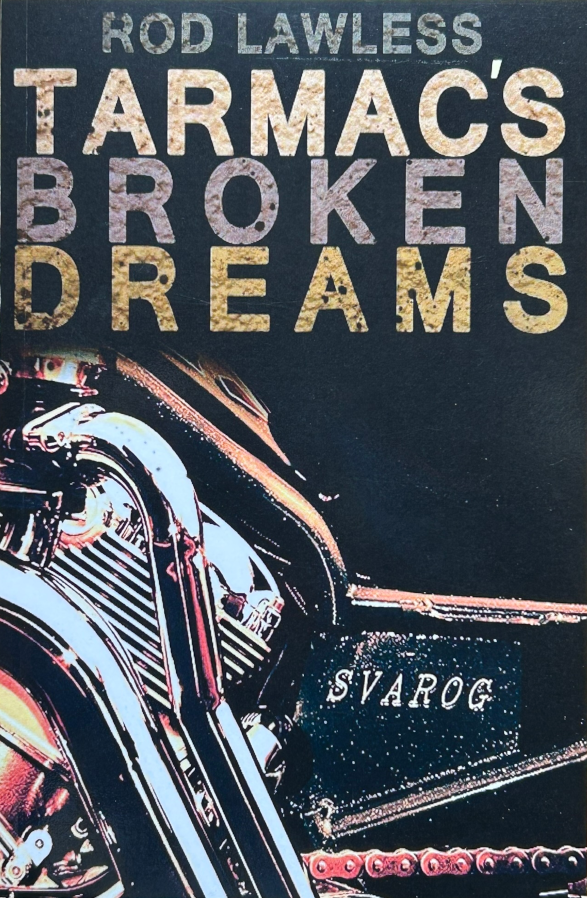
Tarmac's Broken Dreams.
"What you lookin' for, joss stick holders?" The voice drifted into my awareness from the left. It was none other than Paul wandering down an aisle in Tesco supermarket. He has a quick wit, which inevitably twangs the chuckle muscle. We usually talk about bikes and creating them when we meet. One time I had said I would like to build something electric, his immediate remark was, "Maybe a shaver of some sort." That's the way he is. Okay, so I have hippy tendencies and a beard; I can't deny it. The lights in my office are all solar powered, and I've got a compost bin, but why not? It's not lifestyle yoghurt weaving.
Anyway, the conversation turned to the Land Speed Record and why Paul would not go for it. However, I will share what he said later. First, I want to tell you about Svarog, as it's a story needing to be told. I started writing this book way before the planned attempt, and have left it original. I feel it gives the best representation of the circumstances that led to the outcome. As you may no doubt recognise, the plans we make are only a guide for life; we don't have full control over our future, just the impression we do. Older and wiser minds have remarked, “Destiny is in the lap of the gods.” “What will be, will be.” And the all-time favourite, “Many a mickle makes a muckle.”
Anyone who has ever ridden a motorbike knows the feeling of exhilaration from acceleration. Going a bit faster, getting an ounce more enjoyment, is the goal of many of us. This book brings you an account of an attempt to be the fastest man, and his team of dedicated petrolheads. Discover what it takes to strive to be the fastest, and perhaps find inspiration to leave your own mark in the world of two-wheeled record holders. Also, be aware of the pitfalls. Our future is probably not mapped; therein lies the paradox. But if it is, who is the navigator, and has he got the map the right way up?
This story started with an end in mind. As stories go, it is a good one, but it has that all-important unexpected twist. As anybody who has blatted down the quarter mile will tell you, ten seconds takes a year or two to build up to.
Foreword
Preface: See 'Arse About Face' at the back of the book.
Introduction
Chapter One.
History part 1
Everything that has gone before.
History Part 2
Svarog: History of the god.
Chapter Two.
Building up to it.
Chapter Three.
The sponsors and supporters.
Chapter Four.
The team.
Chapter Five.
The Bike.
Tech spec
Chapter Six.
Theory and science.
Chapter Seven.
Turbo's.
Chapter Eight.
The philosophy.
Chapter Nine.
Venues
Chapter Ten.
The attempt.
Arse About Face
Epilogue
He who is brave is free. Lucius Annaeus Seneca.
Introduction.
Our decision to walk creates the path ahead. Paulo Coelho.
Travel broadens the mind, and this whole 'thing' was quite a journey. This is a story about life, the possibilities and impossibilities, the highs and lows, the reasons why and why not. Thin tendrils of chance wind and worm their way out into the world, and many unexpected occurrences would befall the team. At the centre of the Universe is man; everything else happens outside. Then there's tarmac.
Not only are we reaching out into deep space with telescopes, but scientists are also finding ways into the human mind and genes that would freak our forbears. Technology has mushroomed into more than would have been foretold by anyone from thirty years ago. It would appear even science fiction is having a hard time keeping up with what is available to us. We live in times where every bit of Arcane knowledge you can imagine is available. What once remained hidden is now accessible to all.
Think of all the kings of history, and each of us in the Western world has more than any of them. Except Midas, obviously. If you could prove to a pharaoh that you could talk to someone from the other side of the world. Demonstrate how you can get on a flying metal bird, and be with them in a matter of hours, and on the way, download knowledge to enable you to build a metal horse, that Pharaoh would not raise himself from the ground at your feet. Yet we take mobile phones, TV, ready meals, and toilet paper for granted. We complain about the speed of our laptop or how long it takes to microwave a pot noodle. Even the previous King of England (George VI) could not have imagined anything we have in our living rooms today. These things would be magical to the men of old.
Magic in the form of an internal combustion engine is the subject of this book. I always thought if I were to write a book, it would have to be about custom bikes, and choppers in particular. Being only twelve in nineteen-sixty-nine, I had no way to watch an X-rated film like Easy Rider, but I managed to get hold of issue 242 of 'Mad' comic, which did a spoof. If I went to WH Smiths, I would always check out the poster of the film. The course was lit, and as soon as I got my first bike, it had a smattering of rattle-can paint to make it mine. That credo has remained part of my life ever since.
I guess we could catalogue Svarog as a chopper. Rigid rear end, all the crap taken off, altered frame geometry, great paint job, go-faster bag of bits all bolted onto the right places. The list goes on, plus the owner built and rode it. It ticks all the right boxes.
Chapter 1
History Part 1
Winners never quit, and quitters never win.
Vince Lombardi
In compiling this section of the book, some interesting little snippets arose. A long-held belief amongst many is that Herr Benz invented the first car in 1885. But road usage, without the power of muscle, goes way back. In fact, it has to be credited to the French, of all people. Nicolas Cugnot, a French military engineer, designed a steam-powered road-going vehicle. It was configured as a tricycle and built to transport cannons, with a top speed of six kilometres an hour. The year? 1769.
And if you are interested, two years later, he built another, lighter car, which he ran into a wall. The first motorised accident occurred and was recorded. Well done, that man!
All this aside, the first land speed record, although unsanctioned at the time, is now being credited to Rivaz.
Date: 1813
MPH: 3
Vehicle: Isaac de Rivaz
Driver: François Isaac de Rivaz
Place: Switzerland
Engine Type: Turbine
The FIA sanctioning body received information to accept Isaac de Rivaz as the first Land Speed Record vehicle. The car used a mix of hydrogen and oxygen. It makes one wonder how things would have turned out for the planet if we had followed that route.
However, the widely accepted history starts here:
December 18th, 1898. Achères, France. Gaston de Chasseloup-Laubat drove a Jeantaud Duc electric vehicle to the heady speed of 39.24 miles per hour.
Camille Jenatzy beat that a month later on January 17th, 1899. Not to be outdone by a Belgian, Frenchman Chasseloup-Laubat got back in his electric car and had another go. I don't know if he had a lighter breakfast or just rewired the beast, but he got up to 57.65. Jenatzy was not content, and on April 29th, 1899, clocked 65.79 miles per hour. No record exists indicating whether friendly rivalry or steam-curled moustaches and a belligerent squint at dawn motivated them. The matter set in stone was the whole ethos of Land Speed Records was well and truly underway.
It was not long before internal combustion engines took to the field to try to wrestle this title from the electrics. 5th of November in Ablis, France, an American by the name of William K. Vanderbilt (you can tell he had 'Old' money in this) drove his Mors Z Paris-Vienne at 76.08 mph. All these early attempts were over one kilometre as France was the test-bed of choice. In fact, except for one shot in Ostend Belgium, it wouldn't be until 1904 that the other parts of the world got a look in. Then, on 12th January that year, one Henry Ford drove his Ford Arrow on a frozen Lake St. Clair at 91.37 mph. I don't know how this became a Land Speed Record, as ice isn't exactly land, but the adjudicators appear to have let that one slide. So to speak.
The Comte de Chasseloup-Laubat set a land speed record of 57.6 mph at Acheres, near Paris, on the 4th of March 1899, in this formidable vehicle weighing over 3,000lbs or 1,400kg.
That's all very well and good, but it's the motorcycle record we are interested in.
Funnily enough, the 'British Motorcycle Land Speed Record' appears to be the least documented record of all. Maybe the record itself should go into the Guinness Book for that fact. Internet, library, the portal where the Bermuda Triangle deposits its catch, the arcane place where half your socks go, you name it, and I searched. Finding the facts about this most elusive record has been quite a frustrating process. I was wondering if many British records exist.
Motorcycle Land Speed Record.
People claimed that Glenn Curtiss unofficially set the first record in 1903 on his home-built bike. He hit 64 miles per hour with his 1000cc Hercules V-Twin engined bike.
Bitten by the bug, he had another shot in 1907, with a 4000cc beast. He topped 136.27 mph, and that stood for another twenty years.
(Note how quadrupling the cubes only doubles the speed. There may be questions later.)
The FIM (Fédération Internationale de Motocyclisme or, as we Brits would say, International Motorcycling Federation) did not officially sanction a record until 1920.
The FIM didn't come into being until 1904.
1923 saw the first record set in the UK by Bert le-Vac on a 996cc Temple Anzani. With 108.41 mph, he took Brooklands by storm. He beat his own record with a Brough-Superior in 1924. (118.98mph) But along with Claude F. Temple and Oliver M. Baldwin, these early times have not been sanctioned by the FIM rules, so do not formally exist*. It took Joseph S. Wright on an OEC Temple JAP to take the first official record at 137.23 mph. But that was in Arpjon, France. The first British Land Speed Record was going to have to wait until Wright came to Ireland to hit 150.65. But Ireland has been independent of Britain since 1949, so it all gets rather confusing.
(*It would seem red tape was the order of the day, and no matter what one did, there was always someone with a 'control freak' attitude who wanted a piece of the action. On the other hand, someone might have fibbed and taken a record by stealth. Naughty boys.)
Disputation over the 1930 record occurred, when OEC claimed to be fastest, based on a publicity photo taken before a Zenith went quicker. It was quite a while before the controversy died down.
As ever, the technology available in the day would be used to its greatest advantage. That is what sets this endeavour apart. Paul intended to use technology that wouldn't be in production for another five years. Plus, it would be aircraft, not internal-combustion engine technology, as in previous years.
One big question hits people when they first learn of the power plant. Does a V-Rod have the 'balls' to do the business? Well, if American Kenny Lyon can set eleven records with a Gold Wing at Bonneville, then any assumption is mere speculation.
History Part 2
Svarog the god.
Paul has a great interest in history, and in particular, the Byzantine Empire. It was when talking with Andreas, Airbus' top designer, that they came upon the name Svarog as a moniker for the bike. As the conversation unfolded, it seemed the perfect name.
The name Svarog has a long history, and people claim it is one of the earliest known deities.
The Hypatian Codex contains the name of Svarog; scholars rediscovered this compilation in 1617 in what is now known as Ukraine. It contains a Slavic translation of an original Greek manuscript by John Malalas from the 6th century. The complete passage, reconstructed from several manuscripts, translates:
"(Then) began his reign Feosta (Hephaestus), whom the Egyptians called Svarog … during his rule, from the heavens fell the smith’s prongs and weapons were forged for the first time; before that, people fought with clubs and stones. Feosta also commanded the women that they should have only a single husband… and that is why Egyptians called him Svarog… After him ruled his son, his name was the Sun, and they called him Dažbog.
In the Greek text, the names of gods are Feosta, Hephaestus and Helios. Hephaestus was the Greek and Vulcan the Roman equivalent of Svarog. (We all acknowledge who the Norse god is; we named Thursday after him. No more clues, save to say, his film is very popular amongst the ladies.) Apparently, the Russian translator tried to re-tell the entire story (set in Egypt) by replacing the names with those better known to his countrymen. It is uncertain how much resemblance to the Greek gods their Slavic counterparts have. Or when Disney will make a film about it.
What comes out of this are the representations of scientific principles that these gods portray? As with all lesser deities, there are deeper meanings, and Svarog represents the inaugural fire. Much like the Hindu god Garuda, who most likely represents the Big Bang, Svarog represents the inner fire that gives rise to the Sun and all flames on Earth. The creative spark, if you will. Imagine a fire that is beyond the flames we see in the third dimension, and you are getting close. It may even represent the inner fire that is our life force.
Tell me if I get too “hippy” for you. Daddio.


Comments
The author's enthusiasm for…
The author's enthusiasm for motorcycles comes across clearly and makes the subject engaging for enthusiasts. The writing would benefit from a tighter structure and a more focused narrative.
Readers who love motorcycles…
Readers who love motorcycles, whether riding them or the history or whatever, will likely quite enjoy this. You have a casual, unique style that keeps a reader engaged. An edit can help tighten up some of the narrative and smooth out some of the flow.
No doubt captivating for the…
No doubt captivating for the dedicated petrol head but it feels a bit rough around the edges as fas as publication-ready material is concerned. Re-structuring with a clear focus on the writer's personal journey would take this to another level.