

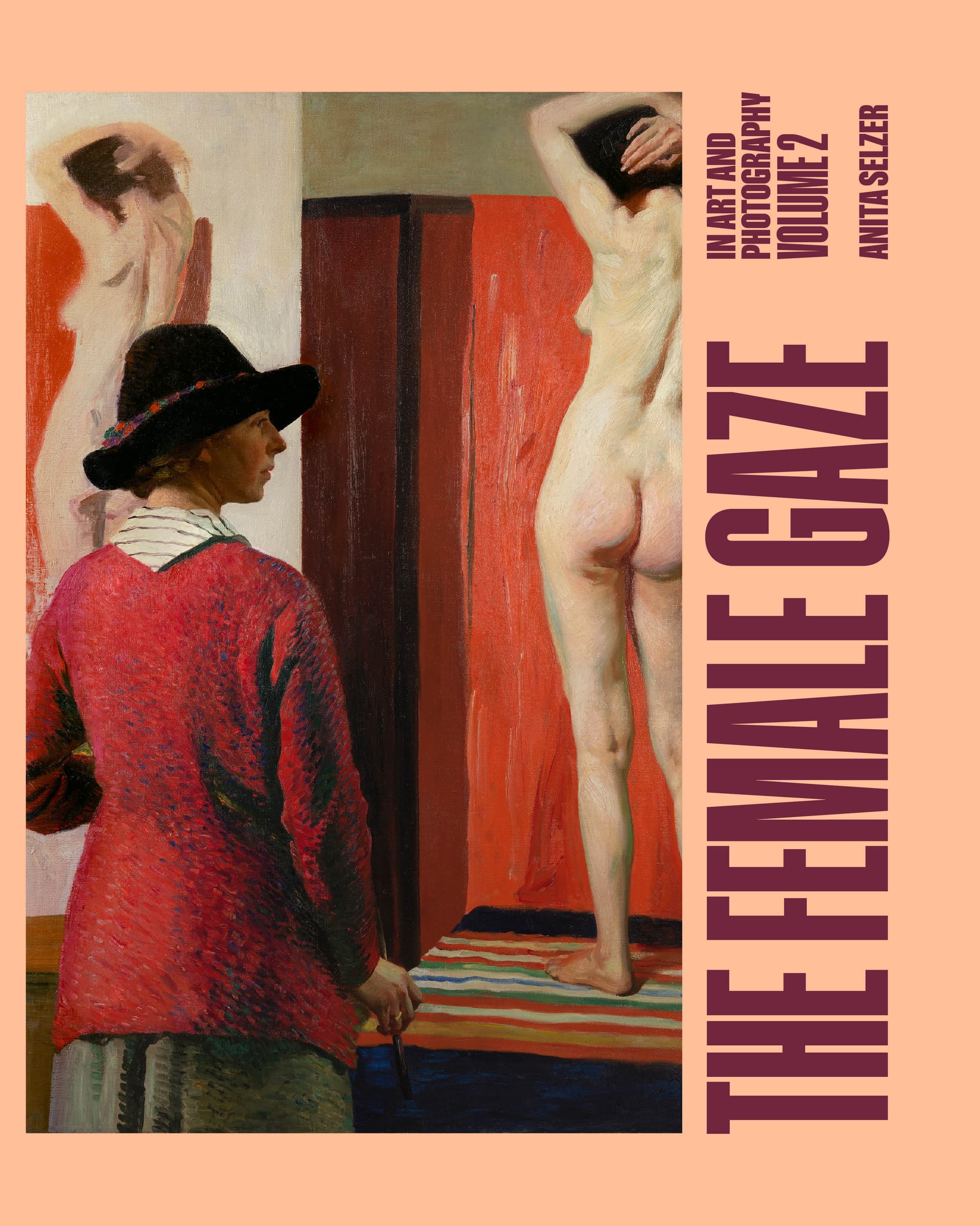
In my first book on The Female Gaze in Art and Photography I focused on contemporary female artists, photographers and sculptors from around the world and looked at how they applied a female gaze in their work. In discussing current trends in global exhibitions, it was clearly seen how women producers in the visual arts today were showcasing their female way of seeing their subjects in their art.
I also included in that book examples of art by female painters from centuries ago and this offered a glimpse as to how they too used a female gaze. This was seen in the discussion of Sofonisba Anguissola (1532–625) from the Italian Renaissance, Artemisia Gentileschi (1593–656), an Italian Baroque artist, and Berthe Morisot (1841–95), a French Impressionist. So, in this second volume of The Female Gaze in Art and Photography, it seemed logical to centre my research on female visual arts creators from the past and their application of the female gaze in their work. By looking at the gaze of women artists who are no longer with us, we extend our knowledge of contemporary visual artists who use this viewpoint to represent our worlds. They showed a way to create this female way of looking and seeing.
This and my previous book on the subject can be read separately or in tandem. Each expands the way we see and look at art through a female gaze. They offer visual and textual perspectives of the creators, their representations and output of work that differs to the male gaze that has, as writer Rebecca Liu says, ‘dominated much of our culture, even in art’.
I also bring a female gaze to this book through my subjectivity as a white, middle-class, cis-gender woman, as well as a wife, mother and grandmother and professional female writer, largely writing about history, gender and education. My whole self is poured into the book – ideologically, intellectually, emotionally, psychologically and physically, all working together.
While there are fewer Australians in this volume than the first The Female Gaze in Art and Photography, there is an even wider global representation from the eastern and western world. The criteria for selecting artists to feature, though, is the same as in the first one. They are works of the artist, photographers and sculptors that had an impact on me in some way. I needed to feel some sort of connection, whether it was to the visual images of their work, the artistic expression of their narratives and storytelling, the representations of ideas, inscribed messages, and/or the emotions transmitted through their visual medium.
Turning the pages, you will see the diverse works created by visual artists from different eras and places. Like the earliest artist represented here, the Italian Artemisia Gentileschi (1593–652/653). Mary Catlett (1844–926), Charley Toorop (1891–955) and Suzanne Valadon (1865–938) were all born in the nineteenth century and alive during the turbulent first half of the twentieth. Others who saw the sun rise well into the twenty-first century, such as Maria Lassnig (1919–2014) and Paula Rego (1935–2022). As well as those from all corners of Europe: Birgit Jürgenssen (Austria), Claude Cahun (France), Romaine Brooks (Italy), Jeanne Mammen and Grete Stern (Germany), Tamara de Lempicka (Poland), Sylvia Sleigh (Wales/England). With Elizabeth Catlett coming from the United States. Uemura Shōen (Japan), Pan Yuliang (China) and Amrita Sher-Gil (Hungry-India) add to the global mix, as do Sue Ford and Janet Cumbrae Stewart (both from Australia). And, of course, Frida Kahlo from Mexico. They all used a female gaze in their art to reflect their way of seeing the world, which is opposed to, as I’ve previously stated, the dominant male gaze.
The Male Gaze
‘The gaze’ refers to a way of looking and seeing. In the previous volume I noted how existentialist philosophers Jean-Paul Sartre and Simone de Beauvoir addressed the notion of the gaze. In Being and Nothingness (1943) Sartre observed the gazer’s subjective power of gazed. And in The Second Sex (1949) de Beauvoir extended the concept to include a gendered perspective: ‘Humanity is male, and man defines woman not in herself, but as relative to him: she is not regarded as an autonomous being … she is the incidental, the inessential as opposed to the essential. He is the Absolute – she is the Other.’ And this way of thinking has historically filtered into the visual arts representation of women.
I also explained how British film critic Laura Mulvey coined and popularised the phrase ‘the male gaze’, noting how women in the visual arts have been viewed by men. The male gaze has ‘idealized or objectified’ women ‘as sirens, goddesses, muses, and sex symbols’, as arts writer and curator Rosie Lesso puts it.
We see an example of the male gaze in the painting La Grande Odalisque (1814) by male painter Jean-Auguste-Dominique Ingres. Rebecca McInerney writes that Ingres’ painting depicts ‘a nude woman, and she takes up the entirety of the picture plane … from an outside perspective. This may be one of the best way to explain the male gaze … an intimate scene, that we, as viewers, seem to be intruding upon … In this way, we can see how the male gaze captures a situation and edits it to be an idealized situation for a male audience … The woman depicted also has slightly elongated proportions, which helps reinforce the idea that this painting is an idealized version of life.’
Looking over her shoulder, this woman was ‘not the Roman goddess of love and beauty,’ Brian Zygmont of the Khan Academy reminds us. ‘Instead she was an odalisque, a concubine who lived in a harem and existed for the sexual pleasure of the sultan.’ In this painting, Zygmont says, Ingres takes the viewer to the Orient, the near east in the 1920s, and this woman looking over her shoulder is surrounded by ‘oriental elements – fabric, turban, fan, hookah’, which ‘provided a distance that allowed the [male] viewer to safely gaze at the female nude who primarily existed for his enjoyment.’
The Female Gaze
The female gaze is very different to that of the male’s. It emanates from a female creator’s experience/s, shaped by them and/or the female perspective/s. The female gaze presents a perspective that shines the light on and represents women as people. Alison Kubler, editor of Vault magazine, noted in the ‘Foreword’ to my first volume that the female gaze is a ‘construct and concept’. It is a construct in that it comprises parts, components structured together forming a whole that is evident in the final artwork by the female artist. The construct is based on a concept, how the female artist sees her work from her point of view, a specific female point of view. It is about seeing through the eyes of women. And significantly, it is about the presence of women in the creation of art, enabling them to tell a visual story, or/and inscribe a message about women, representing them through a female lens and perspective. The female gaze presents a perspective that shines the light on and represents women as people.
In some cases, the female gaze is expressed by a female creator, director and producer of the artwork who is also the subject of the creation, where they are looking and being seen. We have a prime example gracing the front cover of this book: Laura Knight’s Self Portrait aka The Model (1913). Knight was a British painter, and she was the first female artist since 1768 to be accepted into the Royal Academy as well as the first woman artist to be given the title of Dame. Her Self Portrait subverts the male gaze by having a female artist, namely Knight, the creator, producer and director of the painting, actually being in the painting. She is the woman in the red-knitted cardigan and hat looking at the nude female model that she is painting. Knight is one of the main subjects along with the female nude in the painting. The artist is painting herself painting the nude with a palette in her left hand that we, as viewers, cannot see. As Liu writes, Knight ‘contradicts the often-passive role women play in artwork by placing herself, a working woman, as the orchestrator of the piece with absolute power.’
Knight was not able to draw from a live nude model while at Nottingham School of Art because, at that time, women were not permitted to draw or paint from one. That was only a privilege bestowed upon men and the painting references this fact. In this painting, Knight uses her female gaze to upend the male gaze by showing ‘a naked woman, a friend of the artist, not an objectified female body presented for male scrutiny and pleasure,’ which is how the National Portrait Gallery describes it. She also showed how women can equally produce a piece of art successfully, just like men, given the opportunity to do so.
Internationally celebrated painter Angelica Kauffman (1741–807) used her female gaze in the eighteenth century by centring and empowering women as her subjects in her visual narratives. This was exemplified in her painting Self-Portrait of the Artist Hesitating between the Arts of Music and Painting (1794). Kauffman is the woman in white, standing between a woman in red holding sheet music, personifying music, and a woman in blue clutching an art palette, personifying painting. The two women embody the choice she had to make in her younger years in terms of her talent in both arts. She is gesturing with her hand towards the palette and subsequent a career path as an artist. Kauffman used her female gaze as the subject of this painting, its creator and artist, featuring in other self-portraits as a working female artist, an art maker, when that was not the norm of those times.
The female gaze is multifarious. It is used by some female creators to explore the self, as in the work of non-binary Claude Cahun (1894–954). (French surrealist photographer Cahun claimed to be gender fluid and I use the pronoun ‘she’ here as Cahun referred to herself as such.) She engaged in self-portraiture, largely of a performative nature, probing and questioning the idea of gender identity, often representing gender non-conformity. Jordan Reznick reports in Art Journal Open Cahun as saying that ‘neuter is the only gender that always suits me’. We learn more about her work later.
American painter, Romaine Brooks (1874–954) was engaged in romantic relationships with women while married to a male homosexual. Brooks used her female gaze to focus on real women as the subjects of her work, including lovers, highlighting female sexuality and desire. Like Cahun, she used herself as a model for her work in her paintings, questioning gender identity and the notion of the feminine, challenging expected social norms.
Art critic John Berger wrote in 1972 that ‘women are depicted in a quite different way from men … because the “ideal” spectator is always assumed to be male.’ As Janice Loreck also put it in her article in The Conversation, a woman’s ‘feelings, thoughts and her own sexual desire are less important than being “framed” by male desire.’ In the last fifty years or so, this has changed with more female artists subverting this by having the female viewer in mind, using their gendered gaze in the concept formulation, process and production of their artwork.
A female gaze comes from a female way of seeing that is meaningful from that viewpoint. And the female gaze treats all gendered bodies respectfully. We see this in the paintings of Sylvia Sleigh (1916–2010). She wrote for the Brooklyn Museum that she painted male models ‘as portraits, not as sex objects, but sympathetically as intelligent and admired people, not as women had so often been depicted as unindividuated houris’ looking through a male gaze.
The female gaze seeks to appropriate narratives, to offer a more intimate representation of women. It constructs many possibilities of meaning, deconstructing the essentialist view of women that has tended to dominate the male gaze. It showcases female subject matter and female pain, like Paula Rego’s artwork on abortion and Frida Kahlo’s in terms of her personal and physical pain endured in her private life and poor health. The female gaze asserts agency in its subjects and imbues them with autonomy, capturing their interiority.
Philosopher Emma Syea observes that the female gaze provides an empathetic and sensitive viewpoint, ‘depicting women as fully-realised individuals with complex inner lives’. However, she advocates to dispense with using a female or male gaze in visual culture: ‘A better way forward would be to transcend the notion of a gaze altogether.’
I do not share her latter opinion because retaining the construct and concept of the ‘gaze’ enables us to see how it has been used in the past. It documents ways of looking, seeing and creating that have been an integral part of art history and continues to be employed today, especially the female gaze. Consequently, these gendered gazes often bring a different result, offering a point of difference in art production and output, especially if the artist’s experience and subjectivity factor into the work. This should not be dispensed with, unacknowledged or unrecorded, but rather chronicled, so that we have a richer, more inclusive and expansive picture of visual art, and of the telling of multiple visual stories of our past and present.
Before we continue to explore how women from the visual arts represented in this book used their female gaze in the creation of their work, I think we need to go back in time to see the difficulties women faced in being able to become professional artists.
Art History
In her seminal essay, ‘Why Have There Been No Great Women Artists?’, art historian Linda Nochlin discusses the institutional and social barriers that have prevented women from making what was considered ‘great’ art and becoming ‘great’ artists. Perhaps the first question to ask is what constitutes ‘greatness’?
‘History painting’ was considered the highest genre of art in the seventeenth century, where subject matter was drawn from classical history, mythology and the Bible, according to the Tate. During the eighteenth century, it referred to more recent historical subjects and by the end of that century depicted men engaged in battle scenes. Men were the privileged painters of this genre and professional art largely deemed and denoted a masculine space.
Even so, Laura Auricchio notes there were women painters who carved out an artistic space for themselves –Adélaïde Labille-Guiard (1749–803), Anne Vallayer-Coster (1744–818) and Elizabeth Lousie Vigée Le Brun (1755–842), for example – and were highly successful in portraiture and still life, regularly exhibiting at the prestigious French biennial salons. Their art, however, had not been canonised as ‘great’ like paintings by men because women’s art has historically been accorded of lesser value by men, who have largely shaped cultural meaning.
Men have determined the notion of ‘greatness’, established its yardstick and worth. Art historian Griselda Pollock notes in Differencing the Canon that, historically, privileged men have controlled this meaning and practice as part of art history. She says men have legitimated the story of white man’s cultural creativity by constructing this meaning in art discourse, ‘producing an image of art and the artist that was exclusively masculine, Euro-American-centric’, as she put it in Old Mistresses. ‘Art history is an ideological discourse that produces the great man artist,’ she says on YouTube.
Men have constructed what is referred to as the ‘canon of significance’. They have determined what is important in art and art history, what is taught to art students – ‘what we read, look at, listen to, see at the art gallery and study in school or university,’ Pollock writes in Old Mistresses. ‘The canon is a discursive structure … based on ideological practice … a particular way of seeing and interpreting in which beliefs and assumptions of art historians unconsciously shape and limit the very picture of the history of art presented to us.’ Pollock elaborates that ideology unconsciously reproduces ‘the values and systems of belief of the dominant group it serves … the current ideology of male dominance has a history. It was adumbrated in the Renaissance, expanded in the eighteenth century, fully articulated in the nineteenth century and finally totally naturalised in twentieth century art history. This ideology is reproduced not only in the way art is discussed, the discipline of art history, but in works of art themselves. It operates through images and styles in art, the ways of seeing the world and representing our position in the world that art presents. It is inscribed into the very language of art.’
And, so, who were the men to decide what constituted this ‘greatness’?
Male writers have exerted control over art history through educational textbooks since Italian painter and architect Giorgio Vasari (1511–74) wrote The Lives of the Most Eminent Sculptors, Painters and Architects in 1568. H.W. Janson (1913–82), the author of the twentieth century influential The History of Art (1962), followed Vassari’s line of thinking, wielding a male ideological influence in the discourse of art history by focusing on ‘great’ men creating visual art. This position was supported by other male artists, male owners of galleries and male patrons who viewed and bought art works. I will discuss the significance of Vasari and Janson’s later on.
Linda Nochlin did not wish to see women included in this masculinist historical and critical art framework that determined ‘greatness’. ‘According to her,’ Pollock writes in Vision & Difference, ‘women’s social and cultural conditions, including ideologies that equated femininity with accomplishments, but not professional ambition and dedication to excellence,’ plus women’s exclusion from training from the nude in academy classes, practices in art history, art criticism, the art market and many museums have placed women artists in the margins. Pollock shared her view about the conditions of women, their significance and impact on women’s art, wanting to see how subjective and psychological experiences might be inscribed in the female artist’s work by means of artistic construction. We see examples of this in the works of Claude Cahun, Frida Kahlo and Paula Rego, who all bring their subjectivity and psychological experiences into the creation of their works.


Comments
Very interesting! Well…
Very interesting! Well written and informative but not boring or dry, as some nonfiction books can be.
It demonstrates thorough…
It demonstrates thorough research and presents a clear, well-supported argument with an engaging selection of historical examples.
A niche market no doubt but…
A niche market no doubt but very compelling for those who care to consider alternative perspectives.
Serious scholarship ...
Serious scholarship, and the Laura Knight reading is superb — pointing out that Knight painted herself painting a nude she wasn't legally permitted to study from life is exactly the kind of insight that justifies the whole project. One urgent flag: the birth and death dates have lost their leading digit throughout ("1593–652", "1741–807", "1844–926"), which looks like a find-and-replace or typesetting fault and undermines the authority of an otherwise rigorous book; also "Hungry-India" for Hungarian-Indian. Craft-wise, the argument leans on stacked quotation from Liu, Lesso, Zygmont, Pollock and Berger — your own voice is the more interesting one and should carry more of it. For inspiration: Jennifer Higgie's The Mirror and the Palette covers adjacent ground on women's self-portraiture, and Katy Hessel's The Story of Art Without Men shows how to keep scholarly weight while writing in your own register.
Fascinating
The academic tone is clear and appropriate. The information is fascinating. A very thought-provoking and interesting read.
Would love to read further!
An accessible look at a fascinating topic. A book that could provide the foundation for many interesting conversations with friends!
A very thought provoking,…
A very thought provoking, written and researched extract which I found fascinating.
Thought-provoking and informative
Well researched and laid out. A niche topic, but an important one, nonetheless!
Beautifully written
Very well researched and enlightening. A comprehensive take on an evocative topic.
Excellent Addition to the Canon
I have always loved art and art history! This is a great work through a specific lens that holds a place in the larger conversation and canon. Nice work, and excellent references!
Love the Different Perspectives
Historical takes included in this writing have added to my understanding of art history and the particulars of being the person who gazes versus the person who gets gazed upon. Well done!