

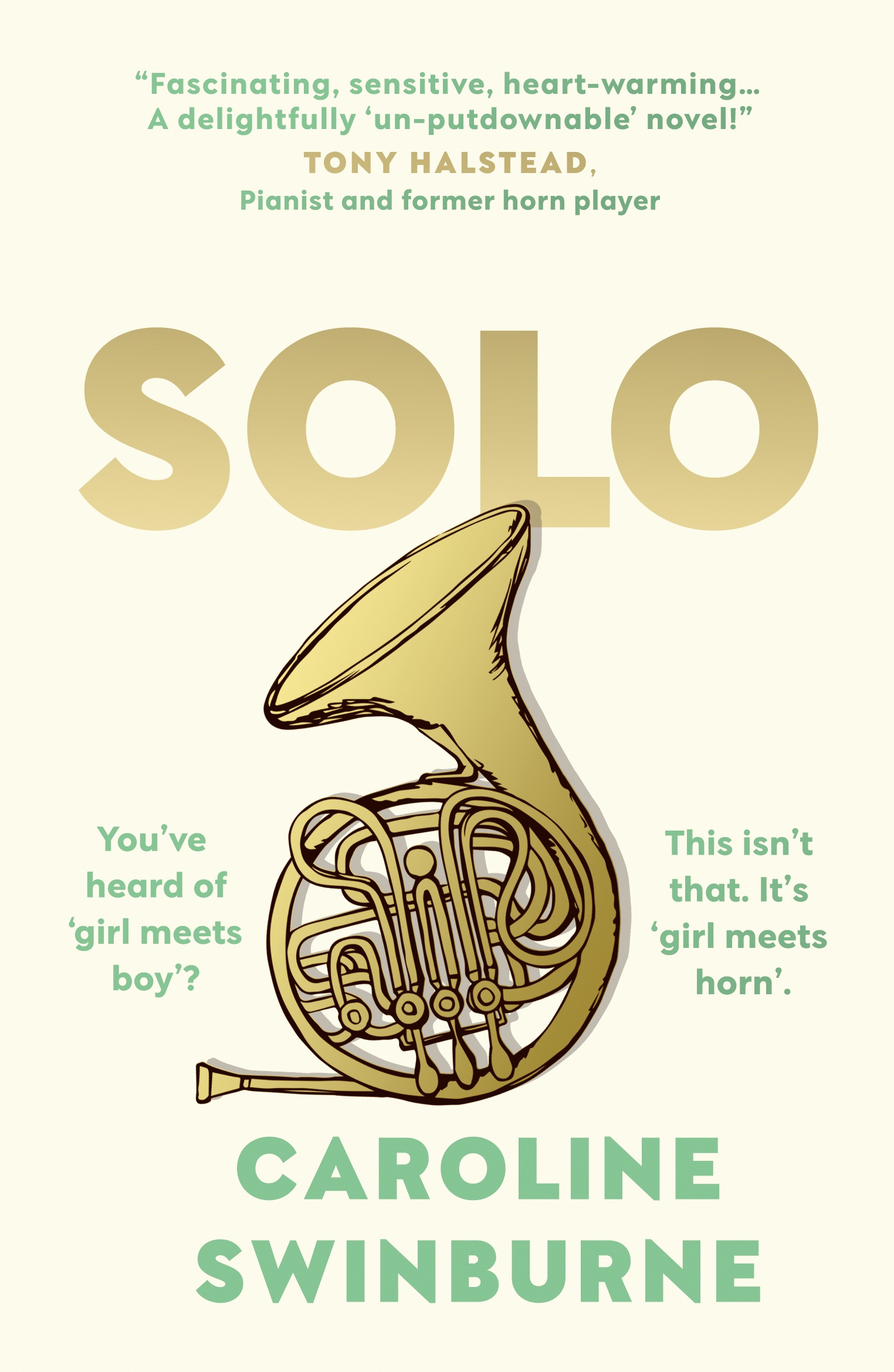
Solo
Chapter One
Breathe. In, out. In and out.
Focus on the music – only the music. The show must go on. Eat a banana. Pop a pill if you must (though, for God’s, sake don’t tell anyone).
But above all, remember to breathe.
I can recite the mantras of the performing musician in my sleep.
But tonight, I’m panting like a dog in a heatwave, and my heart’s thumping so loudly that the audience can probably hear it. I haven’t felt like this since I was a teenager. Even in those days, screwing up was something that only happened to other people; now, at the top of my game, it’s unthinkable.
I haven’t even taken my usual pill; it’s ages since I did a big gig without a bit of chemical help, but the medication is contraindicated. Better play safe.
What joker thought that this would be safe?
It’s as if there’s a demon sitting on my shoulder, goading me with all the things that might go wrong. I’m so jittery, my breath might shake on the long notes, or I might split the top F-sharp in the solo. And given the recent disruption to my sacred practice routine, my lip might even fail at the crucial moment.
Look the fear in the face. Laugh it down. That’s what I tell my students. For instance, there’s that ridiculous chap in the front row wearing the silly hat and the Union Jack bow tie – am I really frightened of him?
But who am I to talk about looking stupid? I’m on stage, in front of the world’s TV cameras, dressed in badly cut polyester trousers and a chain-shop T-shirt two sizes too big. I wasn’t going to demean myself by going back to the flat to get changed, and risking more confrontation; instead, I spent the afternoon sobbing on a park bench in Kensington Gardens before making a last-minute dash to Primark.
The assistant spotted my red eyes and tear-stained cheeks and asked if I was OK.
Even then, I could have done the sensible thing and called in sick, but it would have given the orchestral manager a massive last-minute crisis and the new conductor the excuse he’s been looking for to fire me. If I can just hang on in there for a couple of hours, then I’ll go straight to A&E with the applause still ringing in my ears.
Or maybe not.
Surely, my beautiful golden horn won’t let me down? I cradle my precious instrument in my lap. We’ve been through so much together; I’d trust it with my life. ‘The only baby you’ve ever really wanted,’ Steve had said.
It comes to something when your husband is jealous of sixteen feet of brass tubing.
At least I’ve got a decent “bumper” – an understudy to help with the heavy bits. He’s a post-grad at the college – bit of a dish. Looks like David Tennant. Good player. Nice chap too. It would make his career if I let him play the solo. But no – it would be professional suicide to hand over my big moment.
Here comes the conductor. Toivo Koskinen. Balding, thin-lipped, and glasses that are so thick, I don’t believe he can even see the horn section. He’s hated me ever since I argued about the tempo change in the Mahler. Said I was “too much of a free spirit” – and he didn’t mean it as a compliment. My God, he fancies himself. Look at him, smirking at the applause like a cat that’s got the cream.
The audience are quietening down. Koskinen taps the podium with his baton, gives us his tyrant look, raises his arms, and we’re off.
Nothing to do until the allegro. But it’s so hot; the television lights are glaring in my face, and my hands are slippery and shaky. The pains are coming regularly now – fierce twinges across my abdomen, as if my body is warning me to turn back. I thought Steve was making a fuss about nothing this morning. Maybe I should have listened.
The most important thing is to save my strength for the solo and leave the heavy stuff to the bumper. I’ll have to play the exposed passages, or Koskinen will be on my case, but the quiet octave horn calls only last for a few bars; it’s not too bad. David Tennant takes over again as soon as we get to the fortissimo dotted rhythms.
As the final chords of the first movement echo around the hall, there’s the usual smattering of confused applause. Koskinen, irritated, shushes the audience as if they’re naughty children. Or ignorant peasants. He’s an elitist snob. A dinosaur by today’s standards – seriously old-school. He’s not a woman, he’s not black, he has no visible disability, and if his pathetic flirting with the oboist this morning is anything to go by, he’s not even gay. I’m amazed they gave him the job.
He raises his baton again. David Tennant gives me an encouraging smile, and the strings begin to play low, throbbing chords.
I can see the principal cellist’s bra when she leans forward. Purple – not a good look. But who am I to talk? My T-shirt is like a sack, and my trousers are damp with sweat.
Block it out. Focus on the music. Breathe. And count.
At very least, for fuck’s sake, count.
One-two-three-four, two-two-three-four.
Koskinen’s taking it even slower than in the rehearsal. I hate the way he closes his eyes as if he’s so inspired. He only has to wave his arms around; it’s me who could do with inspiration. I could do with a miracle actually – but no chance of that. I’ve been far too rude about the Almighty to expect Him to leap to my salvation now.
I wonder how many people are listening. There must be several thousand in the hall, and millions more watching on television. Mum will have tuned in back in Middleford. Everyone’s waiting for my big tune.
Five-two-three-four, six-two-three-four.
The huge TV boom swings round. There are bright lights glaring in my face. I feel as if I’m going to throw up. There’s another wave of pain – the worst yet – and something wet and sticky inside my trousers.
Seven-two-three-four.
This time it’s more than sweat.
One-two, breathe… and play.
My tone quivers like an old lady. The slur from the A to the G-sharp is as clunky as Steve’s first car, and I haven’t got the breath to crescendo through the repeated notes. Koskinen opens his eyes and stares, horrified, as the unthinkable unfolds in front of his eyes. David Tennant’s onto it too, following my every note.
I could just let him play it, of course. But no. NO. Somehow or other, I have to keep going for a few more bars.
I muster my last bit of strength to climb to the D-sharp. Sostenuto – sustained. I planned the moment so carefully to make it a peaceful moment of respite before the climax on the top note – as if I had all the time in the world. But tonight I need to keep going. Preserve what little strength I have left.
Oh shit! There’s the pain again.
The second D-sharp implodes, and I realise there’s not going to be an F-sharp. Not a smooth one. Not even a clunky, strangled, split one. There’s not going to be anything.
As if watching from a great distance, I give David Tennant the tiniest of nods; he’s on it in an instant. The tune sings out, smooth and perfect. Koskinen relaxes. The panic has passed. He has his performance back. And my understudy has his career break.
But I’ve lost everything. My husband. My baby. And the beautiful music that has been my life.
Chapter Two
Above me there’s a bright, round light in the ceiling. There are monitors beeping, and equipment is whirring; the air is heavy with disinfectant. There’s a tube sticking out my arm, a plastic tag around my wrist, and people wearing blue outfits, face masks and plastic aprons are bustling around.
One of them pauses by my bed to tell me that the “procedure” has been a success. ‘That’s good news, isn’t it, love.’
If she says so.
I feel woozy; the blue people are floating now, and the light in the ceiling’s all hazy. A distorted Koskinen-like apparition swims into focus, his eyes wide in horror as he relives the massacre. ‘Couldn’t you have hung on in there for just a few more bars?’ His voice is full of contempt. ‘You turned that lovely solo into a strangled mess.’
Strangled mess. Mess of cells. Dead cells. The baby. Shit.
Koskinen fades away, and his place is taken by a younger version of Steve. But the handsome man I fell in love with is red in the face, distraught with grief. ‘You loved that lump of metal more than you ever loved anyone. You killed our baby. You’re a murderer. You’ll rot in hell.’
He melts away into the light. Maybe I’m in hell already? Serves me right for trying to have it all. Not surprising that I’ve ended up with nothing.
My mouth is dry, and my throat feels sore. I retch, but nothing comes out. One of the blue people puts a mask over my face and tells me to breathe. ‘In and out, in and out. Keep breathing. You’ll be fine.’
The sickness dies down, and people stop floating and walk properly again. I become aware of someone stroking my arm. ‘You poor thing. This will pass, I promise.’
It’s a real person this time; I’d know that voice anywhere. ‘Mum. Why? How?’
‘Oh, love, I saw it on TV. I tried to call, but you weren’t picking up, so I phoned round the hospitals. Got in the car. Drove to London.’
I’m starting to remember now. The pains, the bright lights, the tune that died on me. Stumbling off the stage, desperate to escape. The nice clarinettist finding an Uber to take me to A&E. Saturday night crowds, bright lights, people waving me to the front of the queue, someone finding a wheelchair, and a harassed doctor saying I needed to go to theatre immediately. Waving forms in my face, asking if I wanted to phone anyone.
I told her no. Said I was on my own.
‘Oh, love. My poor love.’ Mum’s voice is soft. I turn my face; she looks exhausted. There are deep lines down her cheeks, and her hair, scraped back into a crocodile clip, is greyer than last time I saw her. She was so excited when I phoned a couple of weeks ago to tell her she was going to be a granny. Now her hopes are dashed as brutally as my own.
‘You’re OK. That’s the main thing,’ she says, stoic as ever.
The nurse takes out the drip, puts a thermometer in my ear, checks my blood pressure and pronounces me good to go.
As if anything could ever be good again.
A porter wheels me on a stretcher along echoey corridors decorated with bright paintings and parks me behind a curtain in the day ward. A nurse brings my clothes and handbag and gives me a packet of extra-strong painkillers and two packs of extra-thick sanitary towels.
I haven’t worn towels since my first period.
‘Was it my fault?’ I ask as she’s about to leave. I remember Steve’s cutting accusations. ‘Would it have made any difference if I’d come in earlier? Got checked out? Would you have been able to save it?’
The nurse turns, looking surprised. ‘Oh no, love, I wouldn’t think so. These things just happen. Baby probably had something wrong with her. Most likely dead for a day or two. Nature’s way. Just one of those things. I don’t think anything you did would have made any difference.’
‘It was a girl, wasn’t it?’ I say, swallowing a lump in my throat. It was too early for them to tell when I’d had the scan, but I always knew I was carrying a daughter.
The nurse says nothing. Instead, she reaches in her pocket and passes me a couple of leaflets: “Why Me?” and “Your Feelings After Miscarriage”. Then she puts a hand on my shoulder and looks me in the eye, trying to be nice. ‘I’m sure you’ll be fine next time.’
I don’t want to talk about “next time”; I can’t cope with “this time”.
She bustles out, telling me that her colleague will be along in a moment to deal with the discharge paperwork. Mum and I sit in silence, until at last she asks the question I’ve been dreading. ‘But where’s Steve?’
I fiddle with my wrist tag (“Catherine Jackson-Harper. DOB: 07/06/1982”) and wonder how to begin to explain. ‘Oh, Mum, we had a row.’ I make it sound like yesterday’s fracas was nothing more than a little tiff rather than the Armageddon that had been threatening for months.
I reach in my bag for my phone: four missed calls and a series of frantic texts: “I’m only trying to look after you.” (11.05 am); “I can’t focus on anything. Can you at least call 111?” (12.30 pm); “Why didn’t you come home this afternoon? What’s going on?” (4.18 pm); “For God’s sake, at least answer your bloody phone!” (6.39 pm); and finally, “OK, I’m sorry, right. But I’m worried about the baby. And you, of course.” (8.15 pm)
I’ll have to face him eventually, but I’m not up to it now.
‘Mum, I don’t suppose you could phone him?’ I beg. ‘You’ve always got on so well. Just tell him what’s happened?’
She says nothing for a moment, just sits staring. The rings under her eyes are so dark, they look like bruises. Eventually, she takes my hand again and attempts a weak smile. ‘OK, love. I’ll do my best.’
She goes outside to make the call and returns five minutes later looking shaken. ‘He’s upset. I expect everything will calm down in a week or so.’
‘Let’s hope.’ I wish I could share her optimism. No matter how many leaflets anyone thrusts in his face, Steve’s never going to be persuaded that this was just “nature’s way”; he’ll go to his grave believing that I’m a driven workaholic for whom a baby could never be more important than my beautiful golden French horn.
The receptionist appears, saying she’s come to deal with the “red tape”, and asks the questions I was too confused to answer last night: full name, medical history, next of kin – annoyingly, I have to say Steve – and name of GP.
The hardest bit is when she asks where I’m going to live and who’ll be looking after me while I recuperate. Not Steve, for sure; I’ve had quite enough of his passive-aggressive attempts at “care”.
Mum comes to the rescue. ‘Why don’t you come home to Middleford with me for a few weeks? Give you both a bit of space? I’m home alone. The lodgers moved back to Scotland last month, so we’d have the place to ourselves.’
My Midlands hometown isn’t the cheeriest – I spent much of my adolescence planning my escape – but I’ve never felt more in need of mothering. Middleford is unchallenging, easy and a perfect place to hide from the world. ‘OK, Mum,’ I say at last. ‘Thanks.’
I give the receptionist my childhood address; she ticks the final box then notices a handwritten scribble at the bottom of my notes. ‘You had a suitcase, didn’t you? They took it off you last night when you went into theatre, but we’ve kept it safe.’
Five minutes later a porter appears carrying the large, dark-brown case with a faux-crocodile-skin cover. ‘Here you are, my dear,’ he says, putting it down with a thud. ‘Don’t travel light, do you?’
I do my best to return the smile. I vaguely remember hanging onto the horn when I fled the hall – I’d probably have taken it into the operating theatre if they’d let me – but now, in the cold light of day, I can hardly bear to look at the thing. I’d be happy to donate it to the hospital’s music-therapy department.
But Mum would never allow it; she bought the instrument in the first place, applying for countless grants and topping them up with money originally destined for her paltry pension. The day after my eighteenth birthday she took me to Harrisons, the specialist horn shop in London, to choose the best instrument money could buy. The salesman, who’d seen me on Young Musician of the Year, treated me like royalty, and I went home fizzing with excitement, the proud owner of an Alexander Model 103. Gold brass. Shiny and perfect. The love of my life.
Mum picks up the horn case and guides me through the maze of corridors. Outside in the car park she puts the instrument in the boot of the little Fiat and helps me into the passenger seat for the long journey north to the Midlands.
Fifteen years ago, she drove me in the opposite direction, on my way to student life at the Royal Academy. My beautiful golden horn had enabled me to escape Middleford to start my dream career in the big city. The sun was shining, I ate my way through a package of Mum’s home-made cookies, and we listened to Mozart on the radio.
Today, there’s been an accident at South Mimms. The traffic’s at a standstill, the car is stuffy, and I feel sick. Mum turns on Radio Three, but the music is noisy and unsettling. Janacek maybe? Or Bartok? Whatever – it’s the last thing I’m in the mood for. I turn the volume down and fall into a fitful doze.
It’s almost lunchtime by the time we crawl past the accident. There’s a fire engine and a couple of ambulances, and a man pacing up and down in shock. But this is someone else’s nightmare; all I care is that the traffic eases up. We stop at Corley Services to buy a sandwich and go to the loo, and as we get back in the car, the weather – until then pleasantly sunny – starts to cloud. By the time we reach the M6 Toll, it looks more like February than July, and when we arrive in Middleford in mid-afternoon, my hometown is engulfed in its usual blanket of grey cloud.
Mum turns into the driveway and parks outside the rambling old house that was my childhood home. The paint on the front door is peeling, and there are a couple more broken paving stones, but otherwise it’s pretty much the same as when I last saw it almost a year ago.
I go to my childhood bedroom, with the posters of Leonardo di Caprio and Johnny Depp, the old keyboard I used for harmony exercises, and the silver cup I won in the Tiffordshire Young Musician competition. I accept Mum’s offer of a plate of scrambled eggs, then climb into bed, snuggle down under the duvet and attempt to block out the world.
Chapter Three
For the next two weeks Mum attends to my every whim, feeding me home-cooked, nutritious meals, lending me pyjamas and comfy bed socks, and even turning the heating on so I won’t catch a cold (July is as freezing as ever in Middleford). She moves a TV into the bedroom so I can watch Jeremy Kyle and Homes Under the Hammer and brings me copies of Hello and Good Housekeeping, joking that I should make the most of this opportunity to splurge on gossip rather than worrying about the woes of the world.
I know she wants to keep me away from the newspapers in case I see the concert reviews. She doesn’t realise that if I was that keen to read my lambasting at the hands of the critics, I could always look on my phone – but some things are best left unseen.
My boss at the Academy emails, suggesting “revisions” to next year’s teaching rota and attaching a spreadsheet showing me obliterated except for one pupil taking horn as second study. He apologises for the drastically reduced workload, explaining sadly that the decision was out of his control. The extra job was a nice little earner, and I used to love nurturing young talent, but I can see that no one’s going to want me as a teacher now.
The nice clarinettist organises a get-well e-card (“Hope you’re soon fit as a fiddle”, with a cartoon band serenading), but only five of my colleagues have added their names. Failure’s contagious – you can’t be too careful.
Eventually, after three weeks, the inevitable call comes from the orchestra manager. He puts on his smarmiest and most compassionate voice to tell me he’s so sorry to hear I’ve been unwell; he hopes I’m now on the mend.
I grunt acknowledgment and wait for him to get to the point.
Squirming with embarrassment, he begins a well-rehearsed spiel that sounds like it’s been checked with the lawyers.
Unfortunate as my illness has been, I must have known that there was a policy on such things. It was “highly unprofessional” of me not to call in sick. The concert was “high profile” – the orchestra’s first with the new conductor, televised live to a global audience – and if I’d given even a few hours’ notice, they could have found a replacement. Instead, I’d made them look a laughingstock. Mr Koskinen was most displeased. Nothing on this scale had ever happened in the orchestra’s illustrious seventy-year history – and it must never, ever, be allowed to happen again.


Comments
Super sad! Interesting start…
Super sad! Interesting start, and makes you wonder where it's going from here.
Overall this is an excellent…
Overall this is an excellent piece of writing but it does feel a tad indulgent at the expense of the narrative. It's well-constructed and things happen in the right places; however, the 'I factor' is a bit too overwhelming and it slowed the pace down. More dialogue would have been welcome.
What a beautiful start. The…
What a beautiful start. The reader dives right into the plot. Great writing!