

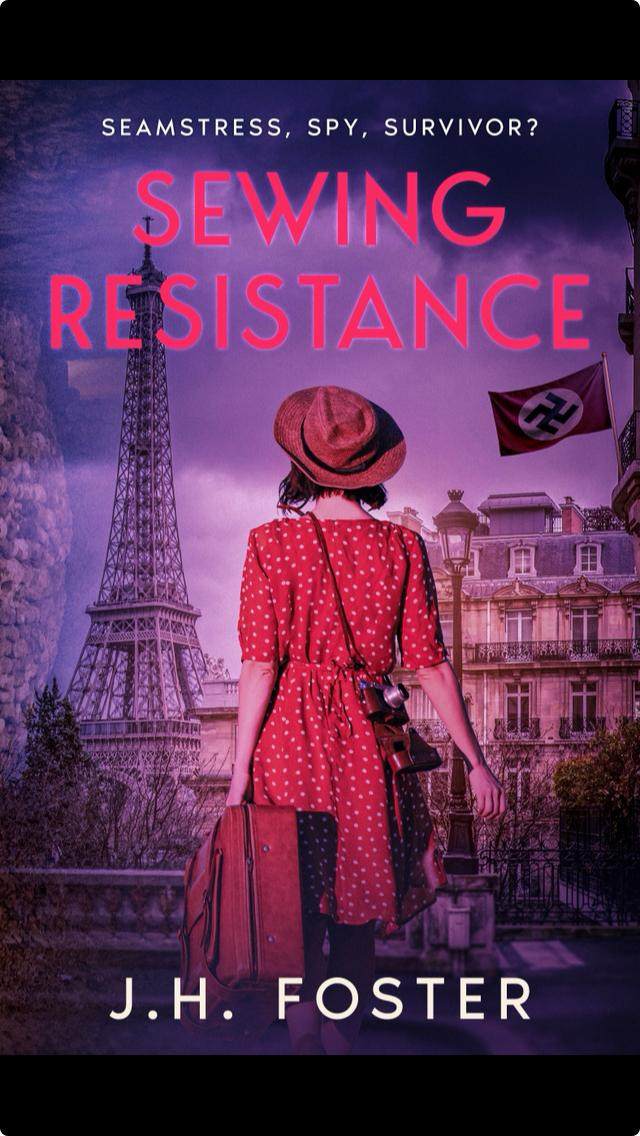
Chapter 1 - March 23rd 1937. Austria.
My foot pauses on the pedal when I hear the rumble of trucks pulling into the convent’s courtyard below. I glance down at the beige shirt held by the needle of my trusty Kohler sewing machine, then through the small window next to me. Adjusting the shirt to fit the smaller chest for one of the orphans will have to wait, as two jeeps, a covered truck and a long-nosed black car fill the yard below.
Soldiers scramble out, guns cocked. A tall officer steps from the back seat of the car. His face is hidden to me as he pulls his cap low, then straightens his long, black SS coat. I draw away from sight, mouth dry, mind racing. With so many armed men accompanying a senior Nazi, this cannot be a cursory check. As if confirming my fears, the barked order echoes up: “Überall suchen.”
Would they search everywhere? I doubt they will leave out my room. My gaze sweeps around the neat, narrow space. It was once a corridor, but now my bedroom-come-workroom has a chest for clothes and a bed. On the shelf near the machine, I store sewing supplies and fabric remnants. Superficially, it’s just an ordinary room. But, in the middle of the long wall is a faded wall tapestry, which appears to be decoration. The hanging has another purpose - behind it is the locked entrance to the room that the corridor once provided proper access to.
If my bedroom, then the next, are searched, explaining away the printing press would be difficult. The scruffy-looking man who rested there for a few days departed last night, using the knotted rope hanging from the window tucked into the ivy which grows up the side of the building. I pray he left no evidence of his presence behind, but, hearing the hammer of boots marching across the flagstones, I’ve no time to check.
As I push my stool aside and stand, I catch sight of Freddie’s holey socks on the bed - my next project. Where’s my son? My stomach clenches as I dash across the room. Wasn’t it today the children are supposed to be learning about tending to vegetables? I fling the tiny bedside window open and stick my head out, searching for our ever-growing group of orphans and Freddie in the gardens and vegetable patches. No small, capped heads are bent over the beds, no sound of chatter or laughter drifts on the breeze.
Under the shadow of the mountain, the grounds seem deserted, but then, I spot grey intruders stalking through the beans. The muzzles of their guns poke through the leaves like wolves’ black noses, peering, searching for prey. What can they be looking for? This is a small convent, dedicated to taking care of orphaned children, although, for the last year, it’s been hard to ignore the comings and goings of late night visitors, and whispered conversations which cease whenever I walk in.
The classroom - the children must still be there. I close my eyes briefly as I shut the window and cross myself, sending the Lord a prayer for us all. The simple action does little to calm me, but then, not born to this Catholic faith, it’s the best I can offer. I have learned the hard way that appearances matter, and, with my sallow skin, dark hair and eyes, I’m accustomed to visibly demonstrating how not Jewish I am now. After being orphaned ten years ago, in this second decade of my life, I follow the religion of my childhood benefactor and current home, and have forgotten everything I was born to. In dark times, Catholicism is safer, or so Herr Franz Weisz said, when he begrudgingly undertook my parents’ wishes and provided a roof over my head. Until, I disgraced myself and ended up here, sheltered by the nuns. I have no desire to take vows, nor could I, but in return for mine and Freddie’s board, I sew, cook and clean.
A cursory, almost habitual, check reassures me there’s nothing to suggest wrong-doing visible, unless you count an old, much-treasured copy of Harper’s Bazaar nestled on top of my clothes in the chest. Satisfied, I rush through the corridors towards the schoolroom at the other end of the building. When I open the door, Sister Marta’s eyes widen and her mouth tightens at the interruption. The children’s fearful white faces swivel to see who’s entered, so I imagine she must know our sanctuary swarms with Nazis and has warned her charges to behave. My gaze is drawn to the front table where Freddie usually sits.
He isn’t there. My throat tightens.
“Can I help, Hannah?” Sister Marta’s voice wavers slightly. How hard it must be to stay calm for the children when we both know what’s at risk.
My speech sounds thick as I reply, “I just wanted to….”
To what? Check on my son, when all the other children here have no parents to care for them? My stomach knots with shame. I should be protecting them all, like the good Sister is.
“If you are looking for Freddie, he was helping Sister Luisa with his camera, cataloguing paintings in the Chapel. All other children are accounted for here, safe with me.”
I throw her a grateful smile and close the door behind me.
As I look back up the corridor, a soldier stands outside my room. He’s young and skinny, barely a man, and probably no older than I. His expression changes from bewilderment to decisive. “Halt!”
I freeze, my hand still on the classroom doorknob. “Can I help you?” I doubt it, but I must draw him away.
“What’s in these rooms?” He grips the gun slung over his shoulder and waves the muzzle at the doors as he strides towards me.
I want to tell him it’s none of his business, but Mother Superior’s voice floats through my head. “Rebellious behaviour will only get you noticed. Know your place, speak only of what you know and all will be well, Hannah,” was her wise advice upon my arrival here, six years ago and pregnant.
“Dormitories for the orphans,” I say, my head low. “And this is their classroom. They aren’t locked. You can go in them, if you like.” They are kept spotless and I’m certain the worst he’ll find in there is a contraband catapult toy. Go into these rooms, I pray, not mine.
His lips pinch together as I urge, “But please, lower your rifle if you enter the classroom. I’m sure there’s no need to frighten the children.”
He nods at me curtly, then flings open the door nearest him. I take the opportunity to dash downstairs. My steps slow as I cross the stone flags of the entrance hall and sneak towards the Mother Superior’s office. Through the doorway, I glimpse the officer’s leather coattails, flapping as he paces.
“Father Tomas only read what he was given,” Mother Superior says in a prim voice. Last weekend, the whole convent, including the children and myself, had attended the Mass in the larger Church in town. We'd all been shocked at the strong opinion - an abject condemnation of the Nazi regime, called, ‘Mit brennender Sorge’. The edict, written by Pope Pius himself in German, was delivered from the pulpit to the congregations of all Catholic churches simultaneously on Palm Sunday. I recall the sharp intakes of breath when Father Tomas paused after reading out, ‘The experiences of these last years have fixed responsibilities and laid bare intrigues, which from the outset only aimed at a war of extermination.’
For those of us from the convent in the congregation, it echoed Mother Superior’s daily caution - each Jewish child we house here must be protected. Their very lives depend on our conspiracy of silence about their origins.
She invokes the authority of the Papal office, saying primly, “A Papal Encyclical must be delivered to the public as soon as it is received.”
“I know it must; I was brought up a Catholic myself,” the officer says. “But it is one thing to have an opinion, but quite another to act upon it, as you have.”
A shiver runs through me as I recognise the deep, clipped voice of Pieter Weisz, son of my benefactor. I have not seen him in years. He’d already moved into the accommodation provided for him by the state, when his cousin - and my only childhood friend - Katarina and I faced the consequences of our actions, back in 1932. Pieter would surely know of my dismissal from his family estate, perhaps even why. And, he knows I’m Jewish.
Chapter 2
Hide, my instinct reacts, before Pieter can see me. Before I can be his undoing, for he would surely shoot me down rather than risk me telling anyone his father housed a Jew, let alone built the family fortune by taking over my parents’ business upon their unfortunate demise.
Mother Superior sounds indignant. “Act upon what? I’m not sure what you mean.”
In a chilling tone, Pieter says, “Don’t you? Perhaps within these walls, you do more than pray.”
“Of course. Aside from our work in the community, we have orphans to care for.”
“If I should find any of them are Jewish, there would be consequences,” Pieter says.
“All children are innocents. Surely you can agree, Oberführer?”
“Not all children are, and a Jew is a Jew.”
This antisemitic stance is well known to me. He has clearly risen the SS ranks in my absence, as well as cast aside the teachings of compassion from his faith. His coveted position was the very reason Herr Weisz was so keen to remove me from his house. The SS must be beyond reproach, generations of pure Aryan blood proven, with no hint of association with a Jew.
I should run - now - but my feet refuse to obey. My hands shake… I cannot leave without Freddie.
Inside the office, the paces cease. Pieter says, “I’m under orders to expose those who assisted in delivering the Encyclical, then deal with them appropriately.”
Find Freddie and go, I decide, mentally repeating it over and over until my feet finally comply. As I creep past the doorway, Pieter’s voice reminds me of the cold deliberation of his father. “You can imagine my surprise when last night, my men captured a known dissident on the road, close by to this very convent, with copies of the Encyclical on him. A man known for spreading disinformation, for resisting. A radical who seeks to disrupt order in this province.”
Mother Superior gasps. “Whomever he is, whatever he’s done, that’s nothing to do with us. We are a simple religious order, seeking only to do God’s work.”
“After ‘questioning’, the traitor admitted he’d been housed at this very convent.”
Just past the door, I freeze. Under torture, I imagine most people would say anything to make it stop. But, there was a man here, until last night…
Mother Superior says, “We have no men here, Oberführer. Apart from a few young male orphans, there are only women living here, of course.”
“Then it is women, nuns even, who have produced this pamphlet preaching rubbish, which we also found on him?”
The implicit sneer in his voice makes my blood run cold. Whatever was printed, I can only assume the contents are critical of the regime we live under. Why else would it be of concern to the SS?
I clench my hands together to stop them trembling. How had I not seen what was right under my nose? But I know, deep inside, the answer to my own question. Fearful, I had suppressed my curious, rebellious nature. For Freddie’s safety was why.
In the silence I imagine Mother Superior is wrestling her usual inclination to voice the truth with the need to protect us all.
But Pieter isn’t done. “Not only are you harbouring criminals, but abetting their pathetic cause. Which makes me think, what else are you hiding here?” He snarls, “Shall we see? How about the chapel? Lots of hiding places there.”
Urgency to find my son overrides my caution. As I dart down the passage towards the chapel, the office door creaks behind me.
“There’s nothing there,” Mother Superior squeals, unnaturally high-pitched. Her voice and the shuffle of her shoes are too close for comfort, but I don’t look back as I slip into the cool recesses of our sanctuary.
I scan the empty pews, chewing my lip. On one side of the chapel, a selection of paintings I’ve never seen before are propped against the wall by the confession booths. “Freddie?” My whisper grows urgent as I tiptoe towards the altar. “Freddie? Where are you?”
“Mama?” He calls from inside the limestone pulpit. As he then stands, his hair pokes above the stone rim, white-blond wisps caught in the sun streaming through the windows.
“I’m coming, stay there!”
Pieter’s voice echoes down the hallway. “There’s rarely nothing in my experience. Where there’s one rat, there’s a nest.”
“Get down,” I hiss as I run towards the pulpit and up the few steps to reach him. “Stay silent until it’s all over.”
He crouches, arms wrapped around his knees, white-knuckled fingers grasping his camera. Relief floods my body as I drop inside the stone booth and clutch him into me. Freddie’s hands shake and I place my fingers over his on the camera in case it rattles. His most precious possession, his only one, is this old Zeiss Ikon Box-Baldur. The metal box was all the rage in Hitler Youth, and passed on to me as a hand-me-down by Katarina just before she left for finishing school. I suppose it might have been Pieter’s once upon a time. Freddie formed an attachment to it from a young age, although we rarely have money for film or to have his photos developed. Of course, he knows nothing of its providence, just likes to take it apart and put it back together again, twiddling the knobs and pressing the trigger with a very satisfying click.
“Resist any more, and you’ll learn the consequences,” Pieter says, closer now.
I bury my head over my son and hold my breath.


Comments
Very well written, wonderful…
Very well written, wonderful characters, and great premise. Scary at the end, and it all served to make me want to read more. Great job.
A very compelling excerpt,…
A very compelling excerpt, atmospheric and plausibly real. There's a restraint in the telling that fits the setting and the premise. Excellent characters and dialogue, coupled with the strong inner voice of the protagonist produce a powerful piece of writing to be proud of.
A very engaging start and…
A very engaging start and great work with setting the scene. I was really hooked and would love to read more.
Assured, tense, and properly researched;
Mit brennender Sorge as the inciting document is a smarter choice than the usual set pieces. A saturated market, so the sewing-and-printing-press angle is what needs to lead. (One catch: "providence" should be "provenance.")
Suspense at its best
This story had me rushing ahead to see if the protagonist and her son were safe. Alas, the excerpt ended, leaving me wanting more. A mother protecting her child is a timeless trope and given the setting, a timely examination of fear and oppression. Well done.
Well-Crafted
Chapter 1 and Chapter 2 knit seamlessly together Truly, the entire submission is well crafted--expertly, even. It has every element required for solid fiction.
Excellent tension.
Hannah is an immediately sympathetic protagonist, and the arrival at the convent creates excellent tension, particularly once her need to protect Freddie collides with the danger posed by someone who knows her past. The hidden printing press, Freddie’s camera and Hannah’s complicated history all promise an intriguing larger story.
I would recommend revisiting one aspect of the historical setting. The chapter is dated 23 March 1937 in Austria, when Austria was still independent and the Austrian Nazi Party and its affiliated organisations had been banned. No, my research might be wrong, but the Anschluss and open Nazi takeover did not occur until March 1938. Austrian Nazis certainly existed and operated illegally in 1937, but an SS officer openly arriving with an armed force, searching a convent and exercising apparent state authority would therefore need further historical justification.
There may also be a related issue with Mit brennender Sorge. Although the encyclical was issued in March 1937, it was addressed specifically to the bishops of Germany concerning the situation of the Catholic Church in the German Reich, and Nazi reprisals followed its secret distribution and reading from German pulpits. If this opening were set in Germany in March 1937, much of the sequence may fit the historical circumstances more naturally. Alternatively, a post-Anschluss Austrian setting would require a different immediate trigger. The historical context is so integral to an otherwise compelling opening that I think resolving this would considerably strengthen it.
Very compelling, with…
Very compelling, with palpable tension. Well done!
A very compelling piece of…
A very compelling piece of prose. I was very drawn to the protagonist through your use of language, dialogue and pacing. A great start and I wanted to continue reading.
Atmospheric and Intriguing
Your variation of sentence structure, atmospheric prose, and use of tension made this such a smooth and enticing read! In such a short amount of time, you’ve managed to make me feel deeply for these characters and the orphans, which is very impressive and difficult to do so early on in the story. Well written. I love it so far!
Very moving, tense and compelling
There has been so much crafted into this sample; the characterisation, the emotional impact, the tension. It is a busy market but there is an edge to the angle that works well. It is really visual to read and filmic.
Good start !
This one for me was well-written but slightly too reminiscent of Kate Quinn's work, including the cover style. I admit to being a somewhat harsh critic, not with the intention of deterring, but rather with the intention of pushing your work further. Keep going. Keep writing. I know you have more within. Keep going!
All the Necessary Elements
Characters are believable, the historical background is chilling, and the tension is palpable. This serves as an excellent foundation for a compelling story. Well done!