

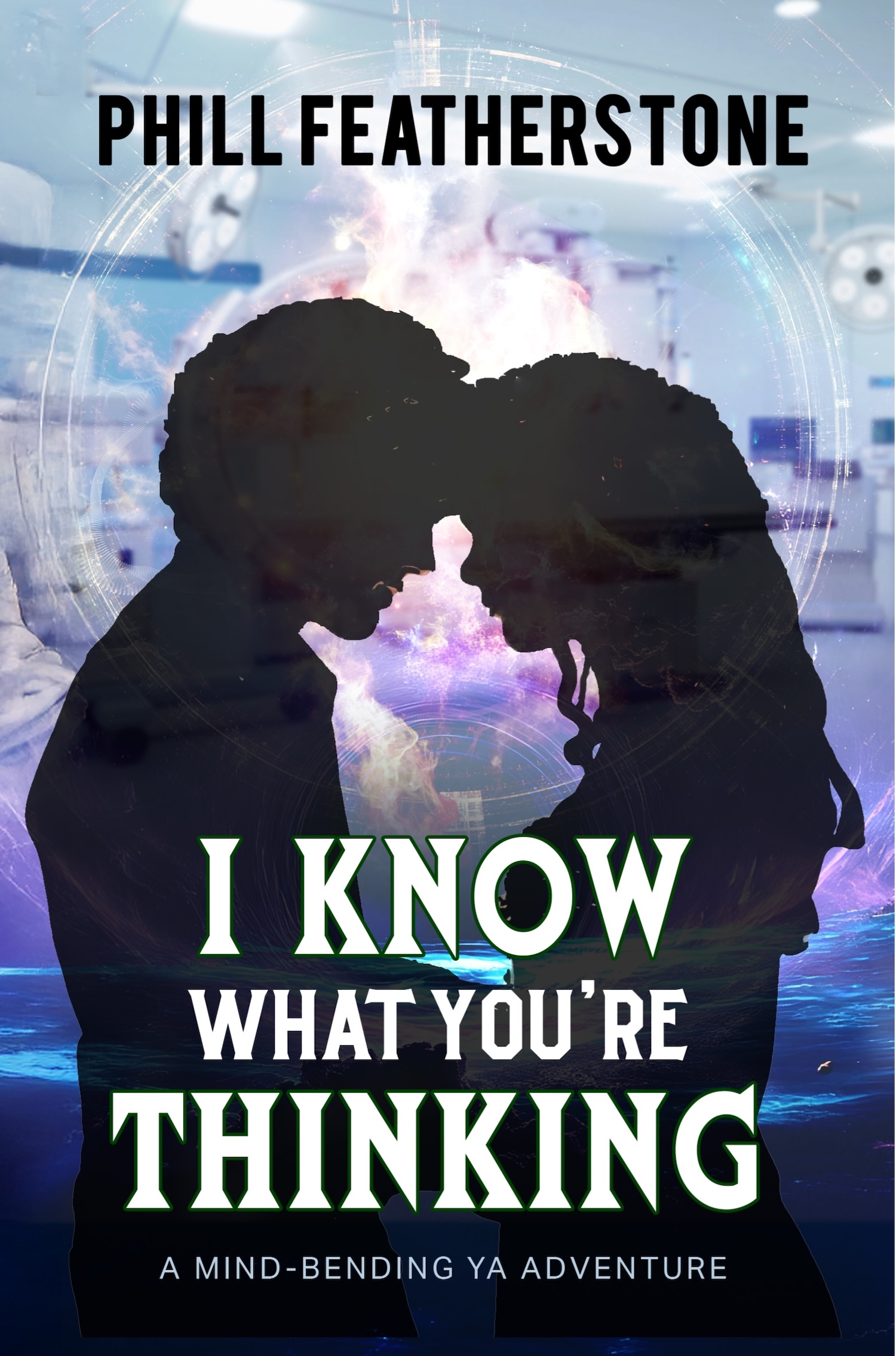
Chapter 1
Beth was on her bed with Cameron beside her. She adjusted her blindfold. Cameron wasn’t wearing one because having his eyes covered made him feel claustrophobic, but Beth found it helped. They had agreed that it was better if they didn’t touch, so they kept a space between them. It wasn’t a very big space, but it was there.
‘Ready?’ Beth said.
‘Yes,’ Cameron whispered.
‘Okay. Start.’
Cameron closed his eyes and took a deep breath. He had already decided on the picture he would create in his mind’s eye, something not too unfamiliar, but also not too easy to guess.
Beth started her relaxation routine. She began at her head and neck, then went down her body in stages, tightening and then unlocking all the muscle groups, the way she’d been taught in dance classes. Next, she tried to empty her head of all thoughts and to shut out sounds—the bird outside her bedroom window, the gentle rhythm of Cameron’s breathing—and to reduce to nothing the sensation of the mattress beneath her body and the pillow under her head.
She imagined a room with no light and no features; a cavernous, dark space lined with black velvet. She allowed herself to sink into the gloom and hang there. Then she saw a speck of light directly in front of her, as if someone had cut a tiny hole in the fabric of the wall to make a spyhole into a sunny, alternative world. Slowly, it grew into a blob. She knew that the light was important. She knew that she must remain completely still and do nothing to disturb it. She felt to be floating and was aware of space below her. She could see her own body and Cameron’s, side by side on her bed.
The pinpoint of light grew, stretching upwards and downwards. Then the line extended, widening at the top. It took on a bluish colour. It began to sparkle, as if polished. It developed an edge and a spike.
Suddenly, she knew what it was. She sat up quickly and snatched off her blindfold. Her eyes watered, dazzled by the afternoon sun streaming through her window.
‘Jesus,’ said Cameron, jerking upright. ‘What’s up? Are you all right?’
‘Yes.’ She couldn’t hold back her excitement. ‘I know what it is. I know what you were thinking of.’
‘What was it then?’
‘It was an icicle. You were imagining an icicle.’
Cameron didn’t reply.
‘Weren’t you?’ said Beth.
‘No,’ he said. ‘It wasn’t that.’
Beth looked crestfallen. The picture in her head had been so clear. ‘What was it, then?’
‘I was thinking of a dagger.’
For a second, Beth was thrown. Then she saw the connection. ‘But I was nearly right. Don’t you see? An icicle is long and thin, with a sharp point. It’s very like a dagger.’
‘Yeah, I suppose,’ Cameron said.
‘Of course it is.’ Beth giggled excitedly. ‘This is fantastic. Our first test, and we were so close. Let’s try again. My turn to send.’
‘Okay.’
They both lay back again, and Beth replaced her blindfold. She went through the relaxation drill, but this time, instead of trying to clear her mind, she reached back into her memory for something that would have meaning for both of them. This time it wasn’t an object. She recollected a walk in the snow that she and Cameron had enjoyed last winter. She recalled a long, straight lane between snowy fields. The lane was lined with trees, and she could hear the melting snow sluttering from the branches. She remembered what she and Cameron had been wearing. She heard the crunch of the snow beneath their boots. She concentrated as hard as she could, holding her breath, not moving, until she could keep it up no longer. She took off the blindfold and rolled onto her side.
Cameron was on his back, with his eyes closed.
‘Anything?’ she said.
‘Not really. I mean, I kept trying. I kept thinking what it might be that you’d want to send to me, but there were so many things, and nothing was clear.’
Beth was disappointed. ‘I don’t think you should be trying to think of anything,’ she said. ‘The idea is that you empty your head and make your mind a blank. If you’re expecting a particular image, it will push what I’m trying to send you out of the way.’
‘Yeah, but it’s hard,’ said Cameron. ‘I can’t think of nothing.’
‘Let’s give it another go, said Beth. ‘Maybe it works best with you sending and me receiving. What you were thinking of got through to me, didn’t it?’
‘Sort of,’ said Cameron.
‘It did. When I think about what I saw, it could have been a dagger. It’s just that I mistook what it was. We must try again. Send me something.’
They lay down once more, and Beth covered her eyes again. Cameron took hold of her hand. She tried to clear her head, but this time it was harder. She couldn’t shift the image of the lane in the snow that she’d been attempting to send to Cameron. Every time she tried to recreate the velvet room and the blackness, the frosted trees and the slushy ruts forced their way in. After a few minutes, she sat up, removed her blindfold and dropped it beside the bed.
‘What’s up?’ said Cameron.
‘It’s no good. I’ve lost the knack. I can’t get out of my head what I was trying to send to you.’ She slid her legs off the bed. ‘I think we need to take a break.’
‘What was it that you were trying to send me?’
‘You remember last winter, when we walked along that lane at the edge of the park, in the snow, you know, when you told me I was the only girl you’d really loved? Well, it was that.’
‘Holy shit!’
‘What?’
‘That’s what I was trying to send you.’
Beth was lost. ‘You mean you were thinking of the lane?’
‘Yes. And the snow, and when we stopped under the trees, a great lump of it came off a branch and just missed us.’
‘Why? What made you think of that? Why remember it now, so much later?’
Cameron shook his head. ‘I don’t know. It just came into my head.’
‘But that’s what I was trying to send to you when you were the receiver, but said you didn’t get it.’
They both looked at each other.
‘Oh my God,’ said Beth. She was so excited that the words caught in her throat, and she could barely get them out. ‘Don’t you see? You did get it. It worked. You did know what I was thinking.’
Chapter 2
Being able to share each other’s thoughts wasn’t new. For as long as Beth and Cameron had known each other, they had been aware of a curious link between them. It showed itself in lots of small ways. For example, they’d both start to speak at the same time and be saying the same thing. Or they would turn up to a friend’s birthday party each with an identical gift. At meals, they’d nearly always make identical choices. Beth would know what Cameron wanted for Christmas before he’d said anything to anyone about it. Cameron would know what bedtime story Beth had had the night before.
At first, they didn’t think it was anything unusual. It had always been like that. Some of their friends treated it as a joke. Archy, Cameron’s friend, said it wasn’t surprising that they both thought the same thing because they’d only got one brain between them. The rest ignored it. Then adults started to notice. ‘Anyone would think you were twins,’ Beth’s Gran said. She thought it was cute. So did Molly, Cameron’s mother. Zak, his stepdad, looked for ways to explain it.
All that was when they were younger, but when they moved to secondary school, it became an issue. At the end of their first term, they were hauled before their head of year. They were puzzled to know why, and were astonished when they were told that the answers they’d given in a history test the day before were virtually identical. The teacher put their papers side by side and demanded to know which of them had copied from the other and how they’d managed to do it.
Beth and Cameron were bewildered and denied that they’d cheated. They both insisted that the work was their own. The teacher didn’t believe them. She picked out examples from their answers. They were not quite the same; just different enough, she claimed, to show an attempt to hide their deception.
They were put in detention. It was not for copying, the head of year explained, but for failing to own up to it, and Cameron was moved to another group which did different work so that the problem couldn’t arise again. However, the pair had acquired a reputation that took some time to shake off.
Beth was convinced that they had a special gift, Cameron not so much. He believed that what was going on was either a fluke or a coincidence, and that it wasn’t surprising that it happened because they spent so much time together. He told her that telepathy was a load of rubbish, and he dug up articles debunking it. Beth challenged him to give another explanation for what they experienced. He couldn’t. She also pointed out that many scientists agreed that there was a lot about the mind that was still not fully understood, and she talked about reports she’d found in her research on the internet that dealt with aspects of the brain beyond the five recognised senses: for example, the functioning of mirror neurons, and the work sponsored by Elon Musk on ‘neuralinks’. They never had a full-blown row about it, but they had some animated discussions.
Cameron said he’d prove once and for all that telepathy was nonsense. He persuaded Beth to carry out a test that he’d found online. It used a pack of “Zener” cards, five sets of five cards, each set bearing a different symbol—a circle, a square, a cross, a star, and wavy lines.
‘What do we have to do?’ said Beth.
‘One of us is the sender and the other the receiver. We sit back-to-back. The sender puts the pack of cards face down and turns them over one by one. They concentrate on the card and try to transmit that symbol to the receiver. The receiver writes down what they think it is. We do that for all the cards in the pack. Then we check and see how many are right.’
‘How many times do we do it?’ said Beth.
Cameron consulted the instructions. ‘It says here you should go through the pack five times.’
‘All right,’ said Beth. She didn’t believe that the experiment would tell them anything. She knew that they had a connection, but she thought Cameron should be humoured.
For their first run, Cameron was the sender and Beth the receiver. When they were done, they went through Cameron’s pile of cards and checked them against the list that Beth had made. They were astounded. Ten of the twenty-five cards on Beth’s list were correct.
Beth was exultant, and even Cameron was impressed.
‘Unbelievable!’ she gushed. ‘Let’s do it again. I’ll send, you receive.’
On the next run, the score was two.
‘Oh,’ said Beth, disappointed. Perhaps she was a more effective receiver than Cameron, and he was a better sender. She handed him the cards. ‘Again. Really concentrate now.’
‘Yes, miss.’
They repeated the test, and this time the score was three.
‘Well, at least it’s going up,’ said Cameron.
‘Yes, but it’s not even average,’ said Beth. ‘With five of each symbol, you’ve got a one in five chance of being right.’
They did it again and scored another two. Then four. Then they gave up.
‘Useless,’ said Cameron. He checked their results on the ready reckoner that had come with the cards. ‘Twenty-one correct out of a hundred attempts. It says that’s “insigni!cant”. Pathetic!’
Cameron felt vindicated. Fond as he was of Beth, there was no mysterious mental link between them. She didn’t know what was happening in his head, and he confessed to himself that sometimes that was a good thing. He certainly had no idea what was going on in hers.
Then something happened that changed his mind. He was with Beth on a patch of waste ground. It was the site of an old factory. The walls had gone but the concrete floor remained, and that was great for skateboarding. At the edge of the site was a huge mound of earth and rubble, and some lads were on top of it messing about with an old tyre they’d found. It was huge, perhaps from a tractor, and they were having trouble handling it.
Cameron climbed up to join them, but Beth stayed at the bottom with her Gran’s dog. She bent down to rub the animal’s head, and just then the boys lost control of the tyre, and it started down the mound. Beth had her back to it, and it was obvious she was directly in its path.
Cameron tried to shout, but no sound came. It was as if his throat was paralysed, but inside his head he screamed at her to move. Beth felt a sudden lunge, like a push in the small of her back. She staggered, and the tyre bounced past. It missed her by a whisker. She swung around and saw Cameron and a couple of his friends hurtling down the mound towards her.
‘Shit, that was lucky,’ one of them said.
‘Sorry,’ said the boy who’d let go of the tyre. ‘I didn’t expect it to go like that. Good job you got out of the way. It would have flattened you if it had hit.’
Beth could see it had been a near miss. The tyre was huge and heavy; if it had struck her, she would have been badly hurt. She also knew that her escape wasn’t down to chance.
When they were alone, she and Cameron talked about it.
‘Thank you,’ she said.
Cameron was shaken by what had so nearly been a terrible accident.
‘What for?’ he said. ‘I didn’t do anything. I tried to shout, but something stuck in my throat and I couldn’t.’
‘You didn’t need to. I felt you. It wasn’t a voice in my head or anything like that. It was as if you shoved me out of the way.’
Less than a week later, there was another indication of their power. It happened in an instant. They were going for a bus to take them into town. Cameron saw it coming on the other side of the street.
‘Come on,’ he shouted, and started to run across the road. Beth was behind him and she froze. He was looking the wrong way. He was about to step into the path of a car.
At that same instant, Cameron felt something hold him. He said later that it was like a fist grabbing his shirt and stopping him from moving. The car sped past, and Beth stood open-mouthed. She hadn’t done anything, but she knew that somehow she had saved him. She needed no more evidence that their minds could connect. She didn’t know how or why, but there was no other way that these things could be explained.
She decided to challenge Cameron’s scepticism and prove to him once and for all that they really did have an extrasensory link. They set up the experiment in her bedroom, and Cameron was at last convinced. He had to accept that, for reasons neither of them could fathom, one was able to reach into the mind of the other. However, it wasn’t something they could rely on being able to do all the time; it just happened sometimes.
‘Pity,’ Cameron said. ‘If it was, we could put on shows and make money out of it.’
They agreed that the favoured tests of telepathy, like trying to reproduce sequences of cards or find objects that had been hidden in a room, were a waste of time. What connected the two of them was not something mathematical or scientific!c: it was emotional and beyond understanding. The only sensible way to handle it was to talk frequently about what they were doing and what they were planning to do, so that they could avoid being labelled freaks, which was obviously what some of their friends thought.
They went through their teens, they grew closer, and their relationship progressed from friendship into something more. As they developed a physical attachment, the mental bond between them became even stronger. Not always, but often, each would know what the other wanted or didn’t want, without them putting it into words. They knew that they were privileged to have such an amazing gift. They didn’t know that one day it would save Cameron’s life, and that it would almost cost Beth hers.


Comments
An intriguing and engaging…
An intriguing and engaging premise. Tightening some sections and reducing repetition would sharpen pacing and heighten the impact of key moments.
Thanks
In reply to An intriguing and engaging… by Falguni Jain
Thank you for your comments and advice, which I appreciate and will take on board.
Really interesting premise!…
Really interesting premise! Intriguing start and fun characters. Tighten up some the prose, which is a bit wordy at times, and i think it could be a hit.
Thank you
In reply to Really interesting premise!… by Jennifer Rarden
Thank you for reading my work. I'm delighted that you think so highly of it!
Pitched at the right level…
Pitched at the right level for the young adult reader. The premise should resonate with this age group although some attention to the style and use of language would invest the writing with more energy and appeal. A good start.
Thank you
In reply to Pitched at the right level… by Stewart Carry
Thank you for reading this. I'll look again at the language and style.