
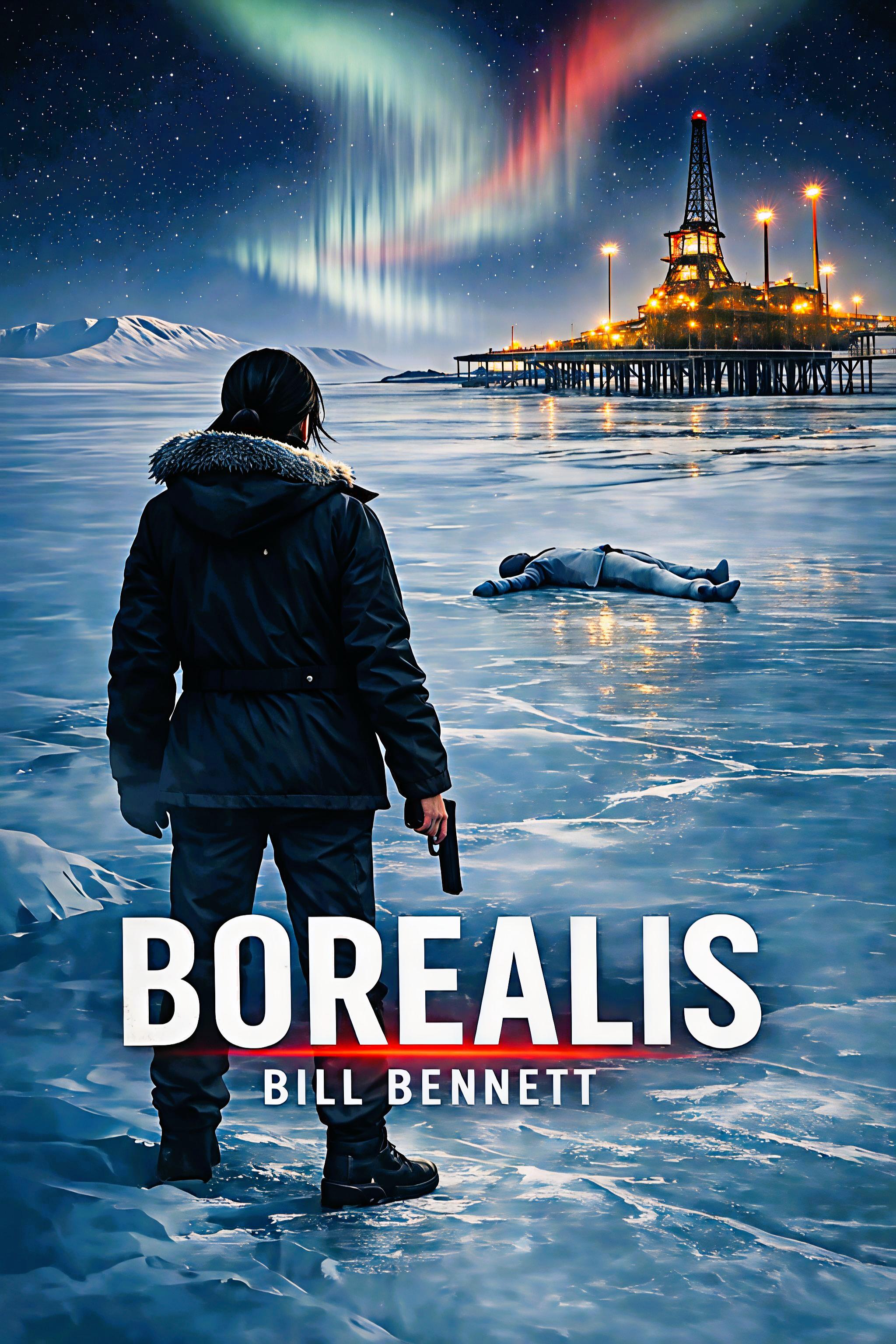
When Detective Ava Martinez heads to Alaska to escape the fallout of her last case, she expects quiet. What she finds is a dying whistleblower, a corporate cover‑up with global stakes, and a mysterious Arctic signal powerful enough to shift the balance of world energy.
Chapter 1 - An Anchorage Beginning
The cold met Ava Martinez like a warning. As she stepped off the plane into Anchorage’s hard blue dusk, the air hit her with a clarity so sharp it bordered on unreal, as if the world here had scrubbed clean everything she’d spent the last year surviving. She paused on the terminal walkway, letting the chill test her—blessing or challenge she couldn’t yet tell—still a soul haunted by the heat and ruin south of the 49th parallel. A gust swept across her cheeks, carrying a faint tang of salt from the inlet, and a flash of light off a luggage cart made her squint, the same harsh glare that had bounced off the mayor’s podium the morning Crystal Cove cracked open.
She remembered that morning’s misleading, pleasant heat. A warm inlet breeze stirred the crowd gathered before City Hall, rustling newspapers and cell‑phone cameras. Ava stood beside Officer Grady, notes folded but unread, the smell of gasoline from the BioSphere warehouse still clinging to her clothes.
Mayor Nicoleto stepped to the podium, voice steady but frayed at the edges. “I want to begin by acknowledging the loss of Paul Klug. We failed him.”
A hush fell, settling deep in her ribs.
“For too long, we buried questions beneath permits and contracts. That ends today.”
He turned to her. “Detective Martinez never backed down.”
A combination of surprise, relief, and anger rippled through the crowd.
Ava stepped forward, the morning light catching the edge of her notes.
“We owe it to the fallen,” she said, “to explain how this happened. For a year, people were silenced—some by fear, some by force. We followed the trail they left behind, even when others tried to bury it.”
Faces tightened. A few bowed their heads.
“This morning, the truth is no longer hidden.”
Nicoleto returned to the mic. “Caldwell and his co‑conspirators stand indicted on racketeering, obstruction, and negligent homicide.”
Gasps. Cameras. A warrant held aloft. Afterward, Mavis Leigh lingered near the steps, cane tapping.
“Nice speech,” she said. “You earned it.”
Ava exhaled. “I hope it sticks.”
“Memories are short in this town,” Mavis replied. “But the ones who stayed? They’ll remember. And that’s enough to start something better.”
Ava watched her walk away, slow but steady.
Before leaving Crystal Cove, she’d tucked two things into her notebook: the photo Grady pressed into her hand—a manatee surfacing in the shallows, its scarred back catching the light—and a pencil sketch of Rick’s dive mask, copied from the evidence log the night they closed the case. Two artifacts of what the investigation had cost. Two reasons she couldn’t stop.
Three weeks later, the call came. A voice she didn’t recognize, low and measured, carrying the weight of someone used to choosing words carefully. “Ms. Martinez? My name is Cole Stratton. I read about Crystal Cove. I think you’re the kind of person who asks the questions most people are afraid to hear.” He’d said something about Alaska, about pressure readings along the pipeline that reminded him of the patterns she’d uncovered in Florida—data that didn’t match the official story. She’d almost hung up. Almost. But something in his voice held her on the line long enough to listen. And listening, she’d learned, was how every investigation began.
❄❄❄
The airport terminal snapped back into focus. A child tugged at his mother’s coat, a folded newspaper swinging from his hand. The headline flashed as he moved: Caldwell Indicted: Crystal Cove Reckons with Scandal.
Ava blinked, startled. She hadn’t expected the story to travel this far, all the way to papers in Alaska. What had begun as a coastal investigation in Florida had rippled outward, carried by wires and syndicates, until even strangers in the far north were reading about Crystal Cove. And there, woven into the coverage, was the name she dreaded: BioSphere. No longer just a giant drug and research company tucked onto the national stage, its reputation was now fused with Caldwell’s downfall.
Ava turned away before she could read the subhead. She wasn’t ready—not yet—to face what justice had cost or how far its echoes had traveled. The city welcomed her with a strange mix of celebration and vigilance. Snowbanks lined the downtown streets like frozen sentinels, and above them fluttered Iditarod banners, their bright reds and blues dancing against a sky thick with low clouds.
She wandered downtown, camera slung over her shoulder like a shield. Drums from an outdoor stage thumped through the cold air. Children chased dogs that looked carved from mythology. Anchorage wasn’t quiet, but it didn’t know her. And that anonymity felt like freedom.
Inside the Westmark Anchorage Hotel, heat from the stone fireplace met the cold on her coat. Delegates clustered near the check‑in desk, voices low and clipped, eyes flicking more often to badges than faces. Business cards flashed. Tablets glowed. Someone sketched pipeline routes on napkins beside half‑finished cocktails.
Ava paused, taking it in. She had come here for distance. Instead, she’d walked straight into the center of something buzzing beneath the surface. Deals weren’t being made here; they were traded in motion, in fragments, in the quiet between breaths. She felt the current brush past her like static.
A weary front desk attendant named Kyra offered a strained smile. “Welcome to the Westmark. Let me guess—you’re not with the Apexion Summit?”
Ava shook her head, brushing snow from her parka. “No. Just passing through.”
Kyra’s relief was subtle but real. “Good. The Summit crowd’s been… intense. Oil execs, defense contractors, foreign attachés. They talk about the Arctic like it’s a chessboard. Makes the lobby colder than outside.”
Ava glanced around. Suits clustered near the bar, voices low, laughter rehearsed. A Russian delegate scrolled through encrypted messages. A Canadian aide murmured into a headset. The Summit was everywhere, even in the way the air seemed to hum with calculation.
Ava raised an eyebrow. “Was it the lack of Patagonia fleece or my missing oil baron swagger?”
Kyra chuckled, brushing a strand of hair back with the weary grace of someone who had been fielding Summit guests all day. “You nailed it. I’m so sorry, Ms…?”
“Martinez. Ava Martinez.”
Recognition flickered. “Right. Well, we’ve had an overflow from the Summit and some check‑ins are delayed. We’ll have your room ready within the hour. You’re welcome to leave your bags with the bell cap.”
Ava exhaled and nodded. “Great. I love when a logistical hiccup becomes character development.”
She signed the register, her pen scratching across the paper. For a moment, she thought of Crystal Cove—the podium, the crowd, the fragile applause. They declared justice, but they failed to secure it. Anchorage had already prepared another theater.
She passed her luggage to a bellhop and wandered toward the concierge desk, drawn by a poster advertising Borealis Glacier Trek: Mid‑Morning Adventures. A rugged man named Mason manned the desk, sipping green tea and flipping through a guidebook thicker than the Iditarod rulebook. Frost flecked his beard as though he had just stepped in from the glacier itself.
“You still have room for a solo hiker on tomorrow’s glacier trek?” Ava asked.
Mason eyed her boots, her posture, the way she carried herself like someone who had walked through storms before. “I’d say you’re overdue. Two slots open for mid‑morning. Bus leaves at nine, ice cleats provided, sarcasm optional.”
“I’ve got the sarcasm covered.”
“That’s promising,” Mason said. “The tour runs about five hours. Shuttle down Turnagain Arm, then hike the trail out to Portage Glacier. Slow ascent, steady terrain, and enough quiet corners for anyone who likes to think while they walk.”
She signed the waiver with a stylized flourish. “Between melting ice caps and corporate summits, solitude might be endangered.”
Mason leaned in, lowering his voice. “Good news—we’ll take you somewhere time moves slower and the cell service forgets it exists.”
As she turned to leave, he added with quieter sincerity, “It’s peaceful out there. Something about standing near ancient ice makes a person listen better—to everything.”
“I’ll be there,” Ava said. “Hopefully with fewer oil tycoons and more quiet truths.”
Outside, the aurora flickered against the horizon, green ribbons twisting above even in daylight. She thought of the child at the vending machine, clutching the newspaper. She thought of Mavis Leigh’s words: Memories are short. But some will remember.
She ducked into galleries along Fourth Avenue, drawn to Inuit carvings and stark oil paintings of tundra storms. One piece stopped her cold: a musher silhouetted against ghost‑white trees, pursued by shapes half lost in the snow. Something about the posture, the tension of the lead dog, the strained curve of the runner echoed the weight she carried. The painting seemed alive, whispering of pursuit, of gloom that never quite vanished.
In a coffee shop filled with beadwork and vintage sled photos, Ava wrapped her hands around a warm paper cup, letting the heat seep into fingers still stiff from the cold. She’d underestimated Alaska’s bite; it wasn’t just temperature, it was intent. A place that tested what you brought into it.
The barista caught her lingering shiver. “First week here?” she asked, a knowing smile tugging at her scarf‑wrapped face.
“Like the cold’s trying to size me up,” Ava admitted.
“That’s because it is.” The woman leaned on the counter, lowering her voice as if sharing local lore. “Last February, I left my truck running while I ran inside for matches. Two minutes, tops. Came back out, and the engine was dead. Battery too. Like something had reached in and taken the warmth for itself.”
Ava paused mid‑sip. “That’s… odd.”
“Thirty below will do strange things,” the barista said, wiping down the counter. “But that day? Like the cold had been waiting.”
The phrasing snagged on a thread of unease she’d been trying to ignore since landing. As she stepped back onto Fourth Avenue, the barista’s words followed her like a draft under a door. Anchorage was alive with Iditarod banners, drums from outdoor stages, and smoked salmon curling through the air.
❄❄❄
The lobby at the historic Westmark had thinned out by the time Ava returned. The earlier surge of Apexion delegates had dissolved into scattered conversations and the soft clink of glassware drifting down from the mezzanine. The space was calmer now, but not quiet—more like a room catching its breath between storms.
Kyra at the front desk greeted her with a relieved smile, shoulders loosening as if Ava’s arrival marked the end of a long shift. “Ms. Martinez, your room’s ready. Room 814. View of the inlet, if the clouds behave. Sorry again for the delay.”
Ava accepted the keycard, the cool plastic grounding her. “It’s alright,” she said, voice low. “I’m glad to have a place to land for the night.”
Kyra’s smile softened. “You and half the Summit. Hope you get some rest.”
“Rest sounds good,” Ava said. And she meant it—not as a pleasantry, but as a small truth she hadn’t been able to admit in months.
She crossed the lobby toward the elevators. The delegates who remained spoke in hushed tones, their conversations clipped and purposeful. A man in a navy suit paced near the fireplace, murmuring into a headset. A woman with a badge lanyard still around her neck typed furiously on her phone, thumbs moving as if racing a deadline only she could see. Even in its lull, the place vibrated with unfinished business.
Ava stepped into the elevator. The doors slid shut with a soft sigh, sealing her away from the lobby’s restless undercurrent. The machinery hummed around her—steady, mechanical, oddly soothing. She let her shoulders drop a fraction, the first real release she’d allowed herself since landing.
Her room was modest but warm, with plaid accents, thick curtains, and a window framing the distant Chugach Mountains like a painting. She dropped her coat over the armchair, kicked off her boots, and sat on the edge of the bed. The mattress dipped beneath her, soft enough to remind her how long she’d been holding herself upright.
Silence settled around her—not empty, but gentle. No sirens. No case files. No voices demanding answers. Just the soft groan of the heater and the faint, rhythmic drip of snowmelt from the roof. For the first time since Crystal Cove, she let herself breathe without bracing.
She showered, letting the hot water erase the road grit and the weight of memory. While unpacking and getting dressed, a news report played on the television. The anchor was Marisa Kade, a familiar face in international broadcasts. Her voice was smooth, practiced, carrying the calm authority of someone who had spent years translating chaos into clarity.
Marisa subtly lifted one eyebrow when she delivered contested claims, signaling viewers to be skeptical even when her tone stayed neutral. “At the Apexion Summit today, leaders will debate the balance between energy independence and environmental stewardship. Critics argue that Indigenous voices remain sidelined, while corporations tout innovation and transparency. Russian officials, meanwhile, insist the Northern Sea Route is theirs by right.”
Graphics beneath her read: ARCTIC FUTURE – FRONTIER OR FAULT LINE?
Ava muted the television. Marisa’s words felt less like news and more like an omen. Dressed in a dark sweater and jeans, she headed down to the hotel’s rustic dining room. Delegates crowded the space, men and women in tailored suits, speaking in low voices and laughing in a rehearsed manner.
Then it happened—a collision, shoulder to shoulder, sudden and jarring. Ava turned instinctively defensive, only to find herself staring into the sharp eyes of a man in a tailored charcoal suit. His badge read: Summit Delegate – Viktor Sokolov.
He steadied his glass of water, then looked at her with a mix of irritation and curiosity. “You should watch where you’re going.” His accent was faint but unmistakably Russian.
Ava raised her chin. “And you should watch where you’re standing. Hallways are for walking, not posturing.”
For a moment, silence stretched between them. Around them, the Summit buzzed on—voices debating corridors, sovereignty, pipelines—but here, in the narrow space between Ava and Viktor, the air charged.
Viktor’s gaze sharpened, knowledgeable about the circles of power. “Martinez, is it? I saw your picture in the paper. Crystal Cove. You exposed Caldwell.”
A thin chill unspooled down her spine, deliberate as a warning. She hadn’t expected recognition here—not in Anchorage, not among oil barons and diplomats.
“Yes,” she said evenly. “And I’d do it again.”
Viktor’s smile was thin, calculated. “Perhaps you should be careful. Some of us prefer silence to spectacle.”
He brushed past her, leaving a faint scent of cologne and cold steel in his wake. Ava stood still, the current quickening, the collision echoing louder than it should have.
At the restaurant check‑in, the wait would be another thirty minutes. Seeing the Summit signage, she decided to slip inside—just out of curiosity.


Comments
I read this after the other,…
I read this after the other, but I'm thoroughly intrigued by the series. This character is fun--I love the sarcasm and everything. Again, this is well written and leaves you wanting more.
The manuscript features…
The manuscript features engaging writing and compelling characters that are easy to invest in. The combination of a strong narrative voice and well-developed characterization makes for an enjoyable and immersive reading experience.
Very plausible from the…
Very plausible from the outset. There's a comfortable familiarity about it that makes me feel as if this has been lived. Storytelling from the inside out. A great start.
Great potential - Keep Going!
The Alaska setting and the Arctic-summit backdrop have genuine potential. Right now the opening spends three pages recapping the previous book before the story starts, and the dialogue reaches for quips that undercut the tension. A firm line edit would help most.
Some potential
The tense undercurrent in this piece is intriguing, and I see potential for a well-rounded story. I did wonder at some of the strange inserts (e.g. Graphic inserts) and an occasional sentence that did not fit. A professional edit to improve readability and eliminate all the dashes would help.
Some Polishing Would Help, But Intrigue Exists!
A little rearranging in the opening might make things more logical–the newspaper headline would make more sense as a trigger, or objective correlative, for the flashback, instead of something that randomly catches Ava’s eye after she has snapped back to the present storyline.
There were some inconsistencies in the tiniest of details. For example, her room was supposed to have a view of the inlet “if the clouds behave, but when she gets there, the windows frame the mountains and there’s no mention of whether or not she can see the inlet. Another example: the cold is (or at least seems to be?) a developing motif in these early chapters, and I imagine, or it at least seems, like it’s going to play some kind of pivotal role in the plot–but there’s the sound of snowmelt. That gave me pause (maybe it’s supposed to?). If it’s so incredibly cold, why/how is the snow melting?
Regarding the dialog: While much of it would work beautifully in narration, it doesn’t necessarily ring true as dialog. It doesn’t really read like things real people would actually say to each other.
All that said, reading this felt like watching it play out, which is a testament to some strengths. Very cinematic, in many ways. I did enjoy it.
An appealing thriller canvas.
The Arctic setting and promise of a larger energy conspiracy give this an appealing thriller canvas, and Ava arrives with an intriguing professional history and clear determination to follow difficult questions. I particularly liked the sense that her attempt to escape one investigation may be drawing her straight into another. I’d consider getting her into the central mystery a little sooner, while allowing some of the ominous atmosphere to emerge more subtly through events; that could make the eventual danger feel even more powerful.
The groundwork here is solid…
The groundwork here is solid, but I agree that a good line edit for pacing would help engage the reader from the book's earliest pages.
I really enjoyed this. The…
I really enjoyed this. The characters and storyline are developed nicely and the pacing is very good. A great start.
A lot of potential here
This is a solid start to an intriguing storyline. This excerpt would really benefit from reworking the opening scene as a way to hook the reader. I enjoy your writing style and think there's tons of potential here!
Good start!
I like the premise of this and I like the setting a lot. It's ripe for a good mystery / thriller / crime novel.
I do think this needs editing. It started a bit slow for me. Interestingly, it seemed to pick up in the hotel scene for me, which I found surprising, since it's a scene in which I wouldn't expect it, but that was where I first felt connected to Ava and saw her personality.
I think some careful editorial choices and a good edit will do this story a justice... Great work!
Engaging Plot!
I can see plenty of potential in this book! What if you started writing in the story's current moment, weaving in the detective's previous case as you go? That might get readers engaged even more quickly.