

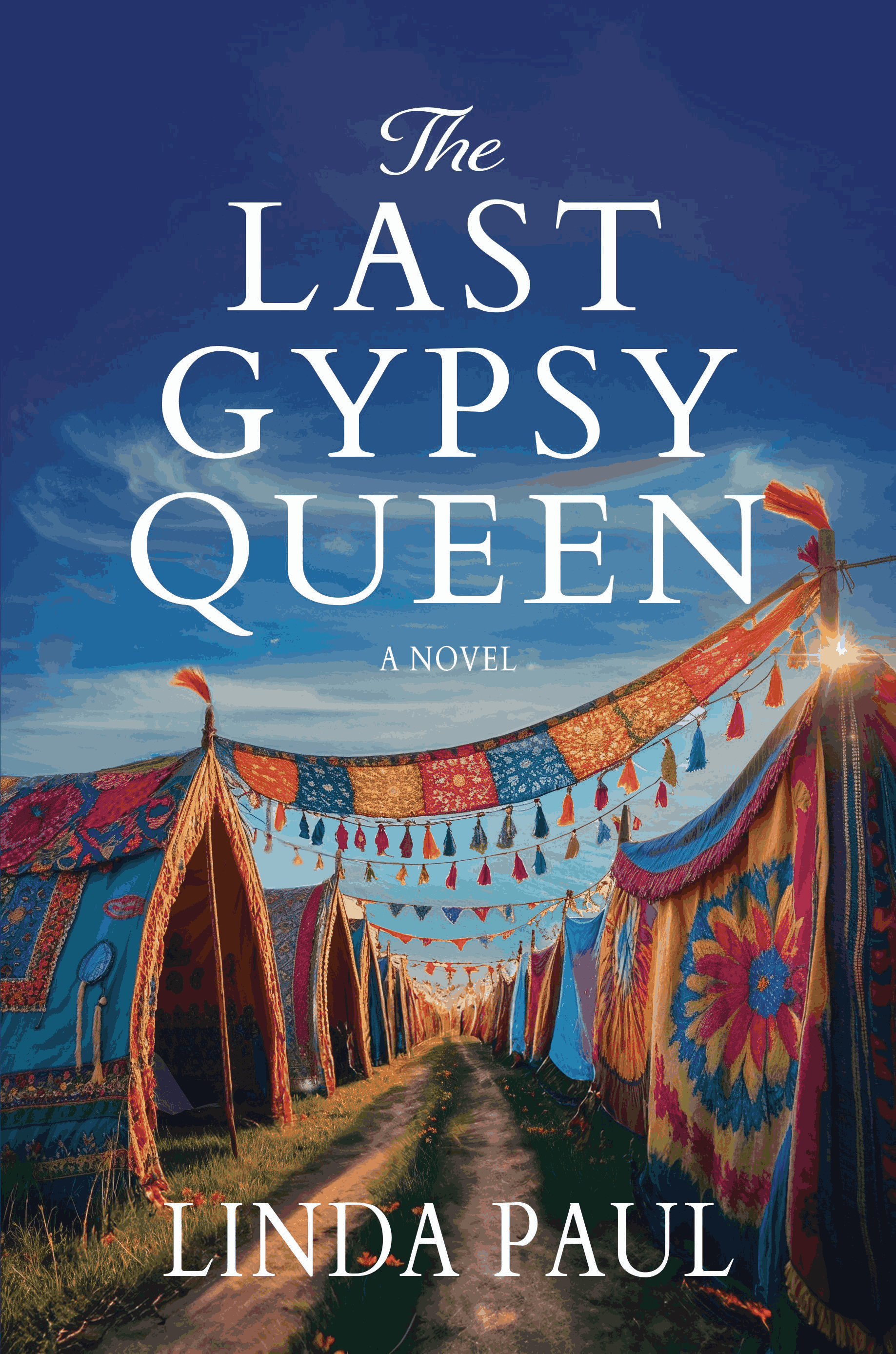
THE LAST GYPSY QUEEN
Romanies have traveled the earth for hundreds of years to escape unwarranted persecution. People commonly used the term Gypsy, especially up through the time of this story. Now, it’s acknowledged that it is an exonym—a term imposed on an ethnic or cultural group by outsiders. It is used with care in these pages.
CHAPTER 1
Marisol Mazaria
The Village of Buckeye Lake, Ohio – June 5, 2014
Marisol clutches the faded woolen carpetbag against her chest, its shape long gone and sagging. The same one she’s used across the years to carry forbidden medicines to the injured, babes, and mammies. It’s empty now except for the two framed photographs that clatter when she moves. The bag’s usefulness has passed, the same as Marisol’s.
It’s been since late last summer when she was here at her son Andrew’s house. Standing in his driveway beside the towering oak tree, Marisol stares up with no recollection of the structure built into its branches. Her body is constantly stiff these days, and her neck protests as she bends it back. Between the tender leaves that flutter in the early evening breeze, she sees the flicker of a long-extinguished campfire. She hears the crackle and smells the sweet, earthy smoke as it curls up toward the stars. Marisol hates it when her mind plays tricks.
Already dusk, three strands of Edison bulbs sway loosely from the tree branches. They stretch over the patio, creating playful shadows as dollops of light skitter across the yard. The gentle blink of fireflies and the evening cricket symphony remind Marisol once again that the outdoors belongs to them.
Andrew and his wife Sarah stand on either side of her now, in case her unreliable legs give out. The long drive through the honking, aggressive city traffic had been tiring. Only two hours earlier, Andrew hurried from his work to collect her from the hospital where she’d been stuck for the past ten days.
Marisol’s body constantly betrays her. She is not resisting finishing her days living with Andrew and Sarah. They are no longer young themselves. The effort and kindness to take her in are more than generous. It is the way of her people, what a clan does. Take care of family, no matter the blemishes or unsavory parts, the circumstances, or what she’d had to leave behind.
“This is the grandkids’ treehouse I’ve been telling you about, Mom,” Andrew says, pointing up toward the rough-hewn boards. A floodlight anchored to a branch illuminates the half-closed door. “We planned it together, and they helped build it. Finished it in the fall before the first snow. We can hardly pry them out since they came to visit last week when school ended for the summer break.”
“That’s a fine hideaway,” Marisol says. She can understand its lure. A place for adventure, to let imaginations run free. The breeze carries the faintest lake water scent across her face. It pushes through a wild lock of once-dark and shiny hair. What remains is thin, gray, and as fine as each of her babies’ when they were born.
“Jack, Mari, come down here and say hello to Nanna,” Sarah calls up. The door creaks back, scraping wood on wood as two children appear. Nine-year-old Mari scurries backward down the slatted ladder and hugs her great-grandmother Marisol’s bony knees.
“Goodness, why are you both so filthy?” their Grandma Sarah asks.
Light streams across the open doorway, bouncing against something red behind Marisol’s great-grandson. She squints hard to bring it into focus through the white film. Her ninety-one-year-old vision is the latest frustrating ailment, another that she refuses to correct with surgery. Why bother?
“What, what is that thing?” Marisol sputters. “What is that?”
“It’s our first treasure, Nanna!” Jack, four years older than Mari, declares. He stands tall atop the platform, his chest puffed forward as though he’s the conquering captain of a pirate ship. “We found it in the woods today near the lake and hauled it back on our skateboards. It’s huge! We could barely get it up here! Look! It says CARAMEL CORN 5¢.”
What is happening? Marisol’s knees give way. Sinking against Sarah and Andrew’s arms, she pushes gnarled fingers into the pinch between her ribs. At once, Marisol recognizes this object. The metal sign has cartwheeled with fury through her dreams for over seventy years, long before the forest claimed its shine. The rust and dents weren’t there back then. But she is sure. Buried all these years. No different from her Romani heritage.
“What is it, Marisol?” Sarah asks too loudly with alarm in her voice, as if Marisol has lost her hearing. “Are you feeling okay? Andrew, grab that chair.”
***
The last thing she wants to do is cause a fuss or be a burden. Though of all the places she’s lived, she never imagined that back here, near the amusement park would be the last.
Sarah stands in the bedroom doorway of Marisol’s new, final home. “We’re happy you’ve come to live with us,” she says. “I tried to arrange your room the best I could. You’ll let me know if we’ve forgotten anything you need, won’t you?” This space is plenty. It’s as large as the caravan Marisol grew up in. They’d brought all her things from her place while she was in the hospital, and now that house is empty, ready to be sold next week.
“Yes, this is lovely. Thank you for making room for me. I’m sorry about the commotion I caused. It’s just…it was probably my mind fooling me.” She doesn’t believe what she is saying. No need to worry Andrew and Sarah. She knows exactly what she saw.
“Don’t be ridiculous. We wouldn’t have you living anywhere else,” Sarah says warmly. She smiles while graciously ignoring Marisol’s reaction to the old park sign. Sarah has always been kind to her. “Be sure to take the pills your doctor sent home with you.” Marisol glances at the row of plastic orange bottles and a glass of water on the bedside stand.
Sarah pulls the door shut, leaving Marisol sitting on the quilt. The one she’s drug along through life. Its once-bright colors are muted now, and frayed threads have found their freedom from weakened stitches along the patches. Marisol traces tiny flowers with her shaky finger, a piece from one of Mammie’s skirts.
She swallows the medications and replaces the bottles beside the two framed pictures. One is in color. Their little family with her husband and two young boys—a summer day at the beach collecting seashells. The other is black and white, though her mind can see the vivid colors of their old Vårdö wagon in the background. She is seventeen, standing in front of it with Gran Rose, Mammie, and Flora.
Marisol pads into the adjoining bathroom, splashes cold water on her face, and changes into her soft cotton nightgown. So much better than the scratchy hospital one. She glances in the mirror. The face that was once plump and full of life now stares back, sunken and wrinkled.
As Marisol crosses to switch off the light, she passes her old wooden jewelry box that sits on the dresser—the one Grandad Henry made when she was ten. She lifts the top, revealing her old heart locket and the shiny purple sequin that is always there. She plucks it up and presses it between her thumb and palm. Marisol closes her eyes and breathes deeply. The gritty, dusty tow path is beneath her thin embroidered slippers. The April sun warms her face.
She doesn’t lift the tray but thinks of the tarot card that lies beneath it. The Sun. Marisol replaces the sequin, closes the box, and switches off the bedroom light. She crawls between the crisp lavender-scented sheets and draws the covers up to her neck.
There is a soft tap at the door. “Mind if I come in?” It is Andrew.
“Of course.”
Muted hallway light spills across the floorboards as he steps in and settles on the end of the bed.
“I’m honored you’ve decided to stay with us,” he says. “I know it’s been hard since Dad died.” He pauses. “I want to know about your life.”
Marisol gently shakes her head. Their lives had been so full and busy. There was never time to slow down and tell her sons the stories of her past. They’d shown no interest.
“I do. I want to hear about the part you left behind before you were our mother. My day is free tomorrow. You probably haven’t heard, but they’ve restored the fountain at Buckeye Lake Park. I thought you and I could take a picnic lunch.”
Andrew wants to hear about the amusement park—her life when she was young. He means before she dies. But that doesn’t bother her. It is inevitable. Her history going with her into the afterlife is bothersome. She is at last ready to tell him everything.
“Yes, I would like to see the place once more.” She won’t be shocked, this time, by the arsonist’s scars. One last visit. To say goodbye.
Once Andrew leaves, Marisol sinks into the mattress. Her physical body is failing. But her memory is sharp—at least the fragments she now carefully preserves. She is thankful it has not betrayed her.
Are we not all simply traveling through this life? she thinks. Marisol calls forward memories of her ancestors more than usual lately, now that they have gone ahead into eternity. She is standing near her journey’s end. What remains is small enough to measure.
When the loneliness makes it hard to fall asleep, Marisol summons the lullabies of her childhood. The soulful violins and plucky mandolins blend in harmony. The steady drumbeat on taunt animal skins lyrically weaves it all together. The whirl of embroidered skirt fabric is bright, the voices are cheerful, and the joy of dancing is unrestrained. She lets the dust from the rutted road and the rough wheels of the caravan take her far away.
***
The next morning, a family of Carolina wrens sings outside her bedroom window. Their music is loud enough to breach the glass and serve as an alarm. She had a peaceful sleep, dreaming of a summer day splashing in the Crystal Pool.
Marisol pinches her shoulders back and stretches her legs forward, her tight, contracted muscles resisting. She remembers that Andrew is taking her to see the fountain one last time. Of her two sons, he’s always been the more introspective, sentimental one.
Andrew helps her out of his car. She braces against the side while he retrieves two folding chairs from the trunk. On her last visit here three years ago, the place was barren, except for industrious weeds poking through the packed-down dirt and random pea gravel strewn about. Only the long-dried-up, four-tiered fountain interrupted the expansive space. Small, jagged patches of once-white paint blotted its mottled gray cement. It is the only remnant that has escaped the relentless march of time. In the glory days, it was the heartbeat of the park. All these years, it stubbornly refuses to succumb to arsonists and the whims of weather, though it can’t defend itself against vagrants’ graffiti tags. Their language means nothing when compared to what once lived here.
Steadied by Andrew’s arm, they walk toward the recently painted fountain. It seems a younger generation does care, after all. The bright white tiers glisten in the morning sun. Though the spire is missing, clear water bubbles at the top from a modern silver pipe, cascading down along the platforms. Tiny rainbows shimmer in the jet spray arches that rain on pennies tossed by the optimistic.
They sink into the canvas chairs as she ignores the surrounding land, tarred black for cars and boat trailers. “There should be a bench here,” Marisol says into the breeze.
She peers out across what extends in front of her—a lake, some docks with shiny boats tethered to their posts, and a few modern clapboard condos. People stroll along the concrete sidewalk, once a proper wooden boardwalk, that winds beside the water. Surely none of them are from here.
Everyone comes from somewhere. This is predetermined. It’s no more of a choice than eye color or height. There is nothing to be done about it and no decisions to be made. But then, everyone is traveling somewhere. This is the choice—the part people struggle with the most.
When Marisol was young, with the expanse of life in front of her, she didn’t think forward to the end. She longed for a different destiny. Not the one cast upon other Romani women. She wanted more than bearing children and keeping a spotless home.
No matter all of that, life moves along. The months and years blur and fade until suddenly, with little notice, it’s all behind. The edges of history, once sharp and stinging, are smoothed out by time. Or are they erased? Who wants to face and remember ugliness? Maybe Marisol’s forgotten. It’s easier to pretend it never was.
“Tell me about the park,” Andrew says.
Her mind can see grass all around the fountain and trees in the distance. The marching bands, high-wire, and juggling acts performed twice each day here at the park’s gathering place.
Marisol points. Nothing is between where they sit and the lake but the sidewalk. “Over there, that’s where the Crystal Ballroom stood. The famous big bands came from everywhere to play.”
Her eyelids fall. Surely, long ago, the final match strikes freed any spirits trapped here. No more tinder roller coasters or food stalls left to ravage. The memories and ashes have been claimed by earth and time.
All that remains is the cement fountain, enduring proof of long-gone summers. She gives in, her memory drifting back. Instead of scorched wood and acrid smoke, the warm June breeze is once more alive with the savory char of hot dogs on a grill, buttered roasting corn, and frying funnel cakes, waiting for their sugar dusting. Her foot taps lightly, the forgotten melodies of the big band’s brass and silky clarinets echoing across the lake.
CHAPTER 2
Marisol
Rural Missouri – December 4, 1941
Tomorrow, on her abjav, Marisol will become Levoy’s wife. Her leg shakes frenetically from jangling nerves, not the cold air outside. Marisol has spent every night since she was born seventeen years ago inside this wagon or at their small winter home back in Indiana. Tonight will be her last.
This cocoon is her only comfort. Her trembling fingers smooth a nonexistent ripple on the soft quilt’s patches. Its thickness pads her narrow bed. Muted light illuminates the vibrant colors, though they blur as she blinks back pooling tears.
Marisol presses a palm to her chest, still fighting against believing what is happening to her tomorrow. It’s been arranged that Levoy will be her husband. She knows acquiescence is her only path.
It’s not that she doesn’t understand the purpose of arranged marriages to help preserve the old Romani traditions and identities. She can even accept the honored doctrines when the bride and groom are part of the decision and grow to love one another.
But her own family experiences don’t support the objective. She’s listened many times as her father, Earl, chastises Mammie Amelia for her inability to bear him sons. Their caravan is so small that every conversation, good or bad, can easily be heard. His confrontations and anger only increased nine years ago after her sister Flora arrived. When her father spirals into his rages, all Marisol can do is clamp her pillow around her ears.
Everything became real five weeks ago. With many clans gathered for a funeral, her father finally paid the agreed-upon bride price on her tenth birthday, without Marisol’s involvement. Back then, he’d made a deal with Levoy’s family clan in Mississippi.
For seven years, her birthday wish was to be spared from marrying a stranger, a man she’d never met and didn’t love. If only Levoy could find someone else before the marriage ever happened. Until now, it worked. Poor fortunes kept the families from traveling long distances as Marisol grew up.
Until tonight, she’d clung to the hope that something big would stop the wedding. With it now hours away, the possibility of a different future has dissolved like sugar in hot tea.
She thinks one last time about running away. But she is unfamiliar with where they have traveled for the ceremony. Where would she go? How would she survive? She has nothing of her own, and living without Gran, Mammie, and Flora, the only people she loves in this world, would be unbearable. Why bother even thinking about it?
Marisol inhales the lingering scent of fried cornbread and savory rabbit stew Mammie made for dinner. A wind gust rattles a kerosene lantern against the outside wooden wall, and melodic strains of mandolins played by those gathered around the roaring campfire seep in through the gaps.
“Come, my child, don’t be so sad the night before your wedding,” her daki dey Gran says, approaching Marisol’s bed. “Here, I’ve finished the embroidery on your vala.”
She spreads the lacy veil across the quilt, then sits so close their thighs touch. Marisol lays her head on Gran’s shoulder, breathing in the rosewater scent. It’s the one she always wears. Born on the first of May, under their horoscope sign of Crown, its symbolic flower is the rose. The bent old woman always honors the traditions and her family. Gran Rose caresses Marisol’s ink-black hair, straight and thick as bear fur.
“Levoy…what he did…I should be the purest on my wedding day tomorrow. My future with him. I know it will not be happy.” The words catch in her throat. When Marisol told Mammie what happened that day they met, she and Gran said she must forget his drunken attack. It is not that easy.
Levoy perpetuates the stereotype that the gadze, the non-Romanies, whisper. Thief. He stole from her. The worst kind of robbery, to try to force his will. Five weeks later, it still sears in the shadows, away from everyone on the opposite side of the roaring campfire. She poked embers with a stick, unable to focus. The different future she’d yearned for was slipping away.


Comments
It's quite an engaging set…
It's quite an engaging set-up although I would suggest a stronger hook to get the reader involved. A very brief prologue perhaps with a teaser that foreshadows a key event to be revealed later?
Really interesting start! I…
Really interesting start! I love the characters and the introspective thoughts of the character.
Great theme and beautifully…
Great theme and beautifully executed writing.