

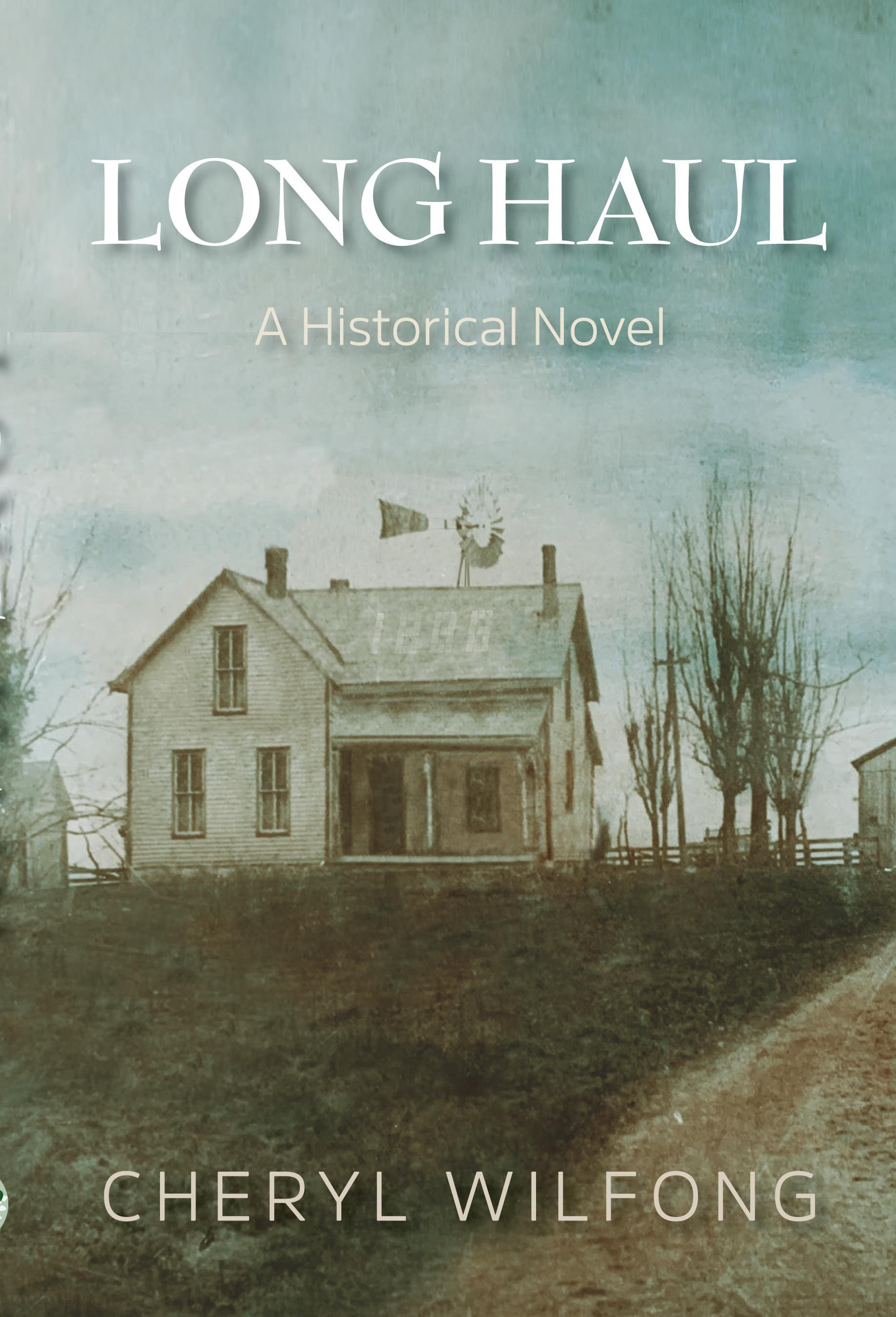
George and Vi’s spoiled 23-year-old son, Aldus, loves life in the fast lane and nearly bankrupts them. George has a secret sin
1918
November 19
“Happy Birthday, Dad!” says Aldus as he turns down the wick
of the kerosene lamp in the center of the kitchen table, and the
flame flickers out.
The room darkens, and Vi brings a cake full of candles to the
table.
“I want to blow out the candles!” shout the grandchildren,
Georgie and Flossie, together.
“All right,” says George. “Come sit on my lap.”
Four-year-old Georgie perches on one knee, arms on the table,
leaning toward the cake, and two-year-old Flossie balances on the
other knee, as George holds each child around the waist. “Make a
wish, Grandpa,” says Georgie. “Make a wist, Gran’pa,” says Flossie.
George closes his eyes, opens them, and winks at Georgie. “All
righty. Ready. Set. Go!”
The three of them blow out all the candles on the angel food
cake. For a moment, all is dark. The adults laugh; the children scream.
“Listen!” says George, and the room becomes silent. The windmill
behind the house is squeaking and whirring. “There’s a cold
front blowing in. It’s going to be shivering cold in the morning.”
In the darkness, George begins his annual recitation of the
Gettysburg Address, which was given by President Lincoln on
this date two years before George was born.
“Fourscore and seven years ago our fathers brought forth, on
this continent, a new nation, conceived in liberty, and dedicated
to the proposition that all men are created equal....”
Aldus moans, “Oh, come on, Dad.”
“Son, we are honoring our fellow Hoosier,” says George.
“Abraham Lincoln spent his boyhood and formative years in
Indiana, and we should be proud of him.”
George continues. “Now we are engaged in a great civil war,
testing whether that nation, or any nation so conceived, and so
dedicated, can long endure.”
Minnie and John join in, seeing who can orate louder than the
other. “The brave men, living and dead, who struggled here, have
consecrated it far above our poor power to add or detract.”
Under cover of darkness, Aldus nuzzles Lula’s neck, and she
swats him away. He takes a puff of his cigarette, which glows red
in the dark room.
“It is rather for us to be here dedicated to the great task remaining
before us—that from these honored dead we take increased
devotion to that cause for which they here gave the last full
measure of devotion—that we here highly resolve that these dead
shall not have died in vain—that this nation, under God, shall
have a new birth of freedom, and that government of the people,
by the people, for the people, shall not perish from the earth.”
Everyone applauds, as Vi strikes a match and relights the wick of
the lamp. “Fifty-three,” she says, shaking her head and bringing a
bowl of her canned cherries to the table to spoon over the cake. “It
sounds so old.” She teases George because she is just a year younger.
“Sarah Lavicie,” George says to his wife, “you know I thank
God every day for being on this side of the sod.”
“Hear, hear,” says George’s brother John, age sixty-two.
George cuts his cake as Vi brings eight dessert plates to the table.
She pours cups of coffee for the men and for Minnie and Lula.
George begins reciting a James Whitcomb Riley poem. He has
memorized several, partly because his middle name happens to be
Riley and partly because Riley was a famous person who grew up
in Greenfield, seven miles away. The Hoosier Poet, as Riley is
called, died a couple of years ago; he was Minnie’s age.
When the frost is on the punkin and the fodder’s in the shock,
And you hear the kyouck and gobble of the struttin’ turkey-cock,
And the clackin’ of the guineys, and the cluckin’ of the hens,
And the rooster’s hallylooyer as he tiptoes on the fence;
O, it’s then’s the times a feller is a-feelin’ at his best,
With the risin’ sun to greet him from a night of peaceful rest,
As he leaves the house, bareheaded, and goes out to feed the stock,
When the frost is on the punkin and the fodder’s in the shock.
“Them old turkeys out in the barn ain’t going to be struttin’
and gobblin’ much longer, Georgie,” says George. “Let’s see here.
About this time next week, you’re going to be eating a big old
drumstick.”
Georgie smiles at his grandpa.
“Say. What do ya think about this Spanish flu?” asks John.
“Oh, it’s bad,” says George’s oldest sister, Minnie, who is
seventy. “Down at the Red Cross, they have us making gauze
masks by the dozen. The influenza is spread by sneezing and
coughing, so cover your mouth with a handkerchief. Or better
yet, a mask. Happy Birthday, little brother.” Minnie hands him
a gauze mask and laughs at her paltry gift. It’s an ongoing joke
among the siblings—who can give the oddest, cheapest gift.
“Lula just got a job at Eli Lilly packaging vaccines,” says Aldus,
as he reaches under the table and squeezes his wife’s hand. “Haven’t
you, honey?”
“Oh, my,” says Lula. “I had no idea there were that many
people in the world. I’m cross-eyed with little boxes by the end of
the day.”
After cake and coffee, the men retire to the living room to
smoke while the women clean the kitchen. The men talk about
the end of the Great War, and where they were when they heard
church bells ringing across the empty fields announcing the armistice
last week. They’ve had this same conversation every day, as if
they can’t believe the peace is real. “I bet the price of wheat is
going to jump now,” says John. “People want bread on the table
after two years of wheatless Wednesdays. Pfft.”
“And wheatless Thursdays, Fridays, Saturdays, Sundays, Mondays,
and Tuesdays,” says George. The short, stout, bald brothers have
talked about wheat prices repeatedly in recent days, trying to talk
themselves into the gamble of selling their wheat harvest at just the
right time—not too early, not too late.
“People are going to want to eat cake, too!” says Aldus.
The men laugh.
The telephone box rings. “Aldus, it’s for you,” Vi calls from the
kitchen.
George and John are silent as they listen to the one-sided conversation.
“Oh, hi, Floyd . . . Mm-hunh . . . I’ll bring my truck
right over to pull you out.”
John raises his eyebrow at George.
“Dad, Lula’s brother got his car stuck in the mud. I’m going to
pull him out,” says Aldus as he walks in from the kitchen. “I’ll see
you later. Happy Birthday, Dad. Good night, Uncle John.”
The back door closes.
John says in a low voice, “And all this time, I thought that truck
belonged to you, Brother.”
George shakes his head as he replies in an equally low voice,
so Vi and Lula won’t hear him. “You know children. What mine
is theirs, and what’s theirs is theirs.” George emits an unhappy
laugh.
“Brother, it’s time to give up on the idea of leaving this farm to
Aldus. That boy ain’t the slightest bit interested in farming. Nan
has a passel of children—four boys and two girls. That’s what this
farm needs—boys to do the farming.”
“Bunny? Here?”
Bunny is George’s pet name for Nan; he’s the only one who
calls her that. He nods his head slowly as if he’s considering John’s
advice, but he’s actually thinking of his oldest grandson, Top, as a
farmer. Such a helpful boy at seven years old—smart and obedient.
George has two namesake grandsons; Bunny’s oldest boy is
nicknamed Top to avoid confusion.
John goes on to tell the same old stories about how his and
George’s father and grandfathers cleared the land around here in
the 1830s by cutting down the big, old trees—oak, hickory, ash,
as well as the cottonwood and sycamore that grew in abundance
alongside the creeks. Their father told stories of wresting the
giant tree stumps out of the ground—using pigs to root them
out, using fire to burn them out, using boys to dig them out.
That took about thirty years. The two old brothers remember
their own boyhoods of digging the ditches for the brown tile
pipes to drain the flat, marshy land and turn it into beautiful
fields to grow corn, wheat, oats, and hay. They know this part of
the township like the backs of their hands. They were born here,
and they will die here and be buried in Simmons Cemetery with
all the rest of their relatives. They belong to the land, and the
land belongs to them.
The next morning, as George walks to the barn in the gray-blue
light of the waning moon above the western horizon, his mind
returns to the Gettysburg Address. Fourscore and seven years ago.
He mentally calculates. Fourscore and six years ago, in 1832, both
his grandfathers arrived in Jackson Township—Grandfather
Smith from Vermont and Grandfather Simmons from Harrisburg,
Pennsylvania—to settle in the forest of the Delaware Purchase.
George wonders why the Delaware Indians were here in
Indiana. Why weren’t they in Delaware? This was the homeland
of the Miami, the Potawatomie, the Piankeshaw, the Kickapoo.
Maybe some Shawnee hunted here, too. There were Mohawks on
the west side of the county. After all, Indiana was Indian Territory
before it became a state.
George remembers seeing an old Indian at the general store in
Willow Branch when he was a little boy. His mother grabbed his
hand tightly, while his older brother taunted the poor old man in
a tattered gray blanket. As a boy, George collected the arrowheads
that can still be found every spring when the fields are plowed.
Hidden in the woods are Indian burial mounds.
Grandfather Smith died before George was born, but he remembers
Grandfather Simmons, who lived to be ninety—a
crotchety old man from whom George kept his distance.
When George thinks of the land, he feels the labors of his
grandfathers, his father, himself. Smith Ditch on the east side of
the township is named for his grandfather. He remembers his
father and his brothers digging the ditches to drain the flat land.
He owns the land, but that’s just on paper; in reality, the land
owns him.
The brave men, living and dead, who struggled here, have consecrated
it far above our poor power to add or detract. Yes. That’s
exactly how he feels about this land.
George knows the names of all the trees in the woods. He can
identify them, even in winter, by their bark. He knows where to
find walnuts, hickory nuts, beech nuts, butternuts, chestnuts.
When he was a boy, he spent winter evenings cracking nuts by
the fire.
He knows every inch of Brandywine Creek—the creek he
grew up on, where he trapped muskrats and beavers and caught
crawdads and catfish. It runs by Simmons cemetery, and past
Bunny’s farm and the Bunker Hill schoolhouse where her children
go to school.
As a boy, he practiced his slingshot until he could hit a gray
squirrel or a rabbit or a raccoon and bring it home for his mother
to cook for dinner. He knew where the critters hid; he knew their
wily ways.
He still knows where to look for morel mushrooms in April.
He knows where wild strawberries grow in June, black raspberries
in July, mulberries in August, pawpaws in October, and persimmons
in November.
George knows his animal husbandry of pigs, cows, horses,
sheep, goats, and chickens. He knows all the grasses—rye, oats,
wheat, alfalfa, timothy, sorghum, and corn.
He knows that Aldus knows all this, too, but Aldus is not interested
in the providence of this good earth they live on. Aldus
wants to be around people and machines, not animals. Aldus
wants to be modern, not old-fashioned. George never thought of
his parents’ or his grandparents’ lifestyles as old-fashioned. It was
simply the way life had always been.
George has put thirty years into his beautiful farm. The sons of
his friends stay on the farm. His friend, Jerry Scott, for example—
Jerry’s son, Walt, helps his father. But Aldus? Aldus doesn’t give a
damn. George’s heart breaks with that thought. All his hard work,
all the sacrifices he has made for his children. For what? What will
become of his bountiful farm?
This land is his home, through and through. His body is made
of the soil; its water runs through his veins. This house, which he
and his father built, is timbered with chestnut trees that once
grew right here. He spent weeks using an adze to hew the logs into
square posts and beams, which are now hidden between the inner
walls of lath and plaster and the outer clapboard siding of oak.
The lath and the clapboards came from his own land. His house,
his home, his life!
Has he, George, worked his whole life to have his son let his
legacy go to wrack and ruin? The hard thing lying on his heart is
that Aldus does not care. Aldus isn’t interested. Aldus wants to
leave the old ways behind and get away. The ties that bind George
are the apron strings that strangle Aldus.
As George pushes open the barn door, Aldus catches up with
him and claps him on the back. “How’s my old man this morning?”
George smiles. He loves his son, his best friend.
November 24
George dresses for church, adding a starched white collar to his
collarless clean white shirt. He takes his black Sunday suit—his
only suit—out of the slim closet. He lays his clean blue overalls on
the bed, because he will change back into comfortable clothes as
soon as he and Vi return home.
Vi put on her navy-blue Sunday dress when she arose this
morning; now she is downstairs in the kitchen, preparing for
Sunday dinner at one. She wears her Sunday white bib apron with
ruffles at the shoulder and around the skirt, which covers her dress.
The pair have followed this pattern for thirty years. Long gone are
the Sunday-morning distractions of small children. Aldus and
Lula spend every weekend at her parents’ house, four miles west,
near Maxwell, where there’s usually a Saturday night dance.
This morning, George feels his throat is scratchy. He doesn’t
want to admit to himself that he feels queasy. Not the grippe, he
thinks, pushing the idea of Spanish flu to the back of his mind and
vowing not to think those words again. Instead, he lists the things
he needs to do to get ready for winter: split enough kindling for
the rest of the week, fill the woodshed with six more cord of firewood,
rake up the oak leaves that have drifted into the yard, patch
the hole in the chicken coop before any more rats sneak in.
He sits on his bed. Matter of fact, now that he is dressed for
church, he will lie down for a minute.
“George!” Vi’s voice echoes up the stairwell and startles him
awake. “Let’s go. We’re going to be late.”
How long has he dozed? He hurries downstairs, picks up his
black, leather-bound Bible in the living room, and walks through
the kitchen. He takes his black Sunday winter coat with a fur
collar off the coat tree beside the kitchen door, removes the clothes
hanger, and lightly brushes the thick black wool with his hand
before he puts it and his black fedora on. He walks through the
vestibule and out the back door, stepping down two steps to the
concrete walkway alongside the house, which he and his father
poured thirty years earlier. He is proud of the walkway, which cuts
down on the mud tracked into the house, and the cement apron
all the way around his farmhouse, which prevents muddy backsplash
on the white clapboards.
His 1915 Chevrolet is parked a few feet away from the back
door. He shakes his head. The car used to belong to Aldus, before
Aldus’s current Buick, and before the Overland, which Aldus ran
into a telephone pole last summer.
The Chevrolet is George’s first car that does not require cranking,
but it can become fussy in cold weather. In October he put
on the California top to protect him and his passengers from the
elements. The doors of Aldus’s new Buick have windows, which
cut down on the cold drafts. He snugs his brown, hand-knit
muffler around his neck and puts on his yellow leather gauntlets.
Babying the choke and throttle, George fires up the automobile,
backs up, and turns the car ninety degrees, pointing it down the
lane. He pulls on the brake, and goes around to open the passenger-
side door for Vi.
While he waits, he takes a rag from under the back seat and
wipes smudges and splashes off the car, so that it shines. As he
shivers in the morning air, he hums. He doesn’t know what he is
humming until the words of the chorus come out of his mouth.
He is well into the second verse of “Over the River and Through
the Woods, to Grandmother’s House We Go” on this Sunday
before Thanksgiving. He remembers when his parents forded
Brandywine Creek and drove the buckboard to his granny’s house,
the children bouncing all through the two miles of fallow fields,
occasionally passing by an eighty-acre parcel of woods here and
there. He sighs.
He watches Vi walk out the back door and tread carefully on
the walkway so as not to dirty her brown kidskin shoes with short,
chunky, hourglass heels. Her Sunday coat is old, but her shortbrimmed
black velvet hat is new. She wears black cotton gloves
and carries her handbag in her right hand, with her Bible in the
crook of her right arm. She has the unconscious habit of lifting
her skirt with her left hand, though hemlines have risen a few
inches above the ankles. George can now see all the ankles he
wants to, but they aren’t as enticing as they were a few years ago.
Vi climbs into the auto and seats herself, and George closes the
passenger door. By the time he is in the driver’s seat, Vi has
wrapped herself in a muffler and car blanket.
George releases the brake, and the car begins to roll down the
ever-so-slight incline. Without stopping, he turns left at the
Range Line Road and steps on the gas; a quarter mile later, he
turns right on a dirt road that looks like every other dirt road in
the checkerboard of roads in Jackson Township. But since George
knows every landowner, each dirt road looks unique to him,
because he knows where each road leads. He knows which fields
belong to whom, and, as they drive, he keeps up a running commentary.
“Looks like Sipe don’t have his machinery under cover
yet.” “Wilson’s fields is looking pretty good.”
Both George and Vi smile slightly with the pride that their
farm compares favorably to their neighbors’; George’s fields are in
apple-pie order and his farm equipment has been shedded for the
winter. George has a few more chores to snug up the house and
prepare for cold weather; he needs to check the paddock and
pasture fencing; he needs to sharpen his ax; and he needs to lay
straw over the buried water line to the livestock trough so that the
water will be less likely to freeze when the frost seeps into the
ground. His oldest grandsons, Top and Shorty, can bring in some
kindling after Sunday dinner this afternoon.
For the next two miles, the dry road dust is so fine that George
and Vi don’t notice it. When they arrive at the Nameless Creek
Christian Church, Vi unwraps herself from the blanket as George
pulls off the road into the field near the church. This is farther
away than he usually parks. He sees Minnie’s horse and carriage
among the few such rigs already standing in the dilapidated church
shed. Minnie must have come early by herself to talk to her Ladies
Aid Society friends to organize the Thanksgiving dinner deliveries.
“We’re late,” Vi says as she pulls a mirror out of her handbag to
check her hair.
When George gets out of the car, he feels slightly nauseous. He
walks around the car and opens the passenger door for Vi. After
she steps out of the car, she brushes off her coat with her gloved
hands.
They greet other churchgoers as they walk toward the door. but
become silent as soon as they enter the foyer. Mrs. McClarnon is
already playing the pump organ. They take a mimeographed church
bulletin from the usher standing at the door to the sanctuary.
“Mr. Smith. Mrs. Smith,” the usher whispers and nods, and
George and Vi nod back.
They walk to their customary pew, near the front since they are
pillars of the church—George, a deacon, Vi, the president of the
Ladies Aid Society. They both close their eyes in prayer, while
hearing the rustling and whispering of later arrivals.
Vi elbows him in his left ribs. He opens his eyes. Was he dozing?
He looks out of the corner of his eye and sees Vi frowning. Yes, he
must have been breathing heavily.
The congregation rises to sing the anthem, and George leans on
the pew in front to push himself to standing. He loves this hymn.
Praise God, from whom all blessings flow,
He notices that his voice is deeper than usual.
Praise Him, all creatures here below;
Praise Him above, ye heavenly host;
Praise Father, Son, and Holy Ghost.
George sighs heavily as he sits back down in the pew. The minister
commences to read Psalm 100.
Make a joyful noise unto the Lord, all ye lands.
Serve the Lord with gladness: come before his
presence with singing.
Know ye that the Lord he is God: it is he that hath made us,
and not we ourselves;
we are his people, and the sheep of his pasture.
Enter into his gates with thanksgiving,
and into his courts with praise:
be thankful unto him, and bless his name.
For the Lord is good; his mercy is everlasting;
and his truth endureth to all generations.
During the sermon, which goes on forever, Vi elbows him a
couple more times.
After the service, Vi chats with a few women of the Ladies Aid
Society. They are arranging Thanksgiving dinners to be taken to
the poor and the invalids. George stands outdoors with his brother
John; their cousin, Marsh Hittle, who is the superintendent of the
Sunday School; his school friend Jerry Scott; and other men, shivering
and comparing livestock prices and the price of wheat.
Everyone is talking about the effects of Armistice Day. After
two years of wartime belt-tightening, there is bread on the table,
no more Hooverizing, thank God. They’ve all had enough of
Herbert Hoover boostering the war effort by encouraging frugality
on the home front. Now they can stop sucking in their bellies,
and eat whatever they want. Isn’t it too bad about that boy who
died at the army cantonment in Massachusetts on November
eleventh, can you believe it?
On their way home, Vi says, “Honestly, George. Sleeping
during the minister’s sermon is so disrespectful.”
“I don’t know, Vi. I didn’t know I was dozing off.”
Vi sits in silence for the remaining five minutes. When George
parks the car, she lets herself out of the passenger door instead of
waiting for him, and she is in the house ahead of him.
He walks in the house and through the kitchen, where Vi has
her apron on. She has already fired up the cookstove and is busy
warming Sunday dinner. He knows she’s not talking to him.
He heads upstairs, where he changes out of his suit and into the
overalls he laid out earlier. He lies on his bed for a minute.
Voices awaken him. Nan has arrived with her brood. Has he
napped for an hour?
George hears Tennessee’s baritone and children running around
downstairs. “Where’s Grandpa?” asks Top.
George has a special spot in his heart for his oldest grandson,
his first namesake. Top is more a chip off his own old block than
Aldus has turned out to be. When he hears Top’s voice, George
gets cracking and hoofs it down the stairs. “How’s my boy?” He
grabs Top, tousles his hair, and gives him a shake.
“Me, too, Grandpa,” says Shorty, so George roughs him up a
little bit before sitting in his favorite brown velvet Morris chair in
the living room.
Tennessee walks into the living room carrying two-year-old
Star and ten-month-old Rascal—one in each arm—while threeyear-
old Rossie whines behind him.
“Come over here, Rossie,” says George. “Looky here.” George
clasps his hands together. “Looky what I’ve got.” Rossie comes to
stand beside him and peer into George’s clasped hands. This
imaginary game distracts the little ones.
Tennessee sets the two smallest children on the carpet and takes
a seat on the next most comfortable chair. Rascal starts crawling
to keep up with Top and Shorty, who are banging on the piano in
the parlor. Star starts talking to George, who smiles at her though
he isn’t as adept at understanding her baby talk as Star’s three
older brothers and sister are.
“She wants to see, too,” says Rossie.
“Oh, do you see him?” George opens a small gap between his
clasped hands.
Rossie peers in and solemnly shakes his head, while Star nods
her head. “Yes, Grandpa. I see him.”
“Well, I think it’s time for him to take a nap,” says George.
“We’ll look at him later.”
Star runs to the piano and starts singing her favorite song,
“Twinkle, twinkle, little star.” Rossie follows her.
George and Tennessee talk animals and news of the township
while Vi, Nan, and nine-year-old Sis clink plates and silverware in
the kitchen.
George enjoys Tennessee’s company. As a barber in town,
Tennessee knows a lot of men as well as the news of what’s going
on. Often, George hears from Tennessee what he will read in
Monday afternoon’s Greenfield Daily Reporter.
Tennessee is a God-fearing man. Before he converted to
Christian Science, back when Tennessee and Nan attended
Nameless Creek Church, the two men went to church conferences
in Indianapolis together. When Tennessee and Nan lived
here with George and Vi and Aldus seven years ago, the farming
was a lot of fun. It felt like a team sport, and George felt a sense
of accomplishment.
George feels fatherly toward his son-in-law, who had a harsh
upbringing. Tennessee’s holier-than-thou father was quick with
the rod on the backsides of his five sons. Tennessee’s mother died
when he was ten; at twelve, he went hoboing to get away from his
stiff-necked father.
The problem with Tennessee is that baseball is his first priority,
followed by barbering, with farming coming in a distant third.
And it is unfortunate about last summer’s accident with Rossie.
Vi has not forgiven Tennessee for that.
The smell of fried chicken drifts into the room, along with the
warmth of cinnamon. “Smells like apple pie,” says Tennessee.
“I’m hungry,” says Shorty.
“Mind your p’s and q’s,” says Tennessee.
“Dinner,” calls Vi from the kitchen.
When the adults and children are all seated at the kitchen table,
George says grace: “Heavenly Father, bless us here as we give
thanks for the bounty Thou hast provided. Amen.”
George doesn’t feel hungry, so he takes a fried chicken wing
instead of his usual two thighs. He is quieter than usual during
Sunday dinner, when he usually holds forth, and this gives
Tennessee an opportunity to talk about the readings from the
Christian Science church this morning. George catches Vi rolling
her eyes toward heaven at the other end of the table.
“Ready for apple pie?” she asks, her chair already scraping
backward on the brown linoleum floor.
Nan, who is feeding Rascal, says, “Sis,” and Sis jumps up.
“Let me help you, Grandmother,” says Sis, and she begins
clearing the plates of the younger children and delivering slices of
apple pie.
“Mighty good Sunday dinner, Vi,” says Tennessee as he pats his
rotund belly.
Top, Shorty, and Rossie run outdoors to play as Sis begins
washing the dishes. “Stack up some kindling fer Grandmother,”
Tennessee calls to the boys as the back door bangs.
After dinner, when the men are sitting in the living room,
Tennessee tells George gossip from the barbershop that women
shouldn’t hear, and George yawns. Vi and Nan in the kitchen
rattle their pots and pans and cluck like chickens about their own
women’s gossip. George falls asleep in his easy chair.
Around four o’clock, before sundown, George sends sevenyear-
old Top and six-year-old Shorty out to bring the cows into
the barn and throw tufts of hay down from the hayloft. As dusk
bedims the sky, Nan and Tennessee gather up their brood and
leave to milk their own two cows.
After waving goodbye, George walks to the barn, looking out
over his fields to the north and the west. To the ordinary eye, they
look flat, though he knows every dip where the water collects
when there’s too much rain in the spring and nearly drowns his
corn, his wheat, his oats.
He looks to the horizon, and his mind travels east to Sipe’s,
north up the Range Line Road that goes to Bunny’s, to Freeman
Braddock’s, to Brandywine Creek, to the bump-bump of the interurban
trolley line tracks parallel to the railroad tracks, north to
Willow Branch.
He is surrounded by fields, but he can see woods dotted across
the near horizon—disconnected patches of the remaining oldgrowth
forest. Maybe his father, his grandfather, the men, and
boys—himself included—who cut down the Eastern woodland
forest were too tired to get around to these last remnants of woods...


Comments
Great premise, and it's very…
Great premise, and it's very well written with interesting characters.
The evocative historical…
The evocative historical atmosphere and richly detailed sense of place immerse the reader.
The writing itself is very…
The writing itself is very engaging and the content delivered with careful attention to capturing the mood of the era. There's a lot to digest here: I would trim back much of the backstory and anything that doesn't move the story forward. Focus on whatever it is the reader needs to know that will compel them to want to read more.