

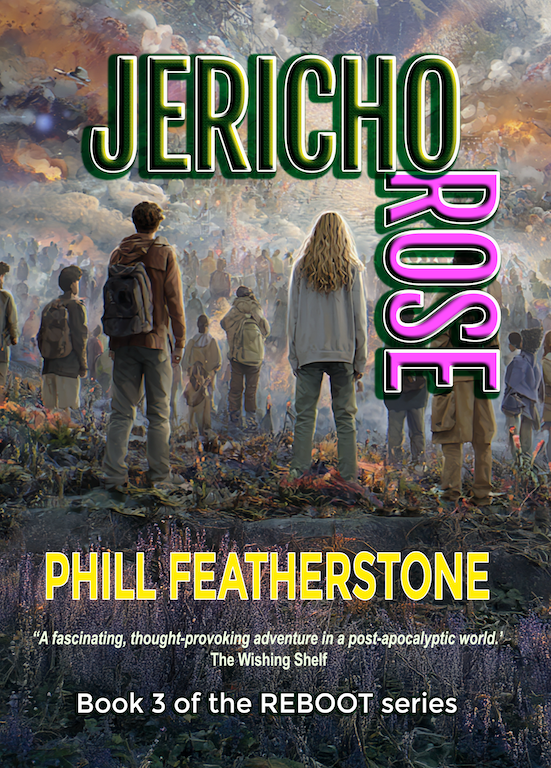
Liberty is threatened by a dictatorial government. Lander remembers how a seemingly dead plant called a Jericho Rose can, with care, be restored to life. Is that a symbol for what must come next?
1
Lander walked away from Adam and Magda, the gravel on the terrace crunching under his feet. He didn’t hurry, although he wanted to. He didn’t look around, despite feeling their gaze boring into his back.
He reached the grassy slope that skirted the lake and followed the path that led to a small wood. Once hidden from the house, he slowed down and took a deep breath. He sat on a tree stump. It was a perfect afternoon, and the land shimmered in an unseasonal heat haze. A few wispy clouds stippled a cornflower sky.
He was full of rage, furious with Adam but also angry with himself. How could he have trusted this man? How could he have been so taken in? As for Magda, her deceit astounded him. They had been through so much together, and he’d considered her a friend; he’d even thought there might be the possibility of her being more than that. Yet here she was on the same side as Adam, and apparently having worked with him throughout the Infection.
His knuckles hurt from hitting Adam, and the bones in his hand hurt. He wondered if maybe he’d broken something. He’d wrenched his wrist too, probably when he’d tried to throttle him.
The grass was still damp from the morning rain, and soon he felt the moisture seeping through his jeans, but he didn’t care. The wispy clouds that stippled the sky were like vapour trails, although he knew they couldn’t be. The aircraft which used to make such things were long gone. Would they ever fly again? Would people march into metal tubes to be carried to other countries at speeds that now could only be imagined? Who knew?
A little way ahead of him, the stream widened into a pool. It was flat calm until a trio of ducks landed messily on the water. Beyond, the trees were a carnival of colour – layer upon layer of oranges, yellows, russets, ochres. Was it his imagination, or was everything more vibrant, brighter, more intense since the Infection? Perhaps it was the lurking presence of death that made it seem so. What was it that Roman guy had said? Carpe diem; grab it while you can. If the Infection had taught him anything, it was that.
There were fields on the other side of the trees. The nearest had been planted with wheat, done at a time when the farmer must have thought it would be needed. It had been neglected, and the ears had dropped so that only the chaff was left. The ribbons of exhausted stalks, beaten down by wind and rain, meandered into the distance. This crop was lost. Would there be another? Would this field ever come back to life?
He remembered a trick Granddad used to perform, a favourite when he and Kerryl were small. The focus was a dull brown wad about the size of a baseball. It looked like dead moss, and it was kept in a plastic bag at the back of the airing cupboard. The ritual never varied. Granddad would show them the lifeless lump and get the two children to examine it, and they would bend over it, sniffing and prodding.
‘What do you think it is?’ Granddad would say, picking it up and flourishing it.
Their answers were always the same. ‘Straw,’ Lander would offer. ‘Wool,’ from Kerryl.
‘Granddad would smile and stroke his chin. ‘Well, you’re both wrong,’ he’d say. ‘It’s not straw, and it’s not wool. It doesn’t look like one, but this is a rose. My next question: Is it alive or is it dead? What do you think?’
‘Dead,’ they’d both say.
‘Are you sure?’
They’d nod vigorously.
‘Well then, I’d better bring it back to life. Do you think I can do that? Do you think I can make this rose live again?’
Kerryl and Lander always said no, even though they knew that was the wrong answer.
‘Very well,’ he’d say. ‘In that case, it looks like I might need some magic.’
He’d get one of Gran’s cooking bowls from the cupboard and fill it with water from the tap. Next, he’d place it in the middle of the kitchen table, nudging it one way or another to get it in the exact centre. When he was satisfied, he’d hold the wad over the bowl, close his eyes and recite what he said was a secret spell.
‘Rose, rose, rise from the dead,
Rose, rose, raise your head.’
Stooping low, he’d place the ‘rose’ reverentially in the water and wave his hands over it, repeating the spell while the entranced children looked on. After a moment or two, something amazing would begin. Slowly at first, then more quickly, the dun lump would swell. Tendrils would extend from it, and as they uncurled, the brown would become green, and it would grow. Over the next few hours Lander and Kerryl would keep returning to the table, and at every visit the plant would look bigger, stronger and more alive. This would go on until Gran decided she needed the kitchen table, or perhaps she simply got fed up with the performance, when she’d make Granddad shift the bowl, and she’d shoo them all away.
As they grew older, he and Kerryl wearied of the trick. Eventually, Kerryl, in a pre-teen strop, said scathingly, ‘Why do you call it a rose? It’s not a rose. It doesn’t look a bit like a rose.’
Granddad shook his head. ‘Oh yes, it is a rose,’ he said. He got down a battered old encyclopaedia from the bookshelf and opened it. ‘Look. There.’
There was a photograph of Granddad’s plant looking shrivelled and dry, and another of it green and lush. Beneath them was the caption Rose of Jericho, also known as The Resurrection Plant, and a short description saying that it was native to desert regions and could survive long periods of drought by apparently dying, springing back to life when the rains came.
‘You see,’ Granddad had said, with an air of I-told-you-so. ‘It’s dead when it has to be, and alive when it can be. It knows how to make the best of things. We could all learn from that.’
That was what the cornfield needed: resurrection. In fact, everywhere did. Lander had heard that the Infection had wiped out ninety-nine per cent of the national population. He couldn’t imagine how anyone could know a figure like that or even estimate it, but certainly an unimaginable number of people had gone. Despite that, there still could be more than half a million who had managed to survive. It would surely be enough to rebuild, except …
Over the months since the retreat of the Infection, it had become apparent that all the women of childbearing age had stopped having periods. At first, the premature menopause had been treated lightly, something of a joke, until people began to see how widespread it was, and realised what it meant. However, that wasn’t the whole of the problem; what made it worse was what had happened to men; they were sterile.
Lander knew this because Adam and Magda had told him. Very few other people did. With no social media, limited phone calls and a single radio and TV channel controlled by the government, there was no way of spreading the news, and the authorities wanted to keep it quiet. So people thought it was something that applied to them and people they knew, not that it was a nationwide problem. Was it worldwide? Was the situation the same in other countries? Why not? Why should the effects of the Infection be any different here?
So there you were: no more babies. There were, of course, children who had been born before the Infection. The virus had been particularly hard on the very young and the very old, but some had got through. With their parents and carers dead, most of the ones that had survived had gone feral, and although it was too soon to tell properly, it looked as though they, too, would be unable to reproduce. So even if the cornfield was resurrected, what it grew would not be needed because there would be no more mouths to feed. And what would be the point of rebuilding anything if people knew that their efforts wouldn’t be needed beyond their own lifetimes? It was an invitation to sink into the sort of nihilism and lawlessness that had been common at the height of the medieval plagues, as populations collapsed and structures crumbled.
The sun was hot on his face, and he began to drowse, to be roused by a faint thrumming. It wasn’t an insect, but at first it was no louder than one. As the sound came closer, it resolved into the throb of a helicopter, and Lander located a tiny speck in the dazzling blue distance. As he watched, it grew; then it was joined by another, some way behind. As they came closer, he saw that the leader had twin rotors: a Chinook, the choice for military transport. The one following was smaller. It was a fascinating sight. These were the first flying machines he had seen since the Infection took hold, and despite the racket shattering the country calm, it was exhilarating to see this demonstration of normality. But it was scary too. Why were they here?
The helicopters came towards the house, making a great sweep over the parkland before landing on the terrace where only a short while ago he and Adam had fought. For a second, he wondered if they were after him, before realising how ridiculous that was. What would two helicopters be doing looking for him? Then he heard a much more worrying sound: the barking of dogs, rowdy and urgent. There was something about the racket that was definitely threatening. It was time to go.
He got up. The sudden movement made him dizzy, and he had to steady himself on a tree. The noise of the dogs was closer now. Then he caught sight of them through the trees. There were a pair of them, big and slobbering, straining against leashes held by two figures in battle fatigues. Had they seen him? It didn’t matter; they were following his scent.
The main path was too well trodden, too obvious, so he moved farther into the woods and found himself at once in a thicket of tangled undergrowth. Creepers and brambles, tree roots and brushwood, caught, scratched and tripped him. The dense scrub meant he could no longer see the dogs, but he could certainly hear them, and they were gaining on him.
There was a stream ahead, and he pushed painfully through another thicket towards it. It was three or four metres wide, shallow and running quickly. He’d heard that a fox would use water to put pursuers off its scent, so he splashed into it and headed in the direction of the flow. It was cold, and the stones were slippery. He slid, cried out as his damaged hand failed to save him, and there was a flash of pain as his knee struck a rock. He struggled back to his feet and limped on. The dogs were baying and snarling, and he could hear their handlers shouting encouragement and crashing about in the brush.
There was a voice through a loud hailer. ‘Lander Shaw. You can’t get away. We have dogs. Come out and show yourself. We don’t mean you any harm.’
No harm? Then why the dogs?
He hurried on, slithering and sliding down the middle of the brook. It would have been easier to run along the tops of the smooth rocks that rose like stepping stones along the shallows at the edge, but he thought the dogs might be able to get his scent from those, so he stuck to the deeper water. With any luck, by the time he climbed out on the other side, he might have lost them.
Ahead of him, the stream ran into a shallow ravine and plunged in a short cascade to a pool below. It looked tricky, but he had to go on. The dogs were on the bank above him and sounded to be only a little way behind. He was exposed. Anyone looking down couldn’t miss seeing him. The barking was closer, almost overhead. He jumped towards the pool, landing with a splash. He righted himself and desperately scanned the bank. To his left was a circular, concrete pipe. It was only just wider than he was. He was afraid of being in confined spaces, but he had no choice. He knelt, and his injured knee screamed in protest. He ignored it and wriggled into the pipe, drawing his legs in after him. He got them in just as the first dog arrived.
2
The tube was pitch black. He’d hoped it might be a short, quick escape route, but his body cut out most of the light, and he couldn’t see where the tube went. He was scared to go on. It might not lead anywhere. It might just come to a dead end with no way out.
However, the options were simple: either he had to go on, or he had to reverse out and face the dogs. There was no choice, and he began to wriggle forward. His damaged hand and his bruised knee protested. It was a good thing that the pipe's surface was smooth, and he found he could use his elbows to ease himself along. The further he crawled, the less light. The pipe was taking some of the water from the stream, and a clammy dam soon formed uncomfortably in his crotch. The culvert amplified his grunting, which made it hard to tell whether the dogs had found the entrance or not. Would he know if they were behind him? Would a dog come into the pipe after him? Might there be a snarling beast between him and the way out? The thought brought on a sudden fit of panic, and he froze.
He was now in complete darkness. The conduit seemed to be straight, burrowing into the hillside. What would be at its end? He reasoned that it couldn’t be a dead end because the water had to go somewhere, but it might not be an exit he could use to escape. How far in was he? It felt he’d gone a long way, but it might only be a few metres. Suppose the men had worked out where he’d gone and blocked the entrance. It would only take a couple of big rocks to trap him. He shuddered, and forced himself to focus on what he must do now.
Despite the chill of the water, he was hot, sweating from the effort of pulling himself along. He felt again the black hand of claustrophobia. He started to tremble, and his head pounded. His impulse was to go backwards as fast as he could, to get out, dogs or no dogs. He fought to control his breathing, to slow his heart, to quell the panic. If he lost control now, in here, it could be … well, it would be fatal. Deep breaths: in, hold, out; in, hold, out. Slowly, the panic eased, his heart rate slowed, and he regained control of his head.
Having moments before been hot, he was now cold, so cold he was shivering. How cold did you have to be to suffer hypothermia? How long did it take? He made himself crawl on in the dark, feeling ahead, breathing in time with each forward reach. The fucking pipe! Where was it going? What was it for? There was a sour smell. It didn’t smell like a sewer, more suggestive of ancient, rotting vegetation. It must be a storm overflow, taking water from the stream to ease the risk of flooding below. Earlier, he’d noticed that beyond the blue dome of the afternoon sky and the wispy filaments of cirrus, dark clouds were building on the horizon. What would happen if there were a downpour? Would the pipe fill? Would he drown? He felt another wave of fear. Keep calm, he snarled at himself. Don’t be a wimp, keep calm.
His leading hand, fumbling forward in the blackness, met an obstruction. There was an instant of terror when he thought the pipe was blocked, before realising that it wasn’t, it just turned sharply to the right. The bend was so tight he had to lie on his side to get around it, and even then it was a struggle. He lay still for a moment to get his breath, then looked ahead and saw … daylight! A slim beam of sunshine struck through a narrow shaft that broke through the top of the pipe a few metres ahead. He could see that beyond it, the broad pipe divided into two smaller ones, and his joy at seeing the light faded. Neither was big enough for him to get through.


Comments
A compelling reflective…
A compelling reflective piece with rich imagery,
Really interesting premise…
Really interesting premise. I love the descriptions, and while I wish there was more dialogue to help break it up, I still think it's a great start.
Very engaging descriptive…
Very engaging descriptive imagery throughout but it felt as though we were thrown in at the deep end, not knowing anything about the characters, the setting or the wider world of the narrative. A brief prologue would have helped to ground us in space and time.