

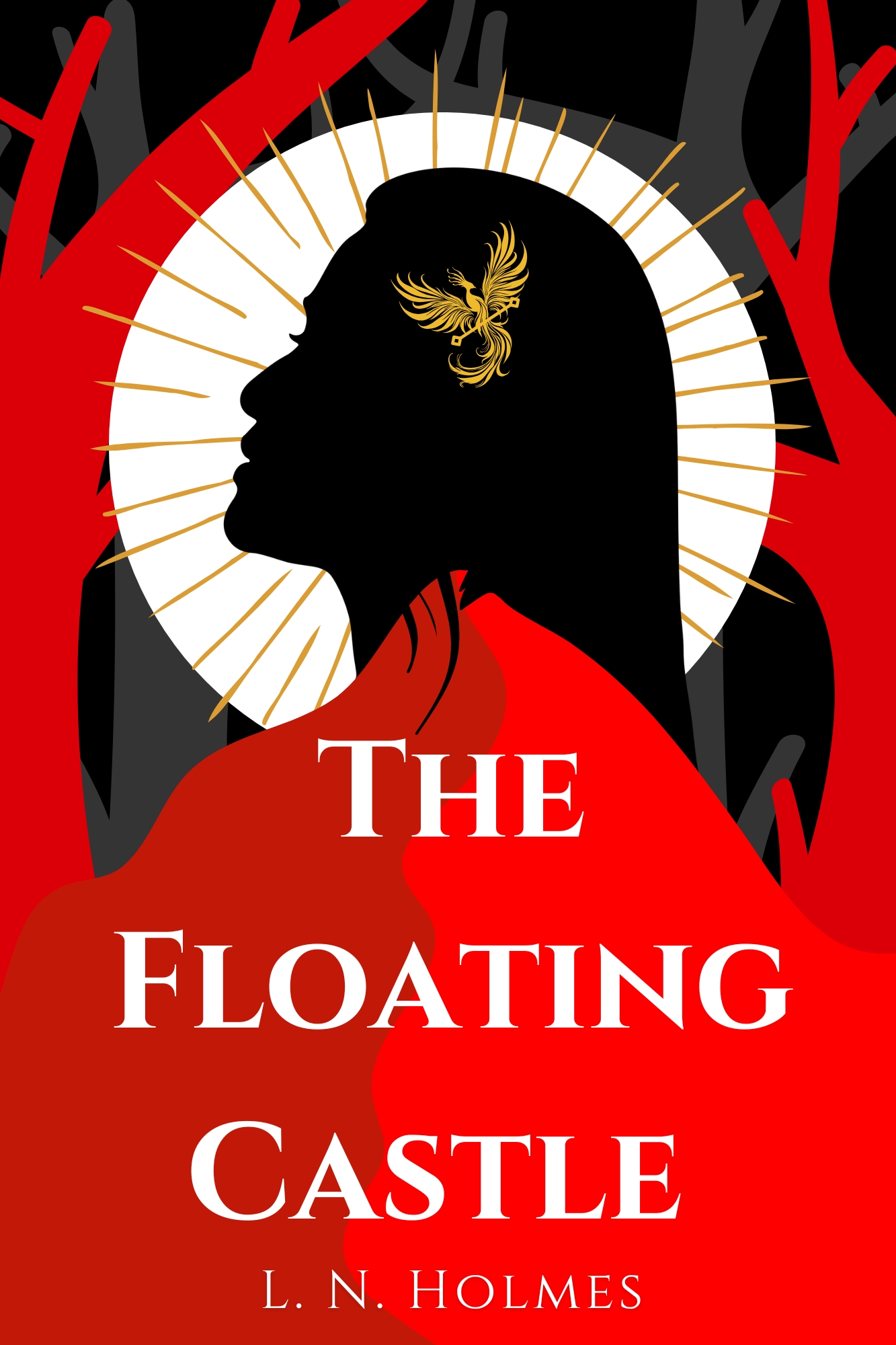
The Floating Castle by L. N. Holmes
Part One
Chapter One
Elias of House Zartisval, Prince of Wallchester, drew his yew longbow and aimed at a hart. Twenty yards separated him and the cluster of red deer. He could tell they sensed him. It was only a matter of time before the wind shifted and carried his scent to the herd. The two trees on either side of the hart acted as a natural sight, guiding his shot. He let the arrow fly. It penetrated the deer, broadside, right behind the foreleg. The hart kicked, alarming his harem, and the herd raced deeper into the forest.
“A kill shot,” said his father, Norman of House Zartisval, King of Gledann. His father pushed off the tree he’d been leaning against and dusted off his brown hunting tunic and trousers. “Congratulations.”
Elias ignored the dispassion in the king’s voice and tied his bow to his horse’s saddle. He stared at his father over the mare’s back. The king arched an eyebrow, his blond hair so light it almost blended into his face. Elias and his sister, Cecilia, had gotten their mother’s traits: hair the black of volcanic glass, eyes the hue of cornflower, skin like aged ivory. Only his half brother, Wallon, looked anything like his father: flaxen-haired, muddy-eyed, skin an almost sickly pallor.
Elias mounted the dapple-gray palfrey. The mare trotted forward after a swift kick to the side. Signaling their guards to continue following at a distance, his father trailed behind on his tiger-eyed stallion.
The hart’s blood trail was easy enough to follow, and after several minutes, they found the bleeding deer, lying dead on the forest floor. Elias dismounted from his horse and retrieved his field dressing kit from his saddlebags. He repositioned the hart so that he could best access its soft abdomen.
“A royal stag,” his father said, joining him at the deer’s side. “It is a shame you could not find a monarch.”
Typical, Elias thought. His father brought him out here without men or dogs and expected him to find the largest stag in the forest.
Elias sharpened his hunting knife on a whetstone. The weapon felt good in his hands, like a natural extension of his arm. Once satisfied with its sharpness, he slit the deer down the middle and began to extract the internal organs. The blood and entrails steamed in the chilly autumn air. Elias made quick work of the hart’s insides, removing everything with one strong pull of the windpipe. He left the pile of gore on the forest floor, an offering for the Antlered Lyon, culler of herds and guardian of the Elder Wood. His father helped him sling the carcass over his horse and secure it.
Using his leather canteen, Elias rinsed his bloody hands and then passed the canteen to his father, who did the same. “When will you tell me what we came here to talk about?”
The king smirked. Blood and water dripped from his fingers. Elias suppressed a shudder, forcing down memories of a dark closet. He had to remind himself that they were outside with guards watching his father’s every move.
Besides, it wasn’t the first time the king had done this, bringing him out to the forest to hunt alone. As a prince, Elias didn’t enjoy being so exposed to attack, especially with bandits and wild beasts lurking in the forest. Usually they’d hunt with experts, all on horseback, along with a pack of trained dogs. Only a few times had the king taken him out alone, the royal guards hanging back far enough in the trees to be nearly invisible. Each time his father did this, there’d been something awful happening: a temporary retreat from Direlan, a devastating defeat during the invasion of Nades, the arrival of his abhorrent half brother at the castle. The king didn’t isolate him in the forest because he sought his son’s council in these moments. Elias suspected his father did this to avoid any embarrassing reactions in front of the courtiers.
“Messengers returned from Toguan this morning,” the king said. He handed the canteen back.
“Have we found an effective route for our soldiers?” Elias returned all of his gear to the saddlebags.
The king studied him. “Our men have not been home a month from Direlan and you are already eager to deploy them to the empire?”
“I simply asked if they found a route through Needlepoint Pass.”
“No.”
Though he felt the anger bubbling in his throat, Elias kept his voice calm. “Then what did the messengers have to say?”
“The emperor is at last honoring your betrothal,” the king said.
“You mean I am to marry?” Elias asked. He’d been betrothed at the age of eight to a princess of Toguan as an act to stave off war. While the betrothal had never been officially dissolved, years went by without their union coming to fruition. Now, at age twenty-five, Elias had grown accustomed to his freedom and imagined the betrothal a formality that would be discarded when his father declared war.
The king gestured at the horses. “The meat will spoil if we linger.”
The hart could be left for the bears and the wolves for all Elias cared. “I thought the betrothal was a bluff.”
When the king stared at him inquisitively, Elias tried again. “You do not truly mean to honor the marriage, do you? I thought we intended to go to war.”
“You continue to say ‘we’ as if you are somehow helping our conquests,” his father retorted. “You do not fight, like our soldiers, although you clearly have the ability. When you attend the war council, you simply advocate for more invasions, regardless of the exorbitant human and financial cost. You are content to leave Wallchester in the hands of a proxy, despite the city’s propinquity to the empire. And now the servants inform me—”
Elias chanced a glance at his father and wished he hadn’t. The king seemed ready to murder him.
“—that you are shirking your responsibilities at the military academy, sending Ava, of all people, to complete the task.”
Elias made a mental note to ferret out who betrayed that information to the king. A few beatings might make them pause the next time they gossiped about him to his father.
He moved to an elder tree and plucked one of the ripe berries. He squished the fruit, its juice like blood on his fingertips. “Maybe I would be more willing to participate in the war effort if we actually won the nations we sought to acquire.”
He knew he went too far when his father thundered, “Maybe you should go to the front, so you can conquer them all yourself!”
Elias sneered, despite the danger. “You seek an empire, not a kingdom, and yet most of your ‘conquering’ involves subduing rebellions in Direlan. The Nades have successfully opposed your attacks for years, and Parsif placates you with their slaves. If you cannot subjugate the three island kingdoms, how will you fare with the wealthier and more populous democratic nations? How will you overcome Toguan, the most powerful empire in the world?”
His father stilled. “You think throwing more soldiers at these issues will solve everything? That if we increase our numbers we can overcome all of them? And as more of our soldiers die, due to your recklessness, how will we resupply? Maybe we should arm our children with sickles and shears and send them to the front as well.”
Elias felt like pushing his luck. “Is that not what you are trying to do to me?”
The king snorted. “You are hardly a child.”
“I am your child. Why must I soil my hands when there are people obligated to do it for me?”
His father quickly closed the distance between them and struck. The slap took Elias off guard. The king hit him so brutally he dropped to the earth, hands smarting from the effort to break his fall. He inspected his palms and hissed at the blood and debris marring his skin. Moisture from the muddy ground seeped into his hunting trousers.
“Monarchs have been dethroned and beheaded for such careless words,” the king said, his voice low. He glanced toward the guards, who’d started to approach and then thought better of it. “Everyone is expendable, even you. If you expect to be king one day, you must be smarter about your relationships with people.”
Elias bared his teeth at the decaying leaves on the forest floor. He didn’t dare turn his expression toward his father, who continued to hover over him, though he longed to.
“You will honor the betrothal,” the king continued, “and you will help Ava assess the students at the academy.”
When his father finally stepped back, Elias stood up. The king didn’t offer to help him. The guards ignored them again and watched the trees.
“Letting women join the armed forces simply because Ava wants it is a mistake,” Elias said.
“The marchioness is a brilliant strategist and has saved countless soldiers from peril, some of them personally. Her men are effective, resilient, and more loyal to her than they are to me. Not to mention Deids flourishes under her leadership. She is infinitely more valuable than you.” The king mounted his stallion. The roan horse glared at Elias, as if challenging him. “Learn something from her and maybe I will start listening to your suggestions at the war council.”
Elias stalked toward his mare. The horse emitted a nervous whicker at his approach. He didn’t intend to learn anything from the marchioness, as if he were some babe clutching at his mother’s skirts. He slit the ropes holding the deer carcass and let it fall to the ground. If his father said anything in response, Elias didn’t hear him. He mounted and took off, not bothering to ascertain if the king followed.
The horse galloped past the guards, too swift for them to catch up. Pain shot through his palms as he gripped the reins. His cheek throbbed with the mare’s jouncing stride. He would be furious if there was a bruise.
His father chased him down. His stallion’s nostrils flared as he matched the mare’s stride. “You will injure your horse!”
Elias ignored him. A thick grove of trees caused them to split. Elias weaved through the trunks, not daring to glance at the king.
“Stop, Elias!” his father shouted, but the wind smothered his voice.
They rushed into a clearing. Elias slowed. Bones and an eviscerated wolf carcass lay scattered on the grass. The smell hit him next—the sweet reek of death. The king rushed in front of Elias, cutting him off. The mare reared, throwing him. Elias cursed as he fell. He crashed into a deer skeleton, the pile of bones rattling with the impact. The pain knocked the wind out of him.
His mare bolted into the woods.
The king circled around him and dismounted. He inspected his son and helped him to his feet.
“You could have died,” his father chided.
“Had you not darted in front of me, I would have been perfectly fine!” Elias snapped. He sucked in a breath. His ribs were bruised. Blood dripped down his arms from several shallow cuts. “I am a mess, thanks to you.”
No comeback came. He noted the distress in his father’s expression.
Reconciliation was the farthest thing from Elias’s mind. He pointed to the bones, all of which were animal skeletons. “What manner of creature did this?”
For a moment, his father’s gaze refused to leave him, likely fearing Elias would bolt again. When the king finally glanced around the clearing, a wary expression crossed his face. “I doubt a wolf or bear. Maybe this is the Lyon’s territory? We should leave.”
For once, Elias agreed.
With his mare gone, he had to share the stallion with his father. The guards caught up and fussed over Elias but stopped when he demanded they take him home. He noticed the dead hart strapped to one of their horses.
As they left, the king didn’t spare him any pain, urging the stallion into a trot. Elias bounced with the horse, every impact agony.
This wasn’t the end of their fight. He wouldn’t marry the princess. He’d find a way out of it. But Elias couldn’t disobey too publicly, at least for now. His father could imprison him for his impudence—or worse. Still, there was one truth that emerged during their verbal sparring match, a promise that Elias held onto like a dagger.
One day he would be king.
Chapter Two
Princess Fu Liling plucked a tiger hair ink brush from her teacher’s hand and then pulled the green sleeve of her silk blouse up to her elbow. She dipped the brush into the ink stone and wrote the phrase “hand me my sword” on the rice paper.
“Yes, that’s the correct spelling,” Honorable Interpreter Chen Bai, Liling’s teacher, said in a contemplative tone.
The early fingers of dawn’s light extended through the lattice windows. A candle guttered on the table. Liling placed the ink brush in her favorite celadon washer and stood, stretching lithely. She couldn’t wait to get out of her room and go outside. She hated being confined for too long.
She turned back to her desk and considered the Gledannish words, written with letters instead of characters. Learning the foreign language proved to be more difficult than she expected. So many nonsensical grammar rules to follow, unlike with Toguanese, which was more logical and tidier. She cared little for Gledannish, but with her marriage to Prince Elias imminent, she studied it obsessively. She wanted to speak and read it to prevent political enemies from gaining an advantage over her. And there would be many enemies in Gledann.
Liling sat down again beside her teacher. She glanced at Bai, whose dark brown eyes returned her inquiring stare.
Bai acted as a translator for all of the emperor’s wives and daughters. When the wives of foreign dignitaries visited the Brilliant City Imperial Palace Complex, her teacher facilitated conversations between them and the women of the palace. No other woman in the empire possessed the ability to interpret three or more languages. It made Bai vital to the emperor’s wives—and to the emperor—even if she would never be permitted to interpret for Zaofu and his sons.
Liling smiled at her teacher. “You have done me a great service. I will miss you dearly when I leave.”
Liling knew she shouldn’t speak with the servants as if they were her confidants and friends. Doing so wasn’t safe or proper. But when it came to Bai, she couldn’t help herself. Her teacher felt like a second—albeit, strict and magisterial—mother to her. With the exception of Shui, whom she secretly regarded as a sister, traveling to Gledann meant she’d leave everyone she loved behind. This final lesson made that reality nearly too terrible to bear.
“Thank you, Your Highness.” Bai dipped her head. “If I may be so bold, what if we didn’t have to part?”
Liling gestured for her to continue. As far as she knew, the emperor had ordered her teacher to stay at the imperial palace complex.
Bai hid her hands in the sleeves of her blouse. “Gledann is a dangerous place filled with ferocious people. You will need every advantage to outwit the members of their court. Straying far from home and speaking a foreign language makes you vulnerable.”
Liling tested the ink on the rice paper with her fingertips. Dry. She removed the paperweights and rolled the scroll. Is that how Bai had felt—vulnerable—when she first came to the Brilliant City? “Have I not progressed well enough under your instruction?”
Bai dipped her chin in a quick bow. “Fluency in Gledannish will prove useful, but I speak many languages. Foreign dignitaries at court may not speak Toguanese or Gledannish. Let me act as your interpreter.”
It amazed Liling that her teacher could speak so many languages without getting them all mixed up in her head. “Are you permitted to come with me?”
Bai removed her hands from her sleeves, placed her right hand on top of her left, and bowed. “Your Highness, the only way I may join your entourage is if you gain the permission of the emperor.”
Liling tied the scroll with a silk belt and placed it back on the table. To ask something of the emperor as a woman, especially if not first summoned, was an extremely risky move. Even as his daughter, she didn’t have that kind of latitude. “What you ask of me is difficult to achieve.”
“Difficult to achieve, yes,” Bai said slowly, “but maybe not as difficult for you?”
Liling didn’t answer. She knew others would notice the favor she’d garnered with the emperor. In addition to their public meetings in the inner gardens, her father granted Liling evening audiences undisclosed to his courtiers, where he’d teach her arts forbidden to women, like politics and martial strategy. Anyone who knew about this could ruin her. As the messenger of the gods, the emperor was above reproach, but his officials could banish Liling from the imperial household and make her a commoner.
Before Liling could answer, Bai tried again. “Your mother received the title of noble consort without bearing sons. You have weekly meetings with the emperor in the inner gardens. According to the courtiers, the emperor refers to you as ‘his treasure.’ Some claim you’ve gained his favor in a way others would kill for.” Bai quickly held up a hand to signal correction. “What I mean is, our esteemed emperor loves you.”
Liling’s face burned.
“He will listen to your request.” Bai placed a hand over her heart. “I want to help you, Your Highness.”


Comments
Engaging and beautifully…
Engaging and beautifully written, with a distinctive narrative voice.
Thank you so much!
In reply to Engaging and beautifully… by Falguni Jain
Thank you so much!
Interesting premise, and…
Interesting premise, and really fun start. The characters are great, and the story so far is really well written.
I really appreciate the kind…
In reply to Interesting premise, and… by Jennifer Rarden
I really appreciate the kind words!
The writing is fluid and has…
The writing is fluid and has lots of energy, giving it real forward momentum. The setup is strong and the conflict between father and son a great hook to get the reader engaged. However, given the word limit and this as your calling card, I'd suggest tightening up the first part and getting us into chapter two a bit sooner.
Thank you very much for the…
In reply to The writing is fluid and has… by Stewart Carry
Thank you very much for the kind comments and advice.