
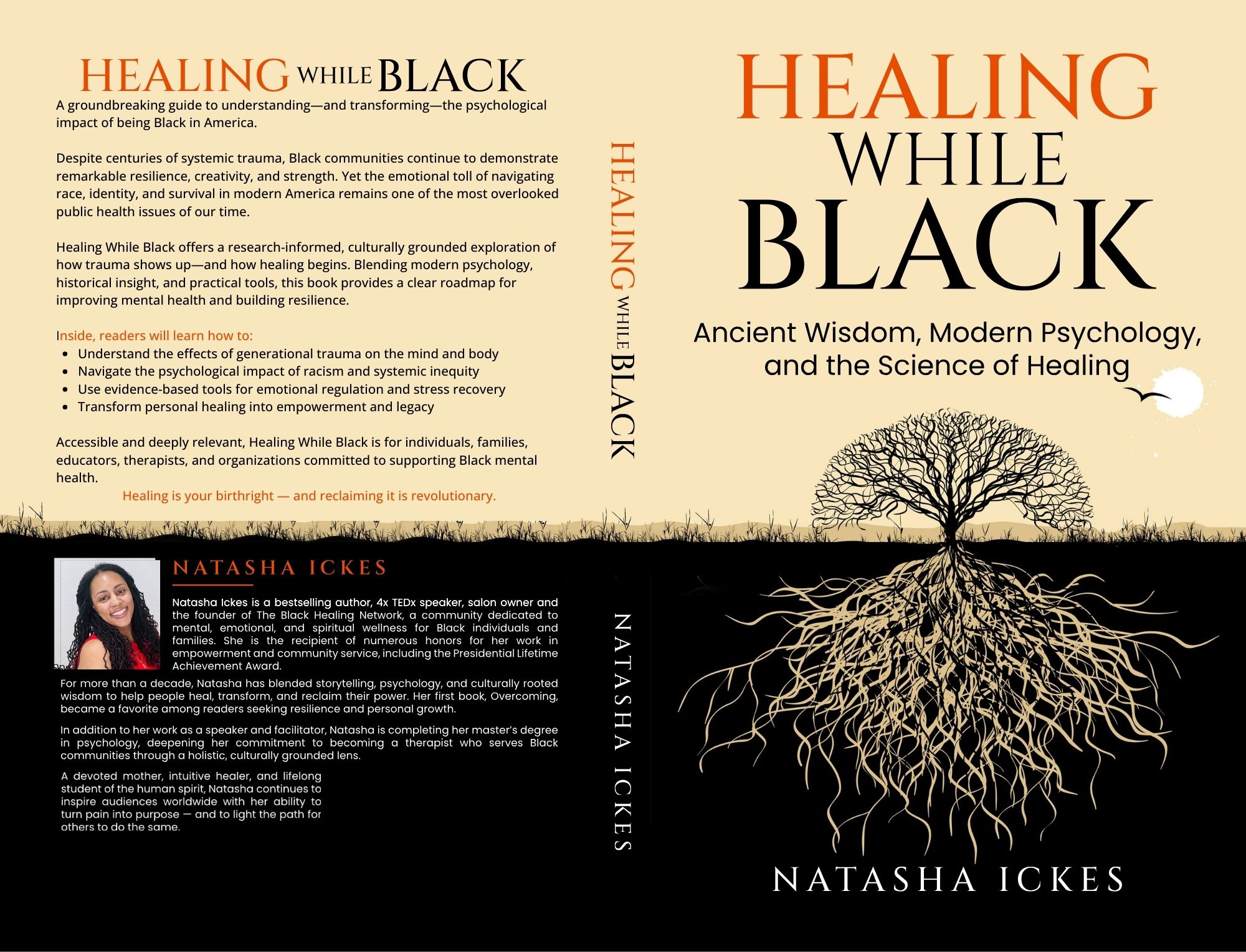
Healing While Black: Ancient Wisdom, Modern Psychology and the Science of Healing
Part I- The Wounds We Carry
Brown Skin
Skin like butter toffee, smooth as silk, kissed by the sun.
Milk chocolate richness, deep as the earth. Brown skin.
Often judged. Mislabeled. Outcast.
Lazy. Unworthy. Disgusting.
The whispers, the weight, the burden—brown skin.
Fetishized.
Run. Jump. Rap. Sing. Perform.
But do it quietly—no thoughts, no voice.
Just take it. Brown skin.
They forget—
This skin carries warriors in its marrow.
Strength in its bones.
Power in its DNA.
A survivor’s bloodline. Brown skin.
We have fought, innovated, built, and rebuilt.
We have learned, taught, wept, and created.
We are the blueprint. Brown skin.
Mothers of civilization, daughters of the stars.
The seed of all that was, the essence of all that is.
Unparalleled beauty, unwavering strength.
Empathy, intuition, wisdom—simply unmatched.
Brown skin.
I believe in reincarnation.
That we choose before we come.
That we walk into this world knowing—
This path is not easy.
This soul is here to shake the ground.
To take on what others would not survive.
To build where many would crumble.
To preserve, no matter what.
Brown skin.
A legacy of warriors.
A people who refuse to break.
We do not settle.
We cannot be silenced.
And no matter what—still, we rise.
Brown skin.
Speckled with gold.
Sun-warmed, earth-rooted, fire-forged.
Brown skin.
-Natasha Ickes
“Rain does not fall on one roof alone. And no matter how long the winter, spring is sure to follow” — African Proverb
Ch.1 Roots
Half-Truths and Erasure
When my daughter was in the 3rd grade, she came home with a worksheet: “10 Facts About MLK Jr.” Fill-in-the-blank style: He was born on __, he was married to ___, he had __ kids. Cute — but missing the whole truth. I grabbed a sharpie and made her write one more fact at the very top: The U.S. government was found responsible for his assassination. Then I told her to get up in front of the class the next day and say it out loud.
She looked confused and asked “Why?”. My answer was simple: “To whom much is given, much is required. When you have knowledge, it’s your duty to share it.”
In 1999, a Memphis jury heard a wrongful death case brought by the King family against Loyd Jowers, who claimed he had been part of a conspiracy that involved government agencies. After four weeks of testimony from more than 70 witnesses, the jury unanimously concluded that Jowers and unnamed “co-conspirators including governmental agencies” were liable for Dr. King’s assassination. The King family was awarded a symbolic $100 in damages. For comparison, families of victims of the September 11 attacks received compensation that often totaled millions of dollars through federal victim compensation funds. Of course they don’t teach that during Black History Month.
When my son came home talking about Rosa Parks several years later, I was just as frustrated with the way her story had been watered down. Too often she’s described as a tired woman who couldn’t bear to give up her seat on a bus. The truth? She was a trained activist and freedom fighter making a deliberate, strategic choice that would help shift the course of history. Rosa Parks herself said, “I was not tired physically … the only tired I was, was tired of giving in” .
See, America gives us half-truths, and if we’re not careful, those become the only version people know. Today we’re watching another wave of erasure — history books being rewritten, entire lessons removed. A government hell bent on taking us backwards, openly spewing racist rhetoric and employing catastrophic policies. It is up to us to stay informed and to pass knowledge down to future generations. As Zora Neale Hurston said, “If you are silent about your pain, they’ll kill you and say you enjoyed it.”
To understand the depth of those wounds, we can’t start with slavery alone. We must go back further — before the chains, before the ships, before the false narratives. Because our story doesn’t begin in bondage. It begins in Africa, with civilizations that birthed knowledge, philosophy, medicine, and culture long before America ever knew our names.
Before the Chains
“Africa was the cradle of humanity and one of the first regions where organized societies, science, philosophy, and governance emerged.” - UNESCO
Most Africans who were brought to America on the transatlantic slave route came from West Africa, or at least left from ports along the West African coast — many through Ghana’s infamous “Door of No Return” at Cape Coast and Elmina Castles. However, our story begins way before then. We come from an ancestry of philosophers, scholars, astronomers, scientists, healers, mothers, fathers, kings, and queens. Before we talk about what was done to us, we have to remember who we were — whole, brilliant, and free.
Long before Europe’s Enlightenment, the Mali Empire (14th–16th century) in West Africa produced kings so wealthy that Mansa Musa is still considered the richest man in history. On his pilgrimage to Mecca in 1324, he distributed so much gold that it disrupted economies across Africa and the Middle East.
Timbuktu, within the Mali Empire, was home to the legendary University of Sankoré, a center of learning that housed hundreds of thousands of manuscripts on medicine, astronomy, mathematics, law, and philosophy. Many of these texts still survive today, standing as proof that Africa was not a “dark continent” before colonization, but a place where scholarship, science, and spiritual inquiry flourished.
And here’s the part that always gets me: when you walk into most museums, the “African section” usually looks primitive (drums, masks, spears) while the European sections showcase paintings, sculptures, books, and inventions. While I am not devaluing what we see, it is not the full story and I believe this misrepresentation is purposeful. As Chancellor Williams the historian said, “Africa was civilized long before Europe and Asia, and Africa was teaching the world when Europe was learning to read.”
African societies had systems of governance, trade routes, art, storytelling traditions, and spiritual practices that were complex and deeply rooted in community. They were just as advanced, and often surpassed, anything in Europe. But you rarely see that displayed behind the glass. In fact, as recently as 2012, when extremists threatened to destroy Timbuktu’s heritage, a Malian librarian named Abdel Kader Haidara risked his life to secretly move nearly 350,000 of these manuscripts to safety. He packed centuries of knowledge—histories, poetry, astronomy, science—into metal footlockers and smuggled them hundreds of miles south to Bamako, one small cart at a time, in a covert mission that felt more like a spy thriller than a heritage operation. His bravery reminds us that our history has always been worth protecting.
And the more I learned about this legacy, the more something inside me ached to see it for myself — not through textbooks or museum glass, but with my own eyes and feet on the soil of my ancestors.
That longing to “go home” stayed with me for years. Finally, in 2023, I traveled to Africa for the first time. I took my son along on a trip to deliver my fourth TEDx talk, this one in Zimbabwe. It was a beautiful and life-changing experience. We went on safaris, explored crowded cities, ate in 5 star restaurants and met amazing people. We visited South Africa where monkeys climbed on our heads, and visited Tanzania where we stood at the largest slave port on the East African coast.
I wanted my son to see both the richness of who we are, and the weight of what was done to us. As we bent forward to squeeze into small stone cells that were once crammed with enslaved people my heart began to pound. Bars covered the tiny windows, and the air felt thick and stifling. I gripped my son's hand tighter as I imagined small children clinging to their mothers, terrified and uncertain of what was to come.
The guide pointed towards a separate cell down the hall which once held dozens of men at a time. I could almost taste the fear and feel the rage that lingered in the air from hundreds of years of men fighting against shackles- wrists and ankles bloody- desperate to break free to protect their families.
Each cell had two narrow stone ledges along the walls where bodies were forced to lie, shoulder to shoulder. The narrow strip of space in the center — what should have been a walkway — was used as a place to urinate and defecate. The smell must have been unbearable. I could almost hear the cries, feel the fear, and sense the despair lingering in the walls, as if the souls of those who suffered there still hadn’t found rest.
When we finally stepped back into the sunlight, I held my son’s hand a little tighter. We were walking out free— and they did not.
Joy and sorrow often live side by side and this trip was no different. It was agonizing, but also proof that even systems built to erase us could not win. As we left, I couldn’t stop thinking about how their bloodline lived on in us. To make sense of that survival, I had to understand what they endured, and how the system that stole them grew into one of the most brutal in history.
See, unlike the West African ports that routed enslaved Africans across the Atlantic, this site was part of the Indian Ocean slave trade that sent people primarily to the Middle East. In the museums and archives, I learned truths that textbooks in America rarely teach: slavery in Africa, while still brutal, often looked very different from the chattel slavery practiced in the Americas. Enslaved people in parts of Africa could sometimes marry, own property, or even buy their freedom.
Everything changed with the arrival of Europeans. They exploited local conflicts, armed rival tribes, and forced leaders into trading captives. I doubt many could have imagined the horrors of what they were entering — a permanent, generational, dehumanizing system that would become the foundation of the Americas. But even in the face of chains and terror, our people refused to be broken. Resistance rose up again and again — sometimes quiet, sometimes explosive, but always there.
Rebellions of Resistance
The transatlantic slave trade operated on a scale and brutality the world had never seen, reducing human lives to cargo and profit. And still, they found ways to resist, endure, and remain human in a system designed to erase them.
Enslaved Africans braided escape maps into their hair and hid seeds in their cornrows, using creativity and intelligence as tools of survival. They sang spirituals that doubled as coded directions for freedom. Freedom fighters like Harriet Tubman returned again and again to liberate her people, while the Haitian Revolution shook the world as the first successful slave revolt that established a free Black republic.
Resistance didn’t stop there — it rose up on plantations across the South, led by ordinary people who dared to defy an impossible system.
Nat Turner’s rebellion of 1831 was a story that captivated me. Turner was a preacher, carried from plantation to plantation to deliver sermons that were meant to make slaves docile and obedient. By cherry picking and twisting certain bible verses, slaveholders tried to brainwash slaves and use religion as a means of control. But as Turner learned to read the Bible for himself, he began to see how its words had been weaponized. Through that he came to believe he was divinely appointed to rise up against slavery.
In August of 1831, he led one of the most significant slave rebellions in American history. Turner and a small group of followers moved from plantation to plantation in Southampton County, Virginia, killing about 55 slave holders and their families in an attempt to dismantle the system that had enslaved them. Though the rebellion was brutally suppressed within days, and Turner himself was captured and executed, the impact was seismic. The revolt sent shock waves through the South, spreading fear among slaveholders and sparking even harsher laws designed to control enslaved and free Black people.
What’s designed to destroy us often becomes the source of our strength. Over and over, our people have turned pain into power and pressure into purpose. Turner’s rebellion reminds us that resistance has never been passive — it’s always been deliberate, often dangerous, and always costly. Yet without people like him daring to act, we wouldn’t have the blueprint of defiance that fuels our struggle today.
And Turner was not alone. Long before and long after his rebellion, others rose with the same unshakable fire.
The Stono Rebellion of 1739, in South Carolina, began with just 20 enslaved Africans. They raided a store for weapons and marched south toward Spanish Florida, where freedom had been promised to fugitives. Along the way, their numbers grew to nearly 100. This was not simply escape — though there is no shame in choosing to run. These men and women burned plantations, killed nearly 30 colonists, and marched with a purpose. The rebellion was eventually crushed, but it was one of many examples of our people organizing, strategizing, and refusing to accept the conditions forced upon them.
Even the German Coast Uprising of 1811 in Louisiana, the largest slave revolt in U.S. history — is one you’ve probably never heard about. Between 200 and 500 enslaved Africans marched along the Mississippi River toward New Orleans with makeshift weapons, flags, and drums, chanting for freedom. They were met with violent suppression; many were killed, and their severed heads were displayed on pikes along the river as a warning. Still, the message couldn’t be silenced.
Over and over again, enslaved Africans rose up, proving that resistance wasn’t an isolated act of bravery but a recurring rhythm of defiance running through our history.
Legacies of Survival
After slavery was outlawed, some ships still smuggled enslaved Africans into the United States. In 1860 — more than 50 years after the transatlantic slave trade was officially banned — a ship called the Clotilda docked illegally in Mobile, Alabama, carrying 160 captives. Among them was Oluale Kossola, later known as Cudjo Lewis, believed to be the last survivor of the slave trade. After emancipation, Cudjo and other freed Africans pooled their resources, purchased land, and built their own community. Outsiders called it Africatown, and it still exists today as a living testament to survival, culture, and legacy. What made Africatown remarkable wasn’t just that it existed, but that its founders preserved their African traditions — keeping their language, honoring their customs, and living in extended family units, passing down identity even in a foreign land.
While Africatown showed what it meant to keep traditions alive, other freedom fighters found resistance in different forms. Survival can be a village built from scratch — or one woman outsmarting an entire system.
Just look at Mary Ellen Pleasant — a woman who demonstrated resistance through strategy, intelligence, and financial power. Born around 1814, Pleasant moved to San Francisco during the Gold Rush and became one of the wealthiest Black women of her time. She built a fortune through savvy investments in businesses, real estate, and boarding houses, often using her wealth to quietly fund abolitionist causes. Historians even credit her with financing John Brown’s raid on Harpers Ferry. Quite fittingly, she once declared, “I’d rather be a corpse than a coward”. She was fearless, unapologetic, and determined to wield her influence for the freedom of her people. But like so many powerful Black women, her legacy was twisted by racism and sexism. Instead of being remembered as a mogul and abolitionist, she was smeared with the nickname “Mammy Pleasant” in an attempt to strip her of dignity and reduce her accomplishments. Yet the truth endures: she was a strategist, a freedom fighter, and a woman far ahead of her time.
Stories like these remind us that even when the system tried to erase us, we carved out space for ourselves — building, preserving, resisting, and thriving in ways both big and small. But as slavery gave way to “freedom,” another system rose in its place: Jim Crow. Slavery may have ended on paper, but oppression simply put on a new mask.
Jim Crow: The System After the Chains
We have all heard of Jim Crow and the laws that claimed “separate but equal.” We also know this was a blatant lie — Black systems were deliberately underfunded, subpar, and unequal. The thing many people don’t realize is how those laws and practices directly shape our lives today. And why, when people say we are living in the past, they simply have no idea how this country was built and continues to run.
Trauma wasn’t just personal; it was written into the law of the land. Schools for Black children often received only a fraction of the funding of white schools — in some Southern states, less than one-third per student. Even now, school funding relies heavily on property taxes. Because Black families were historically excluded from owning property in high-value neighborhoods through practices like redlining, predominantly Black schools remain underfunded. Black children often get teachers who are overworked, underpaid and don’t have access to the same resources that wealthier schools take for granted. In many ways, their education has always been set up as a pipeline — not toward opportunity, but toward prison or the most undesirable jobs in our communities
And it didn’t stop at the classroom. Segregation extended into every corner of life. Even something as simple as a swimming pool was deliberately kept out of reach. This was not a social inconvenience. Swimming is a life-saving skill that we rarely had access to. Even now, Black children ages 10-14 drown in swimming pools at rates nearly eight times higher than White children.
I don’t just know that from statistics — I know it from experience.


Comments
A brilliant start. Would…
A brilliant start. Would love to read it further.
Very well-written and…
Very well-written and informative without sound boring or preachy. Great job!
Obviously the product of…
Obviously the product of meticulous research coupled with the existential truth of personal experience. Having lived and worked in Africa for many years, I must question the validity of using safaris and 5 star restaurants as a portal for experiencing life for the vast majority of people in Zimbabwe. It's unintentionally misleading and out of kilter with most of this excerpt.