
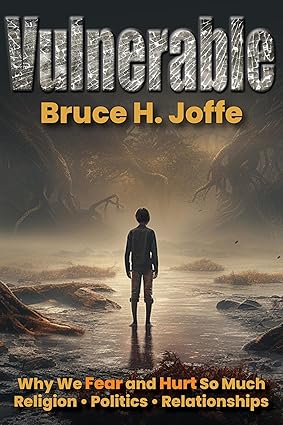
Always was, always will be.
But now, increasingly so it seems.
Being vulnerable is not a choice. It's part of living.
Responding to life situations requires individuals and societies at large to adapt and change. Or to be spurned and lost in the process.
For many, this need to adjust – to a hostile environment, uncertain economic shifts, tensions tugging at war and terrorism, extremist politics, racial injustice and religious intolerance, marginalization, spiritual voids, social disconnections, conflicting realities, artificial intelligence, death and divorce – is threatening, because it removes us from the safety nets and security blankets of our personal comfort zones, wherever they may be.
We feel vulnerable. Fearful. Hurt. So, we do whatever we can to protect ourselves.
For better or worse, we respond and react to these primal threats.
Because vulnerability has become a driving force of our lives.
Introduction …
The Israelis surrounded by enemies who’ve sworn to exterminate them … the Palestinians in diaspora or living in a land locked without home rule … the farmer surveying his parched fields, wondering whether they will yield any crops … the foreigner seeking asylum whose chances are greater for deportation, instead … the parents with no control over what their children are taught (or not) in school … the airplane passenger experiencing a flight with severe turbulence … those crippled by flooding and ever-increasing, ferocious hurricanes … and elsewhere, where there’s not enough water to go around … the faithful whose brothers and sisters have been massacred in their worship centers … the black man running down the street … LGBT folks anxious their human rights will be rescinded … disenfranchised citizens unwilling to vote because they believe the system is rigged … those defending their rights to carry arms and maintain a “FY!” lifestyle … the children separated from their parents, for whatever the reason … the scorned husband or wife who cheats … the hospital patient awaiting anesthesia and the hand of a skillful surgeon … the forest fires devouring Canada, California, Portugal, and Greece … the garbage piling up everywhere … the investor worried about losing his money … the elderly scared about their Social Security stopping … the Russian president annexing land to reclaim and expand his former empire amidst a never-ending war in Ukraine … the former US president impeached twice, indicted in four criminal trials and countless civil cases, speaking with vulgarity and telling lies, challenging justice and reprisals … plagues and pandemics … Iran and North Korea, China, too … the poor, the infirm, the captives, the homeless, the widows, the orphans … the perils and potential of artificial intelligence.
All those who hurt. Us.
“Exposed to the possibility of being attacked or harmed, either physically or emotionally,” is how Google’s English dictionary provided by Oxford Languages defines vulnerable. “Someone who is vulnerable is weak and without protection, with the result that they are easily hurt physically or emotionally.”
Cambridge, for its part, says that vulnerable means “able to be easily physically or mentallyhurt, influenced, or attacked” and offers these examples:
• I felt very vulnerable, standing there without any clothes on.
• It is on economic policy that the government is most vulnerable.
• Tourists are more vulnerable to attack, because they do not know which areas of the city to avoid.
Adds Meriam-Webster, “Vulnerable is ultimately derived from the Latin noun vulnus ("wound"). Vulnus led to the Latin verb vulnerare, meaning "to wound," and then to the Late Latin adjective vulnerabilis, which became vulnerable in English in the early 1600s. Vulnerable originally meant "capable of being physically wounded" … but since the late 1600s, it has also been used figuratively to suggest a defenselessness against non-physical attacks. In other words, someone (or something) can be vulnerable to criticism or failure as well as to literal wounding.”
According to the different types of losses, vulnerability can be further defined as physical, economic, social, and/or environmental.
Metaphorically, vulnerability has been likened to “candles in the wind,” a “sitting duck,” an “Achilles heel,” someone who is “thin-skinned” or “on the line,” a “tightrope walker,” and Humpty Dumpty (beyond the shell), while
synonyms for vulnerable include accessible, defenseless, exposed, liable, sensitive, susceptible, at risk, assailable, and unsafe (among others).
Astute observations and heartfelt analysis also make being vulnerable the subject matter of clever literary quotes:
• If we want greater clarity in our purpose or deeper and more meaningful spiritual lives, vulnerability is the path. Staying vulnerable is a risk we have to take if we want to experience connection. We cannot selectively numb emotions—when we numb the painful emotions, we also numb the positive ones. (Brene Brown, Dancing Greatly: How the Courage to Be Vulnerable Transforms the Way We Live, Love, Parent, and Lead)
• Vulnerability is a state of emotional exposure that comes with a degree of uncertainty. Learning how to be vulnerable involves a willingness to accept the emotional risk that comes from being open and willing to love and be loved. A fear of vulnerability is a very common fear. (Lisa Fritscher)
• To share your weakness is to make yourself vulnerable; to make yourself vulnerable is to show your strength. (Chris Jami)
• Globalization will make our societies more creative and prosperous, but also more vulnerable. (NATO Secretary General Lord Robertson)
• For most Americans, the state of our politics is now a source of genuine anxiety and fear. We are worried about the nation we're leaving behind for our children's generation. (Margaret White, No Labels)
Vulnerability means being in a position where other people can hurt us. It often means expressing the sides of ourselves about which we have the least confidence or certainty and allowing others to respond to them. Similarly, it’s the inability to resist a hazard or to respond when a disaster has occurred or is looming.
It’s been said that vulnerability depends on several factors, such as people's age and state of health, local environmental and sanitary conditions, as well as on the quality and state of local buildings and their location with respect to any hazards. Families with low incomes often live in high-risk areas around cities because they can't afford to live in safer (more expensive) places. This is what we call economic vulnerability. Similarly, a wooden house is sometimes less likely to collapse in an earthquake; but it may be more vulnerable in the event of a fire or a hurricane. This is what we call physical vulnerability.
The environment we grow up in plays a huge part in emotional vulnerability. When that environment is invalidating, and the people around don't seem to understand our emotions, it leads to increased emotional vulnerability.
Vulnerability can also be the inability to resist a hazard or to respond when a disaster has occurred. For instance, people who live on the coast are more vulnerable to floods than people who live closer inland.
Several situations can increase our vulnerability to disasters.
One example is when people cut down too many trees at a faster pace than nature can replace them. This is deforestation. It increases the vulnerability of many communities to rain which, when it falls on unprotected soil, can cause mudslides, landslides, floods, and avalanches. It’s environmental vulnerability.
Building homes in high-risk places makes us more vulnerable. If we live close to a river where people have been throwing garbage into it so that the water cannot flow on through, we will be more vulnerable to floods.
Weakness in an information system, system security procedures, internal controls, or implementation that could be exploited or triggered by a threat all contribute to our vulnerability—physical, economic, social, and environmental.
#########
Religions based on the Bible inherit an historical story about vulnerable people. This compilation of books divided between “Old” and “New” – or Hebrew and Greek – isn’t directed at the rich and powerful, but the vulnerable: the meek, the poor, the sick, the hungry, the homeless, the captive. Those who are vulnerable and hurting.
In Psalm 82-3-4, God judges those who judge and confronts them for acting unjustly. In doing so, he speaks to any of us who lead or are in positions of power. God reinforces the importance of defending the vulnerable such as those who are poor and the fatherless.
Blessed are the meek, for they will inherit the earth, says Jesus, in his famous Sermon on the Mount (Matthew 5:5). Meekness is not the same as weakness, but it does involve humility and a willingness not to use our power to dominate others. In that way, it is a type of vulnerability.
Jesus then made his point about protecting the vulnerable: Truly, I say to you, as you did it (or did not do it, as the case may be) to one of the least of these my brothers, you did it to me. He was saying emphatically that we all will be judged by how we treat (vulnerable) people in need.
For Bible believers, the genesis of vulnerability is found in the Garden of Eden story. In the words of Genesis 3:1-6:
Now the serpent was more crafty than any other beast of the field that the Lord God had made. He said to the woman, “Did God actually say, ‘You shall not eat of any tree in the garden’?” And the woman said to the serpent, “We may eat of the fruit of the trees in the garden, but God said, ‘You shall not eat of the fruit of the tree that is in the midst of the garden, neither shall you touch it, lest you die.’” But the serpent said to the woman, “You will not surely die. For God knows that when you eat of it your eyes will be opened, and you will be like God, knowing good and evil.” (ESV)
But I believe a truer meaning of vulnerability is found in later verses:
Then the eyes of both of them were opened, and they realized they were naked; so they sewed fig leaves together and made coverings for themselves (3:7).
Therein mankind’s vulnerability is scripturally exposed.
Punishment and retribution are immediately doled out by an angry deity, detailing our vulnerabilities:
I will make your pains in childbearing very severe; with painful labor you will give birth to children. Your desire will be for your husband, and he will rule over you, was to be the woman’s curse (3:16). And for the man: Cursed is the ground because of you; through painful toil you will eat food from it all the days of your life. It will produce thorns and thistles for you, and you will eat the plants of the field. By the sweat of your brow you will eat your food until you return to the ground, since from it you were taken; for dust you are and to dust you will return (3:17-19).
Pain, longing, servitude, curses, hard work, injuries, and a grim mortality are among the vulnerabilities awaiting mankind.
Throughout the Bible, we encounter vulnerable people. In fact, the scriptures talk more about the vulnerable than they do about the righteous.
Jesus himself was vulnerable and, in Matthew 26:39-42, openly expressed his vulnerability: And going a little farther he fell on his face and prayed, saying, ‘My Father, if it be possible, let this cup pass from me; nevertheless, not as I will, but as you will.’ And he came to the disciples and found them sleeping. And he said to Peter, ‘So, could you not watch with me one hour? Watch and pray that you may not enter into temptation. The spirit indeed is willing, but the flesh is weak.’ Again, for the second time, he went away and prayed, ‘My Father, if this cannot pass unless I drink it, your will be done.’
Psalms and Proverbs are filled with references to the vulnerable, such as these:
• But when you give a banquet, invite the poor, the crippled, the lame, the blind, and you will be blessed. Although they cannot repay you, you will be repaid at the resurrection of the righteous (Luke 14:13-14).
• The LORD is my shepherd, I shall not be in want. He restores my soul. He guides me in paths of righteousness for his name's sake. Even though I walk through the valley of the shadow of death, I will fear no evil, for you are with me; your rod and your staff, they comfort me (Psalm 23).
Other verses in the Bible also deal with vulnerability:
• Count it all joy, my brothers, when you meet trials of various kinds, for you know that the testing of your faith produces steadfastness (James 1:1-27).
• Bear one another's burdens, and so fulfill the law of Christ (Galatians 6:2).
• Fear not, for I am with you; be not dismayed, for I am your God; I will strengthen you, I will help you, I will uphold you with my righteous right hand (Isaiah 41:10).
• I can do all things through him who strengthens me (Philippians 4:13).
• What is the price of two sparrows-one copper coin? But not a single sparrow can fall to the ground without your Father knowing it. And the very hairs on your head are all numbered. So don't be afraid; you are more valuable to God than a whole flock of sparrows (Matthew 10:29-31).
Love is patient, love is kind. It does not envy, it does not boast, it is not proud. It is not rude, it is not self-seeking, it is not easily angered, it keeps no record of wrongs. Love does not delight in evil but rejoices with the truth. It always protects, always trusts, always hopes, always perseveres.” (I Corinthians 13:4-7)
Lovely words at a wedding, no doubt.
But how quickly things can change! We lose patience with loved ones, aren’t always kind, are jealous of qualities they have that we don’t, argue, and complain … believing we are “right.” We interrupt rather than listen, assume we know better, and yell at those we love, reminding them of how they’ve hurt us in the past. Sometimes the truth is that we no longer love – or like – our betrothed and put each other through the misery of separation and divorce. Although we try to protect what we have (if not who we and they are), we lose trust when we’ve been lied to, especially by loved ones. Hope becomes secondary to immediate gratification, and perseverance withers.
Not all of us can be eternally enamored of Dulcineas to our Don Quijotes.
“The heart is a lonely hunter,” famously said American author Carson McCullers as the title of her debut book, implying that, although predatory, we are essentially alone when it comes to conquering matters of the heart.
Her title is from "The Lonely Hunter" poem by Scottish poet William Sharp, under the pseudonym Fiona MacLeod: "Deep in the heart of Summer, sweet is life to me still, But my heart is a lonely hunter that hunts on a lonely hill."
In And I Love You So, Perry Como (and Don McLean) crooned, “The book of life is brief. And, once a page is read, all but love is dead. That is my belief ..."
The loss of a loved one, albeit human or furry, can be a heartbreaker. How many poems, songs, and movies deal with our vulnerability to love … whether jilted, faded, unreciprocated, or otherwise lost?
I know it hurts.
It’s a very strange feeling how someone can be in your life for months or even years and then one day ... suddenly not be there anymore.
Maybe the relationship ended on good terms … or maybe it was completely catastrophic. Either way ... it’s bizarre how relationships can change so vast and rapidly.
Sometimes, the end of a relationship can be one of the hardest things we go through in life, feeding our vulnerability.
You made memories together. And those memories are something you can’t erase no matter how hard you try.
Because they are a part of your story.
You joined paths for a particular reason. Maybe you walked through some of the hardest times together. Maybe you understood each other in a way no one else ever could. Maybe you encouraged each other to be strong or to embrace who you genuinely were. Or maybe your relationship opened your eyes to what you truly needed in life.
That person meant a lot to you. And it's okay if they still do. It’s also okay that s/he isn’t in your life anymore.
Not every relationship will last a lifetime.
“Sometimes the people you wanted as part of your story are meant to be only a chapter,” advises Cody Bret, a popular YouTuber relationship coach.
“I don't surround myself with people that are always positive and put on a smile to mask away the life they have behind closed doors,” he says. “I prefer people who are blunt, raw and are honest about who they genuinely are. If you're not happy with your life, then I want you to come to me with tears in your eyes and explain to me what made you feel this way and how we can fix it. If you're in my life, I need you to be in your own skin.”
#####
According to Sigmund Freud, two basic drives motivate all of our thoughts, emotions, and behavior. Simply put, they are sex and aggression. Also called Eros and Thanatos, or life and death, Freud asserts that they underlie every motivation we as humans experience.
Sexual activity is a means to procreation, to bringing about life and therefore assuring the continuation of our bloodlines. Even in other creatures, sex is a primary force to assure the survival of the species.
Aggression, on the other hand, serves just the opposite purpose. Aggression is a way to protect us from those attempting harm. Aggression drive is a means to allow us to procreate while at the same time eliminating enemies who may try to prevent us from doing so.
While it sounds primitive, such Freudian models must not be looked at merely as sexual activity and aggressive acts. These drives entail the whole survival instinct and could, perhaps, be combined into this one drive: The drive to stay alive, procreate, and prevent others from stopping or reducing these needs.
Although I am no Freudian, I can understand the strength of his two drives. But, to them, I must add a third: vulnerability. For better or worse, we all want to minimize our vulnerability. Sometimes this is manifested in violent aggression; other times, however, it abides in our efforts to hide, cope, treat, and destroy whatever makes us vulnerable.
For his part, Carl Jung holds that, “If our religion is based on salvation, our chief beliefs will be fear and trembling. If our religion is based on wonder, our chief emotion will be gratitude.”
Christian pastor and author John Pavlovitz deals with our vulnerability and fears in his book A Bigger Table, which invites readers to envision a church that is big enough for everyone by holding up a mirror to the modern church and speaking clearly on issues at the heart of the Christian community.
“Grief will freeze you if you let it, and I felt frozen. Many of us did,” he writes in the book’s introduction. “And it wasn’t merely the reality of the man we’d allowed to ascend to the presidency that brought the mourning, thought that would be reason enough for despair for many of us. It was the cruelty we’d witnessed in one another as he’d made his way there, the sickness that the America we love had shown itself afflicted with. It was the suffocating weight of every horrible reality about our nation; all that bigotry and discord and hatred set upon our chests, hampering our breath. But it was much closer than that, too. It was the words we’d heard from family members, the social media posts from church friends, the incendiary sermons from our pastors, the arguments we’d had with coworkers. It was the stuff we’d learned about ourselves. On this Wednesday morning in November, we woke as a terribly altered people.
“Perhaps more than any period in recent history, the yearlong presidential campaign leading up to this particular Wednesday morning had greatly renovated the landscape of religion in my country. The already deep divides had become cavernous, with Americans driven to opposite poles largely along party lines. The closer Election Day came, the more incendiary the rhetoric grew, the more combustible conversations became, the more civility evaporated.”
#####
If ignorance is bliss, why are the ignorant so angry?
Because it’s not simply ignorance. It’s ignorance filled with disinformation and fear that’s making them feel so frustrated and angry. They see the government in a partisan deadlock, while the cost-of-living soars and their paychecks can’t keep up. Disinformation casts the blame on immigrants and other minorities, rather than the powerful and wealthy who are skewing taxes, voting access, and corporate profits into their own pockets or elected representatives who they have bought out from under their constituents’ noses. Educated people see it as well but fuel whatever frustration or anger they feel into things they hope will make a difference, instead of getting angry and violent about the situation … and covetously blaming others.
A fear of vulnerability is very common.
When vulnerable, we open ourselves up to being judged by others, which puts us at risk for feeling shame … and shame is a very powerful emotion.
Vulnerability can manifest itself in physical reactions. You may feel your muscles tense or that pit drop in your stomach. Your breath might quicken when you openly share your thoughts, emotions, and needs. You may feel your nervous system freeze, rendering you unable to speak.
In “Recovering from the Fear of Vulnerability,” Lisa Fritscher writes: “Vulnerability is a state of emotional exposure that comes with a degree of uncertainty. Learning how to be vulnerable involves a willingness to accept the emotional risk that comes from being open and willing to love and be loved.”
Brené Brown, in Daring Greatly, describes vulnerability as "uncertainty, risk, and emotional exposure. It's that unstable feeling we get when we step out of our comfort zone or do something that forces us to loosen control.”
The turtle metaphor is used to describe people who tend to withdraw from social situations when they're feeling vulnerable. Just as turtles retreat into their shells for protection, some people retreat into themselves when they're feeling vulnerable.
Why do we fear being vulnerable? Why do we hurt and hurt others?
We are afraid that if someone finds out who we really are, they will reject us. While we may try to appear perfect, strong, or intelligent to connect with others, pretense often has the opposite effect: the imposter complex.
Some say that vulnerability fosters good emotional and mental health. Vulnerability also can be a sign of courage. We become more resilient and braver when we embrace who we truly are and what we are feeling.
We fear and are afraid.
#####
It all started, as it often does, in a bedroom. The moment I stepped foot on my CouchSurfing host’s sticky floor, he hurried me to his windowless bedroom.
Thus begins Nolan Yuma’s essay on “Culture-Bound Anxiety” in his Born Without Borders newsletter. He continues to write:
I had just taken a 17-hour (€46.96) Blablabus from Barcelona to Montpellier to Turin and walked ninety minutes through San Salvarlo (the quintessential district of Turin's nightlife) to Lingotto (the old-Fiat-employee-now-broke-student neighbourhood) with three bags weighing twenty kilos.
Since my CouchSurfing host had warned me of his Chinese roommate’s social anxiety—the fact she was Chinese is an important fact I’ll reveal later—I walked into the first pastry shop I saw and bought a Torta Di Nocciole (a humble Piemontese hazelnut cake), thinking that sweets would ease my presence.
Apparently, she was unable to leave her room to accept the cake I bought her. It also became clear that she was incapable of doing dishes, clearing the table, or any cleaning-related matter.
Call me spoiled, but I didn’t want to stay much longer—not that I had a choice. Since I wasn’t allowed to be in the apartment without him, I had to get up at 4:00 AM as he went to work.
After killing time at a Calisthenics park, I made my way to my new CouchSurfing host’s part of town, Crocetta (one of the wealthiest parts of town full of refined Art Nouveau buildings, large pedestrian areas, and people dressed in ways that put my scummy-ass to shame).
That same Calisthenics Park is where my built-up rage and anxiety almost led to an Italian prison.
As I mentioned in “A Planster’s Healing Journey,” art and travel, like all good relationships, are a mirror into the soul. I hope my articles and stories provide that mirror on my quest to the North of Sweden as I explore the therapeutic effects of slow travel.
Before we get into my personal mental health journey in Turin, let’s take a look at some culture-bound anxiety disorders.
Although the question of what conditions could be labelled as disorders is often challenging, the question becomes even more difficult when behaviours are considered problematic in one culture but not in another.
Dhat Syndrome is a disorder often observed in several South Asian cultures. It’s a belief among young men that they are leaking semen, which causes them to be morbidly anxious because semen is primarily viewed as a very precious commodity, and an excessive loss of it is feared to result in serious illness.
Without the set of culturally shared beliefs regarding semen, sexual activity, and health that are prevalent among South Asians, the entire category of Dhat Syndrome would likely be rather meaningless to most North Americans and to North American psychiatrists.
Koro is a clinical syndrome in various South and East Asian countries, particularly in southern China. It’s a morbid fear that one's penis is shrinking into one's body. Hence, why it’s called "head of a turtle” in the Malay language. It is far less common among women, in whom it tends to manifest as a similar fear that one's nipples are shrinking into one's body. Koro meets the criteria for a culture-bound syndrome because of its symptomology, although it is unclear what cultural factors affect its prevalence. One interpretation is that it's grounded in a classical Chinese medicine account of how an imbalance of yin and yang can cause the genitals to retract. However, some American men stoned on weed have also reported their penises shrinking into their bodies.
It seems that components of koro may be universally accessible; however, they only seem to manifest as a clinical syndrome within certain cultures where people are aware of the disorder's existence.
Malgri is a syndrome of territorial anxiety identified among various Australian aboriginal groups. When afflicted individuals enter the sea or a new territory without engaging in the appropriate ceremonial procedures, they believe that they are invaded by a totemic spirit that makes them physically sick, tired, and drowsy.
Agonias is an anxiety disorder identified among Portuguese and Azoreans in which people report a wide array of different symptoms, including a burning sensation, a loss of breath, hysterical blindness, sleep, and eating disorders.
Kufungisisa, which translates as "thinking too much" in Shona, a language spoken in Zimbabwe, is another condition associated with anxiety. People believe that their minds have been damaged by excessive thinking, leading to panic attacks and irritability. Variants of this condition are found in several cultures in Africa, the Caribbean, and among Native Americans and East Asians.
Ataques de nervios is a condition most identified with Puerto Ricans, in which emotionally charged settings, such as funerals or family conflicts, lead to palpitations, numbness, and a sense of heat rising to the head.
And finally, let’s get back to the lady who didn’t accept my cake …
Social Anxiety Disorder
One of the most common anxiety disorders is social anxiety disorder (previously known as social phobia).
We all occasionally suffer social fears as we find ourselves in situations where we realize that we stand to look foolish. But for those with social anxiety disorder, these fears escalate, causing them to avoid such situations altogether, significantly impacting their lives. Yet, how social anxiety affects your life depends on culture.
For example, in East Asian cultures, where saving face and social harmony are highly valued, there are likely greater concerns and anxieties about potentially embarrassing situations than in North American cultures.
Some symptoms of social anxiety, such as being shy, are also perceived less negatively in Asian contexts than in Western ones, perhaps because they are culturally normative. For example, Chinese children who were evaluated as shy were viewed more positively by their peers and teachers, whereas Western children who were considered as shy were more likely to be rejected by their peers.
Additionally, research suggests that among both East Asians and Westerners, heightened social anxiety is linked to interdependence, while independence is correlated with lower levels of social anxiety.
The links between interdependence, independence, and social anxiety raise the possibility that people might view social anxiety disorder as less of a problem in Asia than they do in the West. Indeed, although East Asians tend to score higher than Westerners on measures of social anxiety, epidemiological surveys find far less evidence of people who meet the clinical criteria of social anxiety disorder in East Asia than in the West.
How can we resolve the paradox that Asian Americans report more evidence of social anxiety symptoms than European Americans, but that East Asians are less likely to be diagnosed with a full-blown social anxiety disorder than Americans?
One possibility is that social behaviour norms differ between East Asia and the West. In general, Western social norms entail more direct communication, extraversion, and self-promotion than East Asian norms.
People who grow up learning East Asian social norms but later end up in a Western social context might feel more anxious because the norms they were raised with differ.
At the same time, when people's social anxieties do become problematic, there is evidence that the symptoms are presented differently across cultures.
There is a disorder that a Japanese psychiatrist identified in the early 20th century termed taijin kyoufushou (TKS). This term roughly translates as a phobia of confronting others. It is akin to social anxiety disorder, as both involve a fear of looking like a fool in front of others, and both respond well to the same antidepressants as Auvoxamine.
However, the symptoms of TKS are quite distinct from social anxiety disorder. People with social anxiety disorder tend to be preoccupied with anxieties about how they will look like fools in social situations and how everyone will publicly discover their faults. In contrast, TKS includes various physical symptoms, many psychosomatic, such as excessive blushing, increased body odour, sweating, and an intense gaze.
The major worry of people with the offensive type of TKS is how uncomfortable and tense others will...


Comments
While the depth of knowledge…
While the depth of knowledge and scope of reference material are commendable, frankly speaking, it lacks the cohesion one might reasonably expect in a work of scholarship. I'd recommend looking at the best possible way of making your material more accessible to the average reader.
That is all very heavy and a…
That is all very heavy and a little hard to wade through. Also, I would suggest finding a way to make it personal toward the beginning so the reader knows you have experience, not just the ability to study and learn things.
The submission presents a…
The submission presents a thoughtful premise with well-researched insights. A tighter narrative focus and more engaging storytelling would help sustain the reader's interest throughout.