
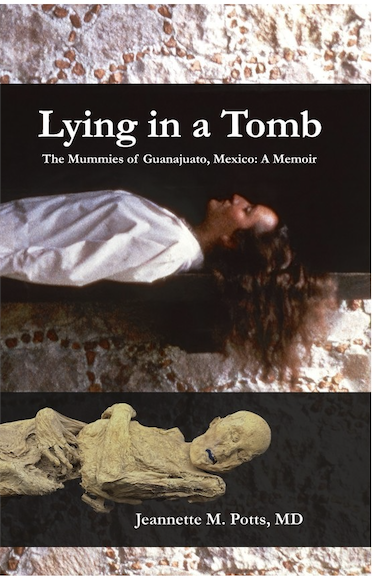
Introduction
The grave diggers told me about partially mummified bodies, hands, and arms that weren’t good enough to save for the museum. They cremated them in the open fire that smoldered in the corner of the cemetery.
I could see two boys playing with the coals. One held what appeared to be a smoked-stained femur, while the other reached for the top piece of a skull. Baseball? I wondered.
And so began what was supposed to be a one-year research project as an international postgraduate fellow. Chosen from among the top Fulbright recipients, I was awarded a lucrative grant from International Telephones & Telegraphs to study the mummies of Guanajuato, a colonial city in central Mexico.
Over the past century, mummified bodies were discovered during routine exhumations and exhibited in one of the city’s biggest tourist attractions, El Museo de Las Momias. But no one knew why the dozen or so bodies discovered each year since 1870 were so well preserved, unlike the majority of remains sepulchered in the same cemetery. It was 1983, I was 21 years old, capitalizing on my maternal Mexican heritage, satisfying my wanderlust, and naively believing I could uncover the cause of the accidental mummies. Compassion, scientific methodology, and youthful zeal, I thought, were no match for tradition, customs, and laws.
Besides the understandable insularity of the community, especially in protecting their dead, I was also confronted by superstition. I learned to tread lightly so as not to conjure fear or suspicion. At times, I became
afraid of the way some people interpreted the time I spent at the cemetery or the museum. I would be considered a witch or someone who is perversely fascinated with the dead. I had recently learned the word “necrophilia.”
One afternoon, I balanced between the dirt wall and a large empty tin can, once containing jalapeños in vinegar, to obtain soil specimens at various depths of a gravesite. As I twisted and bent to reach a lower level with my trowel, the can shifted and I fell to the bottom of this rectangular hole. Every molecule of air was forced from my lungs when I fell onto my back. I can still recall this unique perspective: the deep blue of the zenith, exquisitely framed by the smooth, nearly 2-meter-tall murals of soil. On this very hot day, I felt suddenly refreshed by the coolness and humidity.
If not for the realization that I was lying at the bottom of a grave, and the thought that perhaps this wasn’t an entirely “fresh” excavation, I might have rested for a moment. I dug a small hole in the side of the wall, about halfway up, for one of my feet. I straightened the can and balanced on top with my left foot while holding the ground with my hands. After my right foot found the hole I had made, I was able to climb out of the grave. A bit shaky, I called it a day and walked to the main entrance, where only then I encountered a worker. I rode the bus home, ran to our house, and stripped at the doorway, eager to wash the experience away.
Shortly after this episode, I learned that nearly every mummy had come from a crypt and not from the ground. Studying the soil proved useless. But at least I have had the unique experience of lying in a tomb. Little did I know that this modern anthropological adventure would teach me about culture, religion, misogyny, medicine, and psychology. There were also painful challenges, including a loss of innocence and an epistemic shift in my sense of self. Up until this time, I had naively believed that people of my parents’ generation were more honorable, trustworthy, and ethical. My parents raised me within an insular delusion of moral superiority afforded by Catholicism, stay-at-home mothers, and the modern conservative’s misogynistic definition of family values.
19
Lying in a Tomb
Falling into a grave.
Photo by author, November 2024.
20
This book is a collection of stories, a patchwork of memories that are part autobiography, cultural observation, and scientific exploration. I learned what it meant to fall madly in love—with an emphasis on “madly” —and to navigate controversy while maintaining my objectives.
David Bowie once said, “Confront a corpse at least once. The absolute absence of life is the most disturbing and challenging confrontation you will ever have.” (https://www.esquire.com/ entertainment/music/news/a41108/david-bowie-what-ive-learned/)
I had been confronting the corpses on display at the museum since my teenage years, when I had visited Guanajuato with my family for the first time. And before this, I had said goodbye to my dead grandfather. I was 12 years old when we walked next door to pay our respects to my grandfather, who had just passed away in his bed, in the front bedroom of his home. My grandmother slept in a separate room in the back. After the caretakers took his body, she and I changed the sheets on the bed so that I could sleep there that same evening, so she would not be left alone. I loved my grandfather, but did not feel disturbed or challenged by seeing him, lifeless, in his bed. I am most surprised, however, at the normalcy with which I slept in the very same spot in which my grandfather had died the same morning.
I did not feel the weight of Bowie’s words until many, many years later. I feel conflicted about the research I had begun and the way I have continued to observe and evaluate these once-living vessels.
I still marvel at my younger self, so curious and capable of compartmentalization, yet so oblivious and blind to obstacles and even warning signs. For decades, I felt embarrassed that I had been unable to bring this study to fruition. There was a sense of obligation about recording something- anything- on paper, about the few things I had learned. However, separating the research from the existential romance that had also taken place posed a challenge—or perhaps an excuse—for this prolonged procrastination.
21
Or I am no longer willing or able to contain the secrets I expose in these pages—a patchwork of experiences and memories, thematic and episodic, an anthropological and autobiographical collection of short stories woven in a loose chronological order.
Welcome to my story.
22
Chapter 1:
The Mummy Questions
Madonna, “Borderline”
I arrived to Mexico to begin my post graduate research
as Madonna debuted her first record in 1983.
Listen at https://Obsidian.Press/Music
Using a more rigorous definition, the mummies of Guanajuato might be described as desiccated corpses created because cemetery workers deliberately did not preserve them. In Guanajuato, as in most of Mexico, bodies are not embalmed. The term “accidental” also seems appropriate, since observers consistently noted that only 3–5% of the cadavers interred at the Panteón de Santa Paula became mummies. Since the discovery of the first mummy in 1870, cemetery workers have unearthed roughly one or two each year, often after nonpayment for a crypt led to the tenant’s “eviction.” Most often, they cremated the remains, but when they discovered the bodies intact, they stored them in the ossuary. The actual incidence is a crude calculation based on the number of exhumations that would take place, as well as the occasional discovery of mummified remains when cemetery workers opened an occupied crypt to inter another family member, provided the designated 5-year period had elapsed since the previous burial.
The first time I saw the mummies, I was in high school on a family vacation. The experience left me more curious than horrified. A few years later, during college, I created an independent study in anthropology to address the questions surrounding the how and why of this phenomenon.
Because the mummies had existed for more than a century, I assumed that scholars had long ago answered my questions and that my study would involve compiling these facts.
23
Crypts at the cemetery. Photo by author, November 2024.
24
The Mummy Questions
During my extended visit in 1982, it became clear there had never been a scientific study of the mummies. And yet, I seemed to be surrounded by “experts.”
“Everyone knows it’s because of the minerals and gases contained in our unique soil,” explained one professor at the University of Guanajuato.
“It’s the intense heat within the crypts, it’s quite simple,” described another, with much condescension.
“It’s a curse!” exclaimed another.
When I inquired about the incidence or process of mummification, I hoped for data or resources—but more often, I heard tales of the supernatural.
A scan of Mustafa’s photograph entitled, “The mirror of the soul.”
25
The receptionist for the museo at the time was Ramon Juarez Mujica, who was also a student at the University of Guanajuato. He understood my frustration but defended the culture: “When one is brought up in an environment such as the one we have in Guanajuato, we grow up with the awareness of spirits and ghosts. It may be that our families made these impressions on us, and because of this, each generation remains as superstitious as before. We learn to see things, and we grow up accepting the existence of [the supernatural] without fear. We learn to co-habitate with spirits.”
I returned to the US to complete my third and final year of college, with even more questions. Captivated by my experiences, a group of professors at Lake Erie College for Women in Painesville, Ohio, banded together to encourage me to apply for a Fulbright Fellowship. These prestigious international fellowships were established in 1946 by Senator J. William Fulbright for postgraduate study abroad, with the intention of fostering peaceful relations and mutual understanding.
I had formulated a comprehensive investigation “to find the cause of natural mummification in Guanajuato,” and felt well-equipped to execute the plan. There wasn’t an angle I had not considered.
Noting the significantly higher number of female mummies and their advanced age, I wondered about an accumulative influence over a lifetime. But one must also consider gender and longevity as a socioeconomic risk factor, as women may be at greater risk of poverty as they age, and they often outlive their partners or others who would be responsible for paying for her perpetuity. However, because the exhibition [only] includes those mummies who were exhumed because of nonpayment, we are confronted with another layer of “selection bias,” which may promote the erroneous assumption that poverty was a predisposing factor.
I pondered the question of environment vs the individual’s predisposition. Environmental factors to be considered included:
• The composition of the soil, mineralogically
• The flora of the soil, Aerobes, anaerobes, and fungi
26
The Mummy Questions
• The source of drinking water
• The climatic conditions at the time of burial • The composition of the coffin
• Cemetery locations
Factors which may predispose the individual to mummification might include:
• Genetics
• Socioeconomics
• Age
• Medications
• Cause of death, i.e., dysentery, dehydration, etc.
• Diet (Tortillas, for example, are created through the process of nixtamalization, thanks in part to the use of limestone.)
While studying at the Université de Caen in Normandy, France, during my winter term of college, my parents telephoned to explain that I had won a special grant. “You were among the top 23 [Fulbright] applicants, so they awarded you a separate and larger grant,” my mother tried to explain. My father added, “And now don’t be getting a big head!” Neither of my parents had graduated from college, but they understood the significance of a financial award.
I was undoubtedly excited but did not understand why I had not won the Fulbright. In fact, I was somewhat disappointed. I had also created a dilemma, as I was only a college junior, and the grant was issued for the following autumn. However, first, I had to complete my courses in Caen, return to the US in the spring, and finalize my graduation.
Upon returning home and meeting with my professors, I learned that I had been wrong to be disappointed. I was awarded an International Telephones & Telegraph Award, as one of only 23 recipients in the country, along with a generous, unrestricted grant. A senior had won a Fulbright and would be heading to Germany. And yet another woman would be studying in Europe with her postgraduate scholarship. Our
27
college president had been using our awards to make headlines across the country for fundraising and recruitment. Of a graduating class of fewer than 100 women, three had earned prestigious postgraduate fellowships! I also felt a twinge of guilt, as my grant was twice the amount of the Fulbright, and unlike the person going to Germany, I was heading to a place with a much lower cost of living.
How did I manage to graduate in three years? Because scholarships covered half of my tuition, and the rest I funded through student loans and work-study, I was determined to economize wherever possible. Upon discovering that the college charged flat tuition rather than a per-credit-hour rate, I added extra courses every quarter to accumulate credits more quickly. I had always secretly intended to graduate early, but the university did not share that opinion.
A board of academics and administrators convened to block my graduation. The consensus at the beginning of the meeting was that I had undermined the tradition of a four-year degree, which enhanced the student’s maturation and protected mental health. With trembling hands, I shared copies of my transcripts with the panel. Nervously, confidently, I stated, “As you can see, the course load had not injured my grade point average nor my well-being... and... I think that there is far greater concern about one less year of tuition payment than there is about me.” A debate ensued. During a brief pause, I injected the ace I had kept up my sleeve, thanks to the celebrity cultivated by the college president’s road show. “If I don’t graduate, I will have to turn down this grant.”
I immediately contacted my beloved abuela and invited her to join me. It was my way of reciprocating all the pampering and indulgences of my childhood.
As soon as I arrived in Guanajuato, generously funded and accompanied by my personal concierge and chef—i.e., my abuela—I introduced myself to the authorities and began visiting the civil registry. I befriended the cemetery workers and grave diggers, making my rounds several times a week. I attended burials and exhumations.
28


Comments
Sections of this are set out…
Sections of this are set out like excerpts from an academic paper or a thesis rather than an engaging true story that needs to really grip the reader from the outset. Work on presentation and style to elevate this to another level.
Absolutely fascinating,…
Absolutely fascinating, great subject, and really well handled. Bravo.
The manuscript features…
The manuscript features engaging writing and strong storytelling that keeps the reader invested. The narrative flows well and creates an immersive reading experience.