

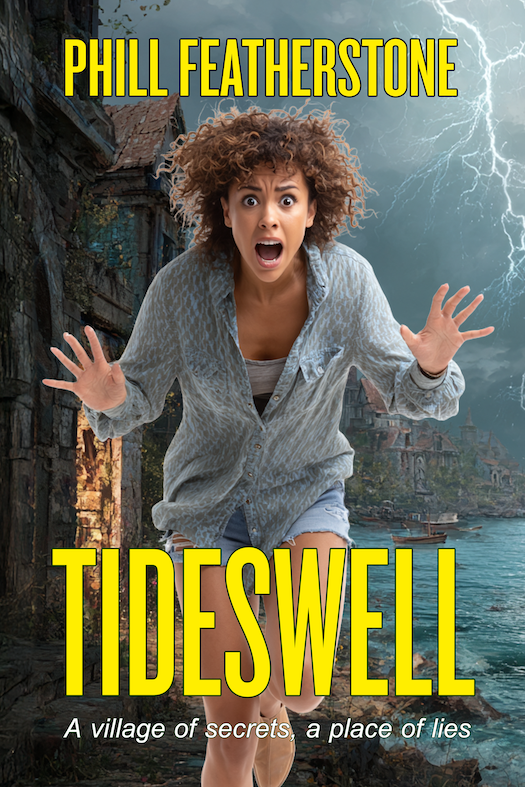
Chapter 1: Arrival
One year, two months and four days. Alice has never been close to her sister, but she knows exactly how long it has been since she disappeared. She’s been avoiding the trip to Tideswell in the hope that something might happen, but it never has, and now she can put it off no longer.
Her phone rings, elbowing aside the track that’s playing on the car stereo. She glances at the info screen and sees a familiar number.
‘Hello, Mum.’
‘Hello, love. Are you there yet?’
‘No, not quite. I’m still on the main road. I should be at the Tideswell junction in a couple of miles. It won’t be long after that, just a few minutes down the road to the village. How are things?’
‘They’re fine.’
‘And the boys?’
‘They’re fine, too.’
‘Stephen’s got PE today. Did you remember his kit?’
‘Of course, dear. I’m not a moron.’
‘Sorry, Mum, I didn’t mean that the way it came out.’
‘That’s all right, dear. There is one thing, though. Michael was a bit tearful when I took him to school this morning. He wouldn’t say why. I looked for his class teacher, but she was in the staff briefing. I’ll try to get a word with her when I drop them off tomorrow.’
‘Oh.’ Alice is concerned. Is he being bullied again? It’s happened before, and if it’s started afresh she expects it’s the same culprit, Ben Ratcliff. She hopes it’s not all flaring up once more, the bed wetting, the pretend sicknesses, the reluctance to go to school. She can’t deal with that on top of everything else. ‘Can you let me know how you get on?’
‘Of course, dear. Don’t you worry. You’ve got enough on your plate. Clearing out our Holly’s cottage is enough to take on for now. The last time I was there, it was a tip.’
‘Yes. I’m not looking forward to what I might find. My sister was never the tidiest of people.’ Her mother says nothing, but Alice can sense her sadness. ‘She might come back, you know,’ she says. ‘There’s always a chance. She could be there when I walk in, pottering around with her paints.’
Both of them know that after all this time, neither of those things is likely to happen.
‘Look, I’m nearly at the junction,’ says Alice. ‘Can you call me later when you’ve seen Michael’s teacher? And give both the boys hugs and kisses from me.’
‘Of course, dear. I’ll be in touch as soon as I’ve got some news. And you make sure you get a good night’s sleep.’
‘I’ll try.’
‘There’s a storm forecast for the East Coast, a bad one. It said on the TV that there’s a red alert. And house clearance is hard work. You’ll need all your energy.’
She knows that’s true. She’s not looking forward to the next few days, but she wishes her mother wouldn’t worry so.
‘Thanks, Mum. Love you.’
‘I love you too, dear. Take care.’
The call ends just as the junction for Tideswell comes into view. Alice flicks the indicator and waits for an oncoming truck to pass. Then she turns onto the single-lane track that leads towards the village and the sea.
The afternoon sun behind her throws shadows across the fields. She rounds a corner to see a tractor coming towards her, filling the narrow road. The driver isn’t prepared to make any concessions to a stranger, and the only passing place is the gateway to a field. Alice tucks her car in as far as she can. The tractor is an old machine, filthy with mud and towing a trailer full of slurry. It misses her wing mirror by millimetres, and flings mud and manure from its wheels, splattering her small car. She swears. She’d been through the car wash only that morning, and now it will need doing again. A sheep gazes gloomily at her through the gate. Recently shorn, it looks cold and abandoned.
‘You and me both, sweetheart,’ she says to it. She slips the car into gear and pulls out onto the road.
Tideswell. She’s always thought the name had a poetic resonance, but any poetry the village may have once possessed has long gone. She used to love visiting her grandmother there when she was a child, and would look forward to it for weeks. Playing on the beach, splashing around in the sea, getting treats in the holiday shops–it had all been heaven. But as she moved into her fickle teens she’d gone off the place. It was too quiet. Nothing happened. There were no boys. It was dull. It was boring. Tideswell held nothing for her, and like many of its inhabitants, she abandoned it.
She reaches the cottage and parks her car in the tiny yard. The space between the car and the cottage wall is tight, and there isn’t much room to squeeze herself through. She reflects ruefully that a movement like this used to be much easier. A sedentary job and comfort snacking have taken their toll. She looks down at her jeans, now smeared with tractor mud and worse. No matter. They’re an old pair she’d chosen because of the cleaning. She’s managed to avoid getting the mess on her quilted jacket, which is new.
She scans the front of the house and feels in her bag for the key. The name on the door says Lilac Cottage, but there’s no lilac in the garden, and Alice has never seen any near. The front door has been painted lilac, but it’s peeling and looks uncared for. So do the window frames. The whitewash covering the masonry is shabby. There’s a rectangle near the door that has been recently repainted and is smarter than the rest, and Alice wonders why, when that was done, the remainder was left in its sad state. She desperately hopes that the Estate Agent will be able to sell it. She needs the money.
There’s a light on in an upstairs room, but that means nothing. It’s one of a pair she set up on time switches the last time she was there, to deter intruders. Not that there’s much chance of burglars here. The fact that nowadays Tideswell has so few inhabitants means there’s little crime, and any robber worth his or her salt would realise a three-mile drive from the main road to a dead village is unlikely to be worthwhile. As well as that, the cottage itself isn’t inviting. It looks poor. A drainpipe is coming loose, and the roof is covered in moss. It should be easy to tell that there’s little of value here.
She flips open the boot of her car, lifts out her holdall and a small bag of tools, and unlocks the cottage door, pushing it against the wave of junk mail accumulated behind it. She kicks the heap aside with her foot. It’s over a year now since her sister disappeared, and the cottage has been empty for all that time; she can’t believe that this rubbish is still being delivered.
She keeps her coat on, because although it’s May, the cottage feels cold. It also smells damp. It’s definitely worse than when she’d last visited it a few weeks ago. Besides the musty smell, there’s another whiff. Mice? Something decaying? Alice is sensitive to bad odours. She sniffs and looks around, but can see no obvious cause. She goes to the cupboard under the sink where there’s an air freshener, and releases several generous bursts from the aerosol. She recalls seeing some scented candles in a kitchen drawer. She takes one out, finds some matches, and lights it.
The stench addressed, it’s now time to deal with the temperature. Even though the day has been sunny, the old walls seem to radiate chill. She pulls her jacket around her, goes back to the kitchen and turns on the central heating. She congratulates herself that she’s remembered to top up the pre-payment cards for both the gas and electricity meters before leaving home. She lights the gas fire in the small, cluttered sitting room and then fetches the mail.
There are only two items that look important. One is a council tax statement. It’s addressed to the owner/occupier, even though Alice had notified the council a long time ago that the tax was now her responsibility and had given them her name and address. The other is a demand for payment for water. There’s no water meter at the cottage, so the water company is charging a flat rate. The place hasn’t been lived in for a year, and the sum it’s demanding is unfair. She’ll have to query it. She sighs at the thought of a long wait on hold, and then a conversation with someone who either doesn’t understand the situation or lacks the authority to do anything about it.
She looks at what’s left and feels a resigned weariness. What are the chances of ever being able to combat climate change and get waste and consumption under control if businesses continue to bombard people with this litter? Junk mail is an apt term for it. Most of the pile is from companies in Brunton Cross, the small town a few miles inland. Pepe’s Pizza Parlour is offering a two-for-one deal. The BC Players are advertising a production of The Importance of Being Ernest, but the date was over a month ago. There’s a menu from a Chinese restaurant, with the suggestion that an order through Uber Eats would get priority treatment and attract “special prices”. Specially down, or specially up? Alice wonders. She turns over a discount coupon from a hairdresser, a flyer from a garden tidying and landscaping business, a leaflet from a painter and decorator, and a mail-order catalogue for “household essentials”. She flicks through it. Plant sprays, foot spas, stain removers, nostril tweezers; how could anyone live without these things? There’s nothing from Tideswell village, which isn’t surprising. There are no businesses here anymore, not even a shop. She throws the lot into a box for recycling.
There is just one item left. It’s a postcard, a photograph of a serious-looking, silver-haired woman wearing what appears to be Victorian costume – a black dress with a tight bodice and taffeta sleeves – and an elaborate headdress. Smoke swirls around the lower half of the image, over which is written “Madame Tabitha, clairvoyant and medium”, followed by a phone number. Not your average junk mail, thinks Alice. Are the people around here so desperate that they go in for this sort of stuff? Do they believe that Madame Tabitha can predict the winning lottery numbers for them?
She turns the card over. On the other side is a simple message.
It is time. Come to me now.
Intrigued, Alice studies the photo again. The woman certainly looks impressive. She wonders how many of the people who have received the card have been fooled by it. She takes another look, then drops it into the recycling box with the rest.
It’s time to get on. It will take several days to clear out all of Holly’s things, so she’d better make a start now. She picks up her holdall and climbs the stairs. There are three bedrooms, but beds in only two of them: what had been Holly’s room, and a spare. At some point in the past, half of the spare room has been converted into a bathroom. What’s left is tiny, barely big enough for a single bed and a small chest of drawers. However, that’s where Alice will sleep. She doesn’t want to use her sister’s room. To do that would be to accept that Holly is not coming back. Although deep down Alice is by now sure that’s true, to take over her room would be affirming it, and she can’t do that.
The remaining bedroom is the largest, and that’s the one Holly has converted into her studio. When she looks in through the door, Alice’s heart sinks. The walls and floor are splashed with paint, and around the edges of the room are canvases, some finished, some partially worked, and some untouched. A well-used easel sits in the centre, and propped on it is a sheet of hardboard, primed and waiting. There’s an old table loaded with brushes, paints and several palettes, and a set of shelves struggling to support untidy stacks of sketchbooks, pencils, charcoal, papers, and magazines. On the windowsill is a worn-looking box file. Beside it is a noticeboard so crammed with cuttings that it’s impossible to take in any of them.
What to do with all this stuff? It will take ages to clear it out, but it will have to go before the cottage can be put on the market. The Estate Agent hasn’t seen the property yet, but his response to Alice’s phone enquiry had been unenthusiastic.
t would not be an easy sell, he warned her. That was what she expected. Tideswell is not what it once was. Why on earth did Holly ever want to live here?
Chapter 2: Storm
The noise when the window blows out shakes the cottage and has Alice leaping out of bed before she can think. It came from her sister’s empty bedroom. She rushes across the landing to the door. She needs to push hard to force it open against the gale, and as she staggers in, it slams shut behind her. She feels for the switch on the wall and takes in the damage.
The problem is obvious, and so is its cause. The casement window has been ripped open by the wind, wrenched backwards to hit the outside wall and then slapped back into its frame. This shattered the glass, which lies in shards on the floor, on the windowsill, and across the bed.
Alice clenches her fists and swears loudly. ‘Jesus!’ Her mother had said there’d be a storm, but she didn’t expect anything like this. There’s a pair of her sister’s trainers beside the bed. They’re too small, but she forces her feet into them. The soles are thin and the fragments of glass savage, so she steps cautiously as she moves towards the window. The wind is a monster attacking the house, charging the walls, battering the doors and windows and howling around the gable. It has broken the window and now it ransacks the room. With nothing to stop it, the rain blasts in. Alice shivers as the icy spray hits her, but she grits her teeth; something must be done, or the room and everything in it will be ruined.
She reaches for the casement, but the wind will have none of it, and she feels a sharp sting as the frame is wrenched from her fingers. She sucks them, tries again, grabs the frame with her other hand, and manages to wedge it shut. The catch couldn’t have been properly fastened, and the storm’s pounding has shaken it loose. Sloppy, and typical of her sister to leave it like that, she thinks.
She stands in the gap made by the missing glass and feels again on her face the slap of the squall. Rain is soaking everything. It has to be stopped. At least she’s had the sense to include a few tools in her luggage and to bring them in from the car when she unpacked.
She leaves the bedroom and goes down to where she dropped her toolbag in the kitchen. Her hand is weeping blood, but she doesn’t have time to deal with it now. She wipes it on her nightdress. The Lady Macbeth look, she thinks. What does it matter? Who cares?
She gets a hammer and some tacks and runs back up the stairs. She remembers that on the easel in her sister’s studio is a rectangle of hardboard, primed and ready for a painting. It won’t be needed for that now, but it could serve as a stopgap replacement for the window. If the rain continues like this, the hardboard won’t last long, but it will at least provide some protection, and maybe keep the worst out until the storm has run its course.
Nailing the hardboard in place isn’t easy. Alice’s right hand won’t stop bleeding, and the cut is now throbbing. Holding the board across the casement, positioning the tacks, and driving them in with the hammer is a challenge. She could do with another pair of hands. She could use Holly to help. But of course, if she had been there, Alice wouldn’t have needed to come to the cottage in the first place.
She manages to fix the hardboard, goes to the bathroom and bathes her damaged palm. She presses the wound, raises her hand above her head, and holds it there. The bleeding stems. She has no plasters, so she wraps the wound in a flannel. Then she goes back to her room. She doesn’t lie down. She’s fearful that her repair might not last the night. She hasn’t slept, and now she knows she won’t.
She bundles herself in the duvet, and with her elbows on the windowsill, looks out towards the sea. The rain batters the window, hammering the glass. She hopes this one doesn’t go the way of the other. After a while it stops, but the wind is still seeking out the cottage’s weak points, looking for an opening to attack. A sullen moon, almost full, pierces the gaps in the racing clouds, and Alice can see in the bay towering waves, with curtains of spray exploding against the breakwater. At one stage a dustbin, preceded by its lid and spewing its contents, hurtles down the road past the cottage. The wind is so loud she scarcely hears the clanking racket.
‘Well thank you, Tideswell,’ she thinks. ‘What a welcome.’
That, as it turns out, is only the start.


Comments
Interesting start. Great…
Interesting start. Great descriptions of the house, both inside and out, and the reader can feel how tired and resigned she is.
Thank you
In reply to Interesting start. Great… by Jennifer Rarden
Thank you for taking the time to read my work and for the feedback. I appreciate your comments and am delighted.
And we do really feel it's…
And we do really feel it's just the start: exactly what an excerpt like this should achieve by the time it ends. The set up is great and the writer holds back just enough exposition to keep us fully engaged without becoming satiated. The mystery of what's happened to Holly - even though we already have a sense of who she is - is carefully denied us. And so it should be. An excellent start to what promises to be an intriguing tale.
Thank you
In reply to And we do really feel it's… by Stewart Carry
Thank you for reading this extract. Your comments have made my day!
The story has an interesting…
The story has an interesting start. The dialogues feel realistic and help the characters come across naturally. The narration flows well and supports the scene effectively. A round of editing can polish the work further.
Thank you
In reply to The story has an interesting… by Falguni Jain
Thank you for reading the opening of Tideswell. I appreciate your feedback. It has been edited, but I take on board your advice that it needs more.