

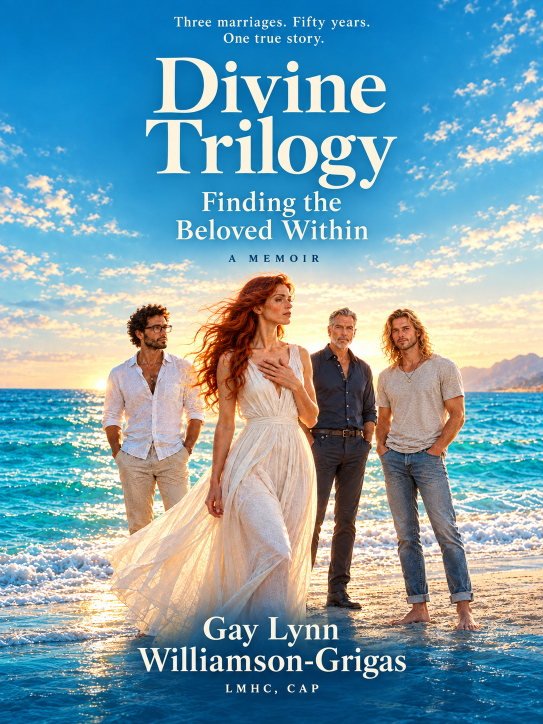
Divine Trilogy: Finding the Beloved Within
Introduction – The Fifty-Cent Dress and the Beloved
At seventeen, I was supposed to be a nice, sensible girl from a blue-collar home. On paper, I mostly was. I got good grades, babysat the neighbor’s kids, and came home to a steady house where my dad—my original Dave—worked as a firefighter, believed in hard work, God, and the power of a few worn-out books.
But my real inheritance wasn’t money. It was a stack of ideas I wasn’t sure were true.
My grandfather had passed The Secret of the Ages to my father—a thin set of volumes by Robert Collier about Universal Mind and the quiet belief that ordinary people could tap something bigger than themselves to change their lives. My dad slid those same books to me, along with Dale Carnegie and How to Sell Yourself to Others, and basically said, “Here. This is what I’ve got to give you.”
I was thirteen, sitting on my bed with babysitting money in one hand and Collier’s promises in the other, trying to figure out if any of it worked. Could a girl whose dad fought fires and whose mom stretched every dollar really “open up the channels” to some Universal Mind and change her life—or was that just grown-up fairy tale?
Still, I took the books seriously. I taped affirmations to the back of my bedroom door:
“You can do anything.”
“You know the answer.”
“Open up the channels between your mind and Universal Mind.”
Every night before sleep, I read them like secret instructions. While my friends practiced cheerleading routines, I practiced imagining a different future—using words in a book instead of a bank account. It was innocent and a little desperate: If this isn’t real, what is my way out?
Our life stayed simple. My dad worked long shifts at the firehouse. My mom made magic out of coupons. College was a dream I tiptoed around, not something anyone could pay for. Then, in my senior year, as graduation crept closer, my parents sat me down and said the thing that made all those books feel suddenly very practical:
“There’s no extra money for college. If you want to go, you’re on your own.”
No savings. No “we’ll figure it out.” Just the truth.
I heard it like a dare and a gut punch at the same time. All the affirmations on my bedroom door fluttered in my mind. If the success books were real, now was the moment. If they weren’t, I was a seventeen-year-old babysitter with no plan.
I wasn’t a trust-fund kid or a legacy student. I was a scrappy, slightly wild girl who’d been quietly training herself to think bigger—and now needed an actual way out. So, I picked the longest shot I could see: the local city-level Miss America pageant, where scholarship money shimmered at the edges of my imagination.
I was an unlikely contestant. No pageant coaches, no designer gowns, no family of means. My parents repeated their line: “Kid, you’re on your own.” So, I did what every broke hopeful girl does—I found a job.
Crowley’s, an upscale department store in the mall, hired me. It paid modestly, but it came with the magic word: discount. I spent my shifts selling to customers and my breaks hunting for pieces that could turn a babysitter from a working-class neighborhood into someone who looked like she belonged on a stage—dresses, shoes, bathing suits, anything the rules required.
The crown jewel of my pageant wardrobe cost fifty cents.
I found a short, sparkling gold cocktail dress in a bargain bin, tagged so low it felt like a misprint. I took it home like treasure. Then I grabbed an old pair of cloth platform shoes and had them dyed to match. That was my talent outfit: fifty-cent dress, reimagined shoes, big hair, and a guitar I’d taught myself to play.
On pageant night, I stepped into the lights and belted out Donna Fargo’s “The Happiest Girl in the Whole U.S.A.”—a country song about a woman who thinks she’s finally found the love that will make everything okay. Standing there at seventeen, I wasn’t singing about a man. I was singing about the hope that some door—any door—might open for me, and that I might not always be the girl counting babysitting cash and reading success books in secret.
Something happened in that auditorium.
This self-made seventeen-year-old in a fifty-cent dress and a borrowed dream touched every heart in the room. I won the talent competition. I won the bathing-suit competition in an outdated suit no one wore anymore but that the rulebook still required. I even won Miss Congeniality—for helping other girls who needed a boost, a dab of makeup, or one last pin to make a dress fit.
I was stunned. So was my family.
In a single night, everything shifted. The firefighter’s daughter with the metaphysical books and the bargain dress walked off that stage with her first scholarship—a modest award from the Roseville Women’s Club, a small group of hardworking women who had never had the chance to go to college and were now funding mine.
They weren’t wealthy donors or pageant royalty in some distant city. They were waitresses, hostesses, managers, mothers—women whose lives looked more like mine than anyone on TV. And yet they were the ones putting their money where my dream was.
A few weeks later, the dream turned visible. I rode down Main Street in Roseville in the back of a convertible, crown on my head, waving at neighbors who’d known me as the babysitter next door. The girl with the fifty-cent dress and the worn-out books was suddenly Miss Roseville, blown hair and borrowed glamour floating over a very ordinary life.
That night didn’t magically solve everything. But it proved something my thirteen-year-old self had been quietly hoping: sometimes, the wild mix of babysitting jobs, bargain bins, worn-out success books, and stubborn enthusiasm can turn a long shot into a real doorway.
The judges saw a girl onstage. I knew they were watching the beginning of a much longer story—one where a seventeen-year-old with big hair and a fifty-cent dress would spend the next fifty years finding out whether Universal Mind, the Beloved, and all those books could actually carry her all the way home.
Chapter 1 – Cleaning Up My Act (and My Heart)
Sometimes the greatest makeovers start with your soul, not your wardrobe. I didn’t know that yet. I thought new clothes, new hair, more sparkle would save my life—would rescue my confidence, my loneliness, maybe even my heart. But no matter how often I changed the outside, the same old patterns kept finding me. It would take three husbands named Dave to make me wonder if the real makeover had to happen inside the girl who kept saying yes.
People always ask the same question: “You’ve been married three times—and all of them were named Dave?”
Yes. Every husband I married was named Dave.
I didn’t have a Dave-only policy. But looking back, it feels less like coincidence and more like a curriculum—three relationships that, one by one, taught me what love is, what it isn’t, and who I had to become to recognize the difference.
Only later did I learn what the name David means in Hebrew: beloved. Three Dave's, three beloveds, each reflecting a different face of love back to me—romantic love, conditional love, love that broke me open, love that nearly cost me myself.
This first Dave appeared not long after that convertible ride, arriving in a blur of disco lights, beauty queens, and bad decisions dressed up as romance.
It’s 1974. I’m nineteen. Life feels simple—unless you count beauty pageants, double dates, and the eternal mystery of why boys can’t say goodbye in under ten minutes.
My date that night is my boyfriend, James. But Dave—yes, that Dave—is there too, dating Miss Detroit.
Beauty queens everywhere. Think Miss Congeniality, but with more Aqua Net.
At the end of the night, James gets a little too comfortable saying goodnight to Miss Detroit at her front door. And by “a little,” I mean long enough for me to wonder if he’s reciting the entire Declaration of Independence.
So, in a moment of equal parts mischief and wounded pride, I turn to Dave and suggest we leave him there.
Dave doesn’t hesitate.
He guns the car down the street while James runs after us, waving his arms like he’s trying to flag down a cab in Times Square. We’re laughing so hard we can barely breathe.
If you ever doubt the power of bonding, try leaving a boyfriend behind together.
James and I break up soon after—or maybe he breaks up with me. Either way, it’s for the best.
Dave, on the other hand, is hard to ignore. He plays in a band, works his way through college, and has the kind of presence that makes even dedicated wallflowers want to dance. I start showing up at the bars where he performs—initially for the music, of course. But let’s just say the lead singer doesn’t hurt.
Looking back, I sometimes wonder if I fell in love with him or with the myth of him. Either way, I was all in.
We’re both in college—he studying business, me in education. We live at home, commute to campus, pinch pennies, and do our best to build something resembling a future. I waitress. He plays rock-and-roll.
Like many couples in that era, we move quickly. Our friends are getting engaged, planning weddings, stepping into adulthood with more enthusiasm than awareness. We follow suit—cheap banquet halls, open bars, and optimism doing the heavy lifting.
Our honeymoon takes us to the Poconos, to Cove Haven, home of the heart-shaped Jacuzzi. Nothing says eternal love like soaking in a tub shaped like a Valentine while surrounded by mirrors and the faint aroma of 1970s romance. Our friends gift us a Kama Sutra kit and a hidden stash of honeymoon marijuana, and we do our best to rise to the occasion.
Somewhere between the laughter, the weed, and the steam, I get pregnant.
Life accelerates after that.
Dave finishes his degree. I drop out and go back to waitressing. We move into a two-bedroom apartment and work opposite shifts, passing each other like ships in the night—communicating through sticky notes and the occasional bleary-eyed hug.
Still, we hold onto the same dream: a home of our own. A yard. A place where family can gather for holidays and milestones, where hard work might finally become something solid.
I scour listings and neighborhoods, walking through tired houses and imagining fresh paint and new beginnings. I believe, with the stubborn optimism of youth, that if we just work hard enough, we can build something better than what we came from.
Dave’s father helps make that dream possible. Using his VA loan, he buys the home we fall in love with, and we arrange to purchase it from him. That house becomes proof of effort—something we saved for, hoped for, and can finally call our own.
We have our first child and begin to feel like real adults. Just before closing on the house, I find out I’m pregnant again. The timing feels almost scripted. We move in, planning a housewarming and a baby shower at the same time, each room echoing with the promise of the baby to come.
For a while, it looks like the story we imagined taking shape: two young parents, one little child, another on the way, and a starter home. We have the house, the growing family, the dream—at least on paper.
But beneath the new paint and fresh carpets, a subtle tension is building.
At first, it’s easy to miss. A suggestion here. An opinion there. A “helpful” correction dressed up as love. Then, slowly, both our mothers begin moving through our marriage like they have voting rights.
Decisions I think belong to Dave and me somehow become group projects. Which job he should take. How we should spend holidays. How to raise the kids. Conversations happen without me. Choices are made before I know there was a choice to make.
It feels less like we’re forming our own family and more like we’re being folded back into theirs.
On paper, we look like a young success story—house, kids, stability. Inside, I am beginning to ache. I don’t have language yet for boundaries or enmeshment. I only know I feel strangely alone in a house full of people.
Chapter 2 – Mother Knows Best… Or Does She?
If you ever want to test the strength of your marriage, invite both your mother and your mother-in-law into the delivery story.
My vision is simple: just Dave and me, awestruck, breathing the same air as our brand-new baby. Dave says he wants that too. But in a twist worthy of daytime TV, he makes a secret pact with my mother. When it’s time to leave for the hospital, he turns to me and says, “Wait, your mom is coming with us.”
My heart drops faster than my hospital gown.
As fate—and hospital policy—would have it, Dave isn’t even allowed into the delivery room for my emergency C-section. So, on Valentine’s Day, surrounded by strangers in scrubs, I give birth. The loneliness is thick in my chest. I had wanted a Hallmark moment. Instead, I get fluorescent lights and a curtain between me and my own body.
Then, as they begin the surgery, the Hallelujah Chorus starts playing.
I ask if anyone else hears it.
No one answers.
While they concentrate on the incision and sutures, I am suspended in awe, hallelujahs swirling around me like a private benediction. And when they lay my daughter against my skin, I am stunned into silence. She gazes at me with ancient eyes, tiny and perfect, heart pressed to heart. In her look, I see both innocence and something timeless—like she has always belonged here.
Even in that holy moment, invisible stories press in. My mother’s restless energy seems to follow us into the room. Yet the music rises above the sterile clatter, insisting on life. Birth and pain arrive braided together. The Beloved is already here.


Comments
Intriguing characters that I…
Intriguing characters that I could really relate to.
I was expecting a manual of …
I was expecting a manual of 'dos and don'ts ' but instead got a riveting and very down-to-earth narrative that comes across as honest and sincere. Everything about this excerpt is thoughtful and conveyed through language that's fluid and laced with humour. A wonderful start.
The manuscript presents an…
The manuscript presents an interesting premise with strong potential to engage readers. The writing is polished and effective, creating a compelling foundation for the story.
Thank you so much!
In reply to The manuscript presents an… by Falguni Jain
Thank you so much Falguni, I am hoping a publisher and agent feel the same way.
I appreciate your feedback!
All the best,
Gay Lynn