

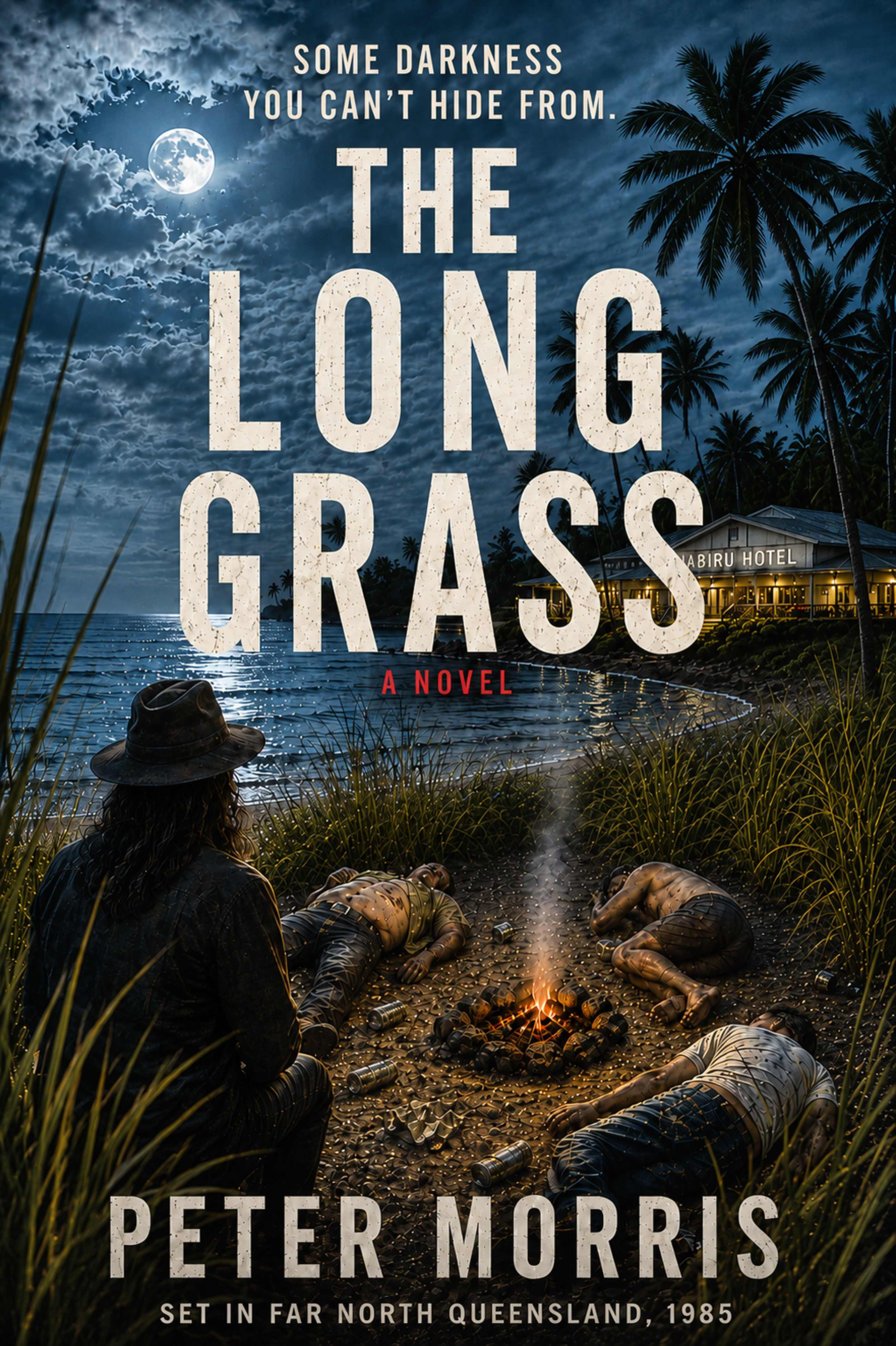
Part One
Chapter 1
Stubby Beach, Weipa – July 7th
Sunday, 3:30 am
1985
The killer walked along the beach, the sound of shells and glass crunching under their boots.
The tide moved in and out with a quiet drag over the pebbled shore. Out past the headland, the Gulf lay flat and still under a cloudless sky. It was the dry season, cool after midnight, bone-dry inland, and clear enough to see stars right down to the horizon. The moon lit the beach in pale silver, picking out broken glass and bleached driftwood. You could smell the salt and the ash of an old fire, and beneath it all, something else… something sour.
Locals called it Stubby Beach, not because of its shape, but because of the bottle shards embedded in nearly every patch of sand. The Jabiru Hotel sat a few hundred metres back, lit up and rowdy earlier, now quiet.
The figure moved slow. Purposeful. A lever-action rifle held casually in one hand, barrel down. Over their shoulder hung a canvas backpack. They carried no torch. They didn’t need one. They’d been here before and anyway the moon provided ample light for their objectives.
They continued to walk through the long grass where the sand gave way to scrub, moving up the slight incline where a thin line of mangrove met red dirt. The smell hit first — piss, sweat, cheap wine, and the wispy smoke of a dying fire. Just ahead, half-hidden in the tall grass, three men slept around a ring of blackened rocks. The embers no longer held a flame, just red eyes staring out from under their own ash. Empty goon sacks lay scattered about. Crushed beer cans were everywhere.
The killer crouched. Waited. Watched.
The first man lay on his side, facing the fire, one arm crooked under his head. His shirt was unbuttoned, stained, belly poking out under a faded tat of a snake curling around a naked woman. He snored wetly through open lips, the sound catching in his throat every few breaths.
The killer moved in… slow, deliberate steps, barely rustling a blade of grass. Stepping over a crushed cardboard goon cask, careful not to crunch it before kneeling behind the man, close enough to smell his sour breath.
From the canvas backpack came the knife. Long. Black-handled. It had an edge like broken glass.
With one hand the killer gripped the man’s forehead and tilted the head back slightly, positioning the man so the cut would send the spray into the dirt away from both of them. The other hand drew the blade in a single, fast, deep arc across the exposed throat. A hot rush of blood fanned out sideways. There was a muffled grunt, a choking bubble, then stillness.
The killer stayed there a moment, listening to the silence settle in again.
The second man — younger, wiry, shirtless — lay curled around a rolled-up towel like it was a lover. His chest rose and fell rhythmically. He hadn’t stirred.
The figure stood, wiped the blade clean on the dead man’s jeans, and stepped across to pick up a large rock — a squat chunk of ironstone, blackened on one side from the fire. Heavy, roughly round in shape. The kind of thing the men had probably dragged over to sit on while they drank themselves stupid.
The killer heaved it up with both hands, staggered slightly, then stood above the sleeping man’s head. One sharp breath, then — CRACK!
The sound was like a dropped watermelon. The man’s skull gave way with a sickening crunch. Blood began to pool around what was left of his head.
The third man stirred. Sat up halfway, bleary-eyed. And then, in a strong French accent, said, “Wot ze fock eez going on?”
The killer already had the rifle up. A click and BOOM.
The shot echoed out across the sand and rocks but was swallowed quickly by the night and the sound of the incoming tide. A single gunshot on Stubby Beach was never going to get anyone out of bed. Somewhere nearby, a curlew let out a long, mournful wail that cut through the stillness.
The killer stood surveying the scene before finally reaching into the canvas pack and pulling out a tightly folded piece of paper. With quiet deliberation, they opened the younger man’s mouth and pushed the paper deep between tongue and palate. The figure stood and kicked the dead man hard in the stomach. They crouched back down and whispered, “Take that to the grave with you, you depraved bastard.”
Three dead men. Three different ways to die. No panic. No rush. Just the faint rustle of dry grass and the soft pop of a dying coal. Eventually, quietly, the killer turned and slipped into the long grass, leaving nothing behind but death, silence and smoke.
Chapter 2
The detectives
Monday July 8th
The Fokker Friendship vibrated steadily as it pushed through the sky, the sound of its engines settling into a low, relentless drone.
Propellers buzzed just outside the thick glass windows, blurring the horizon where dense bush met the endless blue of the Gulf. The air inside the cabin was close, a light smell of aviation fuel, sweat, and the faint tang of someone’s egg and lettuce sandwich.
Detective Inspector Dave O’Reilly sat in the second row, briefcase open on his lap, the sound of the Fokker droning in his ears like a swarm of bees. At forty-five, he stood six-two, built solid from years of Rugby League football — once a back-rower for the Valley Diehards. His short-cropped salt-and-pepper hair was kept neat, sideburns trimmed, face clean-shaven. Piercing green eyes sat beneath a heavy brow. His pale Irish complexion had been burned too many times under the Queensland sun and was starting to go leathery. A square chin gave him a handsome look, spoiled only by a nose that had been broken once or twice on the paddock. He carried himself with a dry humour that people often missed if they weren’t tuned in, and though age had tempered the “bull at a gate” streak he’d once been known for, he was still not a man to be pushed. If it came to that, he was the sort of bloke you’d rather have on your side than against you.
Inside the case, a single mugshot — the only one of the victims they’d been able to get a possible ID on so far. He was the only one of the three carrying a driver’s licence. Name, Gary Hennessy. Forty-two. Two-time loser. Mostly drunk and mostly harmless. His throat had been cut ear to ear.
The other two? No names yet. One apparently had his skull smashed in with something heavy — a rock, according to the local Sergeant’s report. The third had half his face blown away. IDs would take time. Maybe fingerprints, maybe dental, if they were lucky.
He flipped through the contents again. No crime scene photos yet — those were still being processed back in Cairns, along with the fingerprints taken from the bodies. If everything went right, he'd have them by tomorrow. For now, all he had to look forward to when he arrived in Weipa were half a dozen grainy black-and-whites. The snaps were taken by one of the local uniforms with a cheap instant Polaroid.
O’Reilly leaned back, the seat creaking under him. He stared out at the Gulf, then down at the sea of red earth below, carved with thin pale scars — mining roads, bush tracks, and bone-dry creek beds.
Weipa wasn’t an easy part of the country to get to. Most people didn’t even think of Queensland as having a west coast, but it did — and Weipa sat right on it, about three-quarters of the way up, tucked between two croc-infested rivers: the Mission to the north and the Embley to the south. Out the front stretched Albatross Bay, a wide sweep of tidal flats and muddy water that fed straight into the Gulf of Carpentaria.
There were only three ways in. From the south, a rough bush track the locals had the audacity to call a road — it was more of an inland sea during the wet season than it was a road. By boat, a long haul around the Cape. Or by plane, which was by far the quickest, and for most people, the only practical choice.
After reading through the initial report, written by the local Sergeant in Weipa, he shut the briefcase and rested the folder on top of it. He hated not having all the pieces. Hated arriving blind. But thanks to a couple of high-profile murders and an arson in Cairns, they decided to send himself, plus a Detective Sergeant and a rookie detective from Roma Street CIB in Brisbane. Apparently not much happening at the moment in that part of Brisbane. Bullshit. They just wanted him out of the way for a while. What was it they reckoned? That he had PTSD? PTS fucking D, whatever the bloody hell that’s supposed to mean.
Three men murdered in a place like Weipa? Sure, it was a rough town — always had been — but this? This was something else. Even by Weipa’s standards, it was a step too far. And somewhere in the back of his mind, a quiet voice asked the question he already knew the answer to: would the same urgency have been shown if the victims had been black fellas instead of white?
O’Reilly rubbed a finger along the bridge of his nose. He was already sweating in this so-called air-conditioned tin can. Fuck the tropics, he thought.
Outside, the clouds parted for a bit and revealed the red scars of more mining roads below — gouges through the bush, carved straight as a ruler through the wild. Weipa was close now. A company town surrounded by crocodiles, red dirt, bauxite and a shitload of people trying to get away from their former lives.
He handed the thin folder across the aisle to Mollison.
“Have a flick through this before we land. Not much in it, but it’s something. Bugalugs behind us has already memorised it, footnotes and all.”
Detective Sergeant Annette Mollison barely looked up as she took the folder from O’Reilly.
She was thirty, five-eleven, tall for a woman, with mousy blonde hair pulled back in a tight bun. She was striking in her own way. Not pretty, exactly. She was more distinguished, if that’s even a thing.
She wore jeans and a loose white top, perfect for concealing her choice of sidearm, a Smith & Wesson Model 36, the ‘Chief’s Special’. From a shooter’s point of view, she preferred the Model 10 — more reliable, more accurate — but for concealed carry, especially on a field job like this, the lighter snub-nose was the practical pick. At half a kilo lighter than the Model 10, it was ideal for long days and warm nights.
She also carried her personal favourite, a weapon that had nothing to do with department issue. Tucked away in a specially made handbag holster. A Browning Hi-Power 9mm. The Browning rode heavy in her bag. Heavier than most things she carried, not just in weight, but in memory.
It was a gift from her dad. He had served with the Royal Ulster Constabulary during the early 1970s — Belfast, Derry, the thick of it. The pistol had been his sidearm during the worst of the Troubles, and when he moved to Australia, he brought it with him, legally or otherwise. He’d taught her how to strip and clean it by the time she was twelve. “She’s not pretty, she’s not forgiving, but she might just keep you breathing.” She smiled as she remembered him telling her this on more than one occasion.
The voice behind her started up again, crisp and over-enunciated.
“The homicide rate in remote communities is statistically higher during the dry season. There’s a theory about heat and aggression thresholds.”
Mollison closed her eyes. Warwick Wilson was clearly still awake.
Warwick hadn’t stopped talking since take-off. Aircraft mechanics, the psychology of serial killers, rainfall averages for the Cape. The man had a trivia-stuffed brain and no brakes on his mouth.
He wasn’t a bad bloke, just offbeat. Precise to the point of painful. Always corrected people, never read the room.
He’d come through the academy as a cadet. One of those kids who’d done Years 11 and 12 on-site, too smart for his own good but with all the social grace of a border collie in a library.
His reports were flawless. His recall was photographic. But put him in a room full of ordinary people and most were just looking for the door.
Warwick thought they’d sent him north for the experience. Mollison and O’Reilly knew better.
He was twenty-eight, six foot tall. He looked a bit like Clark Kent but without the muscles — thick black-rimmed glasses, pale, neat to the point of obsession, and still somehow managed to look like a kid in a candy shop. His shirt was always tucked in, his shoes always polished, and he carried himself like someone who had memorised the Police Manual cover to cover — and took it literally. He wasn’t cocky. Just… out of sync. Like he was wired a little differently.
He finally paused from his info ramblings and took a breath before saying, “I suppose, like me, you are trying to work out why these guys were sleeping rough?” He said this while looking over at his fellow detective as she read through the folder.
Annette Mollison was one seat forward and across the aisle from Wilson, manila folder open in her hands. She didn’t look up and decided to ignore Wilson’s question.
O’Reilly decided to give him an answer.
“They call it sleeping in the long grass up here,” he said, not looking back. “Some got nowhere else. Some reckon they prefer it. The heat, the mozzies, the grog… it messes with your head after a while. Locals call it ‘going troppo’.”
Warwick blinked. “You’ve worked Far North before, sir?”
O’Reilly finally turned around and looked at him, eyes pale and tired.
“Once.”
He didn’t elaborate.
“Inspector,” asked Wilson before pausing and adding, “why are we up here?”
“Because humans can’t fly without assistance,” replied Mollison before O’Reilly could answer.
“Oh that’s funny,” said Wilson, “and a very good comeback. But you know what I mean. Why did they send a team up from Brisbane for this? Why not grab someone closer from Cairns or Townsville?”
“Too much shit happening at the moment in Cairns,” said O’Reilly, “and I don’t know why they didn’t consider Townsville, but I do know why I’m here. As to why you two are here…” He paused before saying, “Just lucky, I guess.”
The engines whined as the plane began to descend. The light outside turned orange, gold bouncing off the Gulf as it tilted beneath them. Weipa glimmered in the distance, a cluster of buildings clinging to the edge of wilderness.
O’Reilly was thinking about the three uniforms from Cairns who had already been sent in the day before to secure the scene. He could only hope they wouldn’t be totally useless. He’d know soon enough.
The pilot’s voice crackled over the intercom.
“Ladies and gentlemen, we’ll be touching down in Weipa in approximately ten minutes. The current temperature is a balmy 31 degrees. Please remain seated with your seatbelts fastened.”
Mollison handed the file back to O’Reilly, who took it and placed it back in the briefcase and clicked the latches shut. His hand lingered on the handle, then drifted to his wrist. The watch was old, battered and reliable, the same one he’d worn through one divorce, three stations, and until recently, too many late nights at the pub. It ticked on, indifferent to the world around it. It was just past 2:15 p.m.
Outside, the ground was rising fast.
Chapter 3
Welcome to Weipa
Monday 2:30pm
The mid-afternoon sun bounced off the tarmac in ripples as the trio stepped down from the Fokker Friendship. Supposedly the dry season but compared to Brisbane it felt like someone had wrapped a warm, wet blanket around them.
O’Reilly led the way across the short walk to the terminal, little more than a corrugated-iron shed with a row of plastic chairs and a faded, hand-painted Welcome to Weipa sign above the doorway.
Inside, a bloke in stubbies and thongs wheeled their luggage in on a battered trolley and parked it beside a low wooden bench. The detectives claimed their bags in silence, the ceiling fan overhead doing bugger-all to move the thick air.
Wilson looked around. “Doesn’t look like we’ve got a welcoming party,” he said, voice clear and matter-of-fact.
“Maybe they’re outside practising their surprise faces,” Mollison said dryly.
O’Reilly shot her a sideways glance. Alright, he thought, so she does have a sense of humour.
Outside, a white Toyota Land Cruiser Troop Carrier with police markings sat near the edge of the gravel lot, dust-caked and sun-faded. A thin curl of smoke rose from a cigarette being held by Senior Sergeant Mike Carter.
Carter was a stocky man, five-nine or maybe five-ten, the kind who looked anywhere between thirty-five and forty-five but was probably pushing the top end of that range. His skin was tanned and leathery from years in the sun, his deep blue eyes set in a face that said he was not a bloke to be trifled with. Barrel-chested, solid through the shoulders, he wore the standard Far North Queensland police rig — khaki shorts and shirt, a pair of well-worn desert boots, and a sun-bleached Akubra tipped low. Light brown hair showed under the brim, streaked lighter still by the Cape York sun. On his hip sat a police-issue Chief’s Special in a scuffed leather holster, the grip dark from sweat and years of use.
He leaned against the front quarter panel, one boot propped up, a Winfield Red burning between his fingers. He carried himself like a man who’d been out here too long to be rattled — blunt, watchful, with a voice that carried the flat bark of someone used to being obeyed. As they approached, he flicked the smoke into the dirt, crushed it under his heel, then stepped back, swung open the rear barn doors of the Troopy with a clatter, and waved them over.
“Inspector?” he barked.
“That’s me — Dave O’Reilly.” O’Reilly took the extended hand and said, “Good to meet you.”
“Senior Sergeant Mike Carter. Welcome to bloody paradise.” The look on his face suggested he meant the opposite.
“You want the front seat or would you prefer your secretary up there? The back gets a bit bumpy.”
Mollison ignored Carter completely. She walked to the rear of the troop carrier, threw her bag in, then climbed in after it.
“That is Detective Sergeant Mollison,” said O’Reilly. “And I think you just landed yourself on her shit list.”


Comments
The premise is interesting;…
The premise is interesting; however, the storytelling needs to be stronger, with tighter pacing.
The premise is interesting...
In reply to The premise is interesting;… by Falguni Jain
Hi Falguni,
Thanks very much for your feedback.
Looking back, I think the storytelling and pacing improve as the novel progresses, and there are certainly sections that are stronger than others. Writing The Long Grass has been an enormous learning experience for me, and it's already influencing how I'm approaching my second novel, which features one of the key characters from this story.
Thanks again for taking the time to read it and share your thoughts.
Kind regards,
Peter Morris
The beginning is excellent…
The beginning is excellent. Just creepy enough to make the hairs rise on your arms as you read. I like the characters, and the descriptions are great, but some tightening could be done.
The beginning is excellent
Hi Jennifer,
Thank you very much for your encouraging feedback.
I'm really pleased that the opening created the atmosphere I was aiming for, and that the characters and setting resonated with you.
I also appreciate your comment about tightening the manuscript. That's something I've become much more conscious of during the writing process, and it's an area I'll continue refining as I revise this novel and start working on the next one.
Thanks again for taking the time to read it and share your thoughts.
Kind regards,
Peter Morris
An interesting and engaging…
An interesting and engaging premise to get things going. The opening is the hook and it does what it's supposed to do. Could it be done better, with greater impact? Yes, I believe so. The exposition is essential but it has to feel as though it's not being told to us by a narrator but rather through the eyes and POV of the killer. It would be much more powerful if we could get inside his head.
Interesting and engaging
Thank you, Stewart. That's really valuable feedback.
I've probably edited the opening chapter more than any other part of the novel, and I actually agree with your suggestion. After reading your comments, I rewrote the opening to move away from a narrator-driven approach and much more into the killer's point of view. I think it's a stronger opening because of it.
If you'd be interested, I'd be happy to send you the revised Chapter One. I'd genuinely value your thoughts on whether the changes address the concerns you raised.
Thanks again for taking the time to read my work and provide such thoughtful feedback.
Peter