

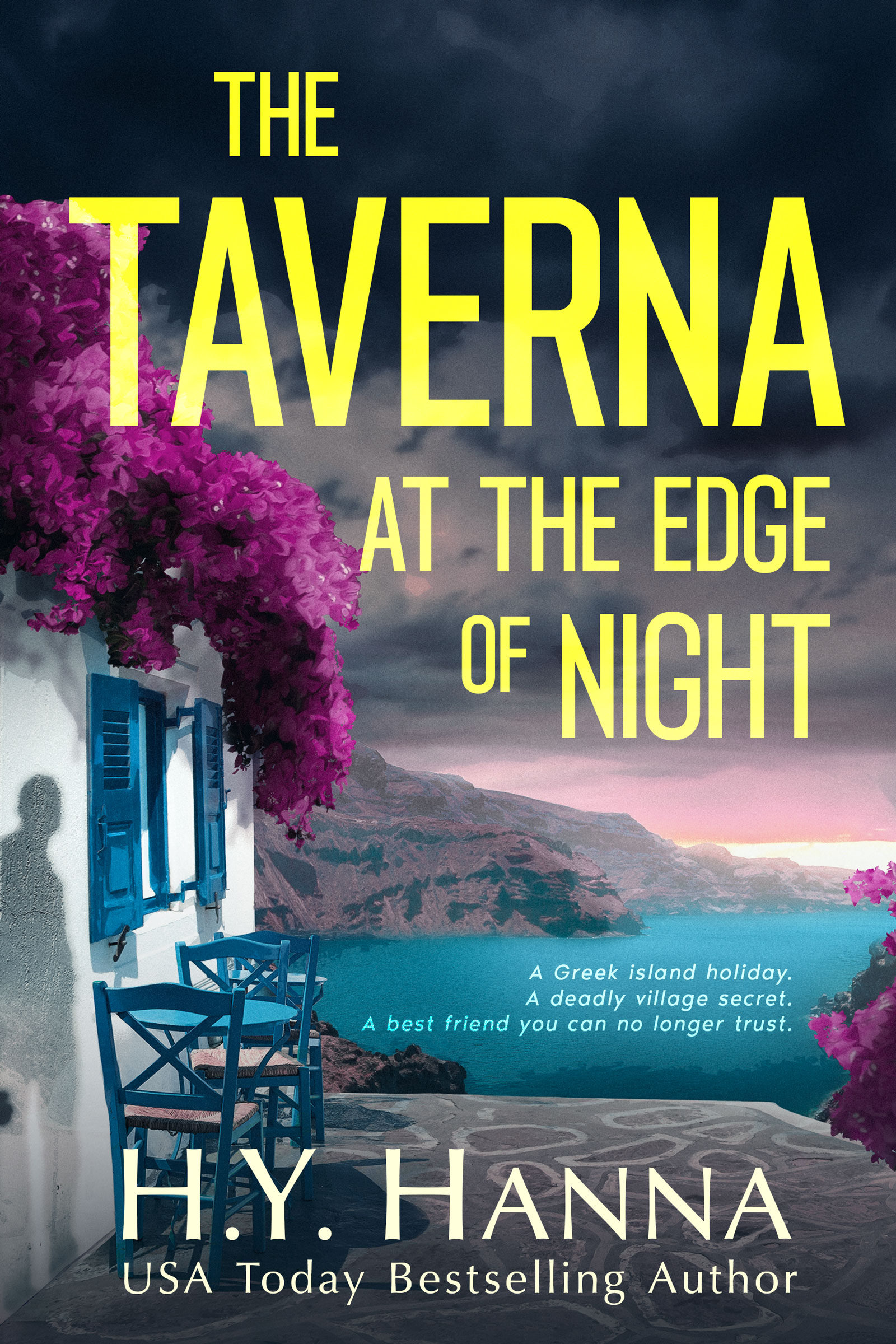
The sun was a deep red orb drowning on the horizon, its lingering warmth seeping into the dark waters of the Mediterranean Sea. Night was coming, and colour was leaching from the land.
She shivered and squinted at the coastal track ahead. The narrow trail, the jagged cliff edge… everything was blending into a stretch of desolate grey. It would have been all too easy to miss a step, to trip and fall in the gathering dark, and she had to force herself to keep a measured pace despite the hammering of her heart.
It would be all right. He would be there.
A gust of wind blew in from the sea, tossing her hair and dragging strands across her face. Her steps faltered as she was blinded for a moment, and she paused to push the hair impatiently out of her eyes. Then she turned swiftly, staring at the empty track behind her.
Had she heard something? The rattle of loose stones, the crunch of dust underfoot?
She strained her ears, trying to listen above the sound of her own hurried breathing. Nothing. She must have imagined it.
She turned to press on, but she had barely gone a step when she heard it again: that sharp scrape against rock, the scattershot of gravel falling down the cliffside. She whirled back, peering into the twilight gloom.
A prickling awareness came over her… a sense of eyes watching her in the darkness. She hesitated, torn between wanting to run and not wanting to turn her back on whoever was watching.
“Who… who’s there?”
Her voice was thin and immediately snatched away by the wind, but something moved in response. She jerked her gaze up. The movement had come from somewhere above. A clatter of stones tumbled down to the track. And then a shape emerged, silhouetted against the indigo sky.
Curved horns, drooping ears, knobbly legs beneath a shaggy, hairy body…
“Oh God…!” The breath left her chest in a shaky laugh.
It was just a goat. A bloody Cretan goat—one of the many feral animals that roamed these mountains. It eyed her with that uncanny goat stare, its jaws moving as it chewed on a piece of scrub. She shook her head, more annoyed with herself than with the creature, and turned back to the track with renewed urgency. Her paranoia had cost her precious minutes—she was already late, and he would be waiting.
The track snaked around a rocky overhang, then widened as the cliffside jutted out to form a small ledge. She knew this place—it was the famous lookout point. After recent landslides, access to its panoramic views had been blocked by barrier tape attached to makeshift posts. A crooked sign hung on one of the posts with a handwritten message: “DANGER / Προσοχή” scrawled in black. But she barely glanced at it—she had caught sight of the figure standing on the ledge and felt a rush of surprised delight.
“You’re here! I thought we were meeting in the cove…?”
He turned, and her heart gave a little jump as she took in the handsome features. Strange—and frightening—to think how quickly someone could become so important to you, so integral to your happiness. Then she caught her own thoughts. It isn’t so simple, she reminded herself grimly. There were still questions he hadn’t answered, things he had promised to explain.
She climbed over the barrier tape and joined him at the end of the ledge, where the land broke off in a sheer drop into the darkness. Below, she could hear the hush and sigh of the sea as water surged against the rocks at the base of the cliffs.
She thought that he would reach out and take her into his arms, but instead, he began to talk. Words that made her cringe, words that made her stare at him in sick horror.
“No…” She shook her head vehemently. “No!”
He did reach for her then, but she shrank away, unable to bear the thought of him touching her. Not now. Not when she knew what those hands had done. She stumbled back, slipping on the uneven ground, and felt a yawning emptiness against her back. But that was nothing compared to the yawning abyss of rage, anguish, and despair in front of her. How could he be the one who had betrayed them all along?
He was still talking, his voice loud and urgent, but she couldn’t take the words in, couldn’t even look at him any more. She shoved him away, violent and hysterical, and saw his face darken in anger—
And now she realised that she was too close to the edge. The ground was crumbling beneath her feet.
She gasped and flailed, her fingers clawing air… her body teetering…
But he was there, standing behind her. Relief cut through the panic. He would pull her to safety. She twisted, reaching for him at last. His eyes locked with hers. They were desperate, blazing. And then his hands came out towards her.
CHAPTER ONE
The first thing to do when you arrive in Crete, they’d told me, is to buy a charm to ward off the Evil Eye—a mati pendant, with its concentric circles of black, white, and blue, which would absorb malevolence and deflect misfortune. But perhaps I should have bought myself a protective charm before I left home, I thought ruefully as I stood in the empty car park, shielding my eyes against the dazzling morning sunshine. So far, what should have been a short, breezy trip from London had morphed into a grim endurance test. Airport strikes, additional baggage inspections, multiple flight delays… it was as if the ancient Greek gods themselves were conspiring to keep me from the island.
Still, when I had finally arrived in Chania late last night and staggered into a hotel in the Old Town, I’d thought that the ordeal was over. I had even congratulated myself on finding a room at such short notice, given that it was high season and I’d never planned a stopover in this popular harbour city. My smugness was short-lived, however. And when I’d hurried to the car rental agency this morning to claim the vehicle I should have picked up yesterday, I was met by a moustachioed attendant who informed me lugubriously that my car had been given away.
He looked up now from the outdoor kiosk where he had been studying a tablet and shook his head. “Ochi. No, I am sorry. There is no other car… Maybe if you stay in Chania, wait one or two days… it’s possible there will be a cancellation.”
“Two days? I can’t wait two days!” I took a deep breath and looked at him pleadingly. “I’m only a little bit late. It’s not even been twenty-four hours. I know I was supposed to come yesterday afternoon, but my flight was delayed and I didn’t arrive until after your office was closed—”
He shook his head again. “I am sorry, madam. It is the policy. We only hold for three hours after the booking, then we give to another customer. It is June, you see. It is peak season. Many people want cars.”
“Surely you must have something?” I said. “I’m happy to pay more for an upgraded model.”
“It is not the money. We have no car to give you. All the car fleets on the island is fully booked already. People, they reserve their car many months before.” He made a sweeping gesture with one hand across the empty car park. “The one you book is the last one. But when you don’t come, we give to the man on the waiting list.”
I swallowed my frustration, knowing that he only spoke the truth. In fact, I’d been lucky to find a hire car at all when I’d decided on my impulsive trip to Crete last week. I sighed and gazed across the empty car park—then paused as my eyes fell on a nondescript grey sedan in the far corner.
“What about that one?” I asked, pointing. “Isn’t that available?”
Instead of answering, he said: “To where you are driving? You stay in Chania and you make daytrip?”
“No, actually, I’m heading to a village called… um, Agia Eleni…”
“Ah, Agia Eleni,” he said, pronouncing it “Aya Eh-LAY-nee”. He raised his eyebrows and looked at me with new curiosity. “It is small fishing village—very small. On the south coast, on the other side of the mountains. Very difficult to find. Most tourists don’t go there.”
“I’m going to visit my friend,” I explained. “My best friend Roxy has bought the old taverna in the village and is fixing it up. She told me there’s going to be a lot of development there—apparently a new luxury resort opened recently?”
“Ahh, yes, last month. Big hotel. With many swimming pools and restaurants and spa. But that is in Agios Georgios, the next village, not in Agia Eleni. Most people do not know Agia Eleni… except from the news. Because of the woman who died there.”
“What woman?” I looked at him in mild surprise. “I didn’t hear about that.”
The attendant pulled a face. “It’s only two weeks ago. She is a woman from England. She had accident. They found her body.”
“Oh.” I recoiled slightly. “What… what happened?”
“She is hiking near the village, on the cliffs beside the sea. Is very high up and the way is dangerous sometimes.” He gave a shrug. “But what to do—many of the tourists, they don’t take care. The police say she don’t wear good walking shoes, she don’t have water—even no mobile phone.” He turned earnestly to me. “Many people, they don’t understand Crete, you know? It’s not like Mykonos or Santorini. There, it is easy to walk, to go see the view and take photos, and there is many places to eat and drink and rest. They are gentle islands,” he said with a contemptuous wave of his hand. “But here in Crete, it is different. It is wild. There is still many places that have no human touch. All you see is the mountain and trees and rocks… some of the small villages, still you can only go there by boat or by walking. There is no road.”
I had certainly heard a lot about the rugged, untamed beauty of Crete and the remoteness of the southern coast, but the way he described it felt particularly disquieting.
“Is the hiking that difficult?” I asked. “I’d been looking forward to trying some of the trails around Agia Eleni. I heard that there are lots of beautiful hikes on the south coast, through the gorges in the mountains.”
“Ah, yes… very beautiful… the most beautiful!” the attendant said, his voice warming with pride. “We have the most beautiful nature in Crete, you know? Every year, there is hundreds and thousands of people come from all over the world. Just for the hiking in Crete. You know the Samaria Gorge? It’s very famous, the longest canyon in Europe. Is eight hours to walk. Also many, many other gorges and tracks through the mountains. But… it’s not easy. It’s not like holiday on the beach. There is big rocks, and you have to climb up and go down… some parts are very sharp—how you say…?” He made a tilting gesture.
“Very steep?” I said.
“Yes, very steep. It’s easy to fall if not careful. And there is nobody to help you—the mountain is very empty. You cannot use your mobile phone. But it’s okay,” he added hastily, seeing my expression and belatedly remembering that he was supposed to be promoting his country to visitors. “You take water and hat and wear the good walking shoes. You follow the sign of the track. Then is no problem. Just you prepare.”
“Oh, don’t worry—after what you’ve told me, I’m not setting foot in the mountains without a firstaid kit, a head helmet, and a GPS tracker!” I declared, only half joking.
He grinned suddenly. “That is good. We say in Crete: Kalýtera na déseis ton gáidaro pará na ton gyréveis. It means: ‘Better to tie up your donkey than have to look for it after.’”
I laughed. “We have an English version of that, about stitches and time, but I like the Cretan version better.”
The attendant glanced at the remaining grey sedan again, then eyed me speculatively. “You drive in Crete before? You are good driver?”
“Well, no, this is my first time in Crete—in Greece, actually. But I am a fairly good driver,” I said quickly, not wanting to admit that living in London meant that I hadn’t driven a car regularly in years. “I’m sure I can manage,” I added with a bright smile.
He didn’t look convinced. “You have to drive up and through the mountains to reach Agia Eleni,” he said gravely. “It is not a long drive. It is three hours, maybe four maximum. But the road is narrow, especially in the mountains, and many parts is not smooth, not cover by cement, you know? And there is many turns, like this—” he made sharp snaking motions with his hands, “—when you cannot see who is coming from the other side. The local people, they drive very fast, you know?” He paused. “Sometimes there is bad accidents.”
Somehow, his stark statement hit harder than a dramatic warning. I could picture the twisting roads with blind corners and a sheer drop down one side.
I swallowed. “I’m sure if I just familiarise myself with the car’s controls and take it slow…?”
He looked at me doubtfully. “Maybe it’s too difficult…” He didn’t actually say “for a woman” but the words hung in the air between us.
Before I could make an indignant retort, he added: “That car is available—but it is manual.”
“Oh.” Much as I wanted to bristle at any sexist patronising, I had to admit that his scepticism in this case was well-founded. Any driving I’d done in recent years had been on an automatic transmission; I hadn’t touched a manual vehicle in over twenty years. Considering that I would have to drive on the right side of the road—something I’d never done before—as well as negotiate dangerous mountain routes with maniacal local drivers… well, the whole thing was beginning to feel less like feminist bravado and more like plain foolhardiness.
I heaved a sigh of defeat. “No, I can’t take a manual car.”
“Then maybe it’s better you take taxi,” said the attendant quickly. “I can call one for you. I know very good driver. He has private car for tourists. He is driving across the mountains often.”
I hesitated. A private car would be expensive, but it wasn’t the cost that gave me pause. Instead, it was the recollection of Roxy’s scornful voice the last time we’d had a dinner together back in London:
“You have no idea how the other half lives any more, Daphne. Since you sold your business and got all that dosh, you’ve become so used to your first-class flights and Michelin-star restaurants that you can’t appreciate what it’s like. Most people haven’t got that kind of money to throw around.”
“That’s not true!” I had cried, defensive and hurt. “I do know what it’s like to manage on a tight budget: I’ve shared a grotty bedsit, I’ve lived on nothing but pot noodles and tinned beans, I’ve done night shifts cleaning kitchens… you know I have—you were there!”
“That was years ago when we were students. Come on, when was the last time you had to be uncomfortable, just to save money? When was the last time you didn’t stay in a five-star hotel? Or worried about the price of anything?”
I winced now at the memory of that conversation. Arriving in Agia Eleni in a private chauffeured car would confirm everything Roxy had said. It was silly, perhaps, but I needed to prove to her—to myself—that it wasn’t true; that I hadn’t lost touch.
“No,” I said resolutely. “I don’t want a private car. How about public transport? Is there a public bus?”
The attendant looked even more doubtful. “There is no bus which go directly to Agia Eleni. It’s not near the main road. The only way is you go to Plakias first—this is the closest village. There is beach there, some of the tourists go there. From Plakias, you can take local taxi to Agia Eleni. But—” he raised a hand, cutting off my eager rejoinder, “—the public bus to Plakias is from another city, Rethymno, so you have to go there first. That is one and half hour. And then you have to make transfer from the bus station… but there is not many bus going to Plakias often, so maybe you have to wait for long time in the station…”
He shook his head, frowning and lapsing into a thoughtful silence, before brightening suddenly. “Ahh! Maybe I have answer for you! I speak to my friend. You wait here…”
Slightly bemused, I stood by the kiosk as the attendant wandered a short distance away, talking on his phone. From his impassioned tone and violent gesticulations, it sounded less like he was speaking to a friend and more like to a foe! But when he finally returned, his face was wreathed in smiles.
“I arrange for you,” he announced proudly. “My friend, he is concierge in the hotel here in Chania. They have private coach, take the guests for tour to south coast. The coach is leaving at 12 p.m. They will pass by Plakias on the way. So I ask him to take you also—you can go with the tour until Plakias and leave the coach there. Then you can take local taxi to Agia Eleni. You pay only half-price for the tour. It’s more expensive than public bus, but not so much like private car. You like this idea?”


Comments
The premise is intriguing…
The premise is intriguing. The opening would benefit from a stronger hook and tighter editing.
This has a great premise,…
This has a great premise, and the beginning was spooky. I really enjoyed the dialogue between the man and the main character.
It's quite engaging although…
It's quite engaging although using the name Daphne might not be wise given the logline. The writing is strong and has real momentum although it does tend to get a bit too immersed in detail, at times bearing an unfortunate similarity to tourist guides found in the back of aircraft seats.