
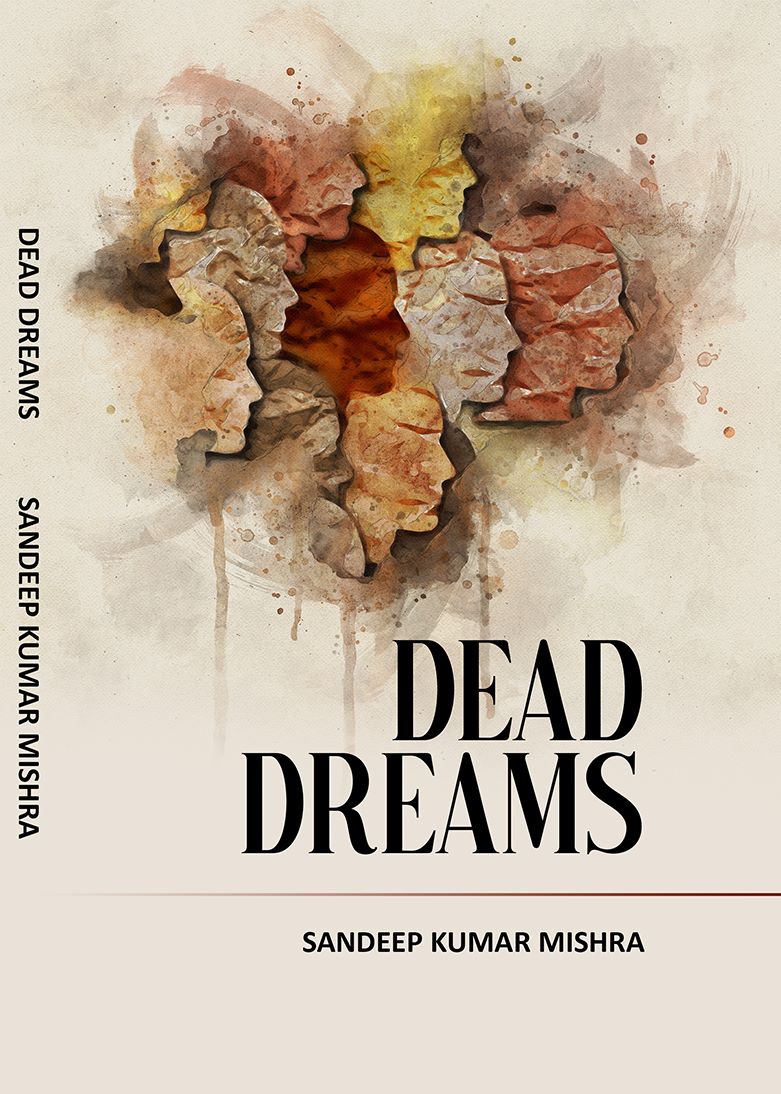
DEAD DREAMS AND OTHER STORIES
DEAD DREAMS
In his dreams, Rajan searches for the ghosts. He hunts for
them, tracing their footsteps in the dirt. He is back in his
hometown— he knows these roads. The moonlight shivers on
his skin. The crooked streets rattle around him. His heart burns
in his chest.
Baba, Mama. Where are you?
He runs, following the path laid out for him. The streets
smell like smoke. Everything is hazy and deserted, shuttered
up and locked away. He knows his neighbors behind each door,
but no one steps out to help him. They’re too scared. Rajan is
terrified, too, but he keeps running.
Please, if I could just see you one more time. I didn’t know
it would be the last time. I would have said so much more.
Baba, Mama.
When he looks up, the ghosts are further away than before.
They blur in the distance, like poorly developed photos, but
he can still sense the sadness etched upon their faces. Their
feet twist backward from their bodies. Bhuta. Spirits. He should
have known better— he’s been following their trail the wrong
way the entire time. He won’t ever catch up now.
Grief sweeps over Rajan like a monsoon. He drops to his
knees. The ground begins to crumble. A dark pit opens
underneath him— a grave, cloying and sticky with the scent of
death. The spirits watch from a distance, cold in the low
moonlight. Rajan falls.
He wakes up with a jolt. It’s still dark outside. Warm air
filters in from the cracked window by his cot. The only sound
in his cell is his own unsteady breath and what sounds like the
rustle of paper. He looks at his journals, but they lie still across
the room, untouched.
He looks out the window. Two beady black eyes stare back
at him, then rise in the dark, unfurling into an undulating brown
body. The snake’s tail lashes out and strikes the window. Rajan
jumps back, his heart hammering in his chest. The snake hisses,
but it sounds more like a shriek of mocking laughter.
He doesn’t sleep for the rest of the night.
***
Dawn spills like pale pink soup over the horizon, bringing
with it a searing heat that refuses to break. The prisoners queue
up to receive sloppy rations of oatmeal ladled into their bowls.
The cafeteria smells like vinegar and bleach.
Rajan sits down at a table and pulls out one of his journals.
He’s made it a point to write every day he’s been imprisoned—
it’s the only thing keeping him sane. A flip of the journal’s
pages shows his journey: raw confusion at first,legal jargon
to lookup later, and then feverish thoughts of revenge as he
realizes what has happened. After, his writing shows a dull
acceptance of his fate, then a sudden jolt back to confusion as
the pandemic hit and the world spun upside down.
He still feels all those things like an ache in the pit of his
chest, a heartburn he can’t get rid of. Rajan used to take pride
in his sensitive emotions. It made him a better poet, after all,
and his poetry landed him a teaching position at a prestigious
university. Now, though, he wishes he could turn off his mind.
There’s too much to feel. It’s overwhelming.
“Hey.” One of the other prisoners, a skull-inked man aptly
nicknamed Bones, nudges Rajan’s side.
“Stop writing, professor. What’s the point? None of us are ever getting out
of here.”
Rajan does not spare him a glance and continues writing.
“The words are the point.” If he doesn’t write, then the words
haunt him in the dark, and he doesn’t sleep.
Bones grunts. “That’s deep, man. I bet if I was that deep,
my wife wouldn’t have left me.”
This is a ritual the prisoners go through daily, sitting around
the table and wishing things had gone differently— a
storytelling of sorts.
Rajan has heard it all by now. If I hadn’t met her… if he
hadn’t pissed me off so much… if the cops hadn’t been nearby
that day… Rajan has never played their game. There’s no point
in wondering about the past. He isn’t even sure about enough
details about his case to wish differently.
All Rajan knows is this: One minute, he was an esteemed
professor travelling internationally to attend a literary seminar.
The next, airport security found a bag of white powder in his
carry-on, and there was a global pandemic. The world was
having a collective panic attack, and his pleas of innocence
were lost in the cries of a million others.
Rajan’s mouth goes dry just thinking about the horrors of
that day. He takes a sip of milk, but it’s curdled and stings
going down his throat. He hacks up a cough.
Bones leans back. “Hey, get away from me, man. Is that
contagious?”
“The sour milk? I hope not.” Rajan understands Bones’ anxiety.
The fear of the plague is almost a second pandemic in
and of itself. He sets the cup on the corner of his tray, as if it
must be quarantined from the rest.
“Ugh.” Bones makes a face. “Why is everything here so
rotten?”
“It’s a metaphor,” Rajan tells him dryly, and they both laugh.
***
Mid-morning, he gets a migraine, which makes him scream
and kick his cot in frustration. He’s been plagued by headaches
his whole life, but they got viciously worse when he came to
Australia eight months ago: Something about the climate, he
suspects. He’s learned that there’s nothing to do but wait them
out.
Rajan curls up in a corner of the room, his hands wrapped
around his knees. White spots dance in his vision. It feels like
a hammer is raining blows down on the back of his skull. When
things got this bad, his wife used to soothe him with a cool
compress, but now she’s a continent away. He passes out with
her name on his tongue.
In his hazy, pain-filled sleep, he sees a snake. He can tell
by the markings that it’s the same one from the previous night.
Mottled spots of green blot the snake’s body like mold. No,
not mold— it reminds Rajan of the diagrams of the COVID-
19 virus he and the other prisoners were shown at the beginning
of the pandemic.
The snake hisses at him. Rajan is distantly aware that this
is a dream, so he does not flinch. The desert blurs around him.
The prison is at his back. He’s outside. He’s free, if he can just
get past the snake in his path.
Rajan picks up a stick from the ground, intending to shoo
the snake away. Before he can, the snake shrieks and flails, its
tail lashing on the ground. Rajan jumps back. The snake hurls
itself towards him. He raises the stick and clubs it over the
head. Its scales brush his wrist. He feels a pinch of pain. He
pulls away and strikes it again. It keens, wild and pained.
Adrenaline floods Rajan’s veins. He strikes the snake for a
third time. It lies still.
Breathing hard, Rajan looks down at his wrist. Two pinpoint
pricks of fang-bite are embedded in his skin. Poison seeps
slowly through his veins. Dizziness overwhelms him, and he
collapses.
He wakes up smothered in sheets from head to toe, like a
funeral shroud.
***
The rest of the week flits by like a ghost in the mist. Time
blurs, and Rajan struggles to find things to record in his journal.
It’s just another day after day after day. What is there to write
about when everyone is trapped, when nothing changes?
He knows vaguely that this is momentous, that the world has never
seen a pandemic of this magnitude, but he’s so isolated in the
prison that he can’t even conceptualize how the outside world
is changed.
He is starting to forget the details of his family’s faces.
He draws awkward, crooked pictures of them in his journal.
Does his father wear two rings or one? Does his mother have
a mole under her right eye or left? It strikes Rajan with a deep,
tolling sadness that he will never again be able to look at them
and remember.
With nothing else to do, Rajan starts recording his dreams.
The doctor prescribed him sleeping pills to help with the
migraines and insomnia and they do help, but they make him
dizzy, thick-limbed and unable to differentiate wake and sleep.
In this half-twilight, he writes:
October 18, 2020. The ghosts came to visit me again.
This time, it was my children. They danced around me in a
circle, chanting, “Baba’s dead! Baba’s dead!”
I tried to tell them that I wasn’t dead, that I was just away
temporarily, but they couldn’t hear or see me. I tried to
embrace them, ruffle their hair, but I couldn’t touch them. It
was as if I was invisible or a ghost. Am I becoming a ghost?
My feet are straight, and bhuta are restless, transient things. I
never move. I am stuck. I hate being so stuck.
October 19, 2020.- Last night, I saw the snake. The same
snake I always do. I killed the snake. But the snake returns.
It bites itself— a perfect, pure, ouroboros. It behaves like it
also wants to die. I don’t know how to feel about this. The
snake returns. The snake returns.
The rest of the entry trails off into unintelligibility, marked
by a spot of sleepy drool at the edge of the page.
***
“What’s up, dude?” Bones prods Rajan’s shoulder. They’re
in the exercise yard, Rajan crouching to pick up a dumbbell
bar, Bones watching to make sure he doesn’t injure himself.
“You look even more depressed than usual, which is saying
something.”
Rajan focuses his efforts on squatting, then lifting the bar
over his head. His muscles burn, but it feels good to sweat.
“Nothing. I’m fine.”
“Really?” Bones arches an eyebrow. “You look like you’re
about to pass out.”
“I am not—” A burst of light-headedness flows through
Rajan. He sways unsteadily on his feet and sets the dumbbell
down with a thunk.
“I am not going to pass out,” he says, panting.
“Seriously, professor, you’re worrying me.” Bones offers
him a water bottle, which Rajan gratefully accepts.
“Is it the nightmares? Are they getting worse?”
Rajan blinks. Water drips down his chin. “How did you
know?”
“You cry in your sleep.” At Rajan’s expression, Bones
rushes to reassure him.
“We all get the bad dreams, dude. We’ve all been through something heavy.
If anyone judges you for it, I’ll beat them up.”
“Thanks,” Rajan says, flattered by the offer. He wipes sweat
off his forehead.
“I think… I might be cursed. I don’t know.”
He gestures to his chest. “All my emotions are like water,
filling me up, drowning me. There’s only so much grief a person
can take.”
Bones sits next to him. “What do you see in the dreams?
You don’t have to tell me if you don’t want to.”
“A snake,” Rajan says, holding up his hands. “About this
big. We fight. I kill it. The snake returns.”
Bones scratches his head. “The same dream? Every night?”
Rajan shrugs. “Pretty much.”
“Cool,” says Bones. “In my dreams, my wife always yells
at me all the time.”
Rajan laughs humorlessly. “If you had the
same dream every night, a spirit was haunting you. You needed
to do something to appease it.”
“Like what?”
“Well, leave bowls of honey and milk outside for the fairies
to eat, but you can’t do that here.
Maybe just do something different to help it out?
Hmm.
“Bones taps his hand against the barbell. “Saying that aloud,
it all sounds pretty nutty.”
Rajan gestures to the prison yard, to the barb-wire walls
and the world at large, where panic and a pandemic consume
them all.
“If you ask me, anything’s worth a try.”
“Or ask your doctor to double your prescription.”
“No, thanks. If I take any more sleeping pills, I might never
wake up again.”
The thought had been appealing, at times, but
Rajan can’t go through with that. He has to find his way back
to India, to his wife and to his children, to his parent’s ghosts
and graves. He has to believe that someday, this will end. Giving
up means he will end.
***
Rajan takes no sleeping pills that night. He lies on his cot,
his arms folded over his chest, and watches the moonlight seep
like spoiled milk through the window. Some part of him thinks
the snake might come to find him while he is awake, but the
desert outside his window remains bleak and empty. In the end,
he has to go to it, instead.
He closes his eyes. His breathing is soft and steady. He
slips into sleep and dreams.
Here he is again. The jail behind him, the snake in front of
him. Imprisonment or death. Are those his only options? Is he
supposed to give up and let the snake poison him? Rajan refuses
to believe it is so.
The snake bares its fangs, which curve like crescent moons
in the light. Rajan picks up the stick. The wood is familiar in
his hands, grooved from his grip.
“Back off,” he tells the snake. It hisses at him. “I mean it.”
The snake lunges for him. Rajan dodges away, swiping the
stick out to protect his bare feet.
“What do you want from me? Just leave me alone!”
The snake writhes and coils. Its tail thumps in the dirt again.
Rajan hits it with the stick. It howls.
This is his dilemma, the problem he’s figured out over
many nights of mystic battle: He can wound the snake, but
whenever he closes in for the killing blow, it finds a way to
bite him.
Slaughtering it only results in both of them dying.
Do something different. Break the cycle. Bones’ voice
whispers in the back of Rajan’s head.
Rajan backs away. The snake follows. Blood drips from its
abdomen.
“Stop,” Rajan says. “I don’t want to hurt you.”
The snake ignores him. It seems compelled to attack. Its black eyes fix
on the weapon in his hand.
So Rajan sets the stick down.
His heart is pounding in his chest. He raises his hands above
his head.
“See?” he says, mouth dry. “I mean it.”
The snake rises up, twists its head to consider him. Its eyes
reflect the white-chip light of the stars above.
“Go,” Rajan says. “You’re released. You don’t have to die
to be free.”
The snake places its body back on the flat ground, as if it is
bowing to him. Then it slithers off into the desert, leaving soft
plumes of dust in its wake. Rajan drops his hands, breathing
heavily. He takes a step forward into the night. Nothing stops
him. For once, there are no ghosts, no migraines, no spirit snakes
waiting to strike. He is free.
***
The next morning, a guard comes to visit his cell, rapping
loudly on the bars.
“Hey. Wake up.”
Rajan hasn’t slept. This time, it wasn’t insomnia, but
indecision: He is burdened by his choice to let the snake go
free.
What has he set loose? The nightmare has so warped his
life that he can’t help but imagine it will impact the waking
world, too. For all his metaphors, for all his knowledge of
spirits and curses and dreamscapes, he doesn’t know what he’s
done.
“Get going,” the guard snaps. “You’re leaving.”
Rajan blinks, sits up. “Leaving?”
“In three hours.”
He almost doesn’t want to ask. It’s too much to hope for.
“Where— where am I going?”
“I dunno. Back to wherever you came from, I guess,” the
guard sneers, but Rajan barely registers the jab. He’s going to
get out.
He glances down at the page in his journal, where he has
written the first scrawling lines of a poem: today I did not kill
the snake / I set it free / it will return to the wild / I will wait
for its mercy / and it will return to me.
He asks, though he already suspects the answer, “Why?”
“Prison’s full— we need more space than usual because
of the pandemic. You’re a minor offender. Your sentence was
shortened.
Congratulations.” The guard tosses a piece of paper
at him, presumably some sort of official court document.
“Pack your stuff.”
Three hours later, he’s out the door.
Two guards accompany him on either side, their nightsticks
swinging. A car idles a few yards away. Rajan breathes in the
sweet desert air. The heat doesn’t bother him, and his migraine
has faded. Clouds of dust bloom like flowers. The world is
still. Even the tumbleweed has stopped its travels to watch
him. It would make a good setting for a poem, Rajan thinks.
As he takes his first steps as a free man, a snakeskin snaps
beneath his shoe.
***


Comments
Excellent writing.
Excellent writing.